
An agentic marketing platform runs marketing work from a goal instead of a click. You set an objective, and the software plans the campaign, builds the audience, writes the copy, and adjusts spend on its own. Thirteen platforms lead the category in 2026, and they split into four jobs: orchestrating journeys, buying media, wiring your own agents, and writing the words. Almost none of them generates the video.
That last part is the thing every shortlist skips. Read the popular lists and you get Salesforce, HubSpot, Adobe, ActiveCampaign, Netcore, n8n, Zapier. Every one of them is real. Not one of those lists tells you which entries can produce the actual image or video the ad needs, and the answer turns out to sort the category better than any other question.
This guide covers thirteen platforms, groups them by the layer they occupy, and adds the column the other lists leave out. Written for marketing leads and agency creative directors who have been asked to pick one this quarter.
Key Takeaways
-
Four layers, not one category. Orchestration agents decide who gets what and when. Media-buying agents decide where the budget goes. Workflow builders let you assemble your own. Content agents write the copy. Comparing across layers on price is how buying decisions go wrong.
-
Video is the dividing line. Of the five orchestration suites, exactly one generates video natively. Adobe does, through the Firefly Video Model. Salesforce, HubSpot, ActiveCampaign and Netcore do not.
-
“AI video” often means editing your footage. HubSpot’s video AI scripts, clips, captions and translates video you already have. TikTok Smart+ asks you to supply “creative assets” up front (ads.tiktok.com, September 2026). Neither makes a clip from nothing.
-
Salesforce routes images through a third party. Salesforce’s own documentation describes Typeface as “a non-SFDC application” used to generate images in Content Builder (salesforce.com, September 2026).
-
Pricing transparency splits the field. HubSpot, ActiveCampaign, Salesforce and Adobe Firefly publish rates. Adobe’s agent layer and Netcore’s platform are quote-only.
-
Compliance arrived in August. Article 50 of the EU AI Act has applied since 2 August 2026 and requires synthetic image, video, audio and text to be marked in a machine-readable format.
What is an agentic marketing platform?
An agentic marketing platform is software that takes a marketing goal and executes toward it without step-by-step instructions. You describe the outcome, such as raising repeat purchase among lapsing customers, and the platform plans the campaign, picks the audience, drafts the messages, schedules the sends, and adjusts based on results. A human sets the objective and the guardrails, then approves or overrides.
That is the difference from marketing automation. Automation runs rules you wrote in advance: if a contact opens twice, send email three. An agent chooses the steps itself and changes them as data arrives. Salesforce frames it as marketers defining the strategy while “AI agents handle the execution” (salesforce.com, September 2026). Netcore puts it as “You set the direction. Agents execute, learn, and deliver results” (netcore.ai, September 2026), with marketers keeping final approvals.
The category is young and the label is loose. Every vendor with a large language model in the product now claims it. The useful test is whether the software can act without you naming the next step.
One distinction worth holding. A platform is the system you buy and the data it sits on. An agent is a single worker inside it, scoped to one job. This guide compares the platforms. If you are shortlisting the individual workers instead, our ranking of AI marketing agents covers those.
The four layers of an agentic marketing stack
Most confusion in this category comes from comparing tools that do unrelated jobs. Sorted by layer, the thirteen platforms line up cleanly.
Orchestration agents own the customer. They hold the data, decide segments, choose channel and timing, and run journeys. Salesforce, HubSpot, Adobe, ActiveCampaign and Netcore sit here. They are priced per organisation or per seat and they replace campaign ops work.
Media-buying agents own the budget. They allocate spend across placements, pick which variant runs, and optimise on conversion signals. Meta Advantage+, TikTok Smart+ and Superscale sit here. They are priced as a share of ad spend or as a subscription on top of it.
Workflow builders own the wiring. They give you nodes and triggers so you can assemble an agent against your own systems. n8n, Zapier and Gumloop sit here. They are priced per execution, per task or per credit.
Content agents own the words. They take a brief and produce copy at volume, with brand rules attached. Jasper and Copy.ai sit here, priced per seat.
There is a fifth layer, and no ranked list on this topic includes it. Something has to make the picture and the clip that the other four layers move around. That is covered further down.
How these platforms were ranked
Six factors, applied to every entry:
- Autonomy. Does it act on a goal, or does it recommend and wait?
- Scope of the loop. How much of plan, make, place and measure does it close?
- Creative generation. Can it produce the image or video itself, verified against the vendor’s own documentation?
- Pricing transparency. Published rates, or quote-only?
- Data requirement. How much customer data does it need before it works?
- Fit honesty. Which team size and channel mix it genuinely suits.
Every price and capability below was checked against the vendor’s own pages in September 2026. Where a vendor’s pages contradict each other, that is stated rather than resolved.

Orchestration agents: who owns the customer
Salesforce Agentforce Marketing
Salesforce rebuilt its marketing suite around agents and renamed it. The suite is Agentforce Marketing, described on Salesforce’s own page as “formerly Marketing Cloud”, and the flagship product inside it is Marketing Cloud Next (salesforce.com, September 2026). It is the deepest option here for organisations already standardised on Salesforce data, and the campaign-creation agent genuinely works end to end: draft a brief, refine it, build the campaign from the brief, generate insights.
The shipped agent actions cover campaign creation, content drafting, journey decisioning and account discovery. Salesforce’s summary of the generative scope is that AI “can draft a campaign brief, a campaign, and campaign components” and suggest a segment.
Pricing runs on two meters. Marketing Cloud Next Growth Edition is $1,500 per organisation per month and Advanced Edition is $3,250 per organisation per month, both billed annually (salesforce.com/marketing/pricing, September 2026). Agentforce consumption is separate: Flex Credits at $500 per 100,000 credits, standard agent actions at 20 credits each, or $2 per conversation, plus a $5 per user per month Agentforce licence (salesforce.com/agentforce/pricing, September 2026).
On creative, the documentation is unusually clear. Einstein generative AI in Content Builder generates “subject line and body copy options”. For images, Salesforce writes that it “has partnered with Typeface, a non-SFDC application, to generate images” (salesforce.com, September 2026). No Salesforce page reviewed for this guide claims video generation. Best for enterprises whose customer data already lives in Salesforce.
HubSpot
HubSpot ships the broadest set of named agents at mid-market prices, and Agent Hub is included rather than sold separately: “Agent Hub is included in all Starter, Professional, and Enterprise editions” (hubspot.com, September 2026). Content, Prospecting, Customer, Data and Campaign agents cover most of what a small marketing team does weekly.
Marketing Hub Professional is $800 a month on annual commitment or $890 a month month-to-month, and includes three core seats. Enterprise is $3,600 a month, billed annually, with five seats. Both carry a required one-time onboarding fee, $3,000 for Professional and $7,000 for Enterprise (hubspot.com/pricing/marketing, September 2026).
Agent work runs on HubSpot Credits, and the arithmetic is worth doing before you buy. Professional includes 3,000 credits a month, and HubSpot’s product catalogue prices a Content agent action at 1,000 credits (legal.hubspot.com, September 2026). Additional credits are $9.00 per 1,000 when paid annually.
HubSpot generates static images for blogs, pages, emails and social posts. Its video AI is a different thing: scripting, clipping, captioning and translating footage you upload. Best for mid-market teams who want many agents on one bill and are not producing video.
Adobe CX Enterprise
Adobe announced CX Enterprise at Adobe Summit on 20 April 2026, with CX Enterprise Coworker reaching general availability on 10 June 2026 (news.adobe.com, 2026). Adobe Experience Platform Agent Orchestrator is the layer underneath. The agent roster is long: Audience, Journey, Content Advisor, Brand Governance, Experimentation, Site Optimization and a Content Production Agent among others.
Adobe is the only orchestration platform in this group that generates both image and video creative natively. Firefly Image Model 5 handles stills and the Firefly Video Model outputs 1080p from text or an image. Firefly also carries partner models including Veo 3.1, Nano Banana 2, Runway Gen-4.5 and Kling 2.5 Turbo, so the creative layer is a catalogue rather than one house model.
Pricing splits. The agent layer is quote-only, and Adobe’s own page says to “contact your Adobe Sales representative” for an AI Credit quote (business.adobe.com, September 2026). Firefly is published and billed monthly: Standard $9.99 for 2,000 credits, Pro $19.99 for 4,000, Pro Plus $49.99 for 10,000, and Premium $199.99 for 50,000 (adobe.com, September 2026). Best for large enterprises already running Experience Cloud who need creative and orchestration under one vendor.
One correction worth making, because the trade press got it wrong: Adobe announced CX Enterprise as a product. No Adobe page states that Experience Cloud was renamed.
ActiveCampaign
ActiveCampaign is the accessible end of the orchestration layer. Its Active Intelligence features cover an AI automation builder, an AI campaign builder and AI content generation, aimed at lifecycle marketing rather than enterprise CX.
ActiveCampaign lists Starter at $15, Plus at $49, Pro at $79 and Enterprise at $145 per month for 1,000 contacts. Its pricing page states these are billed annually (activecampaign.com/pricing, September 2026). Month-to-month rates are not published anywhere on the site, so treat the figures above as annual-commitment pricing.
AI image generation appears in the pricing feature table on Plus and above, with five brand kits. Video generation appears nowhere on the pricing page. Best for lifecycle and ecommerce teams without a marketing ops function, at a fraction of enterprise pricing.
Netcore
Netcore sells its product under the exact category name, Agentic Marketing Platform, with seven agents covering insights, decisioning, content, audience, scheduling, shopping and orchestration. The Audience Agent builds segment rules from a one-sentence prompt and the Decisioning Agent picks offer, channel and product in real time. Note that the company rebranded from netcorecloud.com to netcore.ai on 30 July 2026, so older links redirect.
Pricing is mostly quote-only, with plan cards leading to sales. One figure is published in the pricing FAQ: the Growth plan starts at ₹12,000 per month for 5,000 monthly tracked users (netcore.ai, September 2026). No USD or EUR pricing is published.
On creative, Netcore’s own pages disagree with each other. The pricing feature table labels the capability “Content Agent (AI Text)” and the Content Agent product page describes text output. The platform overview page claims copy “and images”. No page claims video. Where a vendor contradicts itself, the pricing table is the commercially binding one. Best for ecommerce and D2C brands in markets where Netcore has strong channel coverage.
Media-buying agents: who owns the budget
Meta Advantage+
Advantage+ is the platform-native agent for anyone whose spend concentrates on Meta. It automates audience, placement, budget allocation and creative selection inside Meta’s own auction, which is a structural advantage no third party can match, because it sees signals nobody else does.
Meta has been pushing creative generation into the same surface. In January 2026 Meta announced that advertisers and agencies would be able to access Muse Image, its first image generation model from Meta Superintelligence Labs, through Advantage+ creative, with Muse Video in development (about.fb.com, January 2026).
Worth knowing before you rely on it: when advertisers use Meta’s in-house generative AI creative features in ways that significantly edit an image or video, Meta applies an AI label and shows AI info in “About this ad” (about.fb.com, 2025). Best for brands with most of their budget on Meta.
TikTok Smart+
Smart+ is TikTok’s automated campaign product, handling targeting, bidding, creative combination and delivery from an objective and a budget. TikTok describes it as optimising “ad creative combinations, including CTAs and format variations, through ad group fatigue detection and auto-refresh strategies”.
The creative requirement is stated plainly in TikTok’s own setup instructions: you provide Smart+ with “your Key Performance Indicators (‘KPIs’), creative assets, and target geography and language” (ads.tiktok.com, September 2026). Optional AI features remix music, hooks, formats and scripts from the material you supplied. The agent combines and refreshes. You still shoot or generate the source. Best for TikTok-first brands with a creative supply already running.
Superscale
Superscale is the clearest example of a platform trying to close the whole loop on paid social, from research through creative to launch on Meta, TikTok and Google Ads. It sits at the ambitious end of this layer, and its own ranked comparison of the category is one of the better-argued pages on the topic.
Superscale generates the creative itself, which most of this list does not. Its FAQ describes producing “speaking AI UGC video ads with realistic creators, product demo scenes”, “static ads and CTA screens”, and multi-scene video ads, routing tasks across several third-party models rather than one house model (superscale.ai, September 2026). Named agents include a Static Ads Designer, Concept Illustrator, Video Ad Editor and Motion Designer.
Pricing is published and moved recently. Advanced is $99 a month for 8,000 credits and up to 250 generations, Pro is $199 for 16,000 credits and up to 500 generations, Scale is $399 for 32,000 credits and up to 1,000 generations, and Enterprise starts at $799 (superscale.ai/pricing, September 2026). A five day trial runs before you pick a plan.
Two things to check during evaluation. Superscale’s own homepage lists the Launch and Scheduling step as “Coming soon” for direct publishing to Meta and Google Ads, while reading performance back from a connected Meta Ads account is live (superscale.ai, September 2026). And on rights, its terms assign output to the customer: “Superscale hereby assigns to the customer all rights, title, and interest, if any, it may have in and to the Output.” A separate clause limits the right to use the platform itself to the contract duration, and the terms state Superscale may use customer-generated content to train its model unless you object through account settings (superscale.ai/data/terms-and-conditions, last updated April 2025). Best for paid-social teams that want research, creative and reporting from one vendor.
Workflow builders: who owns the wiring
These are not marketing products. They are construction kits, and they earn a place on this list because a marketing team with one technical person can build a narrower agent than any suite ships, against systems the suites do not integrate with.
None of the three generates creative natively. They call a provider that does.
n8n
n8n builds agents as node graphs and runs them on your infrastructure or theirs. Its AI Agent node connects a chat model and a set of tools, and the agent decides which tools to call, including MCP servers (docs.n8n.io, September 2026). Metering is unusually generous because it counts whole runs, not steps: “An execution is a single run of your entire workflow. It doesn’t matter how many steps are in the workflow or how much data it processes.”
Starter is $20 a month for 2,500 executions, Pro is $50 for 10,000, and Business is $800 for 40,000, all billed annually (n8n.io/pricing, September 2026). Month-to-month rates are not published. A Community Edition is available for self-hosting. Best for technical teams who want agent workflows on controlled infrastructure.
Zapier
Zapier Agents is a separate product line from Zaps, described by Zapier as teammates you equip “with company knowledge” to “do work across 9,000+ apps” (zapier.com/agents, September 2026). The breadth of connectors is the reason to pick it: whatever obscure tool your team runs, it is probably supported.
Agents Free covers up to 400 automated behaviours a month. Agents Pro is $400 billed annually, which works out at $33.33 a month, and no month-to-month rate is published. The core Zapier platform prices separately, from $19.99 a month (zapier.com/pricing, September 2026). Best for non-technical teams wiring a wide SaaS stack.
Gumloop
Gumloop builds and runs agents across connected tools, with 35+ models available, bring-your-own API keys, and hosted MCP servers. Pro starts at $37 a month for 20,000 credits with unlimited agents and seats, plus an 8% orchestration fee, and Enterprise is custom (gumloop.com/pricing, September 2026). Entry is a 14 day trial, and no free-forever plan is listed on the pricing page. Best for teams who want unlimited seats on a low base price and are comfortable managing model keys.
Content agents: who writes the words
This layer is the most mature of the four, which is why it rarely causes buying regret. Both entries produce marketing copy at volume with brand rules attached, and both stop short of video.
Jasper
Jasper ships the largest named agent roster here: “100+ specialized marketing agents, each designed to execute a specific job within the content pipeline”, mapped to plan, create, adapt, activate and optimise stages, plus Jasper Studio for building custom agents without code (jasper.ai/agents, September 2026).
Pro is $69 per seat per month, or $59 per seat on yearly billing, and Business is custom (jasper.ai/pricing, September 2026). Entry is a 7 day trial.
On images, Jasper Image Pipelines handles product imagery through published operations including background removal, cleanup, upscaling to 4x, packshot compositing, uncrop and background replacement, ingesting from a DAM or PIM. The positioning is editing and variant generation from a source photo, described as adjusting “lighting, shadows, backgrounds, and framing without altering the product”. The page is demo-gated and the tier that includes it is not published. No video generation appears on the pricing, agents, studio or pipelines pages. Best for content teams producing high volumes of copy with brand governance.
Copy.ai
Copy.ai positions as a GTM AI platform rather than a marketing suite, and its published use cases lean sales: prospecting, inbound lead processing, account-based marketing, CRM enrichment and localisation. Agents are built from examples rather than prompts, which suits teams with a back catalogue of assets they want matched.
Chat is $29 a month billed monthly or $24 billed annually. Growth is $1,000 a month billed at $12,000 a year for 20,000 workflow credits, Expansion is $2,000 a month at $24,000 a year, and Scale is $3,000 a month at $36,000 a year (copy.ai/prices, September 2026). Monthly billing rates are published only for Chat.
Copy.ai is text and orchestration. No image or video generation appears across its pricing, agents or platform component pages. Best for go-to-market teams whose bottleneck is sales content rather than campaign creative.
The layer nobody ranks: who makes the video
Of the thirteen platforms here, two generate video creative natively: Adobe through the Firefly Video Model, and Superscale through its own agents. A third, Meta, has announced image generation for Advantage+ creative with video in development. The other ten do not make video at all. Image generation is more common, and text is solved everywhere. Video is the gap.
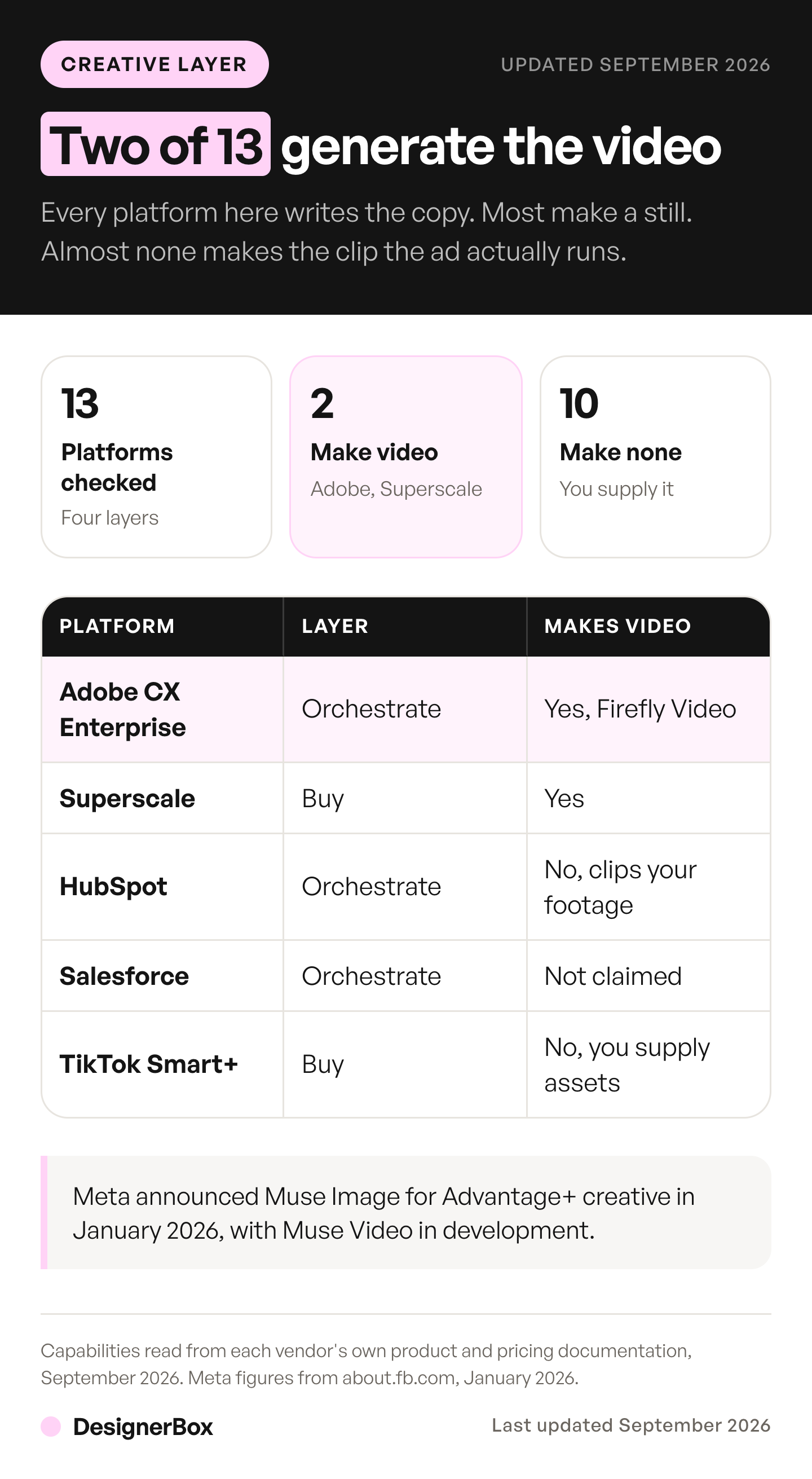
Here is the pattern that emerges once you check every vendor’s documentation instead of their homepage.
| Platform | Layer | Makes images | Makes video |
|---|---|---|---|
| Salesforce Agentforce Marketing | Orchestrate | Through Typeface, “a non-SFDC application” | Not claimed |
| HubSpot | Orchestrate | Yes | No. Clips and captions your footage |
| Adobe CX Enterprise | Orchestrate | Yes, Firefly Image Model 5 | Yes, Firefly Video Model |
| ActiveCampaign | Orchestrate | Yes, Plus tier and above | Not listed |
| Netcore | Orchestrate | Pricing table says “Content Agent (AI Text)“ | Not claimed |
| Meta Advantage+ | Buy | Muse Image announced January 2026 | Muse Video in development |
| TikTok Smart+ | Buy | No. You supply creative assets | No. You supply creative assets |
| Superscale | Buy | Yes | Yes |
| n8n | Wire | Only by calling a connected provider | Only by calling a connected provider |
| Zapier | Wire | No native capability published | No native capability published |
| Gumloop | Wire | No native capability published | No native capability published |
| Jasper | Content | Yes, editing and variants from a source photo | Not found |
| Copy.ai | Content | No | No |
Every cell above was checked against the vendor’s own documentation in September 2026. Where a vendor’s pages disagree with each other, the pricing table was treated as the commercially binding one.
An orchestration agent can decide that a lapsing customer in Manchester should see a video ad for the new colourway on Thursday. Four of the five cannot make that video. A media-buying agent can decide the video deserves 40% of Thursday’s budget and refresh it when it fatigues. TikTok Smart+ cannot make it either, and says so in its own setup guide. HubSpot’s video AI works on footage you already own.
So for most stacks the campaign still stops where it stopped before anyone said the word agentic. Someone has to produce the asset.
For text the gap is closed. Jasper, Copy.ai and every orchestration suite write copy natively. For images it is mostly closed: HubSpot, Adobe and ActiveCampaign generate stills directly, Salesforce routes through Typeface, and Netcore’s own pages disagree about whether it does. For video, ten of thirteen do nothing, and video is where paid social spends.
Where DesignerBox fits, and where it does not
DesignerBox is not an agentic marketing platform. It does not hold your customer data, build segments, run journeys, or buy media. If you are shortlisting a system to own the customer, it is not on that shortlist, and the five above are.
It sits in the fifth layer, as the thing an agent calls when the plan requires an asset. That works because of two pieces. The catalogue is 8 image models and 13 video models, including Veo 3.1, Sora 2 Pro, Seedance 2.0, Kling 2.6 Pro and Runway Gen-4.5, so a video brief has somewhere to land. And the 68 MCP tools expose generation, brand profiles, pipelines and the asset library over the Model Context Protocol, an open-source standard for connecting AI applications to external systems that Claude, ChatGPT, VS Code and Cursor all support. Anthropic open-sourced MCP in November 2024, and the category has since standardised on it: Superscale, Gumloop and Jasper all ship MCP servers of their own.
The practical shape is that your agent plans the campaign in whichever orchestration platform you bought, then calls a generation tool for the assets, then hands them to the buying layer. The full tool reference covers what is callable, and Campaign in a Chat is a worked example of an agent driving the creative step from a chat window.
The part that matters at volume is that the creative step is built once. You set the brand rules, the products and the model choice on the first campaign, and the agent calls the same saved workflow for the next product and the next market. That is what keeps asset one and asset five hundred to the same standard when the orchestration layer starts asking for a variant a day.
Costs are per operation rather than per seat, and the run cost is shown before you press generate. An image runs 3 to 22 credits depending on the model: 4 on Seedream 5, 5 on FLUX Pro 1.1, 14 on Nano Banana Pro, 22 on GPT Image 2. Video is priced per second, and the model choice moves the price 14x. An 8 second clip is 40 credits on the lite video model, 64 on Kling 2.6 Pro, 320 on Veo 3.1 at 720p, and 560 at the top of the range on Sora 2 Pro at 1080p. Plans run $15, $35, $75 and $200 a month billed monthly for 500, 1,000, 2,500 and 8,000 credits, with 112 credits free to start. The commercial licence begins at Pro and AI video needs Premium or higher. Full detail sits on the pricing page.
Be honest about the trade. Adding an execution layer is another vendor. If your creative need is a handful of stills a month, the image generation already inside HubSpot or ActiveCampaign covers it and you should use that. The case for a separate layer starts when video is in the plan, when you need to choose a model per shot, or when the assets must derive from a real product photo rather than a text prompt. Our comparison of MCP-driven creative tools covers that decision, and what to hand an AI creative agent covers what stays with your team either way.
How to choose an agentic marketing platform
Work in this order.
- Name the layer you are missing. Most teams already own one. If you have HubSpot, you have an orchestration agent. Buying a second one is the most common expensive mistake in this category.
- Check where your data lives. Orchestration agents are only as good as the customer data underneath. A platform that needs a warehouse you do not have will underperform a cheaper one that reads what you already collect.
- Count your video need in assets per month. Under five, use what is bundled. Over twenty, price the execution layer separately before you commit to a suite.
- Ask for the metering, not the licence price. Salesforce charges per action and per conversation, HubSpot per credit, Adobe per AI credit on quote. The subscription line rarely predicts the bill.
- Get the quote-only vendors to quote early. Adobe’s agent layer and Netcore’s platform do not publish. That is a procurement timeline, not just a number.
- Run one real campaign through a trial. Not a demo brief. A campaign you were going to run anyway, with your product, your brand rules and your approval chain.
What AI marketing agents still cannot do
They cannot own the quality call. Every vendor here keeps a human approval step, and they say so. Netcore’s own framing keeps “final approvals” with marketers. That is the design.
They cannot guarantee consistency across a set. Each asset is generated as a separate job. Colour, lighting, model and background drift between them, and the drift only shows when you put the campaign in one deck. The four inputs an agent has to reach covers what to pin down before it happens.
They cannot absorb your disclosure obligation. Article 50 of the EU AI Act has applied since 2 August 2026. Providers of systems generating synthetic image, video, audio or text must “ensure that AI-generated or manipulated content are marked in a machine-readable format and detectable as artificially generated or manipulated”, and deployers of deepfake content must disclose it to people “upon first exposure at the latest” in “a clear and distinguishable manner” (digital-strategy.ec.europa.eu, September 2026). A limited grace period runs to 2 December 2026 for the marking obligation on systems placed on the market before 2 August 2026. Machine-readable marks alone do not satisfy the deployer duty.
They cannot fix a thin creative supply. An agent that refreshes fatigued creative needs new creative to refresh with. Running out of assets is the constraint most teams hit in month two, which is the argument for treating creative production as its own system.

FAQ
What is the best agentic marketing platform in 2026?
There is no single best one, because the thirteen platforms here do four different jobs. For enterprises on Salesforce data, Agentforce Marketing. For mid-market teams wanting many agents on one bill, HubSpot. For enterprises needing creative and orchestration from one vendor, Adobe CX Enterprise. For lifecycle teams on a budget, ActiveCampaign at $15 to $145 a month billed annually.
Is agentic marketing the same as marketing automation?
No. Automation executes rules you defined in advance. An agent is given a goal and chooses the steps itself, then changes them as results arrive. The practical test is whether the software can take an action you did not explicitly configure.
How much do agentic marketing platforms cost?
Published rates in September 2026 run from $15 a month for ActiveCampaign Starter at 1,000 contacts to $3,250 per organisation per month for Salesforce Marketing Cloud Next Advanced, both billed annually. HubSpot Marketing Hub Professional is $800 a month annually or $890 monthly, plus a one-time $3,000 onboarding fee. Adobe’s agent layer and Netcore’s platform are quote-only. Budget for consumption on top: Salesforce meters agent actions at 20 Flex Credits each, and HubSpot prices a Content agent action at 1,000 credits.
Can an agentic marketing platform generate video ads?
Of the five orchestration platforms compared here, only Adobe generates video natively, through the Firefly Video Model. HubSpot’s video AI scripts, clips, captions and translates footage you supply. Salesforce, ActiveCampaign and Netcore do not claim video generation on any page reviewed in September 2026. TikTok Smart+ requires you to provide creative assets.
Do I need AI marketing agents and a creative tool?
Only if video is in your plan or your volume is high. Four of the five orchestration suites generate static images, so a team producing a few stills a month is already covered. Teams producing video, or needing per shot model choice, generally add a separate execution layer.
What is the difference between an AI ad maker and an agentic marketing platform?
An AI ad maker produces the asset. AI marketing agents decide what should run, to whom, when, and with how much budget. They occupy different layers, and most teams eventually need both.
Are AI marketing agents fully autonomous?
Not as sold in 2026. Every vendor here keeps a human approval gate, and several say so explicitly in their own product copy. Agents plan and execute well. The decision about whether output is on brand, accurate and legally safe stays with your team.
Do I have to disclose AI-generated ads?
In the EU, Article 50 of the AI Act has applied since 2 August 2026 and requires machine-readable marking of synthetic content plus clear disclosure of deepfake image, audio and video to viewers. Meta separately applies its own AI label when its in-house generative features significantly edit an image or video. Check each platform’s policy for the markets you run in.
Sources
- Agentforce Marketing described as “formerly Marketing Cloud”, Marketing Cloud Next as the flagship product, and the agentic framing of marketers setting strategy while agents execute: (salesforce.com/marketing and salesforce.com/marketing/agentic-marketing, September 2026)
- Marketing Cloud Next Growth at $1,500 and Advanced at $3,250 per organisation per month, billed annually: (salesforce.com/marketing/pricing, September 2026)
- Agentforce Flex Credits at $500 per 100,000, 20 credits per standard action, $2 per conversation, $5 per user per month licence: (salesforce.com/agentforce/pricing, September 2026)
- Einstein generative AI generating subject line and body copy, and Typeface as “a non-SFDC application” for image generation: (help.salesforce.com, September 2026)
- Agent Hub included in all Starter, Professional and Enterprise editions: (hubspot.com/products/artificial-intelligence, September 2026)
- HubSpot Marketing Hub Professional at $800 annually or $890 monthly with three seats, Enterprise at $3,600 billed annually with five seats, one-time onboarding of $3,000 and $7,000, and $9.00 per 1,000 additional credits paid annually: (hubspot.com/pricing/marketing, September 2026)
- Included credits by tier and Content agent priced at 1,000 credits per action: (legal.hubspot.com/hubspot-product-and-services-catalog, September 2026)
- HubSpot AI image generation for blogs, pages, emails and social, and video AI limited to scripting, clipping, captioning and translation of uploaded footage: (knowledge.hubspot.com, September 2026)
- Adobe CX Enterprise announced 20 April 2026 at Adobe Summit and CX Enterprise Coworker general availability on 10 June 2026: (news.adobe.com, 2026)
- Adobe Agent Orchestrator AI Credit quotes available only through an Adobe sales representative: (business.adobe.com, September 2026)
- Firefly plans at $9.99, $19.99, $49.99 and $199.99 per month, Firefly Image Model 5, Firefly Video Model 1080p output, and partner models including Veo 3.1, Nano Banana 2, Runway Gen-4.5 and Kling 2.5 Turbo: (adobe.com/products/firefly/plans, September 2026)
- ActiveCampaign at $15, $49, $79 and $145 per month for 1,000 contacts, billed annually, with AI image generation on Plus and above and no video generation listed: (activecampaign.com/pricing, September 2026)
- Netcore Agentic Marketing Platform agent roster, the Growth plan from ₹12,000 per month for 5,000 monthly tracked users, the “Content Agent (AI Text)” label in the pricing table, and the rebrand from netcorecloud.com to netcore.ai on 30 July 2026: (netcore.ai, September 2026)
- Muse Image access through Advantage+ creative and Muse Video in development: (about.fb.com, January 2026)
- Meta AI labelling when in-house generative AI creative features significantly edit an image or video: (about.fb.com, 2025)
- TikTok Smart+ requiring advertisers to provide KPIs, creative assets and target geography and language, and its creative combination, fatigue detection and auto-refresh behaviour: (ads.tiktok.com, September 2026)
- Superscale Advanced at $99, Pro at $199, Scale at $399 and Enterprise from $799 per month with their credit and generation allowances, and the five day trial: (superscale.ai/pricing, September 2026)
- Superscale creative output including AI UGC video, static ads and CTA screens, its multi-model routing, and the “Coming soon” label on the Launch and Scheduling step for Meta and Google Ads: (superscale.ai, September 2026)
- Superscale assigning output rights to the customer, the contract-duration limit on the right to use the platform, and the model-training clause with objection through account settings: (superscale.ai/data/terms-and-conditions, last updated April 2025, accessed September 2026)
- n8n Starter at $20, Pro at $50 and Business at $800 per month billed annually, the execution definition, and the AI Agent node calling tools including MCP servers: (n8n.io/pricing and docs.n8n.io, September 2026)
- Zapier Agents Free at up to 400 automated behaviours, Agents Pro at $400 billed annually, and the core platform from $19.99 per month: (zapier.com/pricing and zapier.com/agents, September 2026)
- Gumloop Pro from $37 per month for 20,000 credits with an 8% orchestration fee, and the 14 day trial: (gumloop.com/pricing, September 2026)
- Jasper Pro at $69 per seat monthly or $59 on yearly billing, the 100+ marketing agents, and Image Pipelines operations and positioning: (jasper.ai/pricing, jasper.ai/agents and jasper.ai/image/pipelines, September 2026)
- Copy.ai Chat at $29 monthly or $24 annually, and Growth, Expansion and Scale at $12,000, $24,000 and $36,000 a year: (copy.ai/prices, September 2026)
- Anthropic open-sourcing the Model Context Protocol in November 2024: (anthropic.com, accessed September 2026)
- EU AI Act Article 50 applying from 2 August 2026, machine-readable marking of synthetic content, deepfake disclosure upon first exposure, and the grace period to 2 December 2026: (digital-strategy.ec.europa.eu, September 2026)
- Model Context Protocol as an open-source standard for connecting AI applications to external systems: (modelcontextprotocol.io, September 2026)
- DesignerBox model catalogue, MCP tool count, credit costs, plan allocations and feature gating verified against live product configuration, September 2026
Platform pricing and capabilities verified from each vendor’s own pricing, product and documentation pages as of September 2026. Pricing in this category changes frequently and several vendors publish quote-only. Individual results vary.