
Affiliate creative assets are the image, video and copy files a brand supplies to its partners so every promotion looks like it came from the same company. A usable pack covers each hero product in the sizes partners post, states what may be edited, and is versioned. Brands that ship only a logo get partners who generate their own images, and the brand still answers for what those images claim.
The failure is quiet. You recruit 40 partners, send them a Dropbox folder with a logo, three lifestyle shots from last spring’s shoot, and a PDF of brand guidelines nobody opens. Six weeks later your product is on 40 feeds in 40 colour temperatures, two partners have upscaled a product shot until the label is unreadable, and one has generated a photo of a person holding your product who has never existed.
That last one goes beyond style. It touches a rule the Federal Trade Commission can attach a civil penalty to, and the penalty reaches the advertiser as well as the partner.
The channel is big enough to justify the effort. US affiliate marketing spend is forecast at $13.81 billion in 2026, up 11.3% from $12.42 billion in 2025, against 6.7% growth for US retail ecommerce overall, and creators on Awin’s network grew 19.5% year over year (emarketer.com, April 2026). The partner mix is shifting toward the people who need creative most.
This covers what belongs in an affiliate creative pack, where the legal responsibility actually sits, how to build the pack once and rerun it on every new product, and what none of it fixes. It is written for the brand or agency running the programme, not for the affiliate.
Key Takeaways
- The pack is a control, not a courtesy. Partners who are not given usable assets make their own. Every asset you do not supply is an asset you did not approve.
- The FTC puts it plainly: “Your company is ultimately responsible for what others do on your behalf” (ftc.gov, accessed September 2026). Your partner’s disclosure failure is your exposure too.
- The FTC does not ban AI people, and most articles get this backwards. Its guidance says the rule “has no blanket prohibition on the use of AI-generated avatars in marketing.” What carries civil penalties up to $53,088 per violation is a testimonial that misrepresents that the reviewer exists or used the product (ftc.gov, accessed September 2026).
- The stricter line is the platforms’, not the regulator’s. TikTok rejects undisclosed AI ads but exempts background removal; Meta auto-detects third-party AI edits. They disagree on the most common edit in a partner pack.
- A monitoring programme is the defence. The FTC says it is unlikely one rogue influencer triggers an action when the company has “a reasonable training, monitoring, and compliance program in place.”
- Build from the real product photo. Assets derived from your actual product stop partners inventing details, which is the drift source no style guide catches.
- Build the pack once, then rerun it per product. The first pack is a build. Every drop after it is the same definition pointed at a new photo, which is what keeps product 40 looking like product 1.
- The cost is countable before you run it. Image models cost 3 to 22 credits a file, so a 24-image pack for six hero products is 96 credits on the cheapest model and 336 on the default one.
- The honest limits: no partner portal, and the licence gate arrives early. You generate the pack, then distribute it through whatever your affiliate platform or shared drive already does. The commercial licence starts at Pro at $35 a month billed monthly, and shared brand kits and team collaboration are Ultra at $200.
What are affiliate creative assets?
Affiliate creative assets are the approved files a brand gives partners to promote its products: product stills, lifestyle and on-model images, short video, display banners in standard sizes, approved copy lines, and the disclosure wording partners must carry. They exist so a partner never has to invent a visual, and so the brand can say which version of its product was approved and when.
Most brands assemble this once at launch and never version it again. That is where it starts to fail, because the catalogue moves and the pack does not. A partner promoting last season’s colourway is producing an accurate promotion of a product you no longer sell.
The word “approved” is doing the real work. A pack is a record of what you sanctioned. Without one, every partner asset is something you neither made nor cleared, and you will still be asked to answer for it.
Why does partner creative drift from your brand?

Partner creative drifts for a reason that has nothing to do with partner quality. Your partners are not on your team, do not have your files, and are promoting nine other brands the same week. They optimise for shipping a post today, using whatever is to hand.
What is to hand is usually one of four things. The product detail page image, which is sized for a product page and looks wrong cropped to a Reel. A screenshot of that image, which loses another generation of quality. A photo from a competitor’s listing, which happens more than brands like to think. Or a generated image, which is now the fastest of the four and the only one with no ceiling on how wrong it can go.
The same mechanism drives brand drift inside your own team, where each export and re-prompt is a lossy translation of the brand. A partner programme is that problem with the handoffs multiplied by the partner count, and with no ability to review the work before it publishes.
Creators operating on link-based programmes feel this from the other side. They are producing volume against a small commission, which is exactly the pressure that leads to pulling a brand’s product photo without the right to use it. Supplying the asset removes their reason to take it.
What belongs in an affiliate creative pack?
Build the pack around what partners actually post, not around what your brand book contains. A partner needs a file they can upload in under a minute.
| Asset | Why it is in the pack | Per hero product |
|---|---|---|
| Packshot on plain ground | The default for any listing, roundup or comparison grid | 1 |
| Square lifestyle or styled scene | Feed posts and most affiliate storefronts | 1 |
| Vertical 9:16 crop | Reels, Stories, TikTok, Shorts | 1 |
| On-model or in-use shot | The highest converting format for worn and held products | 1 |
| Short product clip | Video ranks ahead of stills on every social surface | 1 |
| Approved copy lines | Stops partners inventing claims you cannot substantiate | 3 to 5 |
| Disclosure wording | The partner’s legal obligation, and yours | 1 |
| What may and may not be edited | The rule that makes the rest enforceable | 1 |
The last two rows are the ones brands leave out, and they are the cheapest to add. The FTC’s own suggested language for a partner is direct: “I get commissions for purchases made through links in this post,” and it notes that “‘Paid link’ right next to an affiliate link should be an adequate disclosure” (ftc.gov, accessed September 2026). Placement matters more than wording, since “the closer the disclosure is to your recommendation, the better.”
Two wordings that look compliant and are not, per the same guidance: the phrase “affiliate link” on its own, because “consumers might not understand that ‘affiliate link’ means that the person placing the link is getting paid,” and “commissionable link,” which is “probably not a clear disclosure.” A “buy now” button does not count either. If your pack ships one disclosure line, ship one the FTC has already blessed.
The edit rule needs to be specific enough to act on. “Stay on brand” is not a rule. “Crop and resize freely, do not recolour the product, do not add text over the product, do not generate a person holding it” is a rule, and a partner can follow it without calling you.
For partners assembling several of your products into one post, supply the set shot the same way, because a roundup made from mismatched sources reads as a scrapbook and converts like one.
Who is responsible when a partner posts an AI image?
Both of you, and the brand’s share is larger than most programme owners expect. The FTC states that a company is “ultimately responsible for what others do on your behalf,” and the Consumer Reviews and Testimonials Rule reaches a business that disseminates a testimonial it “knew or should have known” misrepresented that the reviewer exists or had experience with the product.
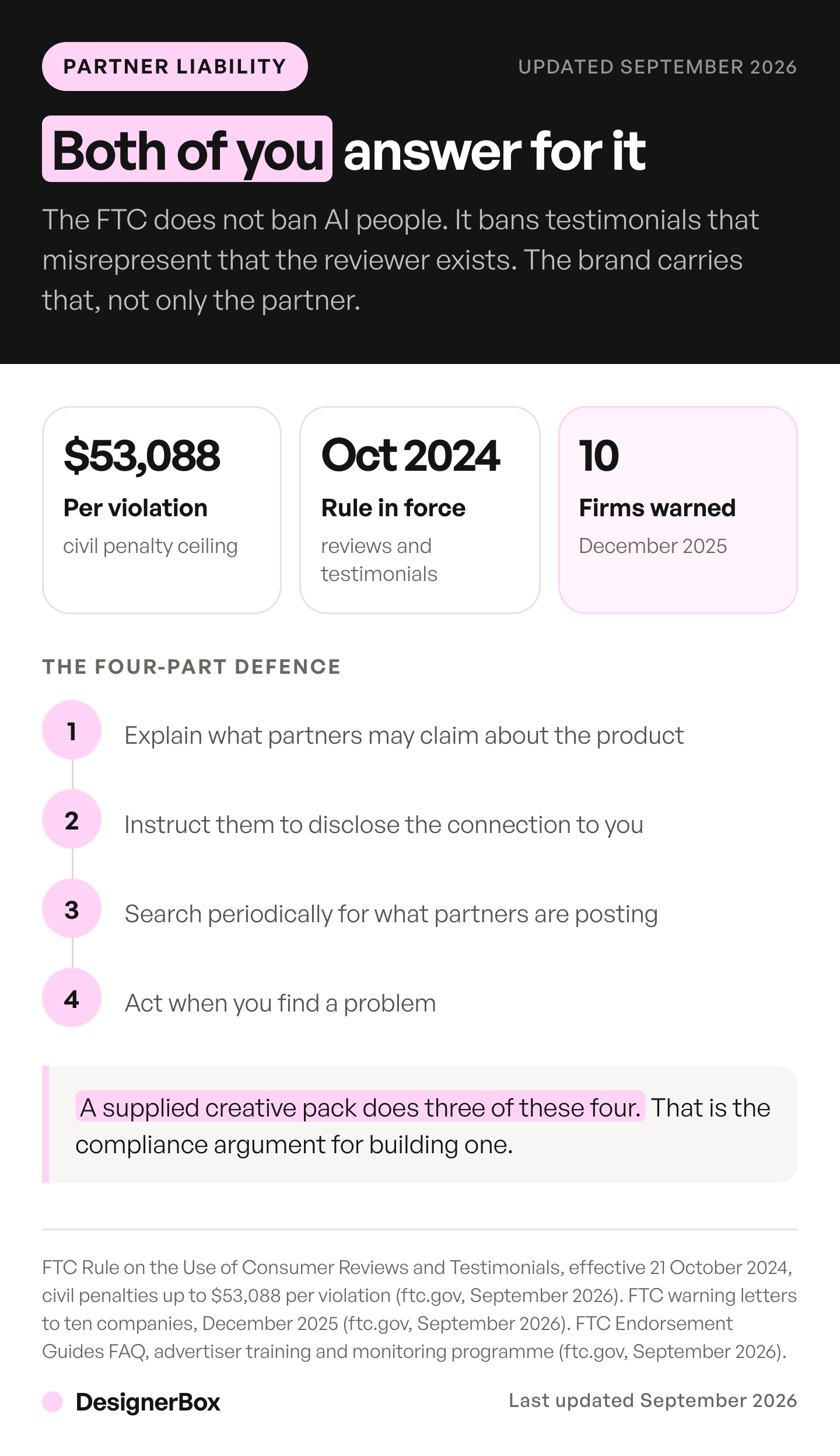
Get the next part right, because most writing on this topic has it backwards. The FTC does not ban AI-generated people in marketing. Its own guidance is explicit: “The rule has no blanket prohibition on the use of AI-generated avatars in marketing,” and section 465.2 “is drafted specifically so as to not prohibit companies from using virtual influencers” (ftc.gov, accessed September 2026). What the rule prohibits is the misrepresentation. A synthetic presenter is allowed. A synthetic presenter framed as a real customer describing a real experience is a fake testimonial, and that is the thing with the penalty attached.
That rule has been in force since 21 October 2024 and carries civil penalties up to $53,088 per violation. In December 2025 the FTC sent warning letters to ten companies about possible violations (ftc.gov, accessed September 2026), so the rule is being worked rather than sitting on a shelf.
Draw the line where the FTC draws it. A relit packshot, a swapped background, a new crop and a styled scene of a product you sell are all depictions of a real product. None of them is a testimonial. The line the rule draws runs between accurate and misrepresented, rather than between synthetic and real.
The platforms draw a second line, in a different place, and that is the one that gets ads rejected. TikTok requires an AI label on ads whose content is completely AI-generated or that show the subject doing or saying something they did not, while explicitly exempting background removal and colour correction, and states that undisclosed AI content means “your ad will be rejected or restricted” (ads.tiktok.com, April 2026). Meta applies an “AI info” label from detected signals and has begun “automatically detecting ads created or edited using third-party AI tools,” with the label surfacing next to the Sponsored label when an AI-generated photorealistic human is included (about.fb.com, updated June 2026).
Those two policies disagree about background removal, which is the single most common edit in an affiliate pack. Write your edit rule to the stricter of the two rather than to the regulator, because the ad review system rejects faster than the FTC does.
The defence the FTC describes is a programme, and it lists four parts: explain what partners can and cannot say about the products, instruct them on disclosing their connection to you, periodically search for what they are saying, and take appropriate action when you find problems. It then says it is “unlikely that the activity of one rogue influencer would be the basis of a law enforcement action” where such a programme exists.
A creative pack does three of those four on its own. That is the argument for building one that has nothing to do with aesthetics.
How do you build the pack once and rerun it per product?
Start from the product photo you own, because every asset derived from it is a depiction of the real product rather than a description of one. Five steps, and the first is the one brands skip.
- Pick the hero products. Not the catalogue. The 6 to 10 products that drive most partner revenue. A pack covering everything gets used for nothing.
- Load the brand once. Colours, type, logo and the product presentation rule go into a brand profile, so every asset generated afterwards reads the same record instead of being re-described in a prompt each time.
- Generate the five formats for one product. Packshot, square lifestyle, vertical crop, on-model, and one clip. Each is built from the photo you uploaded, so what comes back depicts the product you sell.
- Write the copy and disclosure rows. Three to five approved lines, the disclosure wording, and the edit rule. This is 20 minutes and it is the half that holds up legally.
- Save it, then run it on the other five. The definition is now the pack. Every new drop is the same steps pointed at a new photo rather than a rebuild from memory, which is what keeps product 40 looking like product 1.
The arithmetic is small enough to check before you start. Six hero products at four images each is 24 images. That is 96 credits on Seedream 5, 120 on FLUX Pro 1.1, and 336 on Nano Banana Pro, the default. Basic carries 500 credits at $15 a month billed monthly, which covers the pack on any of those rows. The free plan’s 112 credits is 28 images on the cheapest model or 8 on the default, enough to prove the format before you pay.
Video is the second line. One 8-second clip per hero product is six clips, which is 240 credits on the lite 720p row and 1,920 on the premium one. Read the row before you set the count, because the same six clips move by 8x on that one setting, and you can see the number before you press generate.
Two gates decide the plan before the credits do. The commercial licence starts at Pro at $35 a month billed monthly, and a partner pack is commercial use by definition. AI video starts at Premium at $75 a month billed monthly. Basic covers the credit count and not the licence, so price the plan on the gate rather than on the credit balance.
Step 5 is what stops this becoming an annual project. A saved workflow reruns on the next product, and the affiliate weekly batch workflow is that pattern applied to a partner programme. The pack stops being a launch artefact and becomes a weekly output.
How do you keep partners on brand without approving every post?
You cannot review 40 partners’ posts before they publish, and a programme that requires it will not run. The workable version constrains the input instead of policing the output.

Three things do most of the work. Give partners assets good enough that generating their own is the slower option. Write the edit rule so a partner can self-check in ten seconds. Then search periodically, which the FTC asks for anyway, and treat a partner using off-pack creative as a conversation rather than a violation, because it usually means the pack was missing what they needed.
The input side is a product question. Brand profiles and a shared asset library hold the colours, type, logo and reference products in one place, so the pack for the next drop starts from the approved definition rather than someone’s memory of it. Agencies running this across several client programmes get the same problem once per client, which is what keeping each client’s look separate is built around.
Be honest with yourself about scale. At 5 partners you can review everything. At 40 you are running a system, and the pack is the system.
What this does not fix
It does not make partners post. A creative pack raises the quality and consistency of what gets posted, and does nothing for a partner who signed up and went quiet. That is a recruitment and activation problem with different tools.
It does not remove your monitoring obligation. Supplying assets is three of the FTC’s four parts. The fourth, searching for what partners are saying and acting on it, still needs a person and a calendar.
It does not cover partners who want to appear in the content themselves. A creator making a genuine review with their own face is doing the thing affiliate programmes exist for, and a supplied image cannot substitute for it. Give those partners the product and the rules, not the assets. The formats that carry a link are covered in shoppable video for creators, and the tooling those creators use on their own side is worth knowing before you write the edit rule that constrains them. Partners on pay-per-sale programmes are working to a volume maths that shapes what they will accept.
It does not give you a partner portal. DesignerBox generates the assets. Distribution runs through whatever your affiliate platform or shared drive already does. Shared brand kits and team collaboration sit on the Ultra plan at $200 a month billed monthly, and below that the workspace is single-seat, which is the real constraint for a team splitting this work.
The next move is small enough to do this week. Pick the six products that drive most partner revenue, load your brand rules once, and produce the four formats for one of them. If that output survives your own review, save the definition and run it on the other five. Product photography on the main site is where the first pack starts, and image generation lists the models and their per-file rates, so you can price the run before you commit to it.
FAQ
What are affiliate creative assets?
They are the approved images, video, copy and disclosure wording a brand supplies to its affiliate or partner programme, so partners promote the product without producing their own visuals. A working pack covers each hero product in the formats partners post, and states what partners may edit.
Can affiliates use AI-generated images of our products?
Depictions of a real product you sell, such as a relit packshot, a background swap or a styled scene, are generally fine, and supplying them yourself is better than leaving partners to generate their own. The FTC does not prohibit AI-generated people, and states the rule “has no blanket prohibition on the use of AI-generated avatars in marketing.” The problem is a synthetic presenter framed as a real customer with a real experience, which is a misrepresented testimonial. Platform ad policy is stricter than the regulator here, so check Meta and TikTok’s labelling rules before the FTC’s.
Is the brand liable if an affiliate fails to disclose?
The FTC states that a company is “ultimately responsible for what others do on your behalf,” and advertisers may be liable when they hire and direct endorsers who fail to make necessary disclosures. The mitigation the FTC describes is a reasonable programme to train and monitor partners, rather than a contract clause on its own.
What sizes should affiliate creative be?
Supply the crops partners post: a square for feed placements, a 9:16 vertical for Reels, Stories, TikTok and Shorts, and a plain-ground packshot for listings, roundups and comparison grids. Add display banners only if your programme actually includes partners running display placements. If it does, the sizes the networks themselves still list are 728x90, 300x250, 160x600, 300x600 and 320x50 (help.awin.com, March 2026; support.refersion.com, July 2026). Note that the IAB’s published portfolio dates from 2017, so the network pages are the better current reference.
How much does it cost to produce an affiliate creative pack?
There is no single per-image price to multiply. Image models cost 3 to 22 credits a file, so six hero products at four images each is 96 credits on the cheapest model and 336 on the default one. Video is priced per second of output, so six 8-second clips is 240 credits on the lite row and 1,920 on the premium one. The licence gate matters more than either number: commercial use starts at Pro at $35 a month billed monthly.
How often should we refresh the pack?
Version it with the catalogue, not the calendar. A new hero product, a colourway change or a packaging update makes the existing assets wrong, and a partner promoting a product you no longer sell in that form is an accuracy problem. Saving the pack as a workflow makes each refresh a rerun rather than a rebuild.
Do we still need brand guidelines if we ship a creative pack?
Yes, though the pack does the enforcing. Guidelines describe the target and rely on someone to hit it. The pack supplies assets that already hit it, plus one edit rule specific enough to follow without asking you. Keep the guidelines for the cases the pack does not cover.
Sources
- Advertiser responsibility for endorsers, the four-part training and monitoring programme, affiliate disclosure wording and placement, from the FTC’s Endorsement Guides FAQ: (ftc.gov, accessed September 2026)
- Rule on the Use of Consumer Reviews and Testimonials, effective 21 October 2024, coverage of testimonials by people who do not exist including AI-generated fake reviews, and civil penalties up to $53,088 per violation: (ftc.gov, accessed September 2026)
- FTC warning letters to ten companies over possible Consumer Review Rule violations, December 2025: (ftc.gov, accessed September 2026)
- FTC position that the rule carries no blanket prohibition on AI-generated avatars or virtual influencers, and that the prohibition attaches to fake or false testimonials: (ftc.gov, accessed September 2026)
- TikTok advertising policy on AI-generated content labelling, the exemptions for background removal and colour correction, and rejection of undisclosed AI ads: (ads.tiktok.com, last updated April 2026)
- Meta “AI info” labelling, automatic detection of third-party AI tools in ads, and label placement for AI-generated photorealistic humans: (about.fb.com, updated June 2026)
- US affiliate marketing spend of $13.81bn in 2026 against $12.42bn in 2025, and 19.5% year over year creator growth on Awin: (emarketer.com, April 2026)
- Display banner sizes still listed by affiliate networks: (help.awin.com, March 2026; support.refersion.com, July 2026). The IAB New Standard Ad Unit Portfolio dates from 2017
- DesignerBox image and video credit rates, plan allocations and feature gating: live product configuration, September 2026
FTC endorsement, disclosure and consumer review rules verified from ftc.gov, platform AI labelling policy from ads.tiktok.com and about.fb.com, and affiliate spend forecasts from emarketer.com, as of September 2026. Note the date asymmetry: the FTC’s endorser definition dates from 2023, the reviews rule from October 2024, and the IAB size portfolio from 2017, while the platform policies were updated in 2026. This is a summary of published guidance and is not legal advice; check the current rules with your own counsel before setting programme policy. DesignerBox credit rates, plan allocations and feature gating verified against live product configuration, September 2026. Individual results vary.