


AI marketing agents plan a multi-step marketing job, run it across your real stack, read what happened, and adjust. Ten platforms clear that bar in 2026. Each owns a different layer of the job: orchestration (Salesforce Agentforce, HubSpot Agent Hub, Relevance AI), content and creative production (Superscale, Omneky, Pletor, Jasper, Copy.ai), publishing and media buying (Albert.ai), and lifecycle messaging (Braze). No single agent owns all four.
CMOs put 15.3% of marketing budget into AI in 2026. Only 30% say their organization is mature enough to scale it, and 70% say their internal processes are not (gartner.com, May 2026). The money is committed. The choice is not.
This guide sorts the agents by which layer of the marketing job each platform owns. It then adds a second axis: whether the agent can be driven from outside its own interface. Prices move every quarter in this category, so no figure is quoted here. Each vendor’s own pricing page is named instead, read in September and October 2026, and where a vendor publishes no price this guide says so.
Key Takeaways
- An agent runs a loop, a tool runs an errand. Plan, execute, read the result, adjust. A platform that generates an asset on request and stops is a generator, whatever the marketing page calls it.
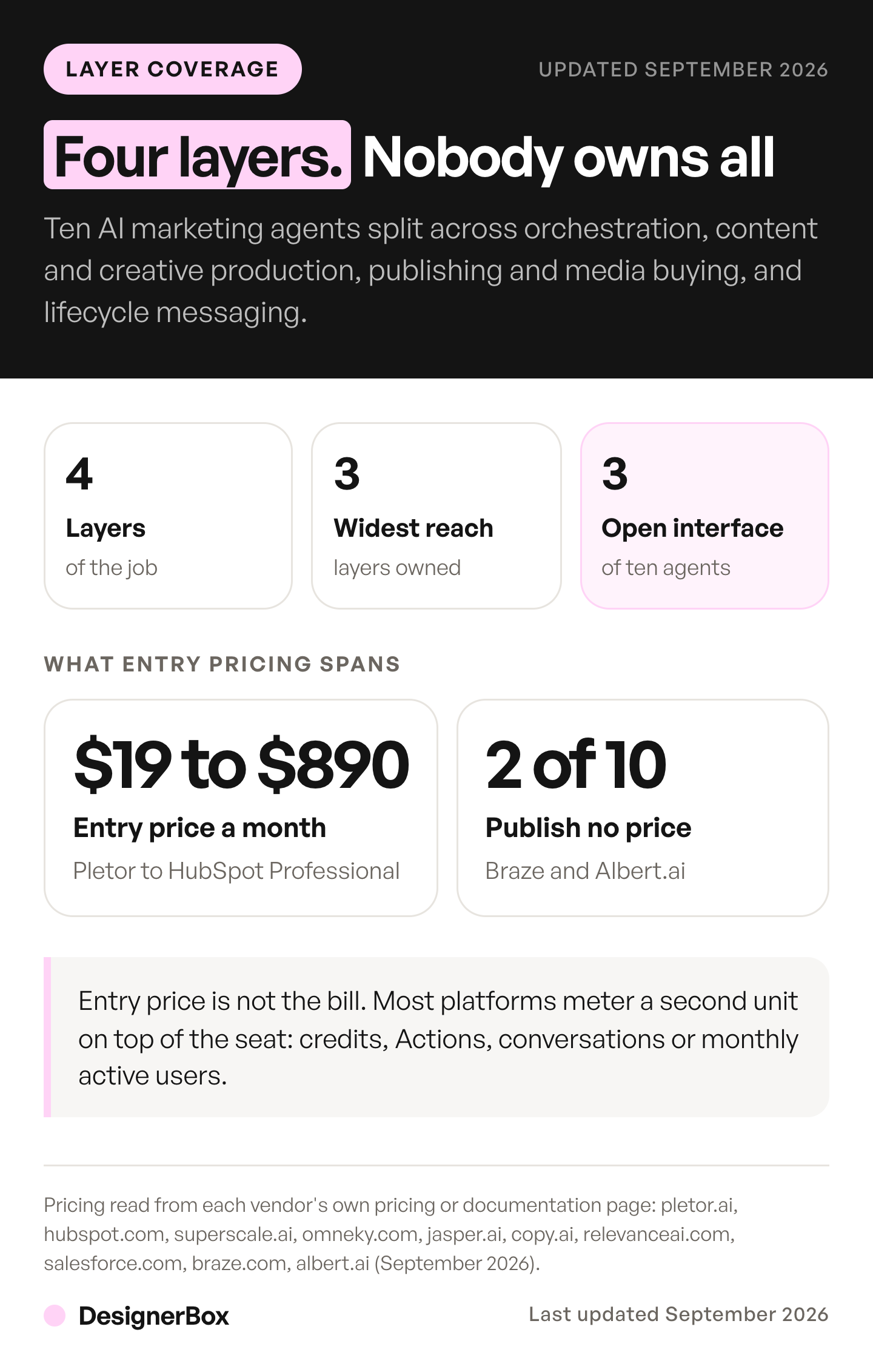
- The marketing job splits into four layers. Orchestration, content and creative production, publishing and media buying, lifecycle messaging. Most teams need two, and no platform on this list owns more than three.
- Entry pricing is not comparable across the ten. A builder tier and a mid-market marketing suite sit in different brackets. Two vendors publish nothing at all, and eight of the ten meter a second unit on top of the seat.
- Eight of ten document an MCP server. Salesforce, HubSpot, Braze, Jasper and Relevance AI have one, and so do Pletor, Omneky and Superscale. The servers expose different things, so read each tool list before you plan a stack around it.
- Publishing splits the field cleanly. Omneky and Albert.ai push into ad accounts, and Superscale labels its launch step “Coming soon”. Jasper, Copy.ai, Pletor and Relevance AI do not document it.
- Creative input is where agents break first. The planning step works. What the agent has to work from decides whether the output survives brand review.
What is an AI marketing agent?
An AI marketing agent plans a multi-step job, executes it against your real systems, reads the outcome, and changes what it does next. Three properties have to be present: autonomy over the sequence, a connection to live systems rather than a sandbox, and a feedback read that changes the next run. Software that produces one asset per request meets none of them.
The word gets applied to three different things. A generator makes an asset when you ask and stops. Marketing automation runs rules you wrote in advance, so the email fires when the cart is abandoned. An agent picks the next step itself.
That distinction is not a ranking. A generator that does one job well beats a mediocre agent and costs less. AdCreative.ai, for example, generates static ads, ad copy and product photoshoots, and lists its plans on its own pricing page (adcreative.ai, September 2026). For a team that needs volume rather than a loop, that is the correct purchase. AI advertising tools sorted by job lists more generators, starting with the free ones inside each ad account. What the distinction changes is what you should expect. A generator waits for you to notice the ad is tired. An agent is supposed to notice on its own.
The four layers of the marketing job
Every platform in this category owns part of the job and hands the rest back to you. Naming the parts makes the shortlist much shorter, because most teams have a bottleneck in exactly one of them.
| Layer | What runs here | Who owns it |
|---|---|---|
| Orchestration | Planning, routing work, holding customer context | Salesforce Agentforce, HubSpot Agent Hub, Relevance AI |
| Content and creative production | Copy, static ads, video, brand-consistent variants | Superscale, Omneky, Pletor, Jasper, Copy.ai |
| Publishing and media buying | Pushing creative live, bids, budgets, reallocation | Omneky, Albert.ai, and Superscale with launching marked “Coming soon” |
| Lifecycle messaging | Email, SMS, push, in-product journeys | Braze, HubSpot, Salesforce |
Two things follow from this table. No platform in it covers all four layers, so a team that needs more than one layer buys a stack. And the layer a team is short on is rarely the one it shops for. Teams with a creative bottleneck often buy orchestration, because orchestration is what the enterprise vendors market hardest.
Pick the layer first. The vendor question is second and much easier once the layer is fixed. For a wider field of 13 platforms sorted the same way, see the agentic marketing platforms compared. The same job divides a second way, by stack rather than by agent. The four layers of AI marketing automation covers that version: data, decisioning, delivery and creative.
The 10 best AI marketing agents in 2026
Ordered by breadth of the marketing job owned, widest first. Breadth is not quality: a single-layer agent that fits your bottleneck beats a three-layer platform that does not.
| # | Agent | Layers owned | How it charges |
|---|---|---|---|
| 1 | Salesforce Agentforce | Orchestration, lifecycle, content | Credits, per conversation, per user or flat fee |
| 2 | HubSpot Agent Hub | Orchestration, content, lifecycle | Per seat, plus credits |
| 3 | Superscale | Creative production, publishing (marked “Coming soon”) | Per tier, plus credits |
| 4 | Omneky | Creative production, publishing | Per tier, plus credits |
| 5 | Braze | Lifecycle, orchestration | Not published, scales with monthly active users |
| 6 | Pletor | Creative production | Per tier, plus credits |
| 7 | Jasper | Content production | Per seat |
| 8 | Copy.ai | Content, GTM workflow | Per seat, plus workflow credits |
| 9 | Relevance AI | Orchestration (build your own) | Per tier, plus two usage meters |
| 10 | Albert.ai | Media buying | Not published |
Eight of the ten list their plans on their own pricing pages, read September and October 2026. The two that do not are named as such below.
1. Salesforce Agentforce
Best for: enterprise marketing teams already running Salesforce who want agents sharing one data spine with sales and service.
Agentforce sits on Data Cloud and lets teams build agents that act across the Customer 360 model: journey orchestration, data-grounded content, lead prioritization. Salesforce lists consumption options, such as Flex Credits, pay-as-you-go and per-conversation billing, and per-user add-ons on its own pricing page (salesforce.com/agentforce/pricing, October 2026). Agentforce Builder and Prompt Builder are included in Salesforce Foundations.
Ad creative production is outside its scope. It writes email, SMS and landing-page copy and runs customer journeys.
2. HubSpot Agent Hub
Best for: SMB and mid-market teams on HubSpot who want agents inside the hubs they already pay for.
HubSpot now groups its agents in Agent Hub, with Breeze Assistant as the chat entry point. Content Agent builds “blog posts, social content, and landing pages in your brand voice”. Campaign Agent turns “a single goal into a fully planned, multi-channel campaign”. Nurture Agent sends “every lead a personalized email based on where they actually are” (hubspot.com/products/artificial-intelligence, October 2026). HubSpot sells Marketing Hub per seat, and it lists its plans on its own pricing page (hubspot.com/pricing/marketing, September 2026).
HubSpot’s agents run on a second meter, HubSpot Credits, billed on top of the seat and included in different amounts by tier. Unused monthly credits do not move to the next month. Paid ad creative production is outside scope.
3. Superscale
Best for: growth teams and agencies whose paid creative output is the bottleneck and who want research, production and performance reads in one loop.
Superscale takes a store or brand URL, researches the category, writes scripts and copy, generates video and static variants, and reads performance back from connected ad accounts to plan the next batch. Its site lists launching to Meta and Google Ads, and labels Launch and Scheduling “Coming soon” (superscale.ai, October 2026). It includes a built-in editor for captions, music, scene order and pacing, and speaking AI UGC video ads. Superscale meters its plans in credits and generations, and it lists its plans on its own pricing page (superscale.ai/pricing, October 2026). There is a 5-day free trial before you choose a plan.
CRM orchestration, lifecycle email and customer service agents are outside scope.
4. Omneky
Best for: performance teams who want one agent generating, launching and rotating ad creative across nine channels.
Omneky generates image, video and UGC ad creative, launches variants into paid channels, and adjusts the creative mix against live performance. It launches on nine channels: Meta, Google, TikTok, LinkedIn, Reddit, OpenAI Ads, Pinterest and X, with YouTube placements through Google Ads. Its pricing is published rather than quote-only. Omneky meters its plans in credits and gives a 7-day trial on its self-serve plans. Omneky lists its plans on its own pricing page (omneky.com/pricing-plans, October 2026).
Connecting an ad account costs no credits. On Meta, Google and OpenAI Ads, you can also launch through Omneky’s own account.
5. Braze
Best for: consumer brands running high-volume lifecycle messaging who want agent decisioning inside the messaging platform.
Braze runs email, SMS, push and in-product messaging, with BrazeAI Agents operating on Action Credits usable across those channels and the BrazeAI Agent Console. Pricing scales with monthly active users. The pricing page lists no prices and offers a free trial and a “Get pricing” form (braze.com/pricing, October 2026). No third-party estimate is quoted here, because none comes from Braze.
Paid ad creative production and media buying are outside scope.
6. Pletor
Best for: creative and marketing teams who want to build their own production pipelines and drive them from Claude or their own front end. For Claude itself, Claude for marketing covers the seven text jobs Claude ships with and the production step Claude does not cover.
Pletor describes itself as “the creative system for commerce”. You build Flows from nodes, and a Brain holds your brand, products and rules as memory. Its docs name Nano Banana 2.1, GPT Image 2.5, Seedream 5.0, Flux 3, Krea 3 and Ideogram 4.5 on the image side, and Seedance 2.5, Kling 3.0, Veo 3.1 and HeyGen Video 1.0 on video (docs.pletor.ai, October 2026). Sora 2 is still named there. OpenAI removed Sora 2 from its API on 24 September 2026 (developers.openai.com, September 2026). Pletor lists its plans on its own pricing page (pletor.ai/pricing, October 2026). You can start free with a small credit grant.
API and MCP access need a paid plan. Its MCP server lets an AI chat build and run Flows and Apps, create images and videos, read a Brain and browse models. Its docs name Claude, ChatGPT and Codex, Cursor and VS Code as clients. Publishing to ad platforms is not documented.
7. Jasper
Best for: brand and content teams who need voice consistency enforced across long-form content, email and social.
Jasper moved from AI copywriter to an agentic content workspace. AI Studio is Jasper’s no-code builder for custom agents, and Jasper IQ holds the brand, product and audience context that the agents share. Its plans include Canvas, Brand Voices, Knowledge assets and Audiences, with a 7-day trial. Jasper lists its plans on its own pricing page (jasper.ai/pricing, October 2026).
Video production, ad publishing and media buying are outside scope. API access and the custom-agent builder sit on the Business plan.
8. Copy.ai
Best for: revenue teams who want repeatable go-to-market motions chained across the marketing and sales seam.
Copy.ai is a workflow builder for go-to-market teams. Fullcast acquired it in 2025 to build what it calls “the first end-to-end AI-native RevOps platform” (copy.ai/fullcast-acquires-copy-ai, October 2026). Its entry plan gives access to OpenAI, Anthropic and Gemini models. Copy.ai lists its plans on its own pricing page (copy.ai/pricing, October 2026).
You design the workflow yourself. Visual and video creative are outside scope, and API access is listed on Enterprise.
9. Relevance AI
Best for: teams that want to build specialized marketing agents rather than buy a fixed set of them.
Relevance AI is an agent builder with two meters: Actions, which are agent task steps, and Vendor Credits, which pass through model and compute cost. Relevance AI lists its plans on its own pricing page (relevanceai.com/pricing, October 2026).
It does not document ad-platform publishing. What it builds is the orchestration layer around whatever else you run.
10. Albert.ai
Best for: advertisers with meaningful paid spend, a working creative engine, and a reason to hand bidding to software.
Albert, now Albert by Zoomd, is the media-buying agent. For the split between an agent that makes the ad and one that runs the account, see the three kinds of AI ad agent. It handles planning, setup, optimization, reporting and media execution across Google search and programmatic, Facebook, Instagram, YouTube and Bing, operating the advertiser’s existing ad accounts (albert.ai, October 2026). Its pages describe creative rotation and optimization rather than creative production, so a team still needs a source of ads. Albert publishes no pricing and directs buyers to contact sales for a custom plan (albert.ai/pricing, September 2026). No figure for Albert is quoted here.
Also worth knowing
Two more agents sit outside the ten above. Klaviyo’s marketing agent, Composer, plans email and SMS campaigns for ecommerce brands. It became available to every Klaviyo customer on 13 October 2026, and Klaviyo’s own line is “Nothing goes live without you” (klaviyo.com/blog/composer-marketing-agent, October 2026). Adobe made its Experience Platform agents and Agent Orchestrator generally available on 10 September 2025. The orchestrator reads a request in plain language and decides which agents to activate (news.adobe.com, October 2026). Neither was checked for an MCP server, so neither appears in the table below. What agentic marketing is explains how these agents differ from the automation they replace.
Can the agent be driven from outside its own screen?
This axis decides whether you can compose a stack. An agent with an open interface can be called by another agent. An agent without one can only be operated by a person, in its own window, on its own terms. In 2026 the interface question has a standard answer, so it is now checkable rather than a matter of vendor preference.

Anthropic donated the Model Context Protocol to the Agentic AI Foundation on 9 December 2025. The foundation is a directed fund under the Linux Foundation, co-founded by Anthropic, Block and OpenAI, with support from Google, Microsoft, AWS, Cloudflare and Bloomberg (anthropic.com, read September 2026). MCP is now a neutral standard rather than one vendor’s convention, so you can check whether a vendor has a server.
| Platform | Open interface | What that buys you |
|---|---|---|
| Pletor | MCP server, plus API, on paid plans | Claude, Cursor or Codex can run your Flows |
| Omneky | MCP server at mcp.omneky.com | An outside agent can create ads, launch campaigns and read performance |
| Superscale | MCP server (check which plan includes it) | Chat-driven creative production |
| Salesforce Agentforce | Hosted MCP servers that expose Agentforce agents and prompt templates as tools | Claude, ChatGPT or Cursor can hand a task to an agent you built in Salesforce |
| HubSpot | A remote MCP server with read and write access to CRM data | An outside agent can read and change contacts, deals and engagements |
| Braze | An MCP server with read and write tools, and no user-profile data | An outside agent can read campaign and Canvas analytics and create content |
| Jasper | An MCP server, plus an API from the Business tier | Your brand voice and rules reach the other AI tools your team uses |
| Relevance AI | An MCP server for your agents, tools and knowledge | Claude, Cursor or ChatGPT can call the agents you built |
| Copy.ai | API listed on Enterprise | Gated above the entry plan |
| Albert.ai | Not documented publicly | Operate it in its own console |
The Salesforce, HubSpot, Braze, Jasper and Relevance AI rows were read on each vendor’s own MCP page on 2 October 2026 (developer.salesforce.com, developers.hubspot.com, braze.com/docs, jasper.ai/mcp and relevanceai.com/docs). The Pletor, Omneky and Superscale rows were re-read on 22 October 2026.
Eight of the ten document an MCP server. The servers do not expose the same things. One hands a task to an agent, another reads campaign analytics, and a third runs a creative pipeline. If your intent is to have one agent brief another rather than to sit in ten dashboards, read each server’s tool list before you shortlist. For the wider set of servers a marketing team can connect, see MCP servers and connectors for marketing, by job. To assemble an agent yourself instead of buying one, AI agent builders for marketing teams compares five builders and the parts you put together.
What AI marketing agents cost
Entry pricing in this category is not comparable across the ten, and two vendors publish nothing. The number on the pricing page is also rarely the number you pay. Most of these platforms meter a second unit on top of the seat: credits, Actions, conversations or monthly active users. Read both meters, on the vendor’s own page, before you compare two shortlists.
Three pricing shapes are in play, and they fail differently.
Seat pricing is predictable and does not limit how much a team uses. Jasper and HubSpot both charge per seat, which is easy to forecast.
Consumption pricing tracks usage and is hard to forecast before you have run a month. Salesforce meters agent work in credits, conversations or per-user add-ons, and HubSpot bills its credits on a separate rate. Run the arithmetic with your own volume before you sign.
Tier gating is the one teams find after purchase. Jasper’s API sits on its Business plan, and Copy.ai’s workflow credits are not part of its entry plan. Read what the entry tier excludes before you read what it includes.
Two vendors, Braze and Albert.ai, publish no pricing at all. That is normal for enterprise software, and it is not a mark against either. It does mean a shortlist with them on it includes a sales call.
Where AI marketing agents break first
The planning step is not the failure point. Agents plan competently. What breaks is the input. An agent asked to produce campaign creative with nothing real to work from returns assets that look fine one at a time. They drift the moment you put them in one campaign.
Gartner expects many projects to stop before they pay back. It predicts that over 40% of agentic AI projects will be canceled by the end of 2027, “due to escalating costs, unclear business value or inadequate risk controls” (gartner.com, 25 June 2025). That is a prediction, not a count of failed projects.
Four inputs decide whether the output survives brand review, and an agent cannot generate any of them for itself. The first is your own product photo, so the asset shows your product rather than a lookalike. The second is your brand rules as data rather than a PDF. The third is a model catalog wide enough that one shot can use a different model than the next. The fourth is an asset library the agent can read, so the twelfth run matches the first.
This is the same failure the Gartner readiness number describes from the budget side. 70% of CMOs say internal processes are not mature enough to scale AI. In creative work, process maturity mostly means whether these four inputs exist in a form software can reach. We covered the four inputs an agent has to be able to reach in more detail, and what to hand a creative agent and what to keep separately.
The cost of getting it wrong is the rework at every handoff between tools, which is where the six-tool stack spends your money.
How to pick one
| If you are | Start with | Why |
|---|---|---|
| Short on paid creative volume | Omneky or Superscale | Omneky publishes today. Superscale labels launching “Coming soon” |
| Already on Salesforce at enterprise scale | Agentforce, plus a creative engine | Orchestration is covered, creative is not |
| Already on HubSpot | Agent Hub, plus a creative engine | Same split, at mid-market pricing |
| Building your own pipelines | Pletor or Relevance AI | Open interfaces and per-node control |
| Short on long-form content, not ads | Jasper | Voice enforcement across text formats |
| Running lifecycle messaging at volume | Braze | Agent decisioning inside the messaging layer |
| Spending enough to automate bidding | Albert.ai, plus a creative engine | Media buying only, needs ads fed to it |
Two rules survive every version of this table. Buy for the layer you are short on, not the layer with the best demo. And check the interface column before you sign, because the platform you cannot call from elsewhere is the platform your next agent will have to bypass.

Where DesignerBox fits
DesignerBox is the creative production layer that an agent calls, and it is built to be called. It does not buy media, publish to ad accounts, or read campaign performance.
The MCP server at mcp.designerbox.ai exposes 75 tools covering image and video generation, avatars, brand profiles, assets and templates, pipelines and workflows. Claude, Cursor and ChatGPT reach the same image and video models the web app does. The tool reference lists every one, and the connect guide covers the setup for each client.
The four inputs above are the reason it exists in this shape. Assets start from your own product photo. Brand profiles hold your rules as data. You pick the model for each step when you build the workflow, and every run after that uses it. Each step can use a different model. One library holds the results. The same model, light and framing reach every product.
The model in each step sets the rate. A run shows its cost before it starts, so the number arrives before the spend does.
The stills, the video, the editors, the brand record, Assets and batch come from one account. An agent can call any of them, and a colleague can run the same job in the app.
Uploading your own photos and the commercial license start on the Pro plan. AI video and the editors start on the Premium plan. Team features, shared brand kits and white label are on the Ultra plan, and every plan below Ultra is one seat. Plans and credits are on the pricing page.
The reason to wire a creative layer into an agent at all is repetition. Build the job once with your brand, your products and your rules, and save it as a workflow. The agent runs it again for the next product, the next drop or the next client. Row one and row two hundred then meet the same standard.
Pair it with whichever agent owns your orchestration layer. That is the shape of a working stack in 2026, and it is why the interface column matters more than the ranking.
FAQ
What is an AI marketing agent?
An AI marketing agent plans a multi-step marketing job, executes it across your live systems, reads the result, and adjusts what it does next without a person driving every step. The three properties that have to be present are autonomy over the sequence, a connection to real systems rather than a sandbox, and a feedback read that changes the following run.
What is the difference between an AI marketing agent and an AI marketing tool?
A tool does one job when you ask and stops. Marketing automation runs rules you wrote in advance. An agent picks the next step itself, acts, and reads what happened. A tool waits for you to notice the ad is tired, and an agent is supposed to notice on its own. Neither is better in the abstract, and a good tool beats a weak agent at lower cost.
Which AI marketing agent is best for a small team?
Pick by the layer you are short on. For paid creative volume, look at Omneky and Superscale. Omneky publishes to ad accounts today, and Superscale labels launching “Coming soon”. For building your own pipelines, look at Pletor. For text content with brand-voice enforcement, look at Jasper. Each one lists its plans on its own pricing page, read October 2026.
How much do AI marketing agents cost?
Entry prices are not comparable across the ten, because a builder tier and a mid-market marketing suite are different products. Salesforce Agentforce lists credits, per-conversation billing and per-user add-ons. Braze and Albert.ai publish no pricing at all. Most platforms meter a second unit on top of the seat, so read the credit rate and what the entry tier excludes before you compare two headline numbers. Every vendor’s own pricing page carries the current figures.
Can one AI marketing agent replace a whole marketing stack?
Not in 2026. The category splits across four layers: orchestration, content and creative production, publishing and media buying, and lifecycle messaging. No platform on this list owns more than three. Most teams pair a creative agent with whatever orchestration layer their CRM already runs, then add media buying only when spend justifies it.
Do AI marketing agents publish ads automatically?
Some do. Omneky launches on nine channels, including Meta, Google, TikTok, LinkedIn and Reddit. Albert.ai operates the advertiser’s existing ad accounts directly. Superscale lists launching to Meta and Google Ads and labels it “Coming soon”. Jasper, Copy.ai, Pletor and Relevance AI do not document ad-platform publishing.
Can I drive an AI marketing agent from Claude or ChatGPT?
Only where the vendor runs an MCP server or an open API. Eight of the ten document an MCP server: Salesforce, HubSpot, Braze, Jasper, Relevance AI, Pletor, Omneky and Superscale. Salesforce names Claude, ChatGPT and Cursor as tested clients for its hosted servers. Pletor names Claude, ChatGPT and Codex, Cursor and VS Code. Copy.ai lists an API on Enterprise. Each server exposes different tools, so read its tool list first.
For driving the work from a terminal instead of a platform, see Claude Code for marketing.
Sources
- CMO AI budget allocation of 15.3%, 70% citing AI leadership as a 2026 goal, 30% reporting mature AI readiness, from a survey of 401 marketing leaders conducted January to March 2026: (gartner.com, May 2026)
- Model Context Protocol donated to the Agentic AI Foundation, a directed fund under the Linux Foundation co-founded by Anthropic, Block and OpenAI with support from Google, Microsoft, AWS, Cloudflare and Bloomberg: (anthropic.com, September 2026)
- Salesforce Agentforce Flex Credits, pay-as-you-go, per-conversation billing and per-user add-ons: (salesforce.com/agentforce/pricing, October 2026)
- HubSpot Marketing Hub per-seat plans and HubSpot Credits: (hubspot.com/pricing/marketing, September 2026), and Agent Hub with its named agents (hubspot.com/products/artificial-intelligence, October 2026)
- Superscale credit metering, the 5-day trial, its editor, and the “Coming soon” label on Launch and Scheduling: (superscale.ai and superscale.ai/pricing, October 2026)
- Omneky credit metering, the trial, the nine launch channels and its MCP server: (omneky.com, omneky.com/pricing-plans and omneky.com/mcp, October 2026)
- Braze Action Credits and the absence of published pricing: (braze.com/pricing, October 2026)
- Pletor’s self-description, paid-plan API and MCP access, model list and supported MCP clients: (pletor.ai/pricing and docs.pletor.ai, October 2026)
- Jasper plan features, AI Studio, Jasper IQ, trial length and API tier gating: (jasper.ai/pricing and jasper.ai/studio, October 2026)
- Copy.ai model access, workflow credit gating and the Fullcast acquisition: (copy.ai/pricing and copy.ai/fullcast-acquires-copy-ai, October 2026)
- Relevance AI Actions and Vendor Credits: (relevanceai.com/pricing and relevanceai.com/docs, October 2026)
- Albert.ai channel coverage and the absence of published pricing: (albert.ai/faq and albert.ai/pricing, October 2026)
- MCP servers, read on each vendor’s own page on 2 October 2026: Salesforce Hosted MCP Servers for Agentforce and the tested clients (developer.salesforce.com/docs/platform/hosted-mcp-servers), HubSpot MCP Server (developers.hubspot.com/ai-tools/mcp), Braze MCP server (braze.com/docs/user_guide/brazeai/mcp_server), Jasper MCP (jasper.ai/mcp), Relevance AI MCP server (relevanceai.com/docs)
- Gartner, Gartner Predicts Over 40% of Agentic AI Projects Will Be Canceled by End of 2027, 25 June 2025: (gartner.com, read through an archived copy, October 2026)
- Klaviyo Composer availability (klaviyo.com/blog/composer-marketing-agent) and Adobe Experience Platform agents general availability (news.adobe.com), October 2026
- AdCreative.ai scope and plans page: (adcreative.ai, September 2026)
- DesignerBox plans, the video credit range, feature gating and the MCP tool count: (designerbox.ai/pricing, September 2026, and designerbox.ai/mcp, October 2026)
Capability claims read from each vendor’s own pricing or documentation page in September 2026, and re-read for all ten agents on 22 October 2026. The MCP server pages for Salesforce, HubSpot, Braze, Jasper and Relevance AI and the Gartner survey release were re-checked on 2 October 2026. Nothing above is sourced from a third-party aggregator or a competitor’s comparison page. Pricing in this category changes often, so read each vendor’s own page before you buy. The DesignerBox MCP tool count was read on 22 October 2026. DesignerBox product facts current as of October 2026. Individual results vary.