AI in advertising covers four separate jobs: buying media, making creative, measuring results, and disclosing that AI was used. Only one of those is yours to control. The platforms already run the buying and the measurement on their own models, and the EU disclosure rule in Article 50 of the AI Act has applied since 2 August 2026. Creative production is the layer where your decisions still change the outcome.
Most guides treat this as one capability you adopt or do not adopt. That framing expired. If you spend on Google Search today, your ads are eligible to show above or below AI Overviews in every market that has them, and inside AI Overviews in the countries Google lists, and you cannot opt out. If you read a conversions column, part of that number was estimated by a model rather than observed.
This guide splits the topic by who owns the decision. Three of the four layers reward governance. Only one rewards investment.
Key Takeaways
-
Adoption is settled, so it is no longer the question. 83% of ad executives say their company has deployed AI in the creative process, up from 60% in 2024 (iab.com, January 2026).
-
Two of the four layers are not optional. Google Ads Help states plainly: “No, you can’t opt out of serving ads in AI Overviews,” and “No, you can’t directly target ad placements in the AI Overviews” (support.google.com, September 2026).
-
Your conversions column is partly modelled. Google reports both modelled and observed conversions in the same column, so the number you optimise against blends measured outcomes with estimated ones (support.google.com, September 2026).
-
The disclosure penalty is larger than the AI gain. Experiments by NYU Stern and Emory researchers found fully AI-generated ads lifted click-through rates by up to 19%, while telling people the ad was AI-made cut click-through rates by 31.5% (stern.nyu.edu, November 2025).
-
Disclosure is now law for some content, and some labels are not yours to remove. EU AI Act Article 50 has applied since 2 August 2026. Google may add AI labels itself, for example where the law requires Google to label. You cannot change a label that Google adds (support.google.com, as of September 2026).
-
An AI product shot is not automatically a deep fake. The Commission’s guidelines treat a real product against an AI background, colour correction and aesthetic background replacement as minor. An AI product image can count as a deep fake when it can mislead people about the actual product (digital-strategy.ec.europa.eu, July 2026).
-
The industry misreads its own audience by 37 points. 82% of ad executives believe Gen Z and Millennial consumers feel positive about AI-generated ads. 45% actually do (iab.com, January 2026).
What is AI in advertising?
AI in advertising is the use of machine learning and generative models across four jobs: selecting who sees an ad and at what price, producing the creative assets, estimating what those ads caused, and marking output as machine-generated where the law requires it. The first, third and fourth are largely handled by the ad platforms. The second is handled by the advertiser.
The four jobs mature at different speeds and carry different risks. Automated bidding has been standard for years and is well understood. Generative creative arrived recently and is still briefed badly by most teams. Modelled measurement is quietly the largest source of reporting error. Disclosure is the newest, and it carries statutory penalties under laws such as the EU AI Act.
Teams that treat these as one project buy a creative tool and expect it to fix a measurement problem. For the same argument across the whole marketing function rather than paid media alone, we covered where generative AI for marketing actually pays back.
The four layers of AI in advertising
| Layer | Who controls it | What the AI decides | Your real lever |
|---|---|---|---|
| Media buying | The ad platform | Bid, audience, placement, format mix | Budget, guardrails, exclusions |
| Creative production | You | Nothing, until you brief it | Source assets, brand inputs, model choice |
| Measurement | The ad platform | Which conversions to attribute and estimate | Consent setup, holdout tests, incrementality |
| Disclosure | Regulators and platforms | Whether your ad carries a label | Records of what was generated and how |
Read the second column. On three of four rows the answer is not you. That is an argument for spending your effort on the row where effort converts.
Layer 1: Media buying, where the AI already decides
You cannot opt out of AI-driven media buying on the major platforms. Google’s help documentation is unambiguous on placement: ads are eligible to show above or below the AI Overview in all 200+ markets where AI Overviews are available, text and Shopping ads from existing Search, Shopping and Performance Max campaigns are eligible to show inside AI Overviews in the countries Google lists, and advertisers can neither opt out nor target that placement directly (support.google.com, accessed September 2026).
The same pattern runs through campaign types. Google is retiring Dynamic Search Ads into AI Max, which uses AI to match more search queries. The upgrade is automatic rather than opt-in: campaigns using automatically created assets and the campaign-level broad match setting are being upgraded from September 2026, and the Dynamic Search Ads sunset and auto-upgrade are scheduled to begin in February 2027 (blog.google, April 2026, updated 11 June 2026).
For a media buyer this changes the job rather than removing it. The controls that survive sit at the edges of the system: budget, brand and location restrictions, negative keywords, exclusion lists, and what you feed the algorithm. The controls that have gone sat in the middle, where you used to hand-tune bids and placements. If your paid media process depends on manual placement control, that process has a shelf life set by a platform roadmap you do not vote on.
Layer 2: Creative production, the layer you actually control
Creative is the only layer where your decisions still change what gets made. It is also where the money goes, because a campaign needs volume: multiple aspect ratios, multiple hooks, multiple placements, refreshed on a fatigue cycle. Digital video ad buyers told IAB that one-third of their ad assets will use generative AI in 2026, up from one-fourth in 2025, with the share projected to reach 43% by 2027 (iab.com, July 2026).

Every major platform now ships generative creative inside the ad account, and several give it away. Google describes Product Studio in Merchant Center as “a suite of free, AI-powered tools” for creating and enhancing product images and videos (support.google.com, accessed September 2026). TikTok calls Symphony Creative Studio a “free creation tool” (ads.tiktok.com, June 2026). Amazon describes its Video Generator as “a free tool provided by Amazon Ads” (advertising.amazon.com, as of September 2026). Meta’s developer documentation lists text generation, image expansion and background generation, and says background generation “currently only works with dynamic product ads or Advantage+ catalog ads on Mobile Feed” (developers.facebook.com, as of September 2026).
Three conditions come attached. Each tool works inside its own platform, so a set made in one does not carry over to the next. They sit inside the platform’s own workflow: Amazon’s Video Generator sits in the Sponsored Brands campaign workflow and the Creative tools tab, and Product Studio sits in Merchant Center. And read the terms before pasting a brand asset in, because Amazon’s state that it may use those inputs for “training advertising generative artificial intelligence models” (advertising.amazon.com, last updated 11 September 2026). We compared what the generators already inside your ad account cover against what a paid tool adds.
That gap is the job DesignerBox does. DesignerBox is AI creative production for agencies and brand teams. You start from one product photo and build a workflow that makes product stills, on-model shots, video cuts and ad frames from it. Each model is one step in that workflow. The cost of a run is shown before you press Run. An 8-second clip costs 40 to 560 credits, depending on the model, and AI video starts on Premium. The free plan includes 112 credits a month. The free plan takes no card. Paid plans start at $15 a month, billed monthly, for 500 credits, as listed on the pricing page. Our 2026 AI creative cost benchmark sets production costs against agency, photography and stock costs.
This layer rewards attention because of consistency. Brand drift happens when each tool in a chain starts from a description instead of the real product, so four handoffs later the asset on the feed is a rendering of a rendering. Starting from the product photo and applying a stored brand profile on every run reduces drift at the input, so review catches less of it later. You set the brand once, and the workflow reads it on every run. Do it once for one product, then run the same workflow again for the next one, and the fiftieth ad in a quarter starts from the same rules as the first. That is the argument for treating the static ad templates as a job you build once, instead of a brief you write from blank every time.
Layer 3: Measurement, where the numbers are modelled
This is the layer nobody warns you about. The AI in your reporting infers the outcomes you use to judge the creative.

Google defines it directly: “Modeled conversions use data that doesn’t identify individual users to estimate conversions that Google is unable to observe directly.” The reporting consequence is the part that matters: “In the ‘Conversions’ column, Google reports both modeled and observed conversions” (support.google.com, accessed September 2026). Modelled and observed are blended, not separated.
The modelling exists for a good reason. Consent requirements severed the link between many ad clicks and the conversions that followed. When Google introduced conversion modelling through consent mode, it said the modelling “recovers more than 70% of ad-click-to-conversion journeys lost due to user cookie consent choices” (blog.google, April 2021). Google adds that results for each advertiser “may vary widely”, depending on consent rates and the consent mode setup. Without modelling, a report shows only the observable part. Three consequences follow, and all three change how you read a dashboard:
- Smaller accounts get less modelling. Consent mode modelling needs a threshold of 700 ad clicks over a 7 day period, per country and domain grouping (support.google.com, accessed September 2026). Below that threshold the gap stays a gap.
- Numbers move after the fact. Google says modelled conversions can take up to 5 days to fully process and stabilise, and conversion values are subject to retroactive increases while modelling finalises.
- A creative test can be read wrong. If two variants sit in different modelling conditions, the difference you measure may belong to the model rather than the creative. That is one of several reasons most creative tests cannot be read as run.
The counterweight is a holdout. When a decision is expensive enough to matter, validate it with a geo split or an incrementality test rather than against a blended conversions column alone.
Layer 4: Disclosure, the layer that became law
EU AI Act Article 50 has applied since 2 August 2026, and the amendment that delayed the high-risk rules did not move it. The Digital Omnibus on AI, Regulation (EU) 2026/1744 of 8 July 2026, pushed high-risk obligations out to December 2027 and August 2028. It left the Article 50 date unchanged, and gave tool makers until 2 December 2026 to add machine-readable marks to systems already on the market (eur-lex.europa.eu, July 2026). Coverage saying the AI Act was delayed is describing a different section. The deployer duty to label deep fakes has no grace period.
Two duties fall on two different parties. Providers of generative systems must mark synthetic image, audio, video and text output in a machine-readable format. Deployers, meaning the brand or agency running the ad, must label deep fake content so a person can actually perceive it. The Commission’s FAQ closes the obvious shortcut: “Deployers cannot simply rely on the machine-readable marking embedded in the content by the provider,” because an invisible watermark is not clear and distinguishable to a viewer. Fines for breaking Article 50 can reach up to EUR 15 million or 3% of total worldwide annual turnover, whichever is higher. This is general information, not legal advice.
The scope is narrower than most coverage suggests, and the Commission published its guidelines on 20 July 2026 with worked advertising examples that draw the line. The guidelines are not binding. A real product shown against an AI-generated background is not a deep fake, “as long as the ad is not likely to mislead the audience about the product’s actual representation.” Colour correction, background replacement “for clearly aesthetic purposes” and re-scaling usually have only a minor effect. An AI-generated product image can count as a deep fake when it can mislead people about how the real product looks or works, for example by making it look “more appealing or with improved quality than in real life” (digital-strategy.ec.europa.eu, July 2026).
In practice, the test is whether the ad misleads people about the product. New York’s synthetic performer statute, which took effect on 9 June 2026, points the same way from another angle: it binds when someone who makes an ad knows it contains an AI human who is not recognisable as any real performer, so an AI product shot with nobody in it sits outside it. Put a person in the frame and the rules change. Leave the product alone in the frame and mostly they do not. One line matters if you use an agency: a company that “merely commissions an advertising agency to produce an advertisement, without taking decisions and exercising control over whether and how the advertising agency uses AI,” is not a deployer. Control carries the duty with it.
The platforms moved ahead of the statute, and in a way that removes your discretion. Google shipped an AI content label setting in July 2026 and states the reason plainly: “AI regulations in the European Union, India, and New York require that ads with certain AI-generated or edited assets include disclosures and/or labels.” For campaigns targeting those markets, designated assets carry visible overlays on the ad. Google may also apply labels itself, and in those cases “labels cannot be overwritten” (support.google.com, July 2026).
Meta applies a label when an image or video is created or significantly edited with its own generative creative features, and states that it also automatically detects ads created or edited using third-party AI tools through industry-standard signals, applying an “AI info” label when it does (about.fb.com, February 2025, updated June 2026). Meta says this may vary by region, and detection needs a signal, so not every AI ad gets a label. TikTok goes further on its own output: “An AI-generated label is added to all exported videos per TikTok ad policy” in Symphony Creative Studio (ads.tiktok.com, June 2026). All three platforms now add some labels themselves, without asking you.
TikTok’s ad policy draws a similar line to the EU’s. It treats removing or modifying backgrounds, and adjustments to lighting, brightness or colour saturation, as insignificant AI edits that need no label, and asks for a label on fully AI-generated or heavily AI-edited media (ads.tiktok.com, as of September 2026). The two thresholds sit close together.
So the operational question is whether your records can answer, per asset, what was generated, by which model, and how much of the frame it changed. Build that record while you produce the asset. Reconstructing it later across six tools is the expensive version. We mapped the disclosure rules now in force market by market, including Google Merchant Center and New York’s synthetic performer law.
Does AI in advertising actually work?
Yes on output, with a condition that costs more than the gain. Researchers at NYU Stern and Emory compared visual ads made three ways: by human experts, by human experts and then modified by generative AI, and fully by generative AI. Ads created entirely by generative AI increased click-through rates by up to 19% against the human-expert versions. Telling consumers the ad was made with generative AI cut click-through rates by 31.5% (stern.nyu.edu, November 2025).
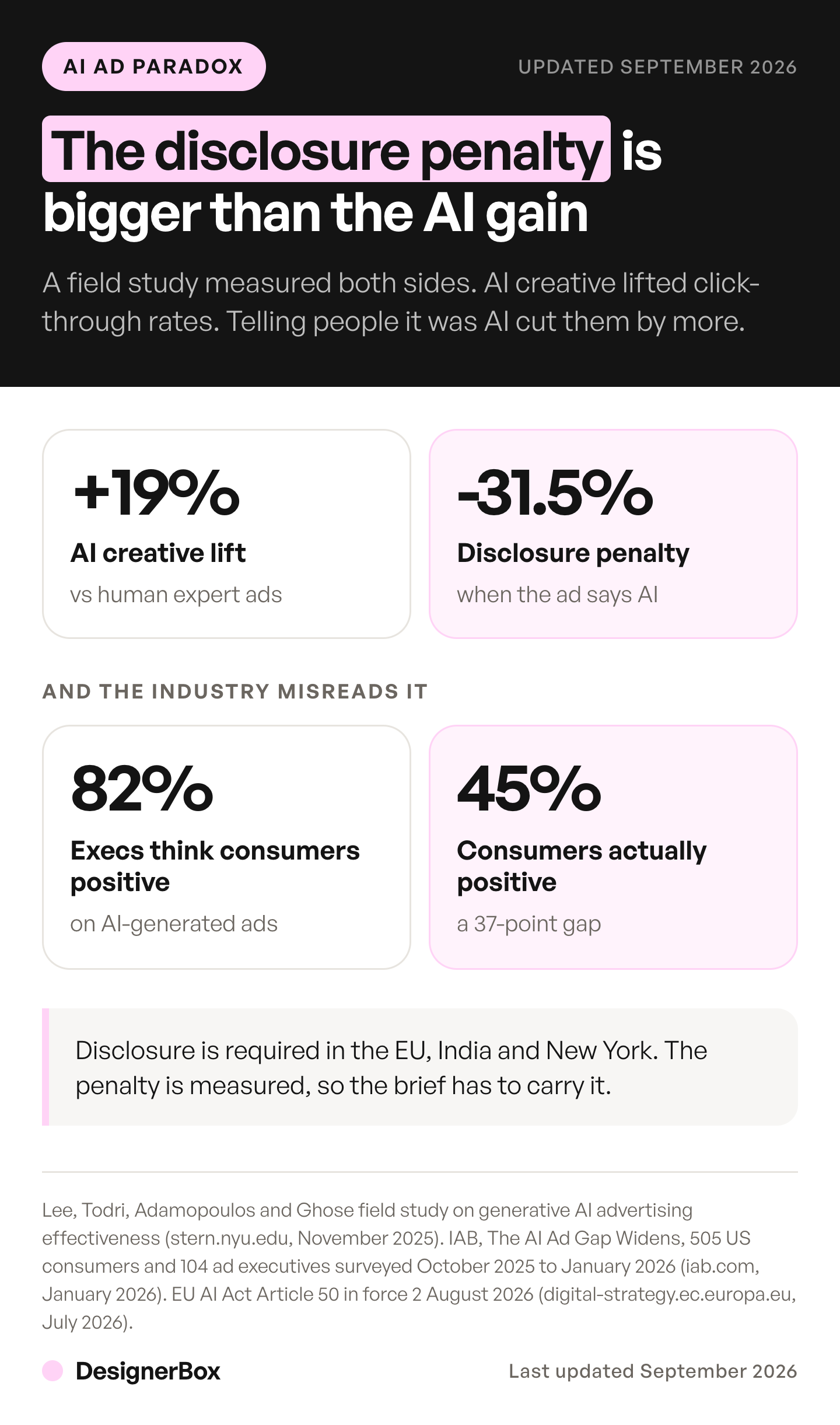
Put those two numbers next to Layer 4 and the commercial problem is obvious. The measured penalty for disclosed AI is roughly 1.7 times the measured gain from using it, and Google says rules in the EU, India and New York now require labels on some AI ads. A separate matched study of display advertising found no average click-through disadvantage for AI images rather than a lift, with the advantage in AI ads that did not look like AI. We covered what that display ad study shows, including the caveat that the data came from a platform with its own AI ad tool. The floor is parity, the ceiling is modest, and visible AI is where performance goes.
Consumer attitudes explain the mechanism, and they also contain a trap. IAB found 45% of Gen Z and Millennial consumers feel positive about generative AI used to make ads, while 82% of ad executives believe consumers feel positive (iab.com, January 2026). Independent polling points the same way: the 2026 Bentley University-Gallup Business in Society survey found 49% of Americans view businesses’ use of AI to create advertisements negatively against 19% positively (news.gallup.com, August 2026). In the IAB study, though, 73% said knowing an ad was AI-made would either increase or make no difference to their likelihood to purchase. That is stated preference, and the 31.5% field result is revealed behaviour. Asked about disclosure, people say it is fine. Shown it, they click less. Plan against the behaviour.
How to start using AI in advertising this quarter
Work the layers in order of control, highest first.
- Audit what the platforms already do to your account. List the campaign types running on automated bidding and broad matching, and put the upgrade dates in your calendar. You are managing a roadmap, not choosing a setting.
- Fix the input before buying a tool. Collect the real product photography, the brand colours, the approved model looks. Generative output inherits the quality of what you feed it, and most generic output traces to a generic brief.
- Produce one campaign end to end from a single source asset. One product photo to stills, on-model shots, a video cut and sized ad frames. Measure the hours and the cost against your current process before scaling. One ad template is enough to test the shape of the workflow.
- Separate modelled reporting from measured reporting. Decide which decisions need a holdout test and which can run on a platform conversions column.
- Start the disclosure record on day one. Asset, model, date, extent of generation. A sheet with one row per asset is a simple way to start while volume is low.
- Save the campaign that worked as a repeatable workflow. The second product should not cost what the first one did.
Teams that start at step 3 without step 2 produce volume that looks like everyone else’s, and in the display ad study the AI images that looked like AI did not get the advantage.
FAQ
How is AI used in advertising?
AI is used in four places: media buying, where algorithms set bids, audiences and placements; creative production, where generative models produce images, video and copy; measurement, where models estimate conversions that cannot be observed directly; and compliance, where platforms and regulators require AI-generated content to be marked. Advertisers control the second layer and set guardrails on the rest.
Will AI replace media buyers?
It has already replaced most manual bid and placement tuning, and that shift follows platform roadmaps rather than adoption choices. What remains is budget allocation, account structure, exclusions, creative strategy, and judging whether reported performance is real. The job moved from operating the machine to governing it.
Can ChatGPT run my ads?
Not directly. General-purpose assistants can write copy, analyse exported reports and draft campaign structures, but they do not hold your ad account, spend budget or serve impressions. Buying still happens inside Google Ads, Meta Ads Manager or a demand-side platform, and the platform’s own models make the bidding decisions.
Do you have to disclose AI-generated ads?
Sometimes. EU AI Act Article 50 has applied since 2 August 2026, and its deployer duty covers deep fakes rather than every AI-assisted image. The Commission’s guidelines treat a real product against an AI background, colour correction and aesthetic background replacement as minor. An AI product image can count as a deep fake when it can mislead people about the actual product. New York’s law covers AI people rather than products. Google and Meta also add their own labels in some cases. This is general information, not legal advice.
Which AI tool is best for advertising?
The answer changes by layer. For media buying you use the platform’s own system, because there is no alternative. For creative production the useful test is whether a tool starts from your actual product photo or from a text description, and whether it runs the same job again on the next product.
Does AI-generated ad creative perform better than human creative?
Experiments by NYU Stern and Emory researchers found fully AI-generated ads lifted click-through rates by up to 19% over human expert-created ads, while a matched study of display advertising found no average click-through disadvantage rather than a lift. Both point to the same condition: AI performs best when viewers do not see the ad as AI-made.
What does AI in advertising cost?
The buying and measurement layers cost nothing extra, because they are built into the ad platforms. The creative layer is where spend sits, and it is driven by asset mix rather than by plan. In DesignerBox, an 8-second clip costs 40 to 560 credits, depending on the model, and the cost is shown before the run. DesignerBox starts free with 112 credits a month, then runs $15, $35, $75 and $200 a month billed monthly.
Sources
- Ads and AI Overviews, placement eligibility and the absence of an opt-out (support.google.com, accessed September 2026)
- Dynamic Search Ads upgrading to AI Max, automatic upgrade timeline (blog.google, 15 April 2026, updated 11 June 2026)
- Modeled online conversions, definition and blended reporting in the Conversions column (support.google.com, accessed September 2026)
- Consent mode modelling, the 700-click eligibility threshold (support.google.com, accessed September 2026)
- Conversion modelling through consent mode, the early recovery rate of more than 70% (blog.google, 15 April 2021)
- Google Ads AI content label settings, EU, India and New York requirements, non-overwritable labels (support.google.com, July 2026)
- Product Studio described as a free suite of AI-powered tools (support.google.com, accessed September 2026)
- EU AI Act Article 50 transparency obligations, application date and deployer duties (digital-strategy.ec.europa.eu, accessed September 2026)
- Regulation (EU) 2026/1744 of 8 July 2026, the Digital Omnibus on AI, amending the AI Act and delaying high-risk obligations while leaving Article 50 on its original date (eur-lex.europa.eu, in force 27 July 2026)
- Commission guidelines on the transparency obligations for AI-generated content, C(2026) 5054 final, including the worked advertising examples for deep fakes and standard editing (digital-strategy.ec.europa.eu, 20 July 2026)
- New York General Business Law section 396-b, synthetic performer disclosure in commercial advertisements, took effect 9 June 2026 (nysenate.gov, accessed September 2026)
- Meta generative AI transparency in ads products, automatic labelling of first-party and detected third-party AI content (about.fb.com, February 2025, updated June 2026)
- Meta Marketing API, generative AI features for Advantage+ creative (developers.facebook.com, accessed September 2026), TikTok Symphony Creative Studio described as a free creation tool (ads.tiktok.com, June 2026) with an AI-generated label on every exported video (ads.tiktok.com, June 2026), TikTok advertising policy on significant versus insignificant AI edits (ads.tiktok.com, last updated April 2026, accessed September 2026), Amazon Video Generator cost statement and placement (advertising.amazon.com, accessed September 2026) and Amazon advertising product terms on input use (advertising.amazon.com, last updated 11 September 2026)
- “The Impact of Visual Generative AI on Advertising Effectiveness”, up to 19% click-through lift and 31.5% disclosure penalty, by Hyesoo Lee, Vilma Todri, Panagiotis Adamopoulos and Anindya Ghose, summarised by NYU Stern (stern.nyu.edu, 6 November 2025)
- AI creative deployment at 83%, the 37-point executive-consumer perception gap, and the 73% purchase-likelihood figure, from 505 US Gen Z and Millennial consumers and 104 US ad executives surveyed October 2025 to January 2026 (iab.com, January 2026)
- Share of digital video buyers’ ad assets using generative AI in 2026, IAB Digital Video Ad Spend and Strategy Full Report (iab.com, 14 July 2026)
- Consumer sentiment on AI-created advertising, 2026 Bentley University-Gallup Business in Society survey of 3,270 US adults (news.gallup.com, 19 August 2026)
- DesignerBox pricing page (designerbox.ai/pricing), plans, credit allocations and feature gating, September 2026
Platform policies verified from Google, Meta, TikTok and Amazon documentation as of September 2026. Regulatory positions verified from European Commission guidance as of September 2026. This is general information, not legal advice. Confirm the current statute and platform policy for your market before publishing a campaign. Individual results vary.