
AI generated ads perform about the same as human-made ads. The largest matched study of the question compared 4,633 AI-generated and human-made ads across more than 369 million impressions and 2.5 million clicks. It found no detectable average click-through disadvantage for AI images. AI ads beat human ads on one condition: the AI image does not look like AI.
That is a narrower claim than the one this category runs on. The standard argument says AI ad generators improve campaign performance because they produce more variants, more variants mean more tests, and more tests find the winner faster. Every step of that chain is plausible. None of it is what the measured research reports.
The research reports something more useful and more awkward. The generator is close to neutral on click-through rate. What changes is the look of the result: ads that do not read as AI do best. Disclosure has its own measured cost. This guide covers what the two largest studies found, what the ad platforms claim for their own AI creative tools, and what the numbers change about how you brief the work.
Key Takeaways
AI generated ads show no average CTR disadvantage. Across 4,633 matched sibling ads, more than 369 million impressions and 2.5 million clicks, the researchers found no detectable average click-through-rate disadvantage for AI-generated images (Exner, Hartmann, Ding, Zhang and Netzer, SSRN working paper, last revised 12 August 2026).
The lift is conditional on invisibility. AI ads outperformed human-made ads when the AI images did not look like AI.
Visual cues decide how an ad reads. Intense colour, high warmth and visible text in the image signal AI to viewers. High aesthetics scores and medium to large faces read as human-made, even though AI produces both of those.
Meta’s own numbers are modest. Meta states a 2-3% conversion lift for background generation and 2% for video expansion on its Advantage+ creative page.
The one large lift came from personalization, not from image quality. A field experiment with more than 21,000 consumers found 6 to 9 percentage points of extra engagement, and the treatment was video personalized to each person’s purchase history.
Cost per variant is where the value sits. The matched study compares click-through rates. If performance is roughly equal, the cost of each variant decides the value, and you can check that against your own budget.
Do AI generated ads perform better than human-made ads?
No, not on their own. On click-through rate, AI-generated ads show no detectable disadvantage against human-made ads when you compare like for like. The performance difference appears when you split AI ads by whether they look like AI. The ones that do not look like AI outperform human-made ads.
This is the result almost no page on this topic reports, because the comparison it requires is hard to run. You need AI and human creative from the same advertiser, in the same campaign, at the same time, or you are measuring the advertiser rather than the creative.
A separate study puts a number on the downside: telling consumers an ad was made with generative AI cut click-through rates by 31.5% (NYU Stern, November 2025), which is larger than any measured gain from using AI. We set that against the compliance rules in who controls each layer of AI advertising.
What the largest study of AI generated ads found
Researchers from the Technical University of Munich, Columbia Business School, Harvard Business School and Carnegie Mellon worked with Taboola, a display ad platform, to study this directly. The paper is “AI in Disguise: Quasi-Experimental Analysis of a Large-Scale Deployment of AI-Generated Ads” by Yannick Exner, Jochen Hartmann, Ziqian Ding, Shunyuan Zhang and Oded Netzer. SSRN lists it as last revised on 12 August 2026 (SSRN 5096969, accessed September 2026).
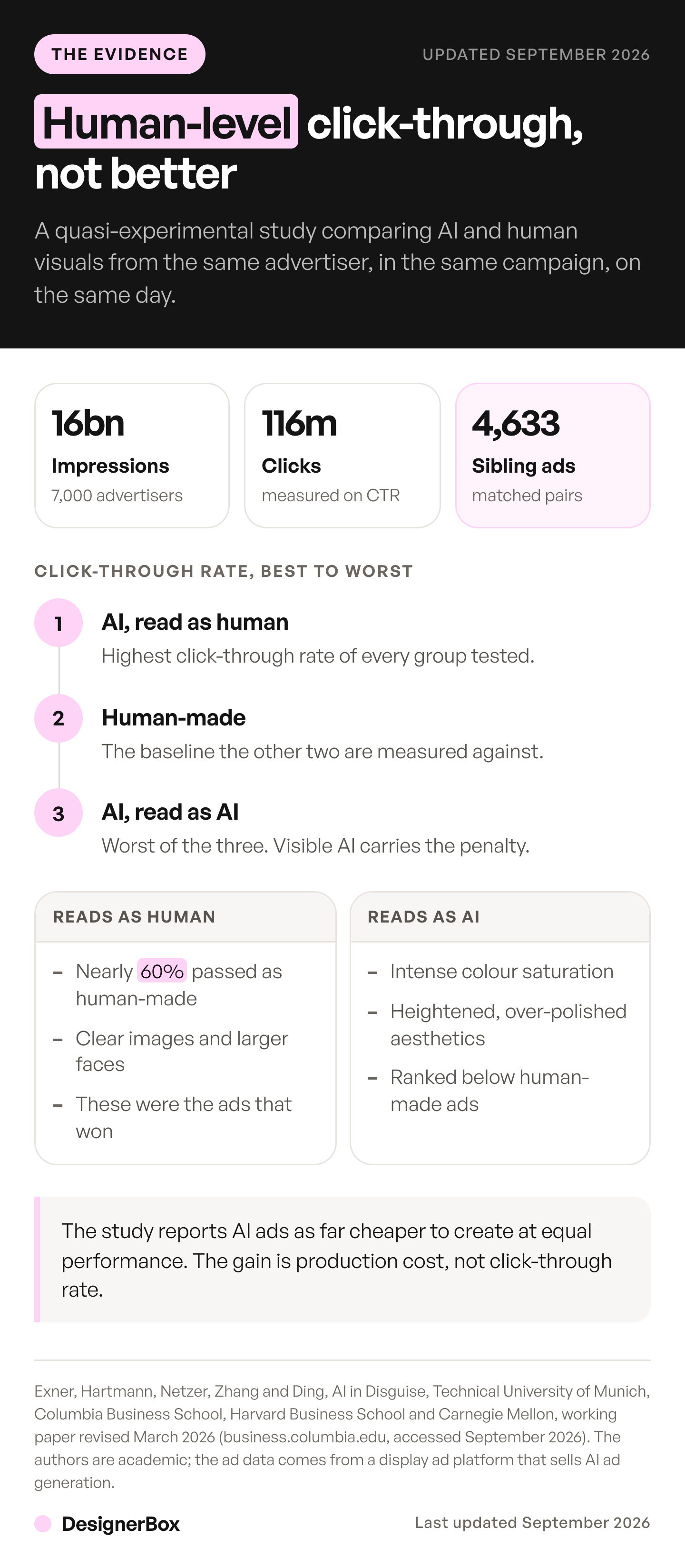
The design is the part that matters. They isolated 4,633 sibling ads: AI-generated and human-made images launched by the same advertisers, in identical campaign settings, at the same time. That strips out the advertiser, the budget, the audience and the timing, and leaves the image. The sibling ads span more than 369 million impressions and 2.5 million clicks.
One caveat belongs up front, because it changes how much weight the result carries. The authors are academic and the data is not. It comes from Taboola, which launched its own AI ad image tool, the GenAI Ad Maker, and the paper says its findings support Taboola’s roll-out. Taboola also published a summary of the study. In that summary, raw click-through rates were 0.76% for AI ads against 0.65% for human ads, and the two groups came out comparable once the tightest statistical controls were applied (taboola.com, January 2026). Read it as the best available evidence on this question, not as a neutral referee.
What that setup returned:
| Finding | What the paper reports |
|---|---|
| Average performance | No detectable average click-through-rate disadvantage for AI-generated images |
| Conditional performance | AI ads outperformed human-made ads when the AI images did not look like AI |
| Signals of AI | Intense colour, high warmth and visible text in the image |
| Signals of human | High aesthetics scores and medium to large faces |
Read that as two separate results. On average, no penalty for using AI. On top of that, a gain for AI that does not look like AI. The click-through comparison says nothing about what each ad cost to make.
What makes an AI generated ad look AI generated
The study went further and identified which visual features drive the perception of artificiality. The answer is counterintuitive enough to be worth planning around.

Intense colour, high warmth and visible text in the image signal AI to viewers. Images with high aesthetics scores and with medium to large faces read as human-made, even though AI generates exactly those features. So some of the properties people assume give an AI image away are not the ones that do, and the vivid, saturated, warm grade many teams treat as a quality bar is the one that gets flagged.
That is a briefing problem, not a model problem. It lines up with what consumers say directly. Gallup surveyed 3,270 US adults in May 2026 and found 79% had seen an ad in the previous 30 days that looked AI-made, 49% view businesses using AI to create ads negatively against 19% who view it positively, and 62% call AI-created people or voices in ads unacceptable, rising to 73% among 18 to 29 year olds (news.gallup.com, August 2026). We covered the brand-trust side and where it bites in AI-generated content in brand marketing.
The practical version of this finding is a review step. Before a generated ad ships, check it against the features that read as synthetic, in the order that catches the expensive failures first. That review is set out in the four checks for AI slop ads.
What the ad platforms claim for their own AI creative
Meta publishes performance figures for its own generative creative features. They are worth reading closely, because they are the most favourable numbers available and they are still small.
| Meta Advantage+ creative feature | Stated conversion lift |
|---|---|
| Background generation, Advantage+ catalog ads | 2-3% |
| Video expansion, Facebook Reels | 2% |
| Related media | +13% |
Source: Meta’s own Advantage+ creative page (facebook.com/business, accessed September 2026).
Two things stand out. The two generative features sit at 2% to 3%, which is a real improvement and a small one. The biggest number on the page, +13%, is for related media, which Meta lists as a separate feature. The page does not explain how Meta measured any of the three figures.
Meta reports far larger numbers elsewhere, and they are about a different thing. Its Q2 2026 prepared remarks say its user understanding models, “combined with our GEM model for ads ranking and sequence learning”, generated “an 8.3% increase in ad clicks and a 15.7% uplift in conversions on Facebook” (Meta Q2 2026 prepared remarks, July 2026). That is ad delivery, not ad creation. Conflating the two is how “AI improves campaign performance” becomes a claim you cannot test.
Google is the sharper example. We found no Google figure, as of September 2026, that attributes a percentage lift in conversions, click-through or ROAS directly to AI-generated creative. What Google publishes instead is a two-step chain: advertisers that use asset generation are “63% more likely to publish a campaign with Good or Excellent Ad Strength”, and advertisers who improve Ad Strength to Excellent “see 6% more conversions on average” (blog.google, February 2024). Those are two separate findings from Google’s internal data, placed side by side. Ad Strength scores how closely a campaign follows Google’s own recommendations, so advertiser skill can sit behind both numbers.
The one study where AI creative produced a large lift
There is a measured case where generative AI moved a campaign substantially, and its mechanism is instructive.
Kapoor and Kumar ran a field experiment on WhatsApp with a direct-to-consumer ecommerce brand that sells eco-friendly products. They randomised users into three groups: GenAI-based personalized video ads, personalized image ads, and generic non-personalized video ads. The GenAI personalized video ads increased engagement by six to nine percentage points over the baselines, and the gains held across gender and location (Marketing Science 44:4, 733-747, July 2025). MIT’s write-up puts the sample at more than 21,000 consumers (ide.mit.edu, accessed September 2026).
Note what the treatment was. The personalized ads were tailored to each person’s purchase history, and the paper points to the cost savings of producing them with generative AI. The lift came from personalization, not from the model producing a better-looking frame. MIT’s write-up also notes that the marketing team kept full control over the message and used generative AI as a production tool.
That is the shape of the real result across both studies. Generation is the enabling mechanism. The performance comes from what the lower cost lets you do that you could not do before.
Where the gain sits: cost per variant
Put the two studies together and the economics are clearer. No average click-through penalty in the matched display study, and a large lift in the field experiment when the savings paid for personalization.
That reframes the buying question. The right thing to compare is not whether an AI image outperforms a photographer’s image. It is how many tested variants a fixed budget now buys, and whether your testing setup can read the result. Most cannot: a readable creative test needs far more volume than teams assume, which is the constraint covered in why most ad creative tests cannot be read.
The cost side is where the numbers are worth working out per campaign. We covered how AI ad tools charge for use in AI ad generator pricing, and the wider production benchmarks sit in DesignerBox’s 2026 AI creative cost benchmark.
The finding is about consumer-facing creative. B2B advertisers start further back, with no product photo to test at all, which what to show in a SaaS ad works through.
One warning against over-reading the volume argument. More variants only compound if the winners get replaced before the audience burns through them, and much of the published guidance on that cadence is folklore rather than platform documentation. We went looking for the primary sources in how to scale AI ad campaigns.
How to brief AI generated ads that do not read as AI
The research points at a specific brief, not a general instruction to try harder.
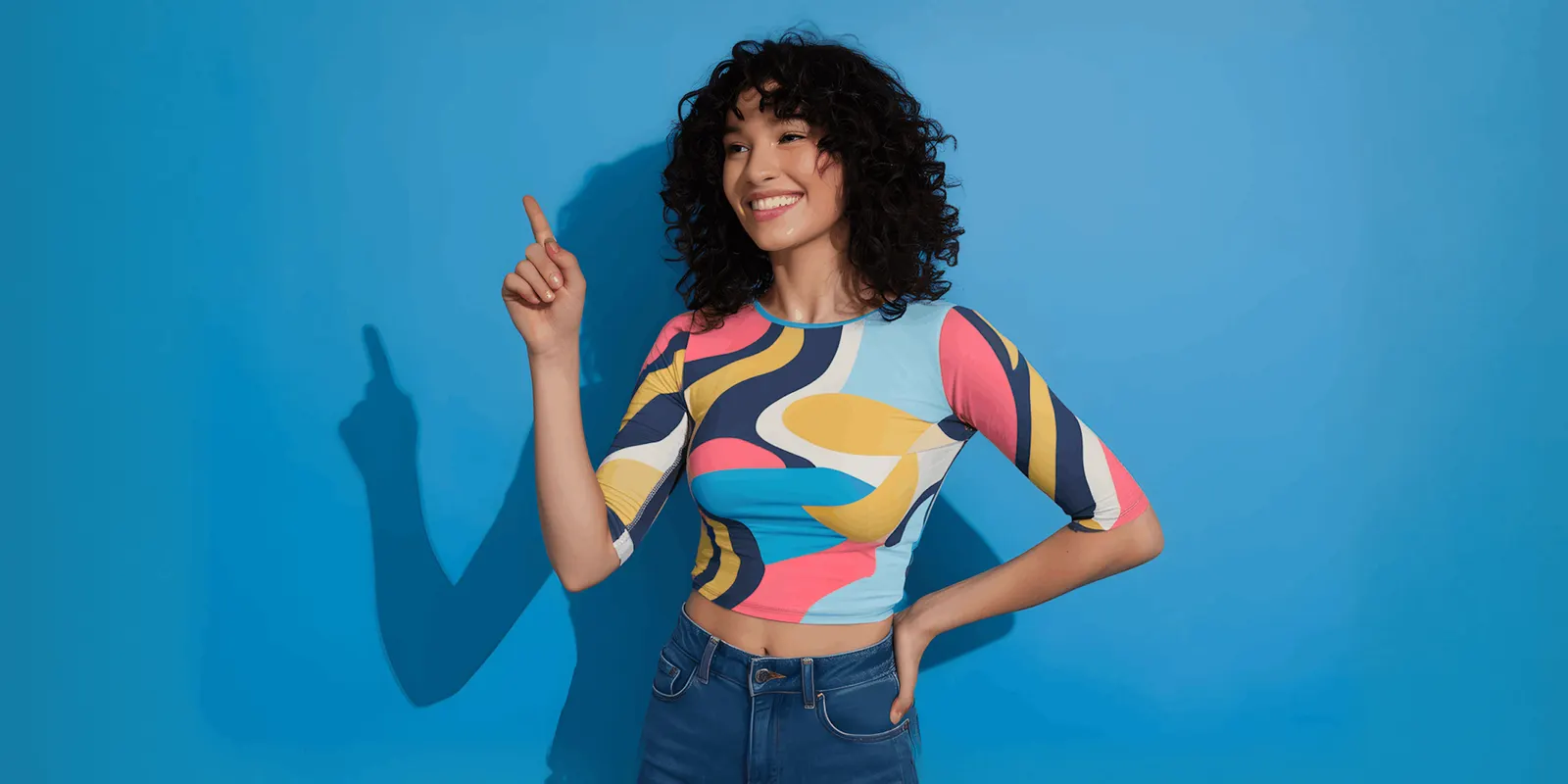
Start from the real product, not a text prompt. A generated product invents details that a buyer who owns the product will notice. A DesignerBox workflow can start from your actual product photo, so the model works from the real item instead of inventing one.
Hold saturation down. The study names intense colour and high warmth as signals of AI generation. Brief for accurate colour and a neutral white balance, and treat a punchier, warmer grade as a risk rather than a finish.
Keep faces medium to large where the format allows. Faces at that size read as human-made, and generative models produce them.
Vary the frame, not the polish. Test angle, scene, crop and message. Do not test how processed the image looks, because the more processed direction is the one carrying the penalty. For the creator-style format specifically, AI UGC ads have their own rules and their own metric.
Review before publish. Check product truth first, then the claim the scene makes, then brand fit, then the channel spec. The order matters because the first two are rejections and the last two are edits.
DesignerBox runs this loop as a workflow. You start from your own product photo. You set the brand rules, the model and the framing once, save that pass as a workflow, and run it again for the next product. The workflow reads the same rules on every run. That matters here, because a grade that signals AI can return with each new prompt. AI results still fail in known ways, such as warped prints, garbled logos and colours pushed too far. Three critic steps score the results, and best-of-N keeps the best one, before your own review.
The static ad templates cover the frames, and a product ad template starts from the same source photo. The ads resizer makes one ad in every size the ad platforms need. Each model has its own credit cost, and you see what a set of variants costs before you run it.
One gate to plan for. The commercial licence starts at the Pro plan, $35 a month billed monthly. The plans sit on the pricing page.
Start from a template, add your brand and your products, and run it. The cost is shown before the run. See the templates.
FAQ
Do AI generated ads actually work?
They work about as well as human-made ads on click-through rate. A quasi-experimental study of 4,633 matched sibling ads, with more than 369 million impressions, found no detectable average click-through-rate disadvantage for AI-generated images. AI ads outperformed human-made ads when the AI images did not look like AI.
Are AI generated ads better than human-made ads?
Not on performance alone. They are close to equal on click-through rate, so the cost of each variant decides the value. The one large measured lift, six to nine percentage points of engagement, came from using generative AI to personalize video to each person’s purchase history.
Can people tell an ad was made with AI?
Not always. In the display ad study, some AI-generated images did not look like AI to viewers, and those ads outperformed human-made ads. Images with high aesthetics scores and medium to large faces read as human-made, even though AI generates both of those.
What makes an AI generated ad look like AI?
In the display ad study, intense colour, high warmth and visible text in the image signal AI generation to viewers. Images with high aesthetics scores and medium to large faces read as human-made. Brief for accurate colour rather than a punchier grade.
How much lift does Meta claim for its AI ad creative?
Meta states a 2-3% conversion lift for background generation on Advantage+ catalog ads and a 2% lift for video expansion on Facebook Reels (facebook.com/business, accessed September 2026). Its largest listed figure is +13%, for related media, which Meta lists as a separate feature.
Do AI generated ads need to be disclosed?
Disclosure rules vary by platform and are moving. In July 2026, Google added an AI label setting across its advertising products (support.google.com, as of September 2026). TikTok asks advertisers to label ads with AI-generated or heavily AI-edited media, and it rejects or restricts ads with undisclosed AI content (ads.tiktok.com, as of September 2026). Check the current policy for each placement before launch. This is general information, not legal advice. We cover the rules and the four tool types in what is an AI ad generator.
Does AI generated content hurt brand trust?
It can when it is visible. Gallup found 49% of 3,270 US adults surveyed view businesses using AI to make ads negatively, against 19% positively (news.gallup.com, August 2026). That is consistent with the ad performance research, where the gain went to AI images that did not look like AI.
Sources
- Exner, Y., Hartmann, J., Ding, Z., Zhang, S. and Netzer, O., “AI in Disguise: Quasi-Experimental Analysis of a Large-Scale Deployment of AI-Generated Ads,” Columbia Business School Research Paper, SSRN 5096969, date written 14 January 2025, last revised 12 August 2026. papers.ssrn.com, accessed September 2026
- Taboola, press release on the study with Columbia University, Harvard University, Technical University of Munich and Carnegie Mellon University, raw click-through rates (taboola.com, 28 January 2026)
- NYU Stern, “The AI Advertising Paradox,” research highlight on “The Impact of Visual Generative AI on Advertising Effectiveness” by Ghose, Lee, Todri and Adamopoulos, 6 November 2025. stern.nyu.edu, accessed September 2026
- Google Ads policy, AI labels in ad creatives. support.google.com, accessed September 2026
- TikTok ads policy, misleading and false content. ads.tiktok.com, accessed September 2026
- Kapoor, A. and Kumar, M., “Frontiers: Generative AI and Personalized Video Advertisements,” Marketing Science, July 2025, vol. 44 issue 4, pages 733-747. pubsonline.informs.org, accessed September 2026
- MIT Initiative on the Digital Economy, “AI-Generated Video Ads Are Getting Personal. Are Consumers Buying It?” ide.mit.edu, accessed September 2026.
- Gallup, “Americans Aren’t Sold on Businesses Using AI in Advertising,” 2026 Bentley University-Gallup Business in Society survey of 3,270 US adults, fielded 4 to 11 May 2026. news.gallup.com, published 19 August 2026.
- Google, “Gemini models are coming to Performance Max.” blog.google, February 2024.
- Meta, Q2 2026 prepared remarks. s21.q4cdn.com, July 2026.
- Meta, “Meta Advantage+ creative,” facebook.com/business, accessed September 2026.
- DesignerBox pricing page (designerbox.ai/pricing), September 2026.
Advertising performance figures verified from the SSRN working paper (revised 12 August 2026), Marketing Science and Meta’s own advertiser documentation as of September 2026. Individual results vary.