
An ad spy tool is a searchable database of ads other brands are running, collected from Facebook, Instagram, TikTok, YouTube, Google and Pinterest. Four platform libraries do the same job for free, one network each. Paid databases add cross-platform search, deeper filters, saved collections and API access. No platform publishes a spend figure for an ordinary commercial ad.
Six vendor plan pages, checked in September 2026, show what the paid tiers add. Adbeat’s higher Pro tier buys 12 months of history instead of 90 days, and unlimited results per search instead of 1,000 (adbeat.com/pricing, September 2026). That is what the money buys: archive depth and result caps. No tier buys a performance number, because no platform publishes one.
This guide covers the four free libraries first, then the paid databases and what their tiers add, then the two questions the roundups skip. What the Meta Ad Library actually discloses. And what you are allowed to do with a competitor’s ad once you have found it. Written for agency creative leads, paid social leads and in-house marketing teams who research before they brief.
Key Takeaways
-
Four platform libraries are free and official. Meta, TikTok, Google and LinkedIn each publish a searchable archive of ads running on their own network, with no subscription and, on TikTok, no login.
-
Paid databases sell history, result caps and seats. Minea, Foreplay, PiPiAds, AdSpy, BigSpy and Adbeat each list their plans on their own sites (vendor pages, September 2026). Check the archive window before the price.
-
Meta discloses no spend or reach for ordinary commercial ads. Those figures appear only on ads about social issues, elections or politics (transparency.meta.com, September 2026).
-
Run length is an inference, not a measurement. A start date plus an active flag tells you someone kept paying. It does not tell you the objective, the budget, or the result.
-
TikTok is the one platform that publishes a performance band. Top Ads Spotlight labels creatives with a CTR percentile band and a budget band rather than an absolute figure (ads.tiktok.com, September 2026).
-
Clone the structure, never the asset. Hook shape, proof placement and pacing are ideas. The footage, the voiceover and the written copy are protected by copyright once they are fixed. Logos and slogans can be protected as trademarks.
-
The tool ends at a brief. Producing the variants is the part that costs money. In DesignerBox the cost is shown before the run, and Basic carries 500 credits a month at $15 a month billed monthly.
What is an ad spy tool?
An ad spy tool is a paid database of advertising creative collected across networks, searchable by keyword, advertiser, format, country, date and engagement. It exists because each platform publishes only its own ads, in its own interface, with its own filters. The paid layer merges those sources into one search box and keeps ads that the platform itself has already dropped.
That last point is the real product. Meta removes an ordinary commercial ad from its library the moment it stops running, unless the ad delivered an impression in the EU, its associated territories or the United Kingdom. The paid tools price that retention directly. Adbeat’s tiers differ mainly by whether a search returns 90 days of data or 12 months (adbeat.com/pricing, September 2026).
Ecommerce, dropshipping and affiliate marketing are the audiences these vendors name on their own pages, which is why product-level filters sit next to the ad filters. Minea sells a products listing and a shops listing alongside its Meta ads listing (minea.com/pricing, September 2026). If you sell services or software, check that the filters map to how you actually search before you buy a year.
Which free ad libraries should you check first?
Start with the platform’s own library. All four are free, all four are published by the platform whose ads they hold, and each one discloses something the others do not. Meta covers Facebook and Instagram in one search. TikTok is the only one publishing a relative performance band. Google spans Search and YouTube. LinkedIn adds impressions and targeting on ads aimed at the EU.
| Library | Covers | What it discloses | Cost |
|---|---|---|---|
| Meta Ad Library | Facebook, Instagram, plus branded content with a paid partnership label | Ad creative, copy, start date, advertiser. Spend and reach only on social issue, election and political ads | Free, Facebook login needed to download results |
| TikTok Creative Center | TikTok | Top Ads filtered by region, industry and objective, with a likes count, a CTR percentile band and a budget band | Free, no login |
| Google Ads Transparency Center | Google Search, YouTube and other Google surfaces | Advertiser name, location, the entity paying, and ads served over a period. Filter by region and date | Free |
| LinkedIn Ad Library | Ads run since 1 June 2023, held one year past last impression. EU-targeted ads add impressions, targeting and run dates | Free |
Meta’s transparency tools reach more than 200 countries and territories, and the library holds all active ads plus all active public branded content carrying a paid partnership label (facebook.com, September 2026). Downloading a search requires a logged-in Facebook account and agreement to the Terms of Service.
TikTok’s Creative Center is a free public home for ad examples, trends and tools, and no login is required (ads.tiktok.com, September 2026). Top Ads inside it is a collection of top-performing creatives filterable by region, industry and campaign objective (ads.tiktok.com, September 2026).
Google shows advertiser information including the advertiser name, location, the entity that pays for the ads, and the ads served over a certain time period, for every advertiser running on Google platforms including Search and YouTube (support.google.com, September 2026). You can search by advertiser or website name and filter by serving region and date, and verified advertisers carry a badge (support.google.com, September 2026).
LinkedIn’s library includes ads run after 1 June 2023, keeps them one year past their last impression, and typically shows a new ad shortly after its first impression (linkedin.com, September 2026). Ads targeted to the European Union carry extra detail: impressions, targeting and the dates the ad ran.
Paid ad research tools and what their tiers add
Six vendors publish their plans on their own pages. The tiers buy history depth, result caps, seat count and API access rather than a different view of the same ad. Read the archive window first. A 90-day window answers “what is running now” and cannot answer “what did they run last Black Friday”.
| Tool | What the plans cover | What separates the tiers |
|---|---|---|
| BigSpy | Four plans listed: Free, Starter, Growth and Ultimate, plus annual and group plans | Platforms covered, daily downloads and analysis features. A free tier to start with |
| Minea | Starter, Premium and Business. Meta ads, products and shops listings plus a brand tracker on all three | Monthly quotas on the AI features below Business |
| Foreplay | Basic, Workflow, Agency and Enterprise, with the same core features on every tier | Seats, and how many brands Spyder and Lens track. A 7-day trial |
| PiPiAds | Basic, Advanced, Enterprise and a custom Flexible plan, all listing the same features and data, plus a free trial | Credits, users and ad tracker slots |
| AdSpy | A single plan | No tiers to compare |
| Adbeat | Basic free, Pro Standard, Pro Advanced and Enterprise | History and result caps. Enterprise adds 36 months of data. No free trial on Pro plans |
All plan details read from each vendor’s own site in September 2026: adspy.com, bigspy.com/en, minea.com/pricing, foreplay.co/pricing, adbeat.com/pricing and pipiads.com. Each vendor lists its current prices on the same pages.

The feature that separates the tiers is usually metered. Minea’s AI ad analysis, AI transcript and Magic search carry a monthly quota on Starter and Premium and go unlimited on Business (minea.com/pricing, September 2026). Adbeat Standard caps a search at 1,000 results and 90 days of data; Advanced removes the result cap, opens 12 months, and adds country filters and competitor alerts (adbeat.com/pricing, September 2026). Foreplay lists the same core features on every tier: Swipe File, Discovery, Briefs, Spyder, Lens, API access and MCP appear across Basic, Workflow and Agency. Its tiers differ by seats and by how many brands Spyder and Lens track (foreplay.co/pricing, September 2026).
Other tools sit in this category, including AdSpyder, PowerAdSpy, AdPlexity and Anstrex. Their plans could not be checked on a first-party page this session, so they are not in the table. Check the vendor’s own page rather than a comparison blog, because third-party roundups in this category disagree with each other on basic figures.
What to compare before you buy
Platform coverage is the first filter. Confirm on the vendor’s own page which of Facebook, Instagram, TikTok, YouTube, Google and Pinterest a tool indexes today, and whether your placements are in there at all.
After that, five things decide whether the subscription earns its line item. Search and filter depth, because a database you cannot narrow is a scroll. Archive window, because history is the only thing the free libraries do not give you. Landing page capture, since the page behind the ad carries the offer and the funnel. Engagement data such as likes, comments and shares, plus any spend estimate, remembering that an estimate is a model and not a disclosure. And API access, if the ads have to land in your own reporting rather than a browser tab.
What does the Meta Ad Library actually show you?
For a standard active ad, the Meta Ad Library shows the creative and the copy. Clicking through to ad details adds items such as About section information or lead-form detail on a lead generation ad. It does not show spend, reach, click-through rate or any performance figure for an ordinary commercial ad. Those numbers exist only for one narrow category, and every third-party tool inherits the same limit.
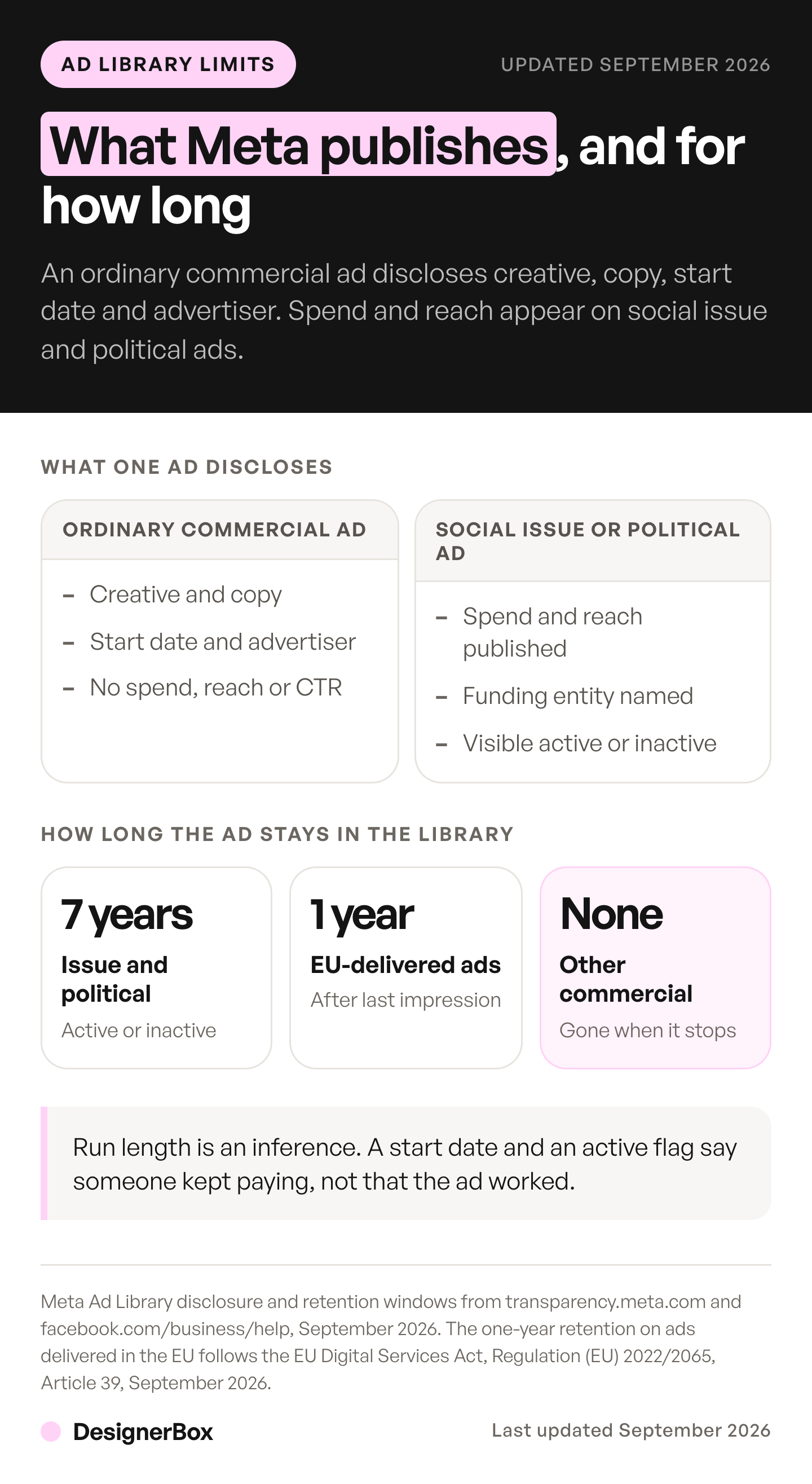
Meta states that ads currently running on its technologies show the ad content, basic information such as when the ad started running, and which advertiser is running it (transparency.meta.com, September 2026). That start date plus an active flag is the entire performance signal available.
Spend, reach and funding entities are published only for ads about social issues, elections or politics. Those are visible whether active or inactive and sit in the library for seven years (transparency.meta.com, September 2026). A shoe ad gets none of that treatment.
Retention splits the same way. An ad that delivered an impression in the EU or associated territories stays in the library while it runs and is archived for one year after its last impression (transparency.meta.com, September 2026). Meta applies the same one-year archive to ads that delivered an impression in the United Kingdom, as a transparency commitment (facebook.com, September 2026). Outside those cases, a commercial ad disappears from the library when it stops running. The EU archive has a regulatory reason: the EU Digital Services Act requires very large online platforms to keep a searchable ad repository covering the whole period an ad ran and one year past its last presentation (eur-lex.europa.eu, September 2026).
Article 39(2) sets the minimum contents of that repository: the ad content with the product, service or brand name, who the ad is presented on behalf of, who paid for it if different, the period it ran, whether it targeted particular groups and the main parameters used, and the total number of recipients reached (eur-lex.europa.eu, September 2026). This is why an ad targeted into Europe carries more disclosure than the same ad targeted at Ohio.
The API follows the same boundary. Meta’s Ad Library API enables deeper analysis of social issue, electoral and political ads and of ads delivering to the EU and associated territories (facebook.com, September 2026). There is no public API for ordinary commercial ads outside those categories.
How do I know if a competitor’s ad is working?
You do not know. You infer. The only public signal on a commercial ad is how long it has been running, and a long run means someone with a budget chose not to switch it off. It does not disclose the objective, the spend, the audience, the offer economics, or whether anyone is watching the account at all. Treat run length as a hypothesis to test, never as a result to copy.
Read what the signal is made of. A start date and an active flag are two facts about a budget decision made by a person you cannot see. A long-running ad can be an evergreen brand placement, an unattended account, or the winner of a test nobody outside the company saw. Nothing public separates the three.
TikTok is the exception worth knowing about. Top Ads Spotlight labels each creative with a likes count, a CTR percentile band such as top 20 percent, a budget band of high or medium, and a short written analysis of why the creative works (ads.tiktok.com, September 2026). That is a relative band, not an absolute CTR or spend figure, and it is still more than Meta discloses on any commercial ad.
The practical consequence for a research session is a ranking rule. An ad carrying a TikTok performance band outranks an ad that has merely been running a long time. An ad running for 90 days outranks one running for 9. Neither outranks a test in your own account with your own audience, which is where creative testing on your own traffic starts and the research stops.
Is it legal to use an ad spy tool?
Looking at ads in a platform’s own public library is what the library is for. The public libraries exist to be read. Two things do carry risk: how the data gets collected, and what you do with the creative afterwards. Automated collection is governed by each platform’s terms, and reuse of the creative itself is governed by copyright and trademark law rather than by any platform policy. This is general information, not legal advice.
On collection, cite the platform’s terms rather than an opinion about a vendor. Meta’s Terms of Service state that, except as provided in the Platform Terms, you may not sell, license or purchase any data obtained from Meta or its services, and you may not circumvent, bypass or override technological measures Meta uses to control or limit access to its Products or data (facebook.com, September 2026).
Meta’s Research Tools Terms, updated 8 December 2025, go further for the products they cover: no crawling or scraping any Research Tool, no text and data mining, and no using a Research Tool or Meta Data to build a competing product or for benchmarking (transparency.meta.com, September 2026). Read the scope carefully, because it matters. Those terms govern the Meta Content Library, its API and the Ads Transparency and Targeting Dataset, not the public Ad Library web page.
Reuse is the half that reaches your own work. US copyright protection attaches automatically the moment an original work of authorship is fixed in a tangible medium, and pictorial and graphic works are one of the protected categories, with no registration or notice required (copyright.gov, September 2026). A competitor’s ad image, video and voiceover are usually protected from the moment they are fixed.
Marks are a separate statute. Trademark infringement is unauthorized use of a mark on or in connection with goods or services in a way likely to cause confusion, deception or mistake about the source, and courts weigh the similarity of the marks and the relatedness of the goods (uspto.gov, September 2026). A close competitor is by definition selling related goods, which is the fact pattern that makes a borrowed logo or slogan expensive.
What should you do after you find a winning ad?
Write the structure down and throw the asset away. What transfers is the shape: the hook form, where the proof lands in the timeline, the pacing, the objection the ad answers, the format and placement mix. What does not transfer is any fixed material, which means the footage, the still, the voiceover, the written copy and every mark. Build your own version from your own product, then test it against your current control. When the ad you liked is a creator video, that means your own creator, filmed with a signed release, or a generated presenter, and the four routes to a UGC ad compare each one.
| Structure you can reuse | Material that stays theirs |
|---|---|
| The hook form: question, demonstration, price first, problem first | The recorded footage and the still image |
| Where the proof lands in the timeline | The voiceover track and the music bed |
| Pacing: cut count, and how long the demo holds | The written headline and body copy verbatim |
| The objection the ad answers | The brand name, logo, slogan and any registered mark |
| The format and placement mix | The creator’s face, likeness and performance |
Turn the left column into a brief, not a mood board. Three lines is enough: the hook form, the proof shot and when it lands, and the single claim. A brief in that shape produces variants you can compare, which is the whole reason for doing the research. Teams that skip this step end up shipping generic-looking ad creative that reads as a copy of a copy.

Speed is the part where competitor research pays for itself, because the window on a format closes. A saved workflow fits this: the structure is fresh, your product is the input, and the result has to be in the account this week rather than next quarter. Then the same brief becomes a repeatable job, and producing ad variants at scale is a scheduling problem rather than a design one.
One more constraint worth stating plainly. Do not build a swipe file that is a folder of other people’s finished ads with no notes. A file like that gets copied under deadline pressure. Store the structure summary next to the screenshot, and the temptation drops.
The cost of producing the variants
Every ad research tool ends at the same place: a brief you now have to produce. That step is where the budget goes. DesignerBox is AI creative production for agencies and brand teams. The image cost depends on the model you pick, and the cost is shown before the run. Basic carries 500 credits a month at $15 a month, billed monthly. Video cost depends on the model too.
Plan a realistic test. Three hook forms taken from three different competitor ads, four background treatments each, gives 12 stills built from your own product photo. A hook-by-background matrix like that is also the component set dynamic creative optimization assembles from at serve time. The same 12 assets as video need a model choice for each clip. An 8-second clip costs 40 to 560 credits, depending on the model, and AI video starts on Premium. You pick the model from the model list, and the cost of the run is on screen before you run it.
The format changes what you brief. A competitor’s static ad is quick to answer with stills. A competitor’s video ad can be answered in video, or with a strong static in the same placement, and when a static wins that slot is worth settling before you commit the credits. The static ad templates make the static side from your own product photo. DesignerBox also has 68 tools over MCP, so an AI chat such as Claude can run the same brief. If you are still choosing where that production step happens, the ad generator comparison covers the options.
Where the tools above are better: a searchable archive of ads across networks, with history and filters. DesignerBox can run a competitor ad research step inside a workflow, and its main job is the production step. That step turns the structure into assets built from your actual product. Build it once, with your product, your brand rules and the hook form the research handed you. A saved workflow then runs the same way on the next brief. You set the brand once, and the workflow reads it on every run, which is what makes the research habit worth keeping. Start from a template and see the cost before you run it.
FAQ
What is the best free ad spy tool?
The platform libraries, because each one is published by the network whose ads it holds. Meta Ad Library covers Facebook and Instagram, TikTok Creative Center is the only one publishing a relative performance band, Google Ads Transparency Center spans Search and YouTube, and LinkedIn Ad Library is the route to B2B. BigSpy and Adbeat also publish free tiers alongside their paid plans.
Where do I check what an ad spy tool costs?
On the vendor’s own pricing page. AdSpy lists a single plan on its homepage (adspy.com, September 2026). Minea, Foreplay, Adbeat, BigSpy and PiPiAds list several tiers (vendor pricing pages, September 2026). Compare the archive window, the result cap and the seat count before the price, because those are what the tiers differ on.
How do I spy on my competitor’s Facebook ads?
Open the Meta Ad Library, search the advertiser by Page name, and filter by country and platform. You get the creative, the copy, the start date and the advertiser for every ad currently running. Downloading a search requires a logged-in Facebook account and agreement to the Terms of Service. Spend and reach do not appear on ordinary commercial ads.
Can I see how much a competitor is spending on ads?
Not on Meta, for ordinary commercial ads. Spend, reach and funding entities are disclosed only for ads about social issues, elections or politics, which sit in the library for seven years. Some paid databases publish spend estimates, and an estimate is a model output rather than a platform disclosure. Treat the two as different kinds of number.
Is it legal to copy a competitor’s ad?
Copying the structure is normal practice. Copying the asset is a legal question with two statutes behind it. The image, video, voiceover and written copy are protected by copyright automatically from the moment they are fixed. The brand name, logo and slogan are marks, and unauthorized use in a way likely to confuse consumers about source is infringement.
Do I need a paid tool if I already use the Meta Ad Library?
Only for two things the free library does not do. History, because Meta drops an ordinary commercial ad the moment it stops running unless the ad delivered in the EU or the United Kingdom. And cross-platform search in one place. If your research is current Meta ads in one country, the free library answers it, and a subscription buys history and cross-platform search you would not use.
Sources
- Meta: About the Ad Library, accessed September 2026 (library contents, what a standard ad discloses, API scope, download requirement, the United Kingdom archive)
- Meta transparency: ad library research tools, accessed September 2026 (spend and reach limited to social issue, election and political ads; retention windows)
- Meta transparency: European Parliament report, accessed September 2026 (what running ads disclose)
- Meta: Terms of Service, accessed September 2026 (data sale and circumvention clauses)
- Meta: Research Tools Terms and Conditions, accessed September 2026 (scraping and benchmarking limits, scope)
- TikTok: Creative Center help article, accessed September 2026 (free, no login)
- TikTok: Top Ads, accessed September 2026 (filters)
- TikTok: Top Ads Spotlight, accessed September 2026 (CTR percentile band, budget band)
- Google Ads Help: advertiser identity and transparency, accessed September 2026
- Google: Ads Transparency Center, accessed September 2026 (search and filter behaviour)
- LinkedIn Help: Ad Library, accessed September 2026 (coverage since 1 June 2023, retention, EU disclosure)
- EU Digital Services Act, Regulation (EU) 2022/2065, Article 39, accessed September 2026 (ad repository requirement and minimum contents)
- US Copyright Office, Circular 1, accessed September 2026 (automatic protection, pictorial and graphic works)
- USPTO: About trademark infringement, accessed September 2026
- adspy.com, bigspy.com/en, minea.com/pricing, foreplay.co/pricing, adbeat.com/pricing, pipiads.com, all read 15 September 2026 (stated plan names, contents and features)
- DesignerBox plans and credits: DesignerBox pricing page (designerbox.ai/pricing), September 2026
Ad library disclosures, platform terms and vendor plan details verified from Meta, TikTok, Google, LinkedIn, EUR-Lex, the US Copyright Office, the USPTO and six vendor pricing pages as of September 2026. Individual results vary.