
The best AI ad generator for most advertisers is the one already in their ad account. Meta Advantage+ creative, Google Asset Studio, and TikTok Symphony generate ad images, video, and text inside the platforms you already buy media on. Paid tools earn their place on three jobs those cannot do: render your real product, reuse one asset across every channel, and choose the model.
Every roundup of this category ranks ten or twelve paid tools and skips that. It is an awkward fact to publish when you sell one of the tools, because for a large share of readers the honest recommendation costs nothing and requires no new login.
So start there. This guide covers what the platform-native generators produce, the limits their own documentation states, the three jobs that justify paying for something else, and why the price column in every comparison table you have read is less solid than it looks.
Key Takeaways
- Three ad platforms ship AI creative generation to advertisers already. Meta Advantage+ creative, Google Asset Studio, and TikTok Symphony. TikTok is the only one whose own documentation calls it “free” (ads.tiktok.com, July 2026).
- They each work in one platform only. An asset generated in Google Ads does not appear in your Meta account, your TikTok account, or on your product page. Cross-channel reuse is the thing they structurally do not do.
- They generate from your ad creative, not your product. Meta’s image generation uses “your provided image or video ad” as a reference to inspire variations (facebook.com, July 2026). A variation on a reference is not the same as your actual product rendered accurately.
- Pay when you need one of three things: your real product in every shot, one asset that travels across all channels on brand, or control over which model renders it.
- The price column is the weakest part of every comparison. Of five paid tools checked in July 2026, only one published a plain month-to-month price without a promotion or an annual-billing rate in the headline slot.
- Video is the expensive operation everywhere. In DesignerBox a static image is 5 credits and an 8 second Veo 3 clip with audio is 6,400.
- Compliance is now a selection criterion. TikTok auto-labels Symphony output, and Google embeds SynthID and C2PA into everything its ad tools generate.
The AI ad generator already in your ad account
All three major ad platforms build creative generation into the buying tools. None of them require a separate subscription to start.
Meta Advantage+ creative
Meta’s Advantage+ creative generates diverse versions of an ad you already have. Its documentation is specific about the mechanic: “Image generation is a generative AI feature in Advantage+ creative that is designed to help you create diverse versions of your original ad creative. Your provided image or video ad is used as a reference to inspire your generated images” (facebook.com, July 2026).
It also does background generation, text variations, image expansion to fit more placements, and text overlay (developers.facebook.com, July 2026).
The documented constraints matter more than the feature list. Background generation “currently only works with dynamic product ads or Advantage+ catalog ads on Mobile Feed.” Image generation “is not available on Advantage+ app campaigns, Advantage+ sales campaigns or Advantage+ catalog campaigns at this time” (developers.facebook.com and facebook.com, July 2026). Meta does not publish a separate fee for these tools; they sit inside Ads Manager.
Google Asset Studio
Asset Studio is Google’s creative hub inside Google Ads, described as “your centralized destination in Google Ads for creating, editing, managing, and sharing your assets, all in one place” (support.google.com, July 2026). It generates images, offers a video builder with trimming and voiceover, and does text asset development.
Two documented details are worth planning around. Generated assets “automatically remain in your Asset library for 14 days” unless used. And Google blocks generation of “branded items and logos not provided as input” (support.google.com, July 2026), which is a direct constraint if your ad concept is your logo on something.
Google also states plainly that “assets created by generative AI aren’t guaranteed to be approved by Ads Policy” (support.google.com, July 2026). Generation and approval are separate steps.
TikTok Symphony
Symphony Video Studio is the clearest case. TikTok’s own help documentation calls it “this free creation tool” (ads.tiktok.com, July 2026). It produces TikTok-ready video clips, static images from text prompts, and avatar videos.
The compliance behaviour is the standout feature. “All content generated by Symphony Video Studio that meets the requirements for disclosing the use of AI from ad policy is automatically labeled as ‘AI-generated’ in the video output” (ads.tiktok.com, July 2026).
That matters because TikTok’s ad policy states: “If we identify AI-generated content that has not been disclosed, your ad will be rejected or restricted” (ads.tiktok.com, July 2026). Symphony handles its own disclosure. A file you bring from elsewhere is your responsibility to label. For the full picture on what each platform requires, see what an AI ad generator is and the rules that govern the output.
Where the platform generators stop
Three limits are structural, not gaps waiting to be patched.
They are single-channel by design. Each generator lives inside one ad account and produces assets for that platform’s placements. Running the same campaign across Meta, Google, TikTok, and your product detail page means generating it separately in three tools and building the fourth somewhere else. Nothing carries across, and neither does brand consistency.
They start from your ad, not your product. Meta’s own wording is that your existing creative inspires the generated versions. That works when you already have the hero shot. It does not solve the problem of not having the hero shot, and a generated variation of a product is not a faithful render of that product. If a customer receives something that does not match the ad, the variation was the problem.
You do not choose the model. The platform picks. When a shot needs a specific model for text rendering, or fabric texture, or native audio, there is no selector.
None of that makes them the wrong choice. For an advertiser who buys media on one platform and already has good product photography, they are very likely the right choice, and the price is hard to argue with.
The three jobs that justify paying

Pay for a tool when at least one of these is true. If none are, the free option is genuinely the answer.
You need your actual product, accurately, in shots you do not have. This is the difference between a lookalike and your SKU. A tool that builds every asset from your real product photo is solving a different problem from one that generates variations of an ad you already made.
You need one asset set across every channel, on brand. Paid social, a PDP, an email header, and a marketplace listing all pull from the same campaign. When that lives in one workspace with one library, the brand holds. When it lives in three ad accounts, it drifts, and the drift is invisible until someone lines the channels up side by side.
You need to choose the model. Different shots want different models. Text on packaging, fabric drape, and video with native audio are not the same rendering problem. DesignerBox includes 13 image and video models across six providers and lets you pick per shot, or picks for you. That is the argument for a catalog over a house model: swap models per shot, keep one bill.
The reusable version of this: the real cost is not the subscriptions, it is the seams. Every handoff between tools is where the brand slips and the hours go.
What the paid tools cost, and why that is hard to answer
Here is the uncomfortable part of writing this guide. Five paid tools were checked against their own pricing pages in July 2026. One published a plain month-to-month price in the headline slot without a promotion attached.
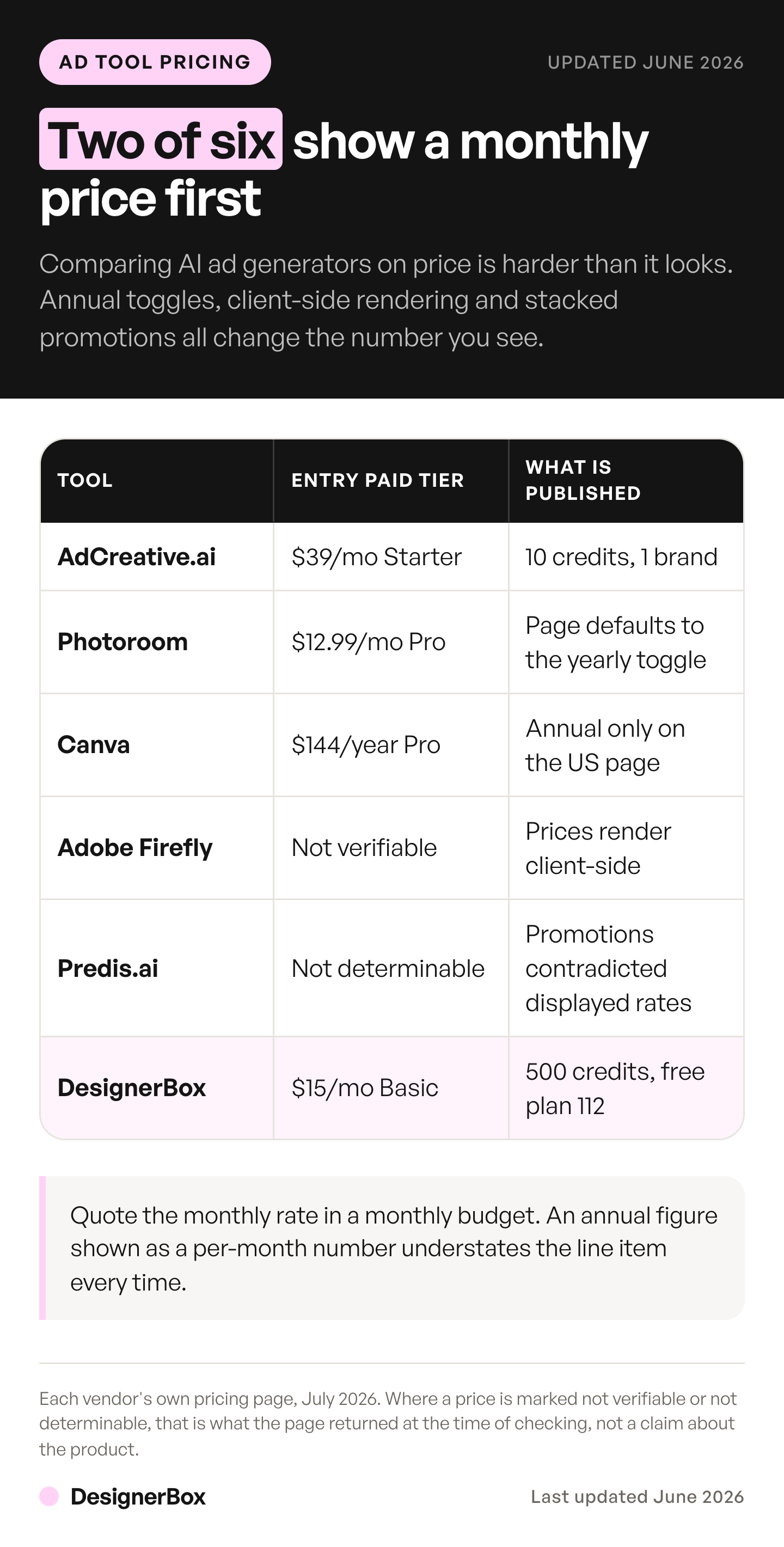
| Tool | Entry paid tier | What is published |
|---|---|---|
| AdCreative.ai | $39/mo Starter | 10 credits/mo, 1 brand. Yearly and quarterly rates were running a promotion. |
| Photoroom | $12.99/mo Pro | Page defaults to the yearly toggle, which renders Pro as $7.50/mo ($89.99/yr). Switch to Monthly for $12.99. |
| Canva | $144/year Pro | Annual only on the US page. AI use is a pooled allowance, not credits. |
| Adobe Firefly | Price not verifiable | Credits published (Standard 2,000/mo). USD prices render client-side. |
| Predis.ai | Not determinable | Stacked promotions contradicted the displayed rates. |
| DesignerBox | $15/mo Basic | 500 credits/mo. Free plan is 112 credits. |
Sources: adcreative.ai, photoroom.com, canva.com, helpx.adobe.com, predis.ai, accessed July 2026. Blank or hedged cells are facts that could not be verified from an official source, not zeroes.
That table is not an accusation. Promotional and annual-first pricing is normal in this category, and every one of those numbers was accurate on the day it was read. The point is narrower and it is aimed at you: when a comparison article hands you a tidy price column, check what billing period it is quoting and whether a promotion was running. A number copied from a listicle into your budget is often the annual-billing rate, which understates the real monthly cost by a third or more.
For the arithmetic behind these plans, AI ad generator pricing works out the real cost per finished ad, the Creatify alternatives comparison covers why credits at one tool have no relationship to credits at another, and what AI video generation costs covers the per-second math.
AdCreative.ai is the clearest example of the billing trap on this list, because it prices a credit as a download rather than a generation and runs a four-step credit slider inside each tier. The AdCreative.ai alternatives comparison shows why that produces seven different true monthly prices on one page.
Where DesignerBox fits,
DesignerBox is the AI creative studio for on-brand campaigns. One product photo becomes the campaign: product shots, video ads, on-model imagery, social creative, every top model on one bill, one searchable library. The Product Ad Generator and the Social Media Ad Studio are the two apps aimed squarely at this job, and Ad Studio is the workspace around them.
Basic is $15/month for 500 credits. A static image is 5 credits, so Basic is 100 images a month. Free is 112 credits, no credit card.
The limits, stated plainly:
- AI video needs Premium at $75/month. It is not on Basic or Pro. If video ads are the job, that is your real entry price.
- Video burns credits fast. An 8 second Veo 3 clip with audio is 6,400 credits, which exceeds Premium’s entire 2,500/month allocation. Budget video separately or price it against tools built narrowly for high-volume video.
- The commercial license starts at Pro ($35/month). Free and Basic do not carry it.
- Team collaboration, shared brand kits, white label, and API access are Ultra ($200/month). Below that it is a single seat.
If your only job is high-volume talking-actor video, price that job against the tools built for it. If your job is one product photo becoming a campaign that holds together across every channel, that is what this is for. Full plan detail is on pricing.
How to choose an AI ad generator

Work down this list and stop at the first yes.
- Do you buy media on one platform and already have good product photography? Use that platform’s generator. Meta Advantage+, Asset Studio, or Symphony. It is free or close to it, and it is built into the workflow you already run.
- Do you need the same campaign across several channels, on brand? A single-channel generator cannot do this. You need one workspace and one library. This is the seasonal case too, where one push has to hit every placement at once, covered in AI tools for a Black Friday and holiday campaign.
- Do you need your real product rendered, not a variation of an existing ad? You need a tool that starts from your product photo.
- Is high-volume talking-actor video the whole job? Price the video specialists directly against your monthly clip count.
- Do you need a specific model per shot? You need a catalog, not a house model.
Then check the disclosure requirement for the platform you are running on before the creative is finished, not after. Google’s AI label setting rolled out across Google Ads, Display & Video 360, Campaign Manager 360, Merchant Center, and Ads Editor through July (support.google.com, July 2026). Meta applies labels automatically based on detection. TikTok makes you declare, and rejects undisclosed AI content.
One number worth carrying into that decision: IAB found 82% of ad executives believe Gen Z and Millennials feel positively about AI-generated ads, while only 45% of those consumers do, a 37-point gap that widened from 32 points in 2024. In the same study, 73% of those consumers said clear disclosure would increase or not impact their purchase likelihood (iab.com, January 2026). Disclosure is not the conversion tax it is assumed to be.
The free AI ad generator lets you test output before picking one, and best AI video tools for advertising covers the video end of the same decision. Shhots AI alternatives covers one more tool in this bracket, and what the Canva alternatives cost covers the design tool most of these teams are already paying for.
FAQ
What is the best AI ad generator?
For most advertisers it is the generator already inside their ad account. Meta Advantage+ creative, Google Asset Studio, and TikTok Symphony all produce ad creative with no separate subscription. A paid tool is worth it when you need your real product rendered accurately, one asset set that travels across every channel on brand, or control over which model does the rendering.
Is there a free AI ad generator?
Yes. TikTok Symphony Video Studio is described as “this free creation tool” in TikTok’s own documentation (ads.tiktok.com, July 2026). Meta and Google do not publish a separate fee for Advantage+ creative or Asset Studio; both sit inside the ad platforms. DesignerBox has a free plan with 112 credits and no credit card, which is about 22 static images at 5 credits each.
Can AI ad generators use my actual product?
It depends on the tool. Meta’s Advantage+ uses your existing ad creative as a reference to inspire variations, which is not the same as rendering your product faithfully. Tools built around a product photo upload start from your real SKU. If catalogue accuracy matters, that distinction is the one to test first with your own product.
Do I have to disclose AI-generated ads?
On TikTok, yes, and an undisclosed AI ad “will be rejected or restricted” per its ad policy (ads.tiktok.com, July 2026). Google added an AI label setting across five advertising products through July 2026, and notes that regulations in the EU, India, and New York require disclosure for certain AI-generated assets. Meta applies labels automatically to ads it detects as AI-created or significantly edited.
How much does an AI ad generator cost?
Entry paid plans checked in July 2026 ranged from $15/month (DesignerBox Basic, 500 credits) to $39/month (AdCreative.ai Starter, 10 credits). Compare those with care: several vendors display an annual-billing rate as the headline monthly price, and promotions were running on others. Check the billing toggle before you budget.
Which AI ad generator is best for video ads?
Video is the most expensive operation on every platform, so price it per clip rather than per month. TikTok Symphony generates video free for TikTok placements. Among paid tools, the video specialists are worth pricing directly against your monthly clip count. In DesignerBox, AI video requires the Premium plan at $75/month, and an 8 second Veo 3 clip with audio costs 6,400 credits.
Can one tool replace my designer?
No, and treating that as the goal produces bad ads. These tools remove the production bottleneck: the resizing, the background swaps, the fifteen placement variants, the reshoot for a new colourway. Someone still decides what the ad says and whether it is on brand. The output is only as good as that judgment.
Sources
- Meta Advantage+ creative image generation, and the wording that your existing image or video ad is the reference: (facebook.com, July 2026)
- Meta background generation, text variations, image expansion, text overlay, and the campaign-type availability constraints: (developers.facebook.com, July 2026)
- Google Asset Studio scope, the 14-day asset retention, the block on branded items and logos not provided as input, the ads-policy approval caveat, and the AI label rollout across five Google advertising products: (support.google.com, July 2026)
- TikTok Symphony Video Studio described as a free creation tool, its automatic AI labelling, and the ad policy on undisclosed AI content: (ads.tiktok.com, July 2026)
- AdCreative.ai Starter tier price and credit allowance: (adcreative.ai, July 2026)
- Photoroom Pro tier price and the billed-yearly framing: (photoroom.com, July 2026)
- Canva Pro annual price and its pooled AI allowance: (canva.com, July 2026)
- Adobe Firefly credit allowances: (helpx.adobe.com, July 2026)
- Predis.ai published rates and running promotions: (predis.ai, July 2026)
- The 37-point gap between ad executive and consumer sentiment on AI-generated ads, and the finding on disclosure and purchase likelihood: (iab.com, January 2026)
- DesignerBox pricing, credit costs, plan allocations and feature gating verified against live product configuration, July 2026
Platform capabilities, disclosure policies, and competitor pricing verified from vendor and platform documentation as of July 2026. Pricing in this category changes frequently and promotions distort headline rates. Verify current pricing on each vendor’s own page before budgeting. Individual results vary.