AI brand consistency breaks at the handoffs, not inside the models. Every time an asset moves between tools, the colour shifts, the type substitutes, and the product detail softens. No single step looks wrong. The drift only surfaces once the campaign is assembled and the assets sit side by side. Keeping the brand kit and the assets in one workspace removes the handoff, which is where the drift happens.
You have seen the version of this that hurts. Eleven assets for a launch, generated across four tools over two weeks, all approved individually. Then someone lays them out in the deck and the hero image is a half-shade warm against the paid social, the packaging shot has invented a seam that does not exist on the real product, and the logo has picked up a background that was never in the brand kit.
Nobody made a mistake. Each asset passed its own review. The drift accumulated in the gaps between the reviews, which is the one place a review does not look.
This covers where brand drift originates, why written guidelines do not catch it, what the data says it costs, and the structural fix. It is for brand teams and agencies running AI in production, not evaluating it.
Key Takeaways
- Drift is a handoff problem, not a model problem. Each export, re-upload, and re-prompt is a lossy translation. The models are fine in isolation. The seams between them are not.
- 81% of companies deal with off-brand content even with guidelines in place, and 50% were producing more content than the year before (Lucidpress State of Brand Consistency, 2019).
- Guidelines do not enforce themselves. 71% of brand professionals say it takes seven or more people to approve a single on-brand asset, and 59% say content ships without finishing that cycle (experienceleague.adobe.com, accessed July 2026).
- AI has already moved into the creative pipeline. 83% of ad executives report deploying AI in creative processes, up from 60% in 2024 (iab.com, January 2026).
- The failure rate is measurable. 70% of marketers reported at least one AI incident including off-brand content, and 40% had to pause or pull ads as a result (iab.com, accessed July 2026).
- Building every asset from the real product photo removes the biggest drift source, because the product stops being re-described in text at each step.
- Shared brand kits and team collaboration are Ultra only at $200 a month. Below that, brand kits are single-seat, and that is the honest constraint.
What is AI brand consistency, and why does it break?
AI brand consistency means every generated asset carries the same colours, type, product detail, and treatment as the rest of your brand. It breaks because generation is not one step. It is a chain of exports, re-uploads, and re-prompts across tools that do not share state. Each link translates your brand into a slightly different description, and translations lose fidelity every time.
Be precise about the mechanism, because “AI is inconsistent” is the wrong diagnosis and it leads to the wrong fix.
A model given the same brand kit, reference, and prompt is broadly repeatable within one session. The instability enters when the brand definition gets rebuilt from scratch in the next tool. Tool A knows your hex value because you loaded it. Tool B gets told “warm coral” by a person typing into a prompt box. Tool C receives a JPEG that already baked in Tool B’s interpretation.
That is three definitions of one colour, and the brand kit was correct at every step. The gap is between the tools, not inside them.
Where does brand drift happen?

Drift accumulates at four predictable points: the export, where colour profile and compression alter the file; the re-prompt, where a person restates the brand in words instead of values; the reference swap, where an already-generated asset becomes the source for the next one; and the library, where nobody can find the approved version so someone regenerates it.
None of those four is a model failure. All four are handoffs. Agencies get each of them once per client, which is why running one workflow per client brand is the version of this problem at multi-brand scale.
The compounding is the part that catches teams. One export at 98% fidelity is invisible. Four chained exports at 98% is roughly 92%, and 92% is where a brand guardian starts squinting without being able to say why. The asset is not wrong. It is off, and “off” survives individual review because review happens per asset, not across the set. Ordering that per-asset review so the costly defects surface first is a separate discipline, set out in the four checks before creative ships.
The reference swap deserves separate attention because it is the most damaging and the least noticed. When an AI-generated image becomes the input for the next generation, every invented detail in it gets promoted to ground truth. A seam the model hallucinated in step two is now a documented feature of your product in step five. That is how a campaign ends up confidently, consistently wrong.
Why don’t brand guidelines fix this?
Guidelines are a reference document, not an enforcement layer. They describe the target and rely on a person to hit it under deadline. The data says that reliance fails at scale: 81% of companies deal with off-brand content despite having guidelines, and the approval process meant to catch it is routinely skipped when the calendar tightens.
There is also a version of this that guidelines never covered in the first place. Most brand books specify colour, type and logo, and say nothing about how a product is always presented: which crop, which angle, which ground. For clothing labels that omission is the main source of drift, which is why the six decisions an apparel brand locks before any shoot start with a written presentation rule.
The approval numbers are the uncomfortable part. 71% of brand professionals report it takes seven or more people to approve a single on-brand asset, and 59% say content is often published without completing that approval cycle (experienceleague.adobe.com, accessed July 2026). A control that seven people must clear and that gets bypassed under pressure is not a control. It is a queue.
Volume is what breaks it. Lucidpress found 50% of organisations producing more content than the prior year, alongside that 81% off-brand figure (prnewswire.com, Lucidpress 2019). Those numbers are from 2019, so treat them as directional. The trend has only steepened: 83% of ad executives now report deploying AI in creative processes, up from 60% in 2024 (iab.com, January 2026).
Volume went up. The manual check did not scale with it. Guidelines describe the standard, and a PDF has never once stopped an export.
What does off-brand AI creative cost?
It costs pulled campaigns and rework, not just aesthetic embarrassment. In an IAB survey of 125 US advertising executives, 70% reported at least one AI incident, including off-brand content, and 40% had to pause or pull ads as a result. More than a third dealt with brand damage or a PR issue, and nearly 30% ran an internal audit afterwards.
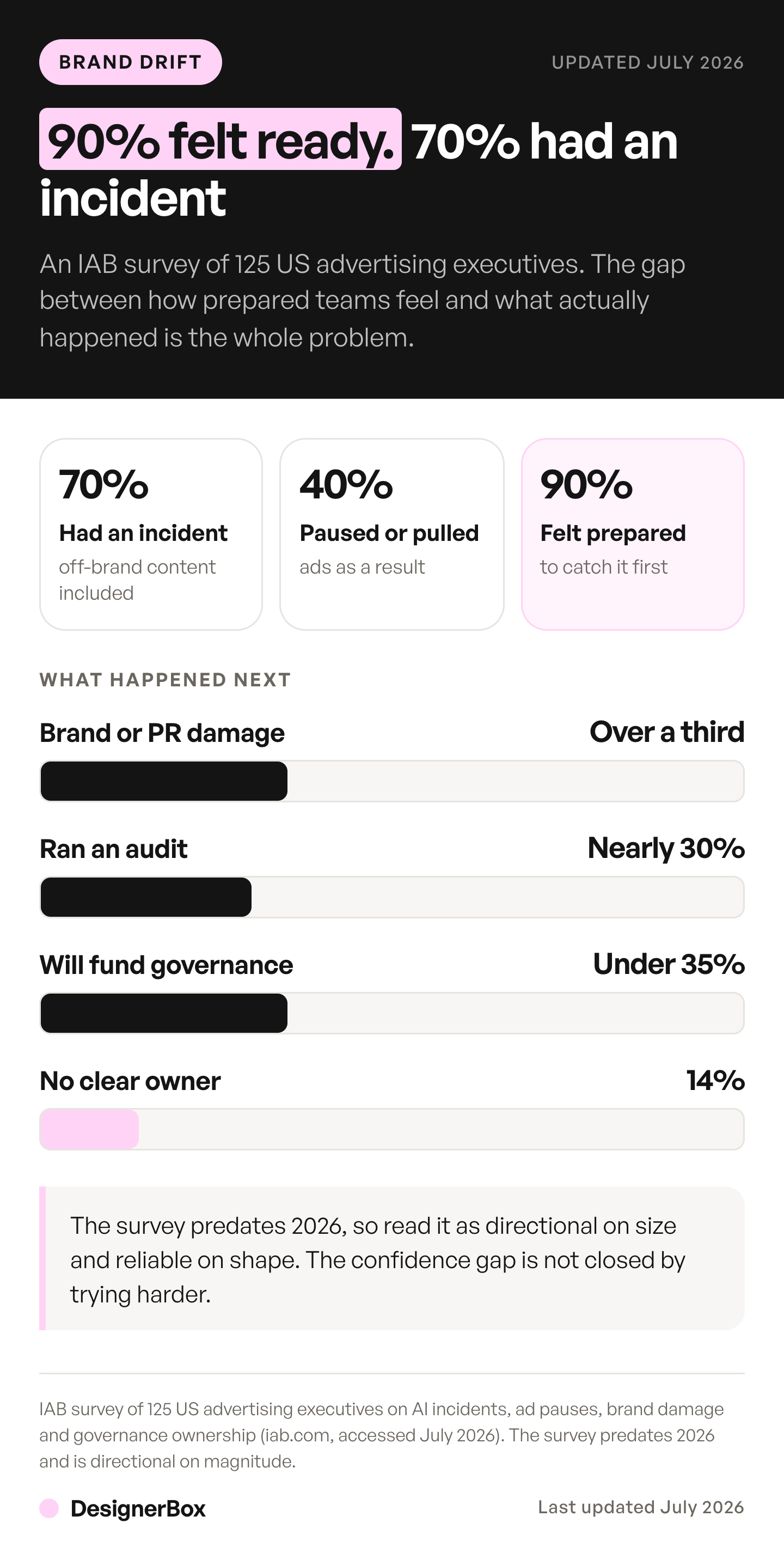
The same research surfaces a confidence gap worth sitting with. Nearly 90% of those executives said they felt prepared to catch AI issues before launch. 70% had already had an incident (iab.com, accessed July 2026). Note that this survey predates 2026, so read it as directional on magnitude and reliable on shape.
Governance investment has not moved to match. Fewer than 35% plan to increase investment in AI governance or brand integrity oversight, and 14% report no clear ownership of it at all (iab.com, accessed July 2026). The gap between “we are confident” and “we had an incident” is not closed by trying harder.
Then there is the cost no incident count captures. Every asset caught late burns the hours meant for the next campaign. It is never billed as a line item, and it is always paid.
How do you keep AI assets on brand?

Remove the handoff. If the brand kit, the models, and the asset library live in one workspace, there is no export, no re-prompt from memory, and no reference swap to a lossy copy. Where a recurring person carries the creative, the same logic applies to the face: build it once as an AI brand character and version the reference set. The brand definition is loaded once and read by every generation. Consistency becomes the default state of the system rather than an outcome somebody has to police per asset.
This is the argument DesignerBox is built on, stated plainly on its own homepage: “The real cost isn’t the subscriptions. It’s the seams.”
Three structural things do the work.
Every asset builds from your actual product photo. This is the biggest drift reducer, and it is not a prompt technique. When the source is a photograph of the real thing, the model edits a fact instead of inventing from a description. Your packaging cannot grow a seam it does not have, because the seam is not in the input. It is also why nothing comes out looking generic AI: the output is your product, not a plausible lookalike.
Workflows rerun. Save the campaign that worked, then rerun it for the next product or drop. The settings, models, and brand references are held by the workflow rather than by whoever ran it last. The visual pipeline builder is where that lives. A rerun cannot drift, because nothing is being restated.
One library, one search. Approved assets are findable, so nobody regenerates a version that already exists. That kills the fourth drift source outright.
Drift hits video hardest, where a recurring character can change face between clips. The same reference-anchor fix applies there too, covered in how to keep characters consistent in AI video.
Model choice stays yours throughout. Thirteen models sit behind one subscription, seven image and six video, including Nano Banana Pro, Seedream 5, Kontext Multi, Veo 3.1 and Sora 2 Pro. Swapping a model per shot no longer means swapping tools, so a model swap stops being a handoff. The gallery is the honest test of whether that holds up.
What changes with one workspace?
| Drift source | The stitched stack | One workspace |
|---|---|---|
| Brand definition | Restated by a person in each tool’s prompt box | Loaded once, read by every generation |
| Colour and type | Re-interpreted per tool, compounds on export | Held as values, not adjectives |
| Product detail | Re-described in text, or copied from a generated file | Built from your actual product photo |
| Repeat campaigns | Rebuilt from memory each time | Saved as a workflow the team reruns |
| Approved assets | Scattered across drives and DMs | One searchable library |
| Model swap | A new tool, a new login, a new handoff | Pick a different model, same canvas |
| Cost of the seam | Paid in rework and pulled ads | Removed rather than managed |
The same logic applies to where designers work. Generating inside the layout instead of exporting into it removes one more paste step, which is what the Figma AI plugin guide covers.
Who owns that setup is a separate question from how it works. The operating side of it, including how approval gets redesigned once volume grows, is in AI for brand managers.
What this does not fix
One workspace removes the handoff. It does not remove the need for a decision about what on-brand means, and it does not make brand governance free.
Be clear about the gating, because it is the part that decides whether this works for a team. Shared brand kits and team collaboration are Ultra only, at $200 a month. Free through Premium are single-seat. If four people need to pull from the same brand kit, Ultra is the tier, and pretending otherwise would waste your evaluation. Ultra includes 8,000 credits a month and five seats, with extra seats at $19.
Do the credit maths before you commit. Generating or editing an image is 5 credits. Basic is $15 a month for 500 credits, which is 100 images. Pro is $35 for 1,000, Premium $75 for 2,500. The free plan starts at 112 credits with no credit card. Video is priced per second of output and is by far the most expensive operation, so a video-heavy brand should model it separately rather than assume image maths carries over. Check the current plan allocations and credit costs before you budget.
You also still need one accurate photo of the real product. That constraint does not disappear, and any tool claiming it does is selling you the drift problem in a new wrapper. What goes away is everything downstream of that photo.
For the neighbouring problems: why AI output reads as generic and how to stop it covers the aesthetic failure mode rather than the consistency one, what a six-tool AI stack costs prices the seams argument out, and scaling creative production without adding headcount covers the volume side of the same pressure. If you are handing campaign production to an agent, what to hand an AI creative agent and what to keep covers where drift shows up in an agent-generated batch.
The brand consistency guardian skill enforces this from Claude, and best AI image model for consistent characters covers the model side.
FAQ
What is brand drift in AI-generated content?
Brand drift is the gradual divergence of generated assets from your brand standard across a campaign. It happens at handoffs between tools, where colour is re-interpreted, type is substituted, and product detail is re-described in words. Each asset passes its own review. The drift only becomes visible once the set is compared side by side.
Why do AI tools produce inconsistent brand assets?
Usually not because the model is unstable. A model given the same brand kit and reference is broadly repeatable within one session. Inconsistency enters when the brand definition gets rebuilt in the next tool from a prompt or a lossy export. Three tools produce three interpretations of one hex value, and each is confident.
Do brand guidelines prevent AI brand drift?
Not on their own. Guidelines describe the target but do not enforce it. 81% of companies deal with off-brand content despite having guidelines (Lucidpress, 2019), and 59% of brand professionals say content is often published without completing the approval cycle meant to catch it (experienceleague.adobe.com, accessed July 2026). A reference document is not a control.
How much does off-brand AI creative cost?
In an IAB survey of 125 US advertising executives, 70% reported at least one AI incident including off-brand content, 40% had to pause or pull ads, and more than a third dealt with brand damage or a PR issue (iab.com, accessed July 2026). The unbilled cost is the rework hours taken from the next campaign.
Does using one AI workspace guarantee brand consistency?
No, and any tool claiming a guarantee is overselling. One workspace removes the handoff, which is where most drift originates. It does not decide what on-brand means for you, and it does not remove the need for one accurate photo of the real product. It makes consistency the default rather than something policed per asset.
Which DesignerBox plan do I need for shared brand kits?
Ultra, at $200 a month. Shared brand kits, team collaboration, white label, and API access are all Ultra features. It includes 8,000 credits a month and five seats, with extra seats at $19. Free through Premium are single-seat, so brand kits below Ultra serve one person rather than a team.
How do saved workflows help with brand consistency?
A workflow holds the settings, models, and brand references that produced a campaign, so the next drop reruns that setup instead of reconstructing it from memory. Nothing gets restated, so nothing gets re-interpreted. Reruns are the cheapest consistency mechanism available, because they remove the human translation step.
Sources
- AI incidents in advertising, paused or pulled ads, brand damage, governance investment and ownership gaps, from a survey of 125 US advertising executives: (iab.com, accessed July 2026)
- Share of ad executives deploying AI in creative processes, 83% against 60% in 2024: (iab.com, January 2026)
- Off-brand content despite guidelines (81%) and organisations producing more content year on year (50%), Lucidpress State of Brand Consistency: (prnewswire.com, 2019)
- Brand approval load, 71% needing seven or more approvers and 59% publishing without completing the cycle: (experienceleague.adobe.com, accessed July 2026)
- DesignerBox pricing, credit costs, plan allocations, model catalogue and feature gating verified against live product configuration, July 2026
Brand consistency and AI adoption data verified from iab.com, experienceleague.adobe.com, and the Lucidpress State of Brand Consistency report via prnewswire.com as of July 2026. The Lucidpress figures date from 2019 and the IAB responsible-AI survey predates 2026, so both are directional rather than current. DesignerBox credit costs, plan allocations, and feature gating verified against live product configuration, July 2026. Individual results vary.