
An AI agent for ecommerce takes a goal, plans the steps, runs them against your store’s real data, and hands back finished work instead of a suggestion. Most guides on the term mean support bots. The other half is product content: listing sets, colourways, product video, seasonal reshoots and ad crops, built once and then run across the whole catalogue.
Google raises the minimum product image size for Shopping listings to 500 x 500 pixels, enforced from 31 January 2027, and recommends 1,500 x 1,500 or larger (support.google.com, September 2026). A 200-SKU catalogue assembled from supplier JPEGs now has a dated deadline attached to it, and roughly 1,200 image slots behind it. Nobody is booking a studio day for that.
This guide maps where agents run across a store, then goes deep on the half the roundups skip. Five agents a 200-SKU brand can run, what each takes as input, what it returns, who reviews the output, and what a full catalogue pass costs. Written for ecommerce and DTC owners deciding what to automate first.
Key Takeaways
- The category is dominated by support agents. Most writing on this term covers customer service and merchandising, and that work is billed per resolved conversation. Product content is the zone with no default answer.
- A content agent is priced per asset, so the budget is arithmetic you can do before the run. Image credit costs run 3 to 22 per file depending on the model you pick.
- The model row moves the bill more than the SKU count does. One full pass over 200 products is 7,060 credits on the cheapest models and 26,960 on the default ones. Same 1,660 files, 3.8x the price.
- Video is no longer the budget wall. An 8-second clip runs 40 to 560 credits across the catalogue of video models, a 14x spread you read before you press generate.
- The review gate decides whether it works. Generation takes minutes. Checking 1,660 files against the real product takes days, and that is the cost you quote on.
- Supplier images set the ceiling on everything downstream. Google’s 500 x 500 minimum lands on 31 January 2027, and Shopify recommends 2048 x 2048 for square product images.
- Five jobs are worth handing over: the listing set, colourways, PDP video, the seasonal reshoot, and ad resizing. Build each one once, then run it on every row.
- Two plan gates decide the tier before the credits do. The commercial licence starts at Pro, $35 a month billed monthly. AI video starts at Premium, $75. Team collaboration, shared brand kits and API access are Ultra at $200, and every tier below it is a single seat.
What is an AI agent for ecommerce?
An AI agent for ecommerce is a program you hand an outcome to instead of a click path. It reads a trigger, pulls your own data, decides which steps to run, calls the tools it needs, and returns finished work. A chatbot answers a question. A script repeats fixed instructions. An agent picks a different branch for each row of your catalogue, then reports what it did.
Five parts show up in every working agent run. A trigger starts it, usually a new row in a sheet or a new product in the store. An input step fetches the real material, meaning your photo, your brand rules and your product data. A branch decides which path each item takes. A generate step calls the model. A review gate holds the output until a person approves it. Those are the five stages of an agentic workflow, and each one fails in its own way.
The review gate is the part teams cut first and miss most. Without it an agent is a very fast way to publish 1,200 files nobody checked. For the wider question of what to delegate and what to keep, see what to hand a creative agent and what to keep.
Where do AI agents actually run in an ecommerce store?
Five zones, priced five different ways. Support agents resolve tickets and bill per resolution. Search and merchandising agents decide what a shopper sees first. Operations agents update orders, tags and fulfilment rules. Media agents split budget across placements. Content agents produce the images and video the other four zones assume already exist.
| Zone | What the agent decides | How it is usually priced |
|---|---|---|
| Customer support | which reply resolves the ticket | per resolved conversation |
| Search and merchandising | what a shopper sees first | platform fee or per session |
| Store operations | order edits, tagging, fulfilment rules | bundled into the platform |
| Media buying | budget and placement splits | share of spend, or per seat |
| Product content | which shots exist for which SKU | per generated asset |
The first four zones own most of the writing on this term, and the pricing follows the shape of the work. Fin bills on resolution rather than on seats, with a monthly outcome minimum when it runs alongside your existing helpdesk (fin.ai/pricing, September 2026). Gorgias states that its AI Agent is on every plan and that you pay when it resolves a conversation, with the helpdesk scaling on ticket volume rather than per agent (gorgias.com/pricing, September 2026). Both price the support job by outcome, and both do it well. Product imagery sits outside that scope.
Store operations already ships inside the platform for many brands. Shopify’s Sidekick analyses store data, manages orders, edits products, writes content such as product descriptions and blog posts, and builds custom apps from plain language. Shopify documents that it “presents changes for your review before applying them” (help.shopify.com, September 2026). That approval step is the same review gate the content zone needs, written into the product. For the tools behind each zone, and the order to add them, see the AI ecommerce automation tools worth comparing.
Zone five is the one with no default answer. Your listing images, your on-model shots, your PDP clips and your ad crops are still produced by hand, per product, by whoever has the file open.
Which creative jobs are worth handing to an agent?
A creative job suits an agent when three things are true. The input is one file you already have, the output is the same shape every time, and a person can approve a batch faster than they could make one. Anything requiring a new creative decision per item stays with a human. That test rules out campaign concepts and rules in the five jobs below.
| Agent | Input it needs | What it returns per SKU | Who reviews |
|---|---|---|---|
| Listing set | one clean product photo | six catalogue images | merchandiser, spot check |
| Colourway | one photo plus the colour list | one image per colour | product owner, every file |
| PDP video | the approved hero still | one 5-second clip | brand lead, every file |
| Seasonal reshoot | last season’s approved set | one restyled scene | brand lead, spot check |
| Ad resize | the approved hero still | three platform crops | paid social, spot check |
1. The listing set agent
This is the highest-volume job in the store and the one supplier photos break first. The agent takes one product image, cleans the background, produces the angles and the detail crops, and writes each file at the size the destination wants. Shopify recommends 2048 x 2048 for square product images and accepts up to 5000 x 5000 or 25 megapixels, under 20 MB (help.shopify.com, September 2026).
Feed it a 900-pixel supplier JPEG and the whole set inherits that ceiling. The supplier image rescue workflow exists for exactly that input, and the Photo Angles app covers the angle half on its own. On slot counts, how many listing images each marketplace actually shows matters more than how many you can generate. Selling on Amazon adds a second set on top of the gallery, because A+ Content modules have to be unique to that block and carry their own minimum sizes.
2. The colourway agent
One garment shot, five colours, five files that have to read as the same product. This job is worth automating because the decision is already made: the colour list comes from your product data, not from a creative call. The agent branches on the colourway field and returns one image per value.
Review every file rather than spot checking. Colour is the thing a customer measures the delivered product against, and a shade that drifts on the product page comes back as a return.
3. The PDP video agent
A five-second clip on the product page, built from the still you already approved. Video is priced per second of output, so the model row moves the bill far more than the SKU count does. An 8-second clip runs 40 credits on the lite 720p row and 560 on Sora 2 Pro at 1080p. That is a 14x spread on the same brief, and you read it before you press generate.
Set the list length after you read the number, not before. Twenty five-second clips cost 500 credits on the lite row and 4,000 on the premium one. AI video needs the Premium plan at $75 a month billed monthly, so the gate arrives before the credit count does. Start on your top 20 SKUs by revenue, measure, then widen. Video generation on the main site lists the models and their per-second rates.
4. The seasonal reshoot agent
Every quarter the same 200 products need a new backdrop, a new prop set, and a new light. The agent reads last season’s approved set, applies the new scene brief, and returns the restyled version. Nothing about the product changes, which is what makes the output checkable at a glance.
This job is where a saved brand brief earns its keep. Build the look once, save it as a workflow, and each quarter is a rerun against new inputs. Start from blank every season and you rebuild the same look four times a year, badly.
5. The ad resize agent
One approved hero still, three placements, three crops. Meta’s ads guide gives 1440 x 1800 at 4:5 as the recommended Facebook Feed image, with a 600 x 750 minimum (facebook.com, September 2026). The crop is mechanical, the subject placement is not, and that is the only judgement the reviewer has to make.
What does an AI agent for ecommerce cost at 200 SKUs?
There is no single per-image price to multiply. Image models cost 3 to 22 credits a file, so the run price is set by which model each job runs on. The five agents above produce 1,660 files across a 200-SKU catalogue. On the cheapest models that pass is 7,060 credits. On the default ones it is 26,960.
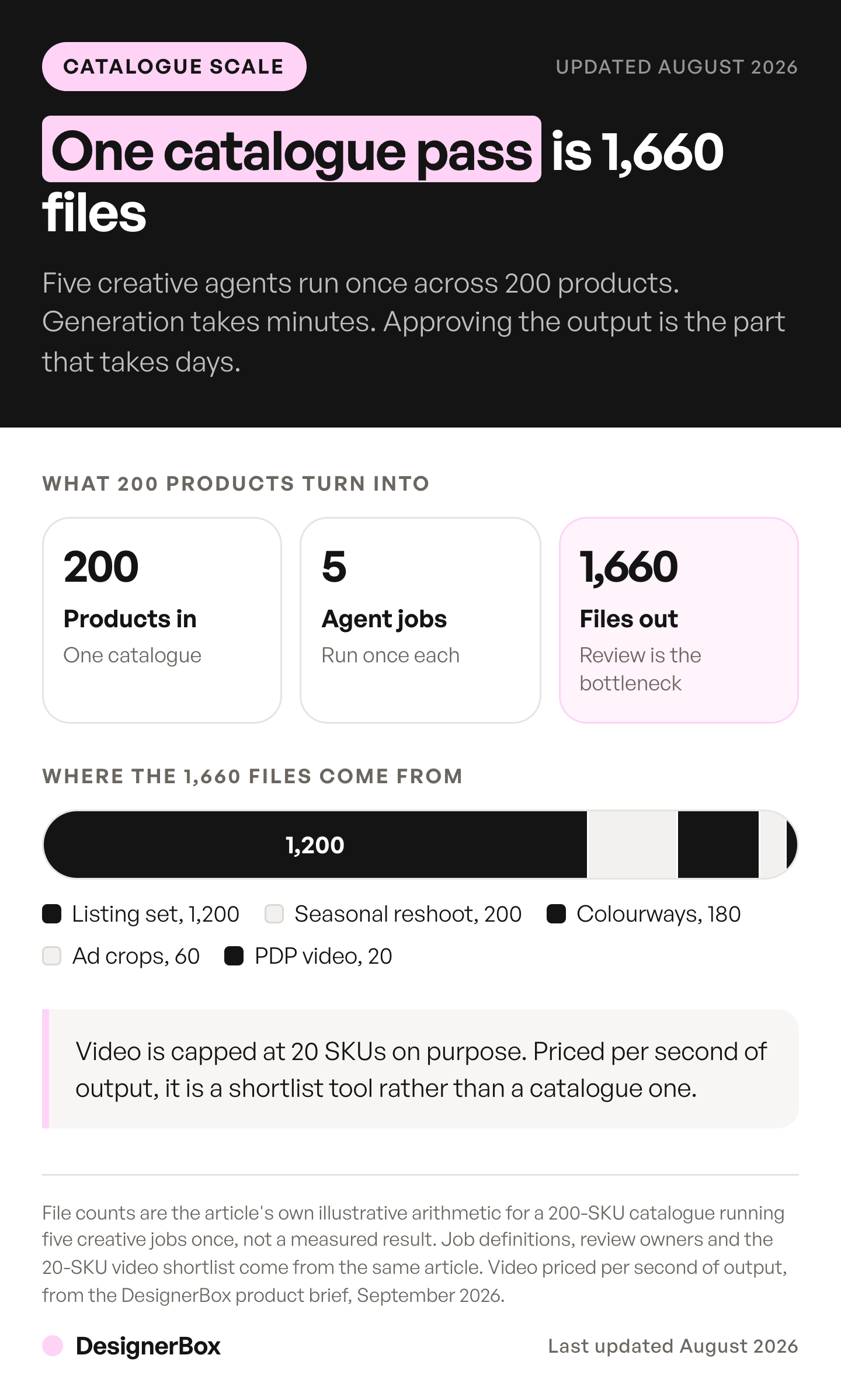
The arithmetic below is illustrative, built from live DesignerBox credit rates and a 200-SKU catalogue. Your file counts and your model mix will differ.
| Job | Assets produced | Cheapest model | Default model |
|---|---|---|---|
| Listing set, 6 images x 200 SKUs | 1,200 images | 4,800 (Seedream 5, 4 each) | 16,800 (Nano Banana Pro, 14 each) |
| Colourways, 3 per SKU x 60 SKUs | 180 images | 720 | 2,520 |
| Seasonal reshoot, 1 scene x 200 SKUs | 200 images | 800 | 2,800 |
| Ad resize, 3 crops x 20 SKUs | 60 images | 240 | 840 |
| PDP video, one 5s clip x 20 SKUs | 20 clips | 500 (lite 720p, 5 a second) | 4,000 (premium 720p, 40 a second) |
| Total | 1,660 files | 7,060 credits | 26,960 credits |
Read the two right-hand columns as one finding: the same 1,660 files cost 3.8x more on one set of models than on another. That is the number to settle before the run, not after it, and it is the reason the model picker sits inside the job rather than in a settings page nobody opens.
DesignerBox plans carry 112 credits free, 500 on Basic at $15 a month, 1,000 on Pro at $35, 2,500 on Premium at $75, and 8,000 on Ultra at $200, all billed monthly. A cheap-model pass at 7,060 credits fits inside one Ultra month. A default-model pass at 26,960 is closer to three and a half, or one month plus top-up packs, or a phased run that does the listing set first and the rest next quarter. Credit packs are one-time top-ups: 100 for $5, 500 for $20, 1,500 for $50.
Three gating facts belong in the budget before you commit. The commercial licence starts at Pro. AI video and try-on start at Premium. Team collaboration, shared brand kits and API access are Ultra only, and every tier below Ultra is a single seat. Those gates decide the tier long before the credit count does. DesignerBox sets out the fit for ecommerce brands separately.
What breaks when an agent runs on a real catalogue?
Three things, reliably. The input quality caps the output, so a supplier JPEG under 500 pixels produces 1,200 files that all fail the same spec. The batch drifts, because a model given 200 chances will change one detail somewhere. And review becomes the bottleneck the moment generation stops being one.

Input first. Google’s Merchant Center currently accepts 100 x 100 pixels for non-apparel and 250 x 250 for apparel, and moves everything to a 500 x 500 minimum on 31 January 2027, with warnings already appearing in Merchant Center ahead of that date (support.google.com, September 2026). Any agent reading those files inherits the problem rather than solving it, unless the first step in the chain is a rescue pass.
Drift is the second one, and it is invisible per file. Every image looks correct alone. Put 40 of them in a category grid and one product has a slightly different stitch, a slightly different shadow, a slightly different grey. The fix is a fixed reference set per product and one set of brand rules the job reads on every row, not a better prompt typed each time. Row one and row five hundred have to come back to the same standard, and that is a property of the job definition rather than of the operator’s patience.
Review is the third and the one that decides your margin. Budget on approval hours, not on credits. Where batch generation falls over covers the throughput maths in detail, and the short version is that a 1,200-file run is a multi-day review, not an afternoon.
How do you connect an agent to your store’s data?
An agent needs four things it cannot generate for itself: your real product photo, your brand rules, a model catalogue, and somewhere to put the output. Connect those four and the agent stops producing generic work. Skip one and you get output that looks fine in a chat window and fails brand review in a deck.
DesignerBox exposes that connection over MCP with 68 tools, so Claude, ChatGPT or Cursor drive the same models and apps you use in the browser. Brand profiles carry the rules. The asset library holds the output and stays searchable. The catalog batch processor skill is the listing set job already assembled, for teams who would rather not wire the chain themselves. If you want to price the platforms that host the chain instead, six agent builders read this month sets out what you still supply yourself.
The reverse direction matters as much. Your agent’s export step needs the destination spec written into it, because a file that is perfect and 400 pixels wide is a rejected listing. For the connection layer in general, the four inputs an agent has to reach goes a level deeper than this section does.
When is an agent the wrong tool for the job?
When the creative decision changes per item, when the volume is under about 30 files, and when nobody owns the approval. A launch campaign with a new concept is a brief for a person. Twelve hero images for a single drop is faster by hand than it is to configure. And an agent without a named reviewer produces output that sits in a folder because nobody is allowed to sign it off.
The deeper constraint is that agents automate repetition, and most stores have less genuine repetition than they think. The four costs that repeat on every asset is the audit worth running before you build anything, because the job you automate should be the one you actually do 200 times.
Start with one job, not five. Pick the listing set, build it once against ten real SKUs, read the credit total, then point the same definition at the remaining 190. DesignerBox’s product photography use case is the version of that first job already set up, and it is the shortest path from one approved result to a whole catalogue running on it.
FAQ
What is the difference between an AI agent and a chatbot for ecommerce?
A chatbot answers a question inside a conversation. An agent takes an outcome, plans the steps, calls tools, and returns finished work without being walked through it. In practice the difference shows up in what comes back: a chatbot gives you an answer to read, an agent gives you 1,200 product images to approve or reject.
Can an AI agent generate my product listing images?
Yes, when it can reach a usable source photo. The agent cleans the background, produces the angles and detail crops, and writes each file at the destination’s required size. Quality is capped by the input, so a low-resolution supplier image produces a low-resolution set. Run a rescue pass on the source files before the listing set job.
How much does an AI agent for ecommerce cost?
It depends on the zone. Support agents bill per resolved conversation. Content agents bill per asset, and the per-asset rate is set by the model. In DesignerBox an image runs 3 to 22 credits a file, and plans are $15, $35, $75 and $200 a month billed monthly for 500, 1,000, 2,500 and 8,000 credits. A 1,660-file pass over 200 SKUs is 7,060 credits on the cheapest models and 26,960 on the default ones.
Do AI-generated product images meet Google Shopping requirements?
The generation method is not what Google checks. The file is. Product images need to clear 500 x 500 pixels from 31 January 2027, and Google recommends 1,500 x 1,500 or larger for best performance across listing formats. Set the agent’s export step to the recommended size rather than the minimum, and the spec change costs you nothing.
Can an agent run on supplier photos instead of my own?
Yes, and it is the most common starting point for a catalogue built from wholesale products. The constraint is resolution and consistency, not permission. Supplier files arrive at mixed sizes, mixed backgrounds and mixed lighting, so the first step in the chain has to normalise them before any downstream job runs on top.
How much does AI video cost per product?
Video is priced per second of output, and the rate is set by the model row. An 8-second clip runs 40 credits at the lite end and 560 at the top, a 14x spread. Twenty five-second clips cost 500 credits on the lite row and 4,000 on the premium one. AI video needs the Premium plan at $75 a month billed monthly.
Does an ecommerce AI agent need API access?
Not to run. You can drive an agent from a workspace or from an assistant over MCP without writing code. API access matters when the agent has to trigger from your own systems, such as a new product row in your PIM. In DesignerBox, API access and team collaboration sit on the Ultra plan at $200 a month billed monthly.
Sources
- Google Merchant Center, image link specification: minimum 500 x 500 pixels from 31 January 2027, 1,500 x 1,500 recommended (support.google.com, September 2026)
- Google Merchant Center, image too small: current 100 x 100 and 250 x 250 minimums, enforcement date (support.google.com, September 2026)
- Shopify Help Center, product media types: 2048 x 2048 recommended, 5000 x 5000 and 20 MB caps (help.shopify.com, September 2026)
- Shopify Help Center, Sidekick: capabilities and the review-before-applying step (help.shopify.com, September 2026)
- Meta ads guide, Facebook Feed image ad: 1440 x 1800 at 4:5, 600 x 750 minimum (facebook.com, September 2026)
- Fin: charged on resolution rather than per seat (fin.ai/pricing, September 2026)
- Gorgias: AI Agent included on every plan, charged on resolution, helpdesk scaled on ticket volume (gorgias.com/pricing, September 2026)
- DesignerBox image and video credit rates, plan allocations and feature gating: live product configuration, September 2026
Platform image specifications and agent pricing models verified from Google Merchant Center, Shopify Help Center, Meta’s ads guide, fin.ai and gorgias.com as of September 2026. Individual results vary.