
How often to post on social media depends on the platform. Post three to five times a week on Instagram, two to five times a week on TikTok and LinkedIn, one to two times a day on Facebook, and three to five times a day on X (buffer.com/resources/social-media-frequency-guide, September 2026). Those ranges are the easy part. The number that decides whether you hold the cadence is the one nobody works out first: how many finished assets a month it takes to feed it.
Every posting frequency guide stops at the recommendation. A brand team reads “three to five times a week”, agrees to it on a Monday, and runs out of things to post by the third week. The cadence was never the problem. Production was.
This guide gives the per-platform ranges, then does the arithmetic those ranges imply for a brand with a product catalog. It is written for brand and ecommerce teams, and for the agencies holding the same cadence for several clients at once.
Key Takeaways
- The ranges are close across platforms: three to five posts a week on Instagram, two to five on TikTok and LinkedIn, and daily on Facebook and X (buffer.com, September 2026).
- More does keep working on some platforms. On Instagram, follower growth rises with volume at every step Buffer measured, from 1-2 posts a week to 10 or more.
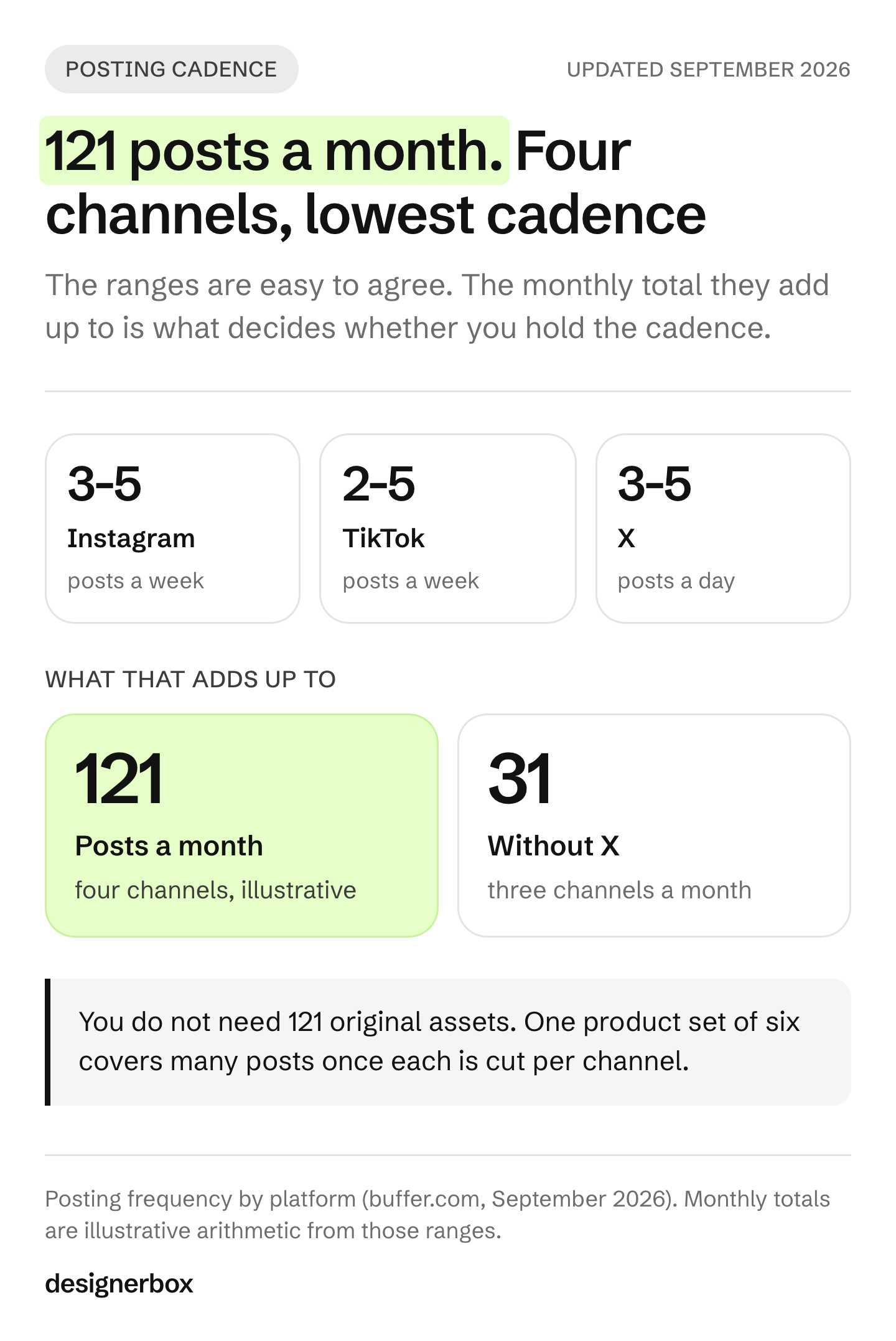
- Four channels at the low end of each range is roughly 121 posts a month, on illustrative arithmetic. That figure surprises most teams.
- You do not need 121 original assets. You need a smaller set of source assets, re-cut per channel. Most teams miss this and try to make everything twice.
- Pick the cadence you can hold in month four, not the one you can hold in week one. A dropped cadence performs worse than a lower one kept.
- Production capacity sets the ceiling. Anyone can make an AI picture. Making hundreds that still look like your brand is the hard part.
How often to post on social media, per platform
Buffer publishes the widest public dataset on posting frequency, drawn from its own users’ accounts. The figures below were read on 19 September 2026.
| Platform | Recommended cadence | What the data shows |
|---|---|---|
| 3 to 5 times a week | Follower growth rises at every volume step measured | |
| TikTok | 2 to 5 times a week | Moving from one post a week to this range gives up to 17% more views per post |
| 2 to 5 times a week | 11 or more posts a week gave nearly triple the engagements per post compared with once a week | |
| 1 to 2 posts a day | Based on a study of more than 13,500 Facebook users | |
| X | 3 to 5 posts a day | Spread through the day rather than together |
| 15 to 20 times a day, or at least once a week | Pinterest’s own recommendation |
Source: buffer.com, September 2026.
The Instagram figures are worth reading closely, because they contradict the common advice to post less and focus on quality. Buffer’s follower growth rate rose at every step: 1 to 2 posts a week, 3 to 5, 6 to 9, and 10 or more, with the highest growth at the top of that scale.
That does not mean you should post ten times a week. It means volume is not the thing holding your account back, and the constraint is almost always production.
The number nobody calculates
Take the low end of each range for a brand on four channels. The arithmetic below is illustrative, not a measured result.
- Instagram, 3 a week: about 13 posts a month
- TikTok, 2 a week: about 9 posts a month
- LinkedIn, 2 a week: about 9 posts a month
- X, 3 a day: about 90 posts a month
That is roughly 121 posts a month at the bottom of every recommended range. Drop X, which is the outlier, and three channels still need about 31 posts a month.

Most brand teams plan for the cadence and never plan for that number. It is why the calendar looks healthy in week one and empty in week three.
Why you need fewer assets than posts
Here is the part the frequency guides leave out. Posts and assets are not the same unit.
One product shoot can produce a hero still, three angle shots, a fabric close-up, a lifestyle frame and a short clip. That is six assets from one product. Cut for four channels at the right crop each, with a different caption, and those six assets cover a lot more than six posts.
The practical ratio for a product brand looks more like this:
- Source assets: the stills and clips you make per product
- Cuts: the same asset at the size and shape each channel needs
- Posts: a cut plus a caption, scheduled on a date
For a worked example on one channel, Instagram content with AI shows how the four formats get made from one set.
A team that plans at the post level tries to invent 121 ideas a month. A team that plans at the asset level makes a set per product and re-cuts it. The second team holds the cadence. The first one burns out.
Where the assets come from
DesignerBox is AI creative production for brands and agencies. Scale your images, ads and video with AI and keep your brand on every piece: build the workflow once with your brand rules, run it on every product, see the cost before each run, and keep everything from the first product photo to the finished ad in one place.
There are four ways to run the same workflow, and how it works walks through them. A template is a workflow somebody already built. A workflow is your own set of steps, saved once with your brand rules. An app is a workflow with a form, so a colleague can run it without opening the steps. Batch runs one workflow over a whole sheet of products. Step one is one photo. Step four is the whole catalog.
For the asset math above, the stage that matters is the last one. If a drop is 40 products and each needs a six-asset set, that is 240 assets. Running that as one job over a sheet is a different proposition from booking a shoot per product.
The brand rules sit in the system and the workflow reads them on every run, so product forty looks like product one. Sequential edits hold their detail and resolution, so you can relight, change the angle or swap a background without the picture degrading. Three critic steps score the results and best-of-N keeps the best one. You keep or discard per row, and re-run one row alone.
The full workflow from the first product photo to the finished ad, in one subscription. That covers the making, the editing, the brand rules, the assets and the AI models. Video starts on the Premium plan. Plans and credits are on the pricing page. If you run a catalog, AI product photography covers the per-product set in more detail, and there is a page for ecommerce brands.
Where the schedule lives
Making 240 assets and posting 121 times a month are two different jobs. DesignerBox finishes at the asset: you download the results, or send them onward with a webhook or an S3 step. Putting a finished file on five channels at the right time, every week, is a scheduler’s job.
PostNext is the social media scheduler built by the same team, and it covers that stage. What matters for holding a cadence:
- Seven channels from one calendar: X, Instagram, LinkedIn, TikTok, YouTube, Threads and Bluesky (postnext.io, September 2026).
- Official APIs only, through each platform’s own login using OAuth 2.0. No password is stored and nothing is scraped (postnext.io, September 2026).
- An evergreen queue and recurring posts, which is how one strong asset gets used again in month three instead of being posted once and forgotten. At 121 posts a month, reuse is not optional.
- A drag-and-drop calendar, so a gap in week three is visible in week one.
- First comment scheduling, so links and hashtags sit in the comment.
Two honest limits. PostNext does not publish to Facebook or Pinterest, and both appear in the table above, so check your channel list before you plan around it. And it schedules posts: making the product photo is a separate job. PostNext has a free plan, so you can test that stage first.
A cadence you can hold
The best cadence is the one still running in month four. Three rules make that likelier.

Start at the bottom of the range. Three Instagram posts a week beats five for two weeks and none for three. You can raise it once production is steady.
Count assets before you commit. Multiply your channels by the low end of each range, then ask how many source assets that needs after re-cuts. If the answer is more than you have made in any previous month, lower the cadence or raise production first.
Batch the making, spread the posting. Make a month of assets in one pass, then schedule them across the month. Our guide to the social media workflow sets out the five stages and who owns each one, and AI for social media content covers making one master asset that survives being cut for several platforms.
Scale content without limits.
Generate content for your products or services with AI, starting today, and keep your brand on every piece.
FAQ
How often should I post on social media?
Three to five times a week on Instagram, two to five times a week on TikTok and LinkedIn, one to two times a day on Facebook, and three to five times a day on X (buffer.com, September 2026). Pinterest is the outlier, where Pinterest’s own recommendation is 15 to 20 times a day or at least once a week. Start at the bottom of each range and raise it once production is steady.
Is it better to post more often or post better content?
On the platforms where this has been measured publicly, volume keeps helping. Buffer’s data shows Instagram follower growth rising at every step from 1 to 2 posts a week up to 10 or more (buffer.com, September 2026). Quality still decides whether a post performs. The practical answer is that production capacity, not the choice between the two, is what usually sets the limit.
How many posts a month is that in total?
For a brand on Instagram, TikTok, LinkedIn and X at the bottom of each recommended range, roughly 121 posts a month on illustrative arithmetic, with X accounting for about 90 of them. Three channels without X come to about 31 a month.
Do I need a separate asset for every post?
No, and planning that way is the most common mistake. One product set of six assets can cover many posts once each asset is cut to the size and shape a channel needs and given its own caption. Plan at the asset level, then cut.
What happens if I miss a week?
A dropped cadence tends to cost more than a lower one held consistently, because the gap removes the compounding the frequency data shows. If you cannot hold five a week, commit to three. Scheduling a month ahead is what protects the calendar from a busy fortnight.
How do I keep the brand consistent at that volume?
Set the brand rules once in the system so the workflow reads them on every run, rather than keeping them in a document nobody opens. Consistency fails at volume for the same reason cadence does: it depends on a person remembering, instead of on a process.
Sources
- Posting frequency data by platform, and the Instagram reach and follower growth figures by weekly volume, buffer.com/resources/social-media-frequency-guide, accessed 19 September 2026.
- PostNext channels and publishing method, postnext.io, accessed 19 September 2026.
- DesignerBox plans and credits, DesignerBox pricing page, September 2026.
Posting frequency figures read from published vendor data as of September 2026. Asset arithmetic is illustrative. Individual results vary.