
SaaS ads sell software, so there is no product to photograph. The creative has to carry the interface, the claim, and the proof instead of a hero shot. In a 2026 benchmark of 153 B2B advertisers, LinkedIn image ads returned a $200 cost per lead against $265 for video. On LinkedIn, the format that converts at the lower cost per lead is also the cheaper one to make.
Many guides on this topic are galleries. Forty-five finished ads, a caption under each explaining why it works, and nothing about how you would produce one. That gap matters more for software than for anything else, because the moment you open an AI ad tool it asks for a product photo, and you do not have one.
This covers what B2B ad creative actually costs per lead, the five formats that convert for software, the four layers inside each one, and how to produce a month of variants when your product is a screen.
Key Takeaways
- Static beats video on cost per lead on LinkedIn. Metadata’s 2026 benchmark puts LinkedIn image ads at $200 per lead and video ads at $265, across 153 advertisers and $57.6M of 2025 spend (metadata.io, September 2026).
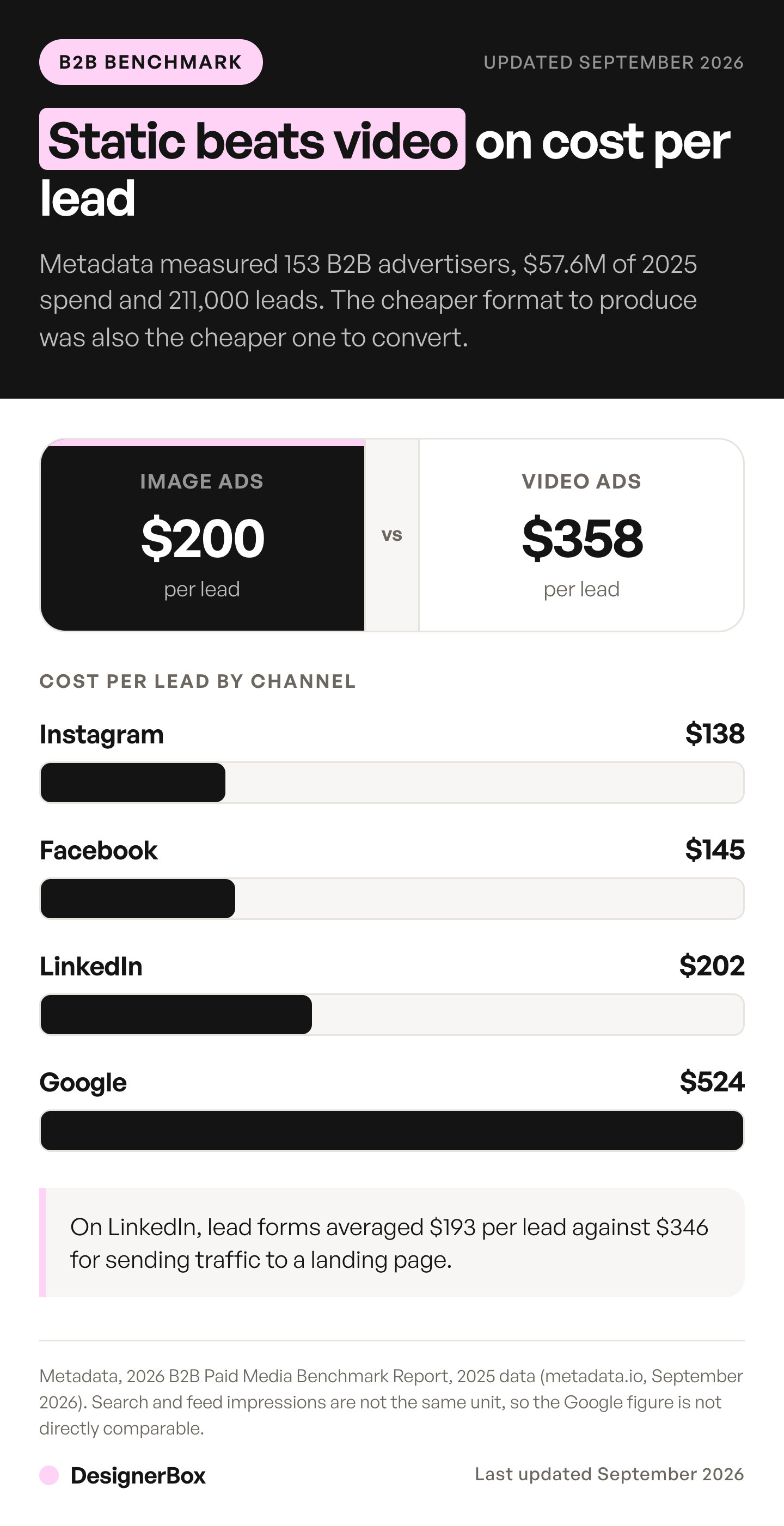
- Channel and destination move the number too. Instagram returned $138 per lead and Google Ads $524, on the same dataset. LinkedIn lead forms cost $193 per lead against $346 for sending traffic to a landing page.
- LinkedIn publishes an explicit refresh cadence. Run 4 to 5 ads per campaign, and every 1 to 2 weeks pause the lowest performer and replace it (business.linkedin.com, September 2026). That is roughly 2 to 4 new creatives a month per campaign, not 100.
- For software, the screenshot is the packshot. Most ad generators ask for a product photo. Supply your own interface capture as the source asset and the stock-photo problem disappears.
- Text on the image is where SaaS ads break. A B2B ad is mostly headline. Image models vary a lot on typography, which is why the model choice matters more here than in product photography.
- Creative is the largest single lever measured, in a different category. NCSolutions attributes 49% of incremental sales to creative, from nearly 450 campaigns. That study is consumer packaged goods and in-store sales, not B2B lead generation, so treat it as direction rather than a B2B number.
- The honest limit: no model will draw your UI. You supply the screenshot. AI produces the frame, the scene, the presenter, and the forty variants around it.
What makes a SaaS ad different from a product ad?
A physical product ad has a subject. The shoe, the serum, the chair sits in the frame and does the persuading, and the copy supports it. A SaaS ad has no subject in that sense. Software looks like a rectangle of interface, and a rectangle of interface at 1200 x 628 pixels in a feed is unreadable.
So the burden shifts to the words and the framing. The headline carries the claim, the visual carries the recognition, and the proof carries the risk reduction. That is why so much B2B creative collapses into a stock photo with a sentence on top: the team had nothing to shoot, so they bought a picture of somebody smiling at a laptop.
The buying cycle changes the maths too. A DTC ad can convert on impulse from a single impression. A software purchase involves several people, a procurement step, and a trial, so the ad’s job is to earn a click into a form or a demo, not a sale. That is why cost per lead, not return on ad spend, is the number this category is measured on.
What do B2B ads actually cost per lead in 2026?
Metadata’s 2026 B2B Paid Media Benchmark analysed 153 B2B advertisers who spent $57.6M in 2025 and produced 211,000 leads. Facebook returned the lowest cost per lead at $145, Instagram $138, LinkedIn $202, and Google Ads $524. Format matters too: on LinkedIn, image ads averaged $200 per lead and video ads $265 (metadata.io, September 2026).
| Channel | CTR | CPC | CPM | Cost per lead |
|---|---|---|---|---|
| 0.79% | $1.95 | $15.50 | $145 | |
| 0.65% | $2.82 | $18.25 | $138 | |
| 0.67% | $9.39 | $63.19 | $202 | |
| Google Ads | 6.33% | $9.76 | $617.91 | $524 |
Figures are spend-weighted aggregates from 2025 data, published 2026 (metadata.io, September 2026). Metadata notes that a search impression and a feed impression are not the same unit, so the Google CPM does not compare to the social ones.
Two format-level numbers from the same report are worth acting on. LinkedIn document ads came in at $142 per lead, the cheapest format in the set, and LinkedIn lead forms at $193 against $346 for driving to a landing page. A software company that moved its LinkedIn spend from landing-page traffic into lead forms would be looking at roughly half the cost per lead before touching the creative at all.
For a SaaS-only cut, HockeyStack’s LinkedIn benchmark covers more than 70 B2B SaaS companies and $28M of spend, reporting a Q1 cost per click of $10.48 at 0.82% CTR rising to $15.72 at 0.96% CTR by Q3 (hockeystack.com, September 2026). That report is dated December 2025, so read it as a shape rather than a current price.
The five SaaS ad formats that convert
Five shapes account for most of what runs and works in software advertising. Each one has a different source asset requirement, which is what decides whether you can produce it.
The interface crop. A tight, deliberately cropped section of your product doing one recognisable thing, with a headline naming the outcome. Not a full dashboard screenshot. One panel, one number, one state change. This is the format nothing else can substitute for, because it is the only one that proves the software exists.
The before and after. The old workflow on the left, your product on the right. Spreadsheet against dashboard, twelve tabs against one view. It works because it states the problem and the fix in one glance with no reading required.
The comparison. A direct feature or price table against the alternative the buyer is already using. High intent, high risk. Every claim in it has to be current and checkable, because a competitor with a screenshot of your out-of-date table is a problem you created yourself.
The proof card. A customer quote, a logo wall, or a metric with a name attached. This is the format that carries the least production cost and the most credibility, and it is consistently the one B2B teams underuse.
The talking presenter. A person to camera explaining the problem in the first three seconds. Expensive per unit and, on the LinkedIn numbers above, more expensive per lead than image ads. Worth running, worth capping.
| Format | Source asset you must supply | What AI can add | Relative production cost |
|---|---|---|---|
| Interface crop | Your screenshot | Frame, device mockup, background, placement sizes | Lowest |
| Before and after | Two screenshots, or one plus a stand-in | Layout, split composition, styling of both halves | Low |
| Comparison | Verified claims and pricing | Layout, typography, colour system | Low |
| Proof card | The real quote or metric | Scene, portrait, brand frame | Low |
| Talking presenter | Script, and a person or an avatar | Presenter, environment, captions, cutdowns | Highest |
Four of the five are static. That lines up with the $200 against $265 cost-per-lead split on LinkedIn, and it is the reason a SaaS creative plan that opens with video usually spends its budget in the wrong place. If you want the reasoning on how many of each to run, how many ad variants you need each month works through the volume side.
The four layers inside a SaaS ad creative
Every ad in that list decomposes into the same four layers. Naming them is what turns “make some ads” into a production brief a generator can act on.

Surface. What the viewer recognises as your product. For software this is the screenshot, the crop, or the device mockup holding it. It is the only layer you cannot generate.
Claim. The headline. One outcome, stated in the buyer’s language. LinkedIn recommends keeping descriptive copy under 70 characters and headlines under 150 (business.linkedin.com, September 2026), and the in-image headline should be far shorter than either.
Proof. The thing that makes the claim survivable: a number, a named customer, a logo, a rating, a compliance badge.
Frame. Everything else. Background, colour system, logo placement, safe margins, and the aspect ratio the placement demands.
The reason this decomposition earns its place is that three of the four layers are variable and one is fixed. Hold the surface constant, rotate the claim across five angles, rotate the proof across three, and you have fifteen genuinely different ads from one screenshot. That is a variant system rather than a batch of near-duplicates, and it is the difference between a test you can read and a delivery report. Why most ad creative tests cannot be read covers what happens when the variants are not genuinely distinct.
Why AI ad tools produce stock-photo slop for software
Many AI ad generators ask for a product photo first. Much of the category was built for ecommerce, where a physical object exists and can be shot, relit, placed in a scene, and multiplied into fifty variants. Feed that pipeline a text prompt for a B2B software company and it has nothing concrete to work from, so it invents the most statistically average business image available. A person in a blazer. A laptop. A meeting room. Slop, and slop that looks exactly like every competitor’s slop.
The fix is to supply the missing input. For software, the screenshot is the packshot. Once a real interface capture goes in as the source asset, the generator stops inventing a subject and starts doing the job it is good at, which is producing the scene, the frame, the presenter, and the forty placement variants around something real.
That reframing also resolves the brand-drift problem. Assets built from your actual interface stay recognisably yours across a campaign, because the one element a viewer uses to identify you is the same file in every variant.
Two caveats before you commit to this. We found no published study that supports the popular claim that a screenshot doubles click-through against stock. A LinkedIn marketing blog post is neutral on image type: it tells advertisers to “vary your image types” and names “icons, GIFs, stock photos, graphics” (linkedin.com, published September 2021, accessed September 2026). The argument for the interface crop is that it is the only format that proves the product exists. No published study has measured it winning.
What to feed a model when your product is software
Four inputs, prepared once, cover an entire quarter of creative.
- A clean interface capture set. Six to ten crops at full resolution: the core workflow, the moment of value, the integration view, the mobile view, and any screen with a number on it worth showing. Capture with real data or convincing sample data, never with placeholder text.
- A brand frame. Logo, two colours, the type family, and the safe margins. This is what stops fifteen variants from looking like fifteen different companies.
- A claim bank. Five to eight outcome statements under 40 characters, each one a different angle rather than a rewording of the same angle.
- A proof bank. Three to five real, checkable proof points. Metric, quote, logo, or certification.
From that set, the production step is mechanical. The surface stays fixed, the frame stays fixed, and the claim and proof rotate. DesignerBox is AI creative production for agencies and brand teams. This is the kind of job it is built for. A static ads template makes ad frames with room for the words. A multi-size ad template makes one ad in every size the ad platforms need. You do not recrop each size by hand. Save the job as a workflow once, with your brand frame in it. Then run it again for the next feature, the next launch and next quarter’s claim bank. A saved workflow runs the same way each time. The results keep the same frame, margins and logo placement. An agency can publish the workflow as an app, a workflow with a form. A colleague adds the screenshot and the claim, then presses Run.
One plan detail matters for SaaS teams. The commercial license starts on the Pro plan, at $35 a month billed monthly, and ads are commercial use. Pro carries 1,000 credits a month. The cost of each run is shown before the run.
Text on the image is where SaaS ads break
A B2B ad is mostly headline. That makes typography the hard constraint, and image models differ on it sharply. A misspelled word or a mangled letterform in a $9.39-per-click LinkedIn placement is wasted spend.

The vendors say different things about text. OpenAI’s image guide calls text rendering in its GPT Image models “significantly improved”, and it still names precise text placement as a limit (developers.openai.com, September 2026). OpenAI released GPT Image 2.5 on 8 September 2026 (developers.openai.com, September 2026). ByteDance lists high-density infographics on its Seedream 5.0 Pro page (seed.bytedance.com, September 2026). Test before you commit a campaign to one model: run the same short headline on two or three image models from the model list and compare the letterforms.
The practical rule is to keep generated type to the shortest possible string. Generate the scene, the frame, and the surface with the model, then set the headline as real text in the layout wherever the platform allows it. Every character you hand to a diffusion model is a character that can come back wrong.
Aspect ratios are the other place SaaS creative gets rejected or cropped badly. LinkedIn recommends 1.91:1 at 1200 x 628, square at 1200 x 1200, and vertical 4:5 at 720 x 900, with a 5 MB file cap on single image ads (business.linkedin.com, September 2026). Video ads take 4:5, 9:16, 16:9 and 1:1, from 3 seconds to 30 minutes, up to 500 MB (business.linkedin.com, September 2026). Design the composition once with the vertical crop in mind, and the other ratios are easier to cut from it.
What a month of SaaS ad variants costs
Take LinkedIn’s own guidance as the volume target, because it states a cadence in plain numbers. Run 4 to 5 ads per campaign, and every 1 to 2 weeks pause the lowest performer and replace it (business.linkedin.com, September 2026). Three live campaigns on that rhythm needs roughly 6 to 12 new creatives a month. Forty a month covers three campaigns across two channels with room to test.
Priced against agency rates, forty statics is a large invoice. Performance creative price lists put a static ad asset with four copy variations at $500 to $1,000 (inbeat.agency, March 2026), and a SaaS product demo video at $1,500 to $15,000 depending on tier, with $3,000 to $15,000 given as typical B2B spend per product video (vidico.com, June 2026). Those are published vendor price lists rather than survey data, so read them as list prices.
In DesignerBox, the image model you pick changes the cost of a run, and the cost is shown before the run. Plans carry a monthly credit allowance. Pro carries 1,000 credits a month at $35, Premium 2,500 at $75 and Ultra 8,000 at $200, each billed monthly. Every plan below Ultra is one seat, so an agency that runs SaaS creative for several clients needs Ultra for team features.
| Plan | Price, billed monthly | Credits a month | What it adds for ad work |
|---|---|---|---|
| Pro | $35 | 1,000 | Commercial license |
| Premium | $75 | 2,500 | AI video |
| Ultra | $200 | 8,000 | Team features, shared brand kits, the API |
Video prices differently. An 8-second clip costs 40 to 560 credits, depending on the model. You see the cost before you run it. AI video starts on the Premium plan.
Put those two facts next to the benchmark and the plan is clear. Static ads cost less to produce and returned a lower cost per lead in the measured LinkedIn data, so the static set is the volume engine and video is the deliberate, capped exception. The 2026 AI creative cost benchmark has the fuller cost picture, and dynamic creative optimization covers what happens when the platform assembles the variants at impression time instead.
What AI will not do for you here
Four honest limits, because a SaaS team that hits these mid-campaign loses a week.
No model will draw your interface. Ask for a “SaaS dashboard” and you get a plausible-looking fiction with invented labels and numbers that mean nothing. Every usable interface asset starts as a real capture from your product.
No model verifies your claims. A comparison ad against a named competitor is a legal surface as much as a creative one. Every price and feature in it needs checking against that company’s current public pages, with the date recorded.
Disclosure is not uniform, and it is moving. This is general information, not legal advice. Meta asks advertisers to disclose AI only in ads about social issues, elections or politics. Its ad policy says that from 1 June 2026 it also uses automated detection to find ad media made or edited with third-party AI tools (transparency.meta.com, September 2026). When Meta finds those signals, it adds an “AI info” label under About this ad (facebook.com/business/help, September 2026). In July 2026, Google started to permit AI labels inside image and video ad creatives (support.google.com, September 2026). Google says rules in the EU, India and New York require labels on some AI ads, and that its label setting does not guarantee compliance (support.google.com, September 2026). We found no AI disclosure rule in LinkedIn’s advertising policy, last revised 18 November 2025. The policy says ads must not be fraudulent or deceptive (linkedin.com, September 2026). Article 50 of the EU AI Act has applied since 2 August 2026, and the AI Omnibus, in force since 27 July 2026, did not move that date (digital-strategy.ec.europa.eu, September 2026). The four AI disclosure rules now in force has the detail.
Volume does not substitute for judgement. Forty variants of a weak claim is forty weak ads. Run the four checks before creative ships on the first ad of each set, not the fortieth.
One last piece of context on why the creative layer is worth this much attention. NCSolutions attributes 49% of incremental sales to creative, ahead of brand at 21%, reach at 14% and targeting at 11%, from an analysis of nearly 450 campaigns (ncsolutions.com, September 2026). That study measures consumer packaged goods against in-store sales, not B2B lead generation, so it does not transfer as a number. It transfers as a direction, and the direction is that the asset is the lever.
FAQ
What are SaaS ads?
SaaS ads are paid advertisements for software sold on subscription. They differ from product ads because there is no physical object to photograph, so the creative carries an interface crop, a headline claim, and a proof point instead of a hero product shot. They are usually measured on cost per lead rather than return on ad spend, because the purchase involves a trial, a form, or a demo rather than an immediate sale.
Are static or video ads better for B2B SaaS?
Static, on the published LinkedIn cost data. Metadata’s 2026 benchmark across 153 B2B advertisers reports LinkedIn image ads at $200 per lead against $265 for video ads. Static is also cheaper to produce. Video still earns a place for presenter-led and demo formats, but it works better as a capped exception than as the volume engine.
Which channel is cheapest for SaaS ads?
On the same 2025 dataset, Instagram returned $138 per lead, Facebook $145, LinkedIn $202 and Google Ads $524. LinkedIn’s higher cost buys tighter professional targeting, and within LinkedIn the format choice moves the number a long way: lead forms averaged $193 per lead against $346 for sending traffic to a landing page.
How many SaaS ad variants should I run each month?
LinkedIn publishes a cadence in plain numbers. It recommends 4 to 5 ads per campaign with the lowest performer paused and replaced every 1 to 2 weeks. Three live campaigns on that rhythm needs roughly 6 to 12 new creatives a month. Forty covers three campaigns across two channels with testing headroom.
Should SaaS ads use screenshots or lifestyle photos?
Use both, and never use only stock. The interface crop is the one format that proves the software exists, so at least one variant in every set should carry a real screenshot. A LinkedIn marketing blog post recommends varying image types rather than favouring one, so rotate interface crops, proof cards and scene-led images across the set and let the test decide.
Can I use AI-generated images in SaaS ads?
Meta, Google and LinkedIn all run ads with AI-generated images, subject to disclosure rules that differ by platform and market. Meta asks advertisers to disclose AI only in ads about social issues, elections or politics, and it labels other ads itself when it detects AI signals. Google permits an AI label inside creatives, and says rules in the EU, India and New York require labels on some AI ads. We found no AI disclosure rule in LinkedIn’s advertising policy, as of September 2026. Check the current rules for your platforms and markets before a campaign launches, because platforms changed these rules several times in 2025 and 2026. This is general information, not legal advice.
What does it cost to produce a month of SaaS ad creative?
Agency price lists put a static ad asset with four copy variations at $500 to $1,000 and a SaaS product demo video at $1,500 to $15,000 by tier. In DesignerBox, the cost of each run is shown before you run it. The Pro plan carries 1,000 credits a month for $35, billed monthly, and includes the commercial license. An 8-second video clip costs 40 to 560 credits, depending on the model, and AI video starts on the Premium plan.
Do I need a designer to make SaaS ads with AI?
Not for the variants, and yes for the system. The four inputs that make a variant set work are a clean screenshot set, a brand frame, a claim bank and a proof bank. Someone has to define those once with judgement. After that, rotating claims and proof against a fixed surface is a production step rather than a design step.
Sources
- Metadata, 2026 B2B Paid Media Benchmark, metadata.io/b2b-advertising-benchmarks, accessed September 2026. 153 B2B advertisers, $57.6M 2025 spend, 211,000 leads. Cost per lead by format is for LinkedIn lead-generation campaigns.
- HockeyStack, LinkedIn Ads Benchmark Report, hockeystack.com, published December 2025, accessed September 2026. More than 70 B2B SaaS companies, $28M spend.
- LinkedIn, Sponsored Content tips, business.linkedin.com, accessed September 2026.
- LinkedIn, Tips and tricks for creating engaging visual LinkedIn ads, linkedin.com, published September 2021, accessed September 2026.
- LinkedIn, Single image ad specifications, business.linkedin.com, accessed September 2026.
- LinkedIn, Video ad specifications, business.linkedin.com, accessed September 2026.
- LinkedIn, Advertising policies, last revised 18 November 2025, linkedin.com, accessed September 2026.
- Meta, Ad standards for social issue, election and political ads, transparency.meta.com, accessed September 2026.
- Meta Business Help, AI info labels on ads, facebook.com/business/help, accessed September 2026.
- Google Ads, About the AI label setting, support.google.com, accessed September 2026.
- Google Ads Help, AI disclosures and labels, support.google.com, accessed September 2026.
- European Commission, Quick facts on AI Act transparency rules, digital-strategy.ec.europa.eu, accessed September 2026.
- OpenAI, Image generation guide and API changelog, developers.openai.com, accessed September 2026.
- ByteDance, Seedream 5.0 Pro, seed.bytedance.com, accessed September 2026.
- NCSolutions, Five Keys to Advertising Effectiveness, ncsolutions.com, August 2023, accessed September 2026. Nearly 450 CPG campaigns.
- Performance Creative Pricing Guide 2026, inbeat.agency, published 25 March 2026, accessed September 2026.
- Product Video Cost in 2026, vidico.com, published 26 June 2026, accessed September 2026.
- DesignerBox pricing page (designerbox.ai/pricing), September 2026. Plans, credits and feature gates.
B2B advertising benchmarks, platform specifications and AI disclosure rules verified from the sources above as of September 2026. Platform policies in this area changed several times in 2025 and 2026, so check them again before a campaign launches. Individual results vary.