
Dynamic creative optimization is a programmatic advertising method that builds each ad at the moment it is served. A creative template holds placeholders for headline, image, price and call to action. A data feed and audience signals decide which components fill them, and the ad is assembled per viewer in a fraction of a second. Amazon Ads calls it real-time personalization from one base creative.
Google’s responsive display ad spec recommends five headlines, five descriptions and ten images across two ratios before the system has much to combine. Smartly published a Samsung campaign that ran 400 banner versions, live five days after the brief (smartly.io, September 2026). The assembly engine is free with the ad account. The 400 banners are not.
This guide covers both halves. The assembly layer is what a platform or ad server does at serve time, and Meta, Google, Amazon and TikTok document it. The supply layer is the component pool those systems draw from, and nobody prices it. It is written for a marketing lead who budgets both.
Key Takeaways
-
The definition is impression-time assembly. Amazon Ads defines DCO as programmatic advertising that builds many iterations of one base creative, tailored by audience, context and past performance.
-
Platform-native dynamic creative is a different mechanism. Meta, Google Ads and TikTok combine assets you upload inside their own auction. Classic DCO swaps frame elements from a feed.
-
Reporting is aggregate, and Meta says so. Meta shows performance across all variations and states that dynamic creative is not recommended as a substitute for split testing.
-
Two Meta notices matter. Since June 2024 dynamic creative may be unavailable for new sales and app promotion ad sets, and the recommended flexible format leaves Ad setup in March 2026.
-
Classic DCO carries a media-side fee. Display and Video 360 adds a $0.12 CPM advanced ad serving upcharge on multi-variant display, video and audio formats.
-
The component pool is the line nobody prices. Google’s spec recommends ten images across two ratios plus five headlines and five descriptions, and no platform says where they come from. Nielsen’s Project Apollo put 65% of a brand’s sales lift on the creative in 2006.
How does dynamic creative optimization work?
Five steps, in order. A designer builds a template with named placeholders. A product feed and a site pixel supply the data. A user is matched to feed items by product identifier. A model picks the combination most likely to perform for that person. The ad renders inside the impression.

Amazon Ads tells advertisers to decide up front which elements vary, and to build a flexible template so production changes are not needed mid-flight. The named decisions: how calls to action and product names align, whether imagery arrives at several aspect ratios or one fixed size, and whether layouts, typography or color also change (advertising.amazon.com, September 2026).
Google’s classic version works the same way. Dynamic creative files act as a frame so content can be swapped, including call-to-action text, exit URLs and images, either manually through profile fields or programmatically through a feed and content rules (support.google.com, September 2026). StackAdapt describes the data half as a site pixel capturing views, carts and purchases plus a scheduled feed carrying SKU, image, title, price and URL (stackadapt.com, June 2025).
Which platforms run dynamic creative, and what do they ask you to supply?
Three walled gardens run their own version and one ad-server route runs the classic one. Meta, Google Ads and TikTok assemble assets you upload and report in aggregate. Google Studio with Campaign Manager 360 swaps frame elements from a feed, which needs an ad server and carries a serving fee. What you supply differs more than what they assemble.
| Platform | What it assembles | What you supply | Reporting | Extra creative fee |
|---|---|---|---|---|
| Meta dynamic creative | Elements combined by audience and placement | Creative elements, capped at 1,000 ads | Aggregate | None listed |
| Meta flexible ad format | Picks single image, video or carousel | Up to 10 assets per campaign | Aggregate | None listed |
| Meta Advantage+ creative | Per-placement enhancements, several generative | A base image or video plus your text | Aggregate | None listed |
| Google responsive display ads | Combinations for sites, apps, YouTube and Gmail | 1-5 headlines, 1-5 descriptions, 1-15 images at 1.91:1 and 1:1 | Per-asset reporting | None listed |
| Google Studio plus Campaign Manager 360 | Swaps any frame element, including CTA text and exit URLs | Frame, feed and content rules | Set by your ad server | $0.12 CPM in Display and Video 360 |
| TikTok Smart Creative | Combines videos, text and CTA, refreshes fatigued ones | Video or image pool, text, CTA | Aggregate; no split test yet | None listed |
Google’s row is the concrete one: headlines at 30 characters, descriptions at 90, horizontal images at 1200 x 628 and square at 600 x 600, five in each ratio recommended (support.google.com, September 2026).
TikTok publishes a scheduling rule nobody else does. Smart Creative ranks videos by scene similarity, observes the most differentiated ones for three to five days on no more than 10% of the ad group budget, then pauses fatigued videos and replaces them from a waiting list (ads.tiktok.com, September 2026).
What is dynamic creative in Meta ads, and how is it different?
Meta dynamic creative takes multiple creative elements you upload, such as images and headlines, and combines them into different ad variations for your audience. Which variations you get depends on the elements and placements you select. It runs inside Meta’s own auction, so there is no feed, no content rules and no impression-level template swap.
The reporting limit is the caveat worth a sticky note. Meta shows aggregate performance across all variations and states that using dynamic creative as a substitute for split testing is not recommended (facebook.com, September 2026). That sentence changes what the feature is for, and the measurement argument runs in full in why most creative tests cannot be read.
The other constraints are specific. It caps at 1,000 ads and does not work with multiple languages, asset customization or political content. Meta notes that as of June 2024 you may no longer be able to use it for new sales or app promotion ad sets, and recommends the flexible ad format instead (facebook.com, September 2026).
Read the flexible format page and a second notice appears. That format picks between single image, video and carousel from up to 10 assets per campaign, and the same page states it leaves Ad setup starting March 2026 (facebook.com, September 2026). Two notices, on the two features that replaced each other. Build the asset pool so it survives a format change, because the pool outlives the toggle.
Advantage+ creative sits closest to generation, with enhancements including add animation, add music, add overlays and image expansion (facebook.com, September 2026).
How much does dynamic creative optimization cost?
Two separate lines, and mixing them produces a wrong budget. The media-side line is an ad serving fee charged per impression on advanced formats. The production-side line is the cost of making the component pool, which no platform charges for and every campaign pays. Meta, Google Ads and TikTok list no creative fee.
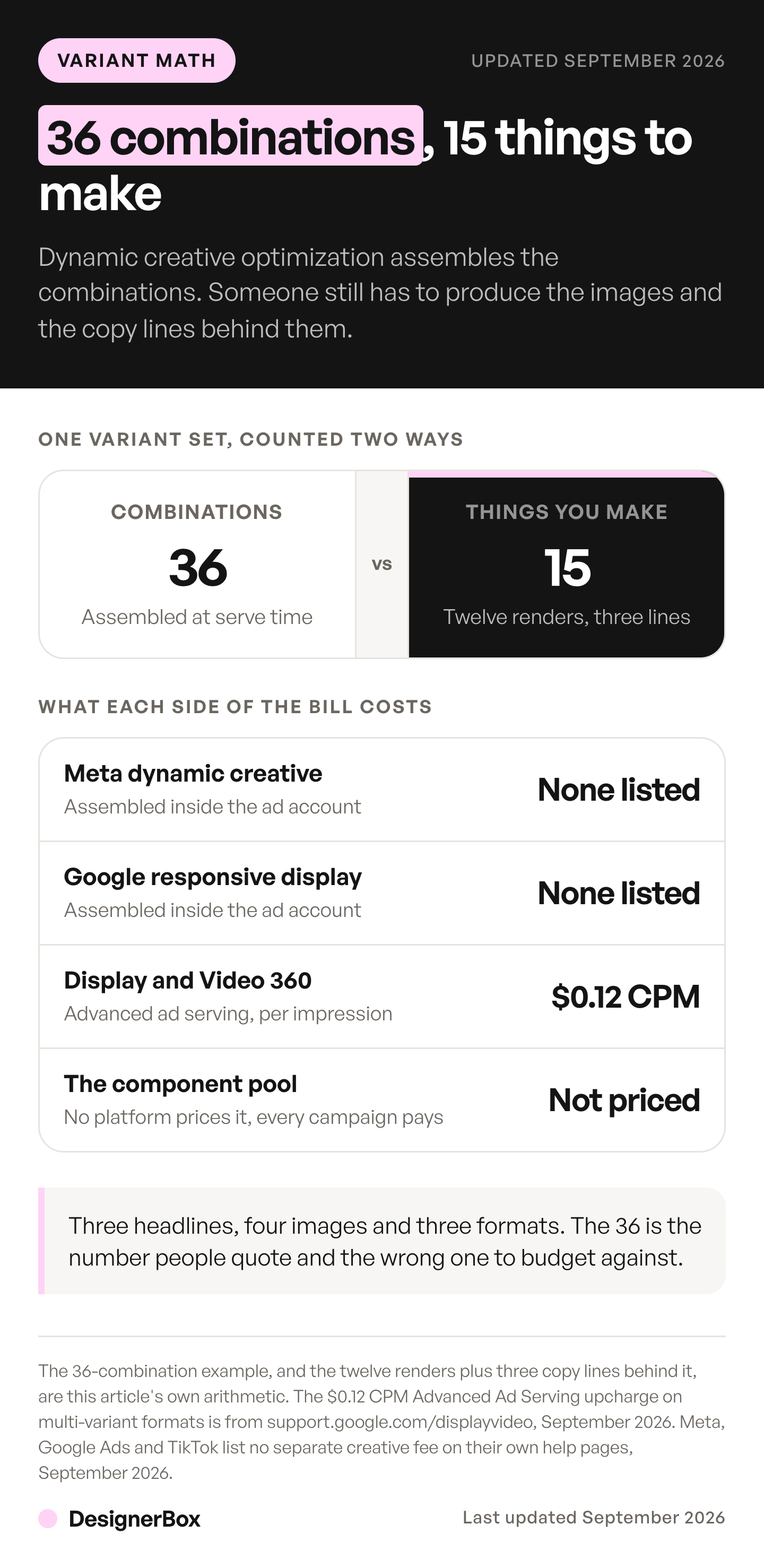
The classic route carries a number. Display and Video 360 charges an impression-based Advanced Ad Serving fee on top of basic ad serving: a $0.12 CPM upcharge on advanced display, video and audio formats, defined as multi-variant creative formats. It is charged once if Campaign Manager 360 runs alongside, arrived on 1 October 2022, and declining it blocks publishing new advanced creatives (support.google.com, September 2026).
The production line is arithmetic you can do before the brief goes out. Three headlines, four images and three formats gives 36 assembled combinations, which is the number people quote and the wrong one to budget against. The job is twelve renders plus three lines of copy.
That set is illustrative. In DesignerBox, the cost of the twelve renders is shown before the run, and the model you pick changes it the most. Basic is $15 a month billed monthly with 500 credits, and the plan ladder runs to 8,000 credits a month. Video cost grows with each second of output, and an 8-second clip costs 40 to 560 credits, depending on the model. The model picker moves both numbers more than the variant count does, and where static ads win against video splits the two by placement.
How many creative variants do you actually need?
Enough to fill the format’s required slots, then enough difference between them for the optimizer to have a real choice. Google’s responsive display ad recommends five images in each of two ratios plus five headlines and five descriptions. Meta’s flexible format caps at 10 assets, and Meta’s dynamic creative ceiling is 1,000 ads.
The gap between 10 and 400 is a budget decision rather than a published standard. You can at least count what competitors keep live, since the four free platform ad libraries list active creative per network, though run length is an inference and never a performance number. AdExchanger reports that DCO generates dozens, hundreds or thousands of variations, and tends toward A/B/n and multivariate testing because the count exceeds what an A/B test captures. The same piece quotes Braze recommending 10 to 15 variants, and reports that advertisers can ask their DCO platform for additional analysis when the reporting does not show which combination is working (adexchanger.com, April 2024).
A practical floor for paid social: cover every placement ratio, then vary one meaningful thing per axis rather than three cosmetic ones. Ten near-identical images give the optimizer nothing to separate. Sizing the batch against traffic you can buy is covered in ad variants at scale.
Where do the variants come from?
Every platform document read for this guide specifies what to upload and none specifies how to produce it. That is the supply layer: the images, the ratios, the copy lines and the refresh cadence. It is where the money and the calendar go, and it decides whether the assembly engine has anything worth choosing. Producing that pool from one approved template or one source photo is the job creative automation names, and it sits upstream of every platform in the table above.
The research supports putting effort there. Nielsen’s Project Apollo found in 2006 that 65% of a brand’s sales lift from advertising came from the creative. NCSolutions research across nearly 500 FMCG campaigns in 2016 and the first quarter of 2017 found media’s effect on sales had risen to 36% from 15% over the preceding eleven years, with creative still the largest single driver, and weak creative producing weak lift (nielsen.com, September 2026).
DesignerBox sits on this side of the line. It is AI creative production for agencies and brand teams. It does not serve ads, hold a product feed, bid in an auction or assemble anything at impression time. It produces the component pool that Meta, Google, TikTok or an ad server then assembles: product shots from one photo, on-model images, ad frames with room for your words, and video. The static ad templates start from that same product photo.
Multi-format output is worth automating first. Google’s own asset spec wants two image ratios and three video ratios, so one approved concept needs five shapes before Meta’s placements are counted. The ads resizer makes one ad in every size the ad platforms need. The case for running a job again is in scaling ad campaigns without scaling the team.
Build that shaping job once as a workflow, with your brand, your products and your rules. A saved workflow runs the same way on the next concept and the next product. You set the brand once, and the workflow reads it on every run. Batch, one workflow over a whole sheet of products, is coming. To build the first one, start from a template. The cost is shown before the run.
What are examples of dynamic creative optimization in practice?
Retail retargeting is the canonical one. A shopper views three products, the feed supplies those SKUs with image, title and price, and the ad renders the last viewed item with a cart reminder. Ecommerce catalog ads work the same way at SKU scale. Multi-location advertisers swap the branch, the showtime or the stock message per viewer.
Epsilon published a movie theatre chain that varied locations, showtimes and now-playing messages, reporting 237,000 creative iterations and a $541:1 return on ad spend (epsilon.com, December 2025). Treat that as vendor-reported: the page states no methodology, so it sizes the production job and proves nothing about your account. Assembling that many iterations starts from a campaign asset set.
Does DCO still work without third-party cookies?
Yes, with a narrower signal set. The walled-garden versions run on first-party signals, because Meta, Google Ads and TikTok match inside their own logged-in inventory. Feed-driven retargeting through an ad server is the exposed part, since it relies on a site pixel matched to a product feed. Signal loss shrinks the audience match while the assembly mechanism keeps working.
The vendor literature treats this as live rather than settled. Criteo runs a section on whether DCO uses cookies (criteo.com, September 2026) and AdExchanger’s explainer closes on signal loss (adexchanger.com, April 2024). Contextual and first-party signals such as location, weather, device, time of day and on-site behavior drive most of the personalization these pages name.
FAQ
What is dynamic creative in Meta ads?
Meta dynamic creative takes multiple creative elements you upload, such as images and headlines, and automatically combines them into different ad variations for your audience. The variations you get depend on the elements and placements you select. It caps at 1,000 ads, reports in aggregate, and does not work with multiple languages, asset customization or political content (facebook.com, September 2026).
Is dynamic creative optimization the same as A/B testing?
No. An A/B test splits the audience at random into non-overlapping groups so one variable can be read. DCO assembles a combination per impression and reports across all variations. AdExchanger notes it tends toward A/B/n and multivariate methods because the variation count exceeds what an A/B test captures. Meta states plainly that it is not a split-test substitute.
Do I need an ad server to run DCO?
Only for the classic version. Swapping elements inside a creative frame from a feed and content rules runs through Google Studio with Campaign Manager 360, and Display and Video 360 adds a $0.12 CPM advanced ad serving fee. Meta, Google Ads and TikTok run their own asset-combination versions inside the ad account with no separate creative fee listed.
How many images does a responsive display ad need?
Google requires at least one horizontal 1.91:1 image and one square 1:1 image, and accepts up to 15 of each. Five in each ratio are recommended, at 1200 x 628 for horizontal and 600 x 600 for square. Headlines, a long headline and descriptions are also required. Logos and videos stay optional (support.google.com, September 2026).
Does dynamic creative work for video?
Yes on all three platforms named here. Google’s responsive display ads accept video in 16:9, 1:1 and 2:3, with 30 seconds preferred. TikTok Smart Creative combines videos with text and a call to action, then refreshes fatigued ones. Meta’s flexible ad format selects between single image, video and carousel. Amazon Ads expects dynamic video to grow with streaming budgets.
Can AI generate the components for DCO?
Some of them, inside the platform. Meta’s Advantage+ creative includes generative enhancements such as add animation, add music, add overlays and image expansion. Outside the platform, the base assets still have to be produced. In DesignerBox, the cost of a twelve-render set covering three formats is shown before the run, and the model you pick changes it the most.
Sources
- Meta dynamic creative: the 1,000-ad cap, aggregate reporting, the split-testing caveat, the June 2024 restriction: facebook.com, September 2026
- Meta flexible ad format and the March 2026 Ad setup notice: facebook.com, September 2026
- Meta Advantage+ creative enhancements: facebook.com, September 2026
- Google responsive display ads: support.google.com, September 2026
- Google responsive display ad asset specifications: support.google.com, September 2026
- Google Studio dynamic creatives: support.google.com, September 2026
- Display and Video 360 Advanced Ad Serving fee: support.google.com, September 2026
- TikTok Smart Creative mechanic and fatigue refresh: ads.tiktok.com, September 2026
- Amazon Ads DCO definition: advertising.amazon.com, September 2026
- Nielsen and NCSolutions on advertising effectiveness: nielsen.com, September 2026
- Variation counts, testing method and the Braze variant recommendation: (adexchanger.com, April 2024)
- Feed mechanic and product feed fields: (stackadapt.com, June 2025)
- Samsung banner version count: (smartly.io, September 2026)
- Movie theatre iterations and reported ROAS: (epsilon.com, December 2025)
- Glossary definition and the cookies question: (criteo.com, September 2026)
- DesignerBox plans and the 8-second video cost range: DesignerBox pricing page (designerbox.ai/pricing), September 2026
Platform mechanics, asset specifications and serving fees verified from Meta, Google, TikTok, Amazon Ads and Nielsen documentation as of September 2026. Individual results vary.