

Seven AdCreative.ai alternatives cover most of what teams look for: DesignerBox, Adobe Firefly, Creatify, Predis.ai, The Brief, Abyssale and Pencil. An AdCreative.ai credit is spent when you download a creative, and you can generate as many creatives as you want (adcreative.ai, September 2026). That download limit is the first thing to check when you compare alternatives.
A note on bias. DesignerBox makes AI creative production software, so it is one of the tools on this list. This guide says where the other tools are the better choice.
AdCreative.ai does make video, including AI videos and UGC videos (adcreative.ai, September 2026). Its pricing needs care too. Each tier has several credit steps, and the billing toggle has three states. This guide prints no vendor prices. Each vendor lists its plans on its own pricing page, named below with the date so you can check it.
Key Takeaways
- An AdCreative.ai credit is a download. Generation is unlimited, and credits are consumed only on download, per AdCreative.ai’s own FAQ. That makes its credit count incomparable to any tool that counts generations.
- AdCreative.ai does make video, covering AI videos, UGC videos, product videoshoots and fashion videoshoots.
- There is no free AdCreative.ai plan, only a 7-day free trial. Creatify, Adobe Firefly and DesignerBox all publish a free tier.
- Adobe Firefly names its partner models publicly (adobe.com, October 2026). Model access alone stopped separating these tools in 2026, so compare scope and what happens on the second run.
- Check the plan gate on the feature you need. The plan you can afford may not carry it.
AdCreative.ai plans and what a credit buys
AdCreative.ai lists its plans on its own site (adcreative.ai, September 2026). There is no free plan, only a 7-day free trial. Refunds run 7 days on monthly plans and 30 on yearly, and only if the platform was not used.
The credit definition matters most, and AdCreative.ai states it plainly in its own FAQ: a credit is used when you download a generated ad creative, generation is unlimited, and credits renew every month (adcreative.ai, September 2026). Read that way, each plan is unlimited drafting and a fixed number of finished files a month.
That reframes the comparison. If your team explores widely and ships a few finals, the model suits you well. If you ship 40 variants a month across four placements, the download allowance is the binding constraint, and unlimited generation does not fix it.
Two more facts are worth having. AdCreative.ai was acquired by Appier, listed in Tokyo, in a deal announced February 2025 worth $38.7 million including a $27.3 million base (appier.com, February 2025). And the platform describes its generation as proprietary AI models trained on real performance data, without naming third-party models (adcreative.ai, September 2026). That is a difference in scope, and it matters only if per-shot model choice is something you need.
Billing states and credit steps
The billing toggle has three states: monthly, quarterly and yearly. The quarterly and yearly cards are footnoted as billed quarterly and billed yearly, so they are prepaid commitments shown as a per-month rate (adcreative.ai, September 2026).
Underneath that, each tier is a credit slider, and each step up the slider raises the price. Three billing states times several credit steps give one plan many possible figures. A usable figure carries two qualifiers: the billing period and the credit step. Promotions also run on this page, so a discounted rate may not be a standing one.
The 7 best AdCreative.ai alternatives in 2026

1. DesignerBox
DesignerBox is AI creative production for brands and agencies. It builds ad creative from your own product photos. Stills, on-model shots, video ads and social creative come from one workspace, and the steps behind an approved result are saved as a workflow instead of retyped. You pick the model for each step when you build the workflow, and every run after that uses it. A template comes with its model already picked. A product ad template and a social ad template are the closest match to AdCreative.ai’s job.
The difference is what happens the second time. AdCreative.ai generates ad creative and scores it for predicted performance, which is its main focus. DesignerBox focuses on the repeat job. A saved workflow runs the same way on the next product, so the next product gets the same brand rules, the same model and the same framing as the first.
An 8-second clip costs 40 to 560 credits, depending on the model. The plan gates and the pricing page are under fit and limits, below.
Best for brand and ecommerce teams, and the agencies that work for them, whose ads have to show the real product and who repeat the same set of shots every time a new product lands.
2. Adobe Firefly
Firefly carries a broad named model catalog, and it publishes its partner models by name. Its page lists Google’s Gemini with Nano Banana 2, GPT Image, FLUX.2, Runway, Kling AI and Luma AI (adobe.com, October 2026). It also offers free daily generations without a plan, across image, video and audio.
Where it differs is scope. Firefly’s plans sell generative credits that you can use across Creative Cloud apps, including Photoshop, Illustrator, Premiere and Adobe Express (adobe.com, October 2026).
Best for teams already inside Creative Cloud who want named partner models inside the apps they use. Adobe Firefly alternatives by team type covers the tools next to it.
3. Creatify
Creatify takes a product URL and returns video ads with AI actors, a more focused job than AdCreative.ai’s. It has a free plan, and exports on that plan carry a watermark (creatify.ai, September 2026). Creatify lists its plans on its own pricing page (creatify.ai/pricing, September 2026).
Its results are video. Still ad creative is outside its main focus.
Best for performance marketers whose unit of work is a talking-actor video variant from a product link.
4. Predis.ai
Predis.ai covers social creative broadly, spanning static posts, carousels and video from one place, with channel publishing built in. Predis.ai lists its plans on its own pricing page (predis.ai/pricing, September 2026). It publishes its own conversion rate from credits to images and videos. There is no free plan, only a 7-day trial.
Best for small teams who want ad creative and organic social posts in one place.
5. The Brief, formerly Creatopy
The Brief is the rename of Creatopy, and creatopy.com now redirects to thebrief.ai.
It offers an ad design workspace with brand kits, and it lists its plans on its own pricing page (thebrief.ai/pricing, September 2026). The notable design decision is that its AI carries no credit system at all and is included for normal use, so there is no per-asset arithmetic to do.
Best for teams producing display and banner sets at volume who want brand controls and no credit accounting. Creatopy alternatives by job covers the banner tools next to it.
6. Abyssale
Abyssale is built around templated batch generation, which is the shape of the problem when one campaign needs the same creative across many sizes and locales. It prices per seat and meters two credit pools, one for generations and one for AI features. There is a 14-day trial. Abyssale lists its plans on its own pricing page (abyssale.com/pricing, September 2026).
Best for teams automating multi-format banner and display sets from a template.
7. Pencil
Pencil connects generation to launch, and it lists ad launch across seven channels. It meters generations a month, and it lists its plans on its own pricing page (trypencil.com/pricing, September 2026). There is no free tier, though a guided flow offers a small number of free ads. A generation cap is the opposite convention to AdCreative.ai’s download cap.
Best for small teams who want generation and ad launch in one loop.
AdCreative.ai alternatives compared
Plan details are each vendor’s own published facts, read on the dates in the Sources. Each vendor lists its current prices on its own pricing page.
| Tool | How use is counted | Main job | Free plan |
|---|---|---|---|
| AdCreative.ai | Credits, spent on download. Generation is unlimited | Ad creative with predicted-performance scores | No, 7-day free trial |
| DesignerBox | Credits, spent per run | Templates, workflows and apps | Yes |
| Adobe Firefly | Generative credits | Named partner models | Yes, free daily generations |
| Creatify | Credits | Video ads with AI actors | Yes, exports carry a watermark |
| Predis.ai | Credits, with a published conversion rate | Social posts and ads, with channel publishing | No, 7-day trial |
| The Brief | No credit system | Ad design workspace with brand kits | No, 7-day trial |
| Abyssale | Per seat, with two credit pools | Templated banner sets | No, 14-day trial |
| Pencil | Generations a month | Generation and ad launch | No |
Three tools are not in this comparison, on purpose. Canva’s plan pages vary by location and render in the browser, so its plans were not compared here. Icon sometimes appears in lists of AI ad tools. Its main offer today is human-filmed UGC ads, labeled “no AI / 100% real” on its own site (icon.com, September 2026), which is a different scope. Pixelcut is an editing app rather than an ad generator, which is also a different scope.
Why credits are not a shared unit
A credit means a different action in each AI ad tool, so credit counts do not compare across tools.
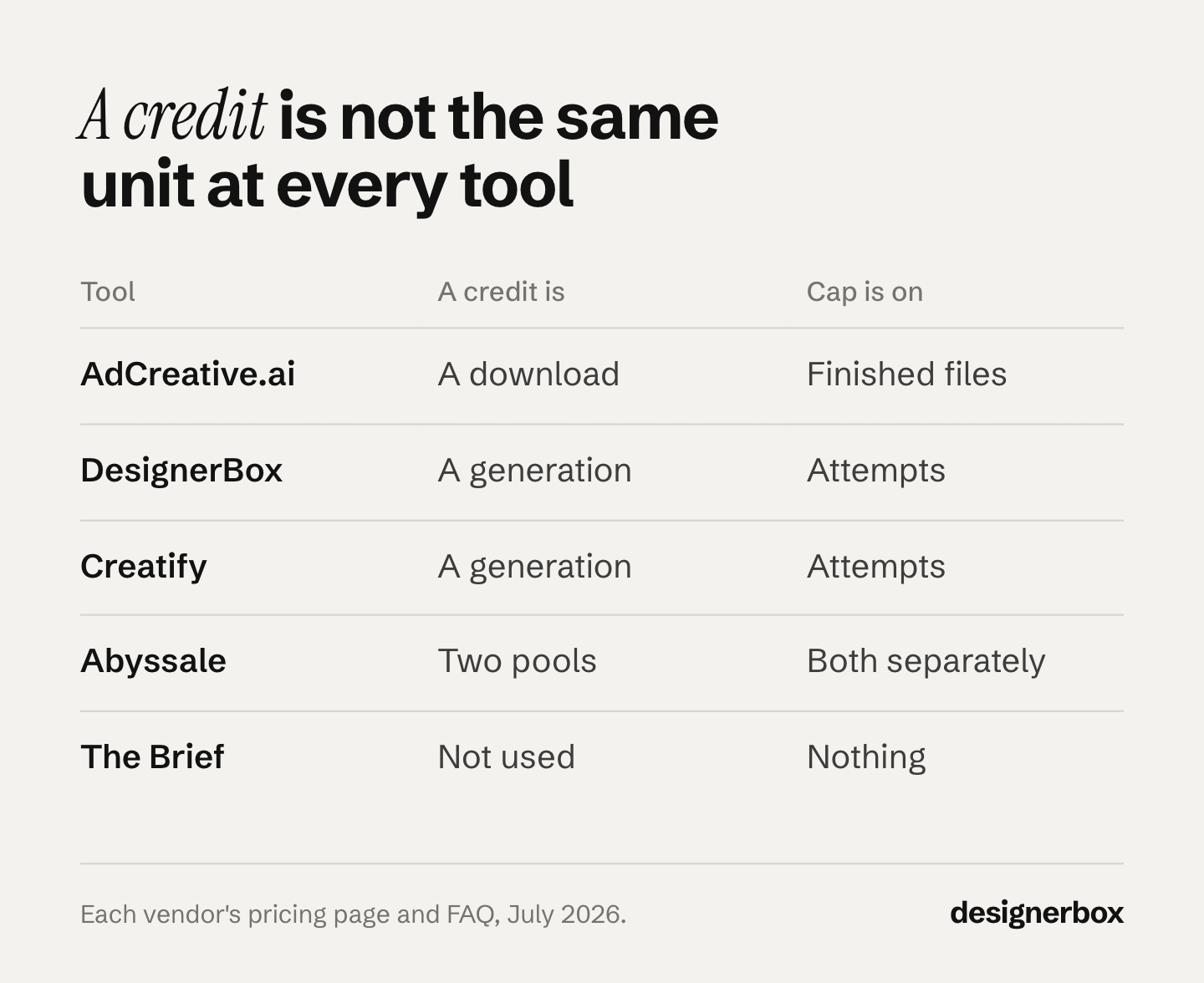
AdCreative.ai counts a credit per download and leaves generation unlimited. Creatify bills per generation, and DesignerBox charges credits per run. Abyssale runs two separate credit pools. The Brief has no credit system at all. Predis.ai publishes its own conversion rate, so its credits translate into a number of images and videos.
The rate moves inside a single tool too. In DesignerBox the image cost depends on the model you pick, so one month of credits makes a different number of images on different models. DesignerBox shows the cost before each run. Every tool on this page has its own rate. The number on a pricing card means little until you know the rate behind it.
A credit count is meaningful only next to that tool’s own consumption rate. The comparable unit is finished assets per month at the price you will pay. AI ad generator pricing explains why the plan price is a poor guide to the cost per ad, and the six-tool AI stack covers the same output across separate tools.
How to pick an AdCreative.ai alternative
Start from output volume, because it is the only input that reliably changes the answer.
- Count your monthly finals. Not drafts. The files that reach an ad account. TikTok’s own guidance recommends 3 to 5 creatives per ad group and 3 to 5 ad groups per campaign, putting one campaign at 9 to 25 assets before any refresh (ads.tiktok.com, September 2026).
- Decide whether you need video. The rate for a clip moves with the model you pick. Price the clip you will run, not the seat.
- Check the gate on the feature you came for. The plan you can afford is often not the plan carrying the capability.
- Check whether the asset has to be your actual product. Generated lookalikes are fine for concepting and a problem on a product detail page.
- Confirm the billing period and any live promotion before the number goes in a budget.
- Ask what the tool does about AI labeling. This moved after this article first published, and this is general information, not legal advice. We found no federal US rule that requires an “AI-generated” label on ads, as of September 2026, and FTC rules against deception still apply. In New York, if you make an ad and you know it contains a synthetic performer, the ad must say so in a way people will notice. That law took effect on 9 June 2026 (NY General Business Law 396-b, September 2026). Article 50 of the EU AI Act has applied since 2 August 2026, and its deployer duty covers deep fakes (European Commission, September 2026). Platforms differ. In July 2026 Google added an AI label setting across its ad products (support.google.com, September 2026). Google also says rules in the EU, India and New York require labels on some AI ads (Google Ads Help, September 2026). TikTok asks for disclosure on ads that contain fully AI-generated or heavily AI-edited images, video or audio, and it rejects or restricts undisclosed AI content (ads.tiktok.com, September 2026). TikTok lists removing or changing a background as an edit that needs no label. Which assets trigger a label is covered in labeling AI-generated images.
Demand is not shrinking. IAB reports nearly two in three video buyers now use generative AI for creative, up from half in 2025, and expects one third of ad assets to use it this year, reaching 43 percent by 2027 (iab.com, October 2026). Meta publishes creative fatigue recommendations in Ads Manager, which appear when an audience has seen the same creative too many times and cost per result rises above its past level (facebook.com, September 2026). Volume is the requirement, and the unit price of a finished asset decides whether you can meet it.

For a wider read, the best AI ad generator starts from the free tiers, what an AI ad generator is covers the types and rules, and the Creatify alternatives comparison sits closest to this one on video-first tools. Arcads alternatives compares the AI actor tools. For organic posts rather than ads, AI social media marketing for small business sets out a weekly routine.
DesignerBox fit and limits
DesignerBox fits when the assets have to be your real product and the same set of shots repeats every time a new product lands. You set the brand once, and the workflow reads it on every run. A colleague can run the same job through an app, which is a workflow with a form. Three critic steps score the results, and best-of-N keeps the best one. Batch runs one workflow over a whole sheet of products. The full workflow from the first product photo to the finished ad, in one subscription.
AdCreative.ai is the better choice for predicted-performance scoring before launch, which is its main focus. DesignerBox is also a poor fit if your ads are video and your budget stops below Premium, because AI video starts on the Premium plan. Uploading your own photos and the commercial license start on the Pro plan, and the free plan runs on sample products. DesignerBox does not publish to an ad account. You download the results, or send them with a webhook or an S3 step. For an agency, team features are on the Ultra plan, and every plan below Ultra is one seat. The static ad templates show the ad side. The DesignerBox and AdCreative.ai comparison page sets the two side by side. The pricing page lists every plan with its billing period. Shhots AI alternatives covers a close neighbor.
The first job is one ad set, built once. Start from a template, add your brand and your products, and run it. See the templates.
FAQ
Does AdCreative.ai make video ads?
Yes. AdCreative.ai’s pages cover AI videos, UGC videos, product videoshoots and fashion videoshoots, and its trial copy says the trial credits make ads, banners, videos and UGC videos (adcreative.ai, September 2026).
How much does AdCreative.ai cost?
AdCreative.ai lists its current prices on its own pricing page (adcreative.ai, September 2026). Each tier has several credit steps and three billing periods: monthly, quarterly and yearly. Check the billing period and the credit step before a figure goes in a budget.
What does an AdCreative.ai credit include?
A credit is consumed when you download a generated creative, and generation is unlimited (adcreative.ai FAQ, September 2026). Each plan allows unlimited drafting and a fixed number of downloaded finals a month. That makes its credit count incomparable to tools that count generations.
Is there a free AdCreative.ai alternative?
Yes. DesignerBox has a free plan, Adobe Firefly offers free daily generations, and Creatify has a free plan whose exports carry a watermark (vendor pages, September 2026). AdCreative.ai itself has no free plan, only a 7-day free trial.
How do I compare costs across AdCreative.ai alternatives?
Compare finished assets per month, and leave the entry price for last. Each tool counts use differently: downloads, generations, seats, or no credits at all. Check whether the feature you need sits on a higher tier, and read each vendor’s own pricing page for the current figure. DesignerBox shows the cost before each run.
Does AdCreative.ai say which AI models it uses?
No. Its site describes proprietary AI models trained on real performance data and does not name a third-party model on any page checked (adcreative.ai, September 2026). Tools publishing a model catalog, including Adobe Firefly and DesignerBox, let you pick a model per shot instead.
What is AdCreative.ai, and who owns it?
AdCreative.ai is an AI ad generator that makes ad creative and scores it for predicted performance. Appier, listed in Tokyo, acquired AdCreative.ai in a deal announced February 2025 valued at $38.7 million including a $27.3 million base (appier.com, February 2025).
Sources
- AdCreative.ai credit steps, billing states, trial and refund terms, video pages, model description and the credit-is-a-download definition: (adcreative.ai, September 2026)
- Adobe Firefly free daily generations, generative credits and named partner models: (adobe.com, October 2026)
- Creatify free plan and watermark: (creatify.ai, September 2026)
- Predis.ai channel publishing, trial and published conversion rate: (predis.ai/pricing, September 2026)
- The Brief (formerly Creatopy) brand kits, trial and no-credit-system design: (thebrief.ai/pricing, September 2026)
- Abyssale per-seat pricing, dual credit pools and trial: (abyssale.com/pricing, September 2026)
- Pencil generation metering, launch channels and free guided ads: (trypencil.com/pricing, September 2026)
- Icon’s human-filmed UGC offer: (icon.com, September 2026)
- Appier’s acquisition of AdCreative.ai and deal value: (appier.com, February 2025)
- New York General Business Law section 396-b, synthetic performer disclosure in advertising, effective 9 June 2026: nysenate.gov, September 2026
- EU AI Act Article 50 and its 2 August 2026 application date: European Commission FAQ on Article 50, September 2026
- Google’s AI label setting across its advertising products, July 2026: support.google.com, September 2026
- Google on EU, India and New York rules that require labels on some AI ads: Google Ads Help, September 2026
- TikTok’s disclosure rule for AI-generated or heavily AI-edited ad media, the rejection consequence, and edits that need no label: ads.tiktok.com, September 2026
- Generative AI adoption among video buyers and the share of ad assets forecast: IAB news release on the 2026 Digital Video Ad Spend and Strategy Report, 14 July 2026, iab.com, October 2026
- Creative fatigue recommendations in Meta Ads Manager: facebook.com, September 2026
- Recommended creatives per ad group and ad groups per campaign: TikTok creative best practices for performance ads, ads.tiktok.com, September 2026
- DesignerBox plans, credits, the video cost range and plan gates: DesignerBox pricing page (designerbox.ai/pricing), September 2026
Plan and feature claims verified from each vendor’s own published pages on the dates above. Disclosure law, platform ad policy and industry data re-verified September 2026. AdCreative.ai’s credit definition, trial and refund terms, the Adobe Firefly page and the IAB release were re-checked on 2 October 2026. Plans in this category change often and promotions run frequently. Check each vendor’s billing toggle and credit step before budgeting. Individual results vary.