

Most brands do not need 100 ad variants a month. The right ad creative volume follows your spend tier. Motion’s benchmark data across 578,750 Meta creatives puts the smallest spend tier at 2.8 new creatives a week, and its top quartile at 4.8. A hundred a month is the volume of the top accounts in the largest tiers. Find your number first, then size the batch.
A round target such as 100 a month says nothing about spend tier or cost. Two accounts can aim at the same number, and only the larger one can fund it. What is in the batch and which model runs it decide the bill.
This covers what the benchmark data and the platform documentation say about monthly creative volume, how to fit a month of variants to a plan, and the four-week rhythm that produces one without a production team.
Key Takeaways
- The published volume benchmark is per spend tier. Motion’s data puts the smallest tier at 2.8 new creatives a week and the largest at 18.8, and top-quartile accounts test 1.7 to 2.9 times their tier average (motionapp.com, September 2026).
- A hundred a month is a large-account number. At 4.3 weeks a month, only the top quartile of the two largest tiers clears it.
- TikTok publishes a number and it is 12. Its account recommendations state advertisers use at least 12 videos each month to avoid ad fatigue in Smart+ or GMV Max campaigns (ads.tiktok.com, September 2026).
- Meta publishes no monthly count. Its creative diversification guidance asks for ads that differ in look, feel, storyline and message (facebook.com, October 2026). Its ad set guidance recommends no more than five ads per ad set (facebook.com, September 2026).
- Volume does buy winners, at a stated rate. Motion reports that about 5% of creatives become winners, so 20 uploads yield about 1 winner and 50 uploads about 2.5 (motionapp.com, September 2026).
- Stills are the cheap half of a batch. In the video half, the model choice moves the bill most.
- Composition decides the bill. Fix the count from your tier, fix the static-to-video ratio from your budget, and the production question becomes trivial. Cover every ecommerce ad format before you multiply variants inside one of them.
How much ad creative volume do you need each month?
Monthly ad creative volume comes from your spend tier, not from a headline. Motion’s Creative Benchmarks 2026 analyzed 578,750 creatives, $1.29 billion in Meta ad spend and 6,015 advertiser accounts, and reports new creatives launched per week by monthly spend tier. The smallest tier averages 2.8 a week. The largest averages 18.8. Top-quartile accounts inside each tier launch 1.7 to 2.9 times their tier average (motionapp.com, September 2026).
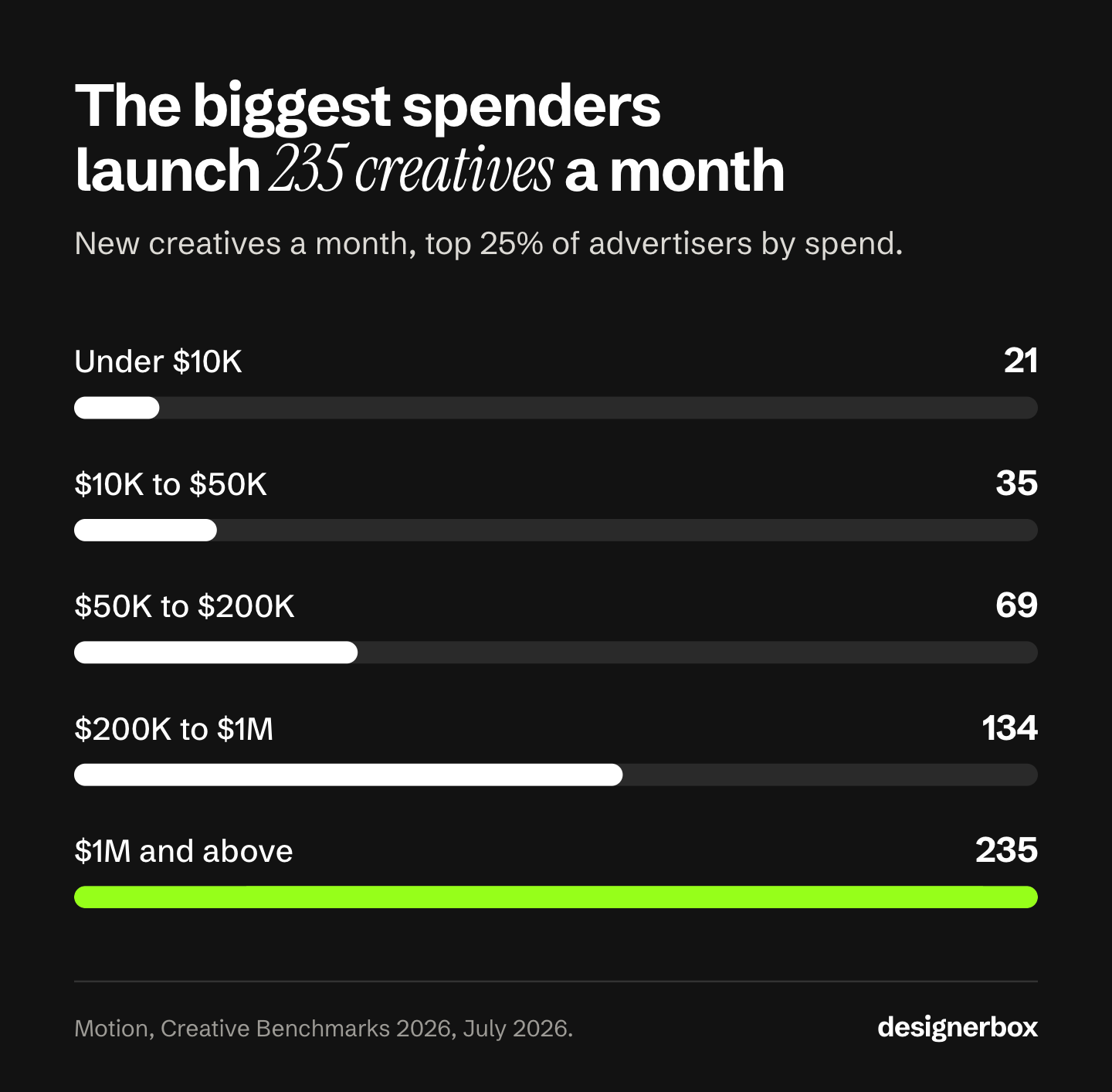
| Motion spend tier | New creatives per week, all accounts | Top 25% | Roughly per month, top 25% |
|---|---|---|---|
| Micro, under $10K | 2.8 | 4.8 | 21 |
| Small, $10K to $50K | 4.1 | 8.0 | 34 |
| Medium, $50K to $200K | 6.6 | 15.9 | 68 |
| Large, $200K to $1M | 11.2 | 31.1 | 134 |
| Enterprise, $1M and above | 18.8 | 54.6 | 235 |
Monthly figures use 4.3 weeks. Motion defines the tiers by monthly Meta ad spend, and it describes the top 25% as the accounts with the most winners inside each tier.
Two things fall out of that table. A hundred variants a month is a habit of the top Large and Enterprise accounts, not a universal target. And the gap between a tier’s average and its top quartile is the gap worth closing, because it is the one your own account can move this quarter.
The winners math is what makes the climb worth funding. Motion reports that about 5% of creatives become winners, meaning they spend at least 10 times their account’s median and at least $500. That puts 20 uploads at about 1 winner and 50 uploads at about 2.5. The average hit rate rises from 4.0% at Micro to 8.8% at Enterprise. Motion also finds that, holding budget constant, advertisers that test more creatives a week surface more winners, and top-quartile accounts get 2 to 3 times more winners a month than their tier average (motionapp.com, September 2026).
What the platforms publish is smaller than the advice
TikTok is the only major platform that names a monthly figure, and the figure is 12. Its account optimization recommendations tell advertisers that “advertisers like you use at least 12 videos each month to avoid ad fatigue” in Smart+ or GMV Max campaigns (ads.tiktok.com, September 2026). Its creative best practices page recommends three to five different creatives per ad group and three to five diversified ad groups per campaign, and advises adding new creatives to an existing ad group rather than building a new one, to extend that group’s lifetime (ads.tiktok.com, October 2026).
Meta names no monthly figure. Its creative diversification guidance asks advertisers to develop ads that differ in look, feel, storyline and message (facebook.com, October 2026). Its ad set guidance names a ceiling: Meta recommends “running no more than five ads per ad set for optimal delivery” (facebook.com, September 2026). Its A/B test compares up to five versions of an ad (facebook.com, October 2026).
Run those two together and the picture is consistent. The platforms want a steady refresh of genuinely distinct creative, not a wall of near-duplicates delivered at once. A batch of 100 near-identical variants and a batch of 20 distinct ones will not perform the same, and only one of them is expensive. The ad versioning guide shows which layers of an ad a platform reads as different.
Distinctness starts at the first frame rather than the filter. The hook shapes that produce genuinely different ads from one product are covered in TikTok product ad examples.
Advertisers with no product photo to vary have a narrower starting point, which is worked through in what to show in a SaaS ad when there is no product. Small B2B audiences change the count too, and B2B ad formats and examples works through the monthly number from LinkedIn’s guidance. A multi-card format multiplies the count again, as the file math for carousel ads shows.
Distinctness also decides whether the results can be read at all. Loading a large batch into a single ad set produces a delivery report rather than a test result, which is worked through in why most ad creative tests cannot be read.
Variant cost is one line in a larger budget. AI digital marketing, priced function by function, covers where the rest of it goes.
Cost of a month of variants
Cost splits on two lines: whether the variant is a still or a clip, and which model runs it. In DesignerBox an 8-second clip costs 40 to 560 credits, depending on the model. A still costs far less, and its cost also depends on the model. Every run shows its cost before you start it, so you can check a batch against your allocation while you build it.

The plan decides what a batch may contain before credits enter the calculation.
| Batch shape | Plan it starts on | Why |
|---|---|---|
| Statics for paid ads | Pro | Uploading your own photos and the commercial license start on the Pro plan |
| Statics plus a small video set | Premium | AI video starts on the Premium plan |
| A video-led batch, or two people working in parallel | Ultra | Team features, shared brand kits and white label are on the Ultra plan, and every plan below Ultra is one seat |
Plans and credits are on the pricing page. Inside each shape, the model choice moves the bill more than the count does. What drives the cost of a video take is covered in what AI video costs, and sizing a video-only pack is in what a video ad pack costs before it runs.
The batch that fits your plan
Start from the allocation. Three compositions cover most accounts.
Statics only, from Pro. This is the right shape for feed placements, catalog ads, and any account below the Medium spend tier. It is also the lowest-cost way toward a three-figure monthly count. The specs for each platform are in image ads.
A small video set plus statics, on Premium. Twelve short clips clear TikTok’s stated monthly minimum, and the rest of the allocation goes to stills. It covers a paid-social calendar running both Meta and TikTok.
A video-led batch, on Ultra. Video becomes the center of the batch. It is the shape for accounts where two people build the batch in parallel.
Inside the video half, the model moves the total most. Twelve takes on a low-cost video model and twelve on a premium model sit at opposite ends of the video credit range. Pick the lowest-cost model that carries the look. Read the run cost on screen, then check the total against your allocation before you run anything.
The four-week rhythm that produces the month
Volume comes from removing repeat setup, not from working faster. The brief, the product photo and the brand rules get built once. Each additional variant then costs its credits and its render time, and nothing else. The same logic applies to the calendar rather than the count, which is the subject of how to launch campaigns faster.

Week 1: build the source set. Upload the product photo. Produce the angles, the backgrounds and the on-model shots that everything downstream will crop from. Twenty to thirty stills is enough, and it is the only week that involves art direction.
Week 2: vary the message, hold the image. Same visuals, different hooks, headlines and offers. This is where the count multiplies without the credit cost multiplying, because copy variants of an existing asset are cheap.
Week 3: read the account, then cut. Motion’s hit rate says most of what you launched will not win. Switch off the losers, note which angle survived, and stop producing variants of the ones that did not. Creative fatigue and the spend side of this loop are covered in how to scale AI ad campaigns without burning budget.
Week 4: rerun the winner. Save the winning setup as a workflow and rerun it against the next product, the next drop or the next client. This is the step that turns a good month into a repeatable one, and it is the same mechanic small agencies use to add creative capacity without adding designers.
Weeks 2 through 4 repeat. Week 1 only repeats when the product does.
Three batch shapes and when each one earns its place
Shape A, one product into a full spread. The product photo produces packshots, flat lays, styled scenes, on-model shots and social crops, and the same setup runs again for the next SKU. Best for a catalog with new SKUs monthly. Cost grows with the count, and the model you set decides how fast, so the count is limited by review time rather than by budget. DesignerBox apps put a job like this behind a form, so a colleague adds the product photo and runs it.
Shape B, one angle across many messages. One visual treatment, ten to twenty copy and offer variants. Best when the creative is working and the offer is the unknown. This is the cheapest way to raise a monthly count, and the one most teams under-use.
Shape C, a small video set on a proven angle. Six to twelve clips, built only after a static angle has already won. Best for TikTok and Reels, where the platform asks for the refresh. Build this last, because it is the half of the batch that carries the cost. The break-even math for that spend is in improve ROAS with product video.
Most accounts should run A once, B continuously, and C only against a validated angle. Running C first spends the most credits before you know which angle works.
Where the volume argument stops
Volume raises the number of winners at a fixed rate. It does not fix a bad offer, a broken landing page, or a product with no demand, and it will not rescue an account that cannot read its own tests.
Three limits are worth stating before anyone plans a quarter around this.
Video costs more than stills, and the model decides how much more. Pick the model for each shot. A premium model on clips that do not need it raises the cost of the whole month.
More variants only pay if the production system behind them can absorb the load, which is a review-queue question before it is a generation one. The four repeat costs in ecommerce creative production works through where that ceiling sits.
More variants also only pay if the account can distinguish them. If your weekly conversion volume cannot support the number of ad sets your batch implies, the extra creative sits unread. Size the test cells first, then size the batch to fill them. Then budget the finishing pass, because a generated image is not yet a shippable ad and the layout step is where variant counts turn into real hours. For one layout across several languages, see localizing one layout across markets.
One setup for every drop
In DesignerBox, saved workflows hold the winning setup. A template for winning-ad variations builds new versions from an ad that already works, without rebuilding the brief per variant. When the batch is large enough to script, the DesignerBox MCP server gives an AI chat such as Claude, ChatGPT or Cursor 68 tools. The full workflow from the first product photo to the finished ad, in one subscription. The ad sizes and languages guide shows the steps for rebuilding one approved ad at every size and in every language.
You build the setup once with your brand rules, your product and the models you picked. The workflow then runs the same way on the next drop and the next client, and batch runs it over a whole sheet of products at once. See the templates.
FAQ
How many ad variants should I produce each month?
Take it from your spend tier. Motion’s benchmark data across 578,750 Meta creatives puts the smallest tier at 2.8 new creatives a week and its top quartile at 4.8, rising to 18.8 and 54.6 at the largest tier (motionapp.com, September 2026). At 4.3 weeks a month that is roughly 12 to 21 at the bottom and 81 to 235 at the top. The useful target is your tier’s top quartile, not the largest number you have read.
Is 100 ad variants a month realistic without a team?
For statics, often yes. The work is one week of art direction plus three weeks of variation. For video it depends on the model, and a hundred clips on a premium model cost far more than a hundred stills. AI video starts on the Premium plan.
How many creatives does Meta recommend per ad set?
No more than five. Meta recommends running no more than five ads per ad set for optimal delivery (facebook.com, September 2026). Its creative diversification guidance asks advertisers to develop ads that are “truly different in look, feel, storyline, and message” (facebook.com, October 2026). Anchor on the thresholds Meta does publish, and derive the rest from your own conversion volume.
How much does it cost to make 100 ad variants?
In DesignerBox the cost of each run is shown before you start it, and it depends on the model. Stills are the cheap part. Video costs more: an 8-second clip costs 40 to 560 credits, depending on the model. Plans and credits are on the pricing page. The composition of the batch and the model behind it set the bill more than the count does.
Should the batch be video or static?
Start static, add video against a validated angle. Statics cost far less per variant and let you find the winning message cheaply. The video then carries the angle that already won. TikTok is the exception worth funding early, since its own recommendation is at least 12 videos a month for Smart+ and GMV Max campaigns (ads.tiktok.com, September 2026).
How often should I refresh ad creative?
TikTok recommends refreshing when delivery results show a consistently declining trend or daily new users are low, and advises adding new creatives to an existing ad group rather than creating a new one, which extends that group’s lifetime (ads.tiktok.com, October 2026). Meta publishes no refresh cadence. A monthly cycle with a mid-month cut satisfies both without producing creative nobody reads.
Do more ad variants produce more winners?
At a published rate, yes. Motion reports that about 5% of creatives become winners, which puts 20 uploads at about 1 winner and 50 at about 2.5. It also finds that, holding budget constant, advertisers that test more creatives surface more winners (motionapp.com, September 2026). The rate holds only while the variants stay genuinely distinct. Near-duplicates raise the count and not the hit rate.
Sources
- Creative volume and hit rate per spend tier, top-quartile figures, the ~5% winner share and the volume-to-winners finding, from Motion’s Creative Benchmarks 2026: (motionapp.com, accessed September 2026)
- TikTok’s recommendation of at least 12 videos a month for Smart+ and GMV Max campaigns: ads.tiktok.com, accessed September 2026
- TikTok’s three-to-five creatives per ad group guidance and its refresh advice: ads.tiktok.com, accessed October 2026
- Meta’s creative diversification guidance, published 16 December 2025: Meta for Business, accessed October 2026
- Meta’s A/B test limit of five versions: Meta Business Help Center, About Experiments, accessed October 2026
- Meta’s recommendation of no more than five ads per ad set: Meta for Business, ad set structure, accessed September 2026
- DesignerBox plans, the video credit range and feature gating: DesignerBox pricing page (designerbox.ai/pricing), September 2026
Creative volume benchmarks and hit rates from Motion’s Creative Benchmarks 2026, covering 578,750 creatives, $1.29 billion in Meta ad spend and 6,015 advertiser accounts, accessed September 2026. Motion is a vendor, and these are its own figures. TikTok’s 12-video recommendation and Meta’s five-ads-per-ad-set recommendation verified in September 2026. TikTok’s creative best practices, Meta’s creative diversification guidance and Meta’s A/B test limit re-checked on 2 October 2026. DesignerBox plans from the DesignerBox pricing page, September 2026. Individual results vary.