
An AI agent builder is a platform where you assemble a multi-step AI job without writing the orchestration code yourself. You set a trigger, lay out the steps, pick which tools the agent may call, and say where the output lands. Marketing teams use them for research, routing, briefing and asset production. Entry prices run from free to about $37 a month.
A team buying one of these platforms is buying two things at the same time. The first is a place to draw the steps. The second is a bill for every step that runs, forever. The second one moves, and it moves faster than the first. OpenAI shipped a visual agent canvas in 2026 and has already scheduled it to close: Agent Builder shuts down on 30 November 2026 (developers.openai.com, September 2026). Whatever you draw today has to outlive the editor you drew it in.
This guide covers the platforms a marketing team would actually shortlist, with prices read from each vendor’s own page in September 2026. Then it covers the part the roundups skip: the five pieces you still have to supply yourself, what the running cost looks like once creative work is involved, and which jobs are worth building versus buying outright. It is written for a marketing lead with a small team, a real budget line, and no ML engineer.
Key Takeaways
- The canvas is the cheap part. Entry plans run $9 to $37 a month. The generation, the storage and the person who maintains the graph cost more than the seat does.
- Most builders orchestrate text, not pixels. Zapier, Make and n8n move data between systems very well. Producing an on-brand product image or a video ad is a separate tool and a separate bill.
- Free tiers are real but small. Zapier’s free plan carries 100 tasks and 400 agent activities a month; Make’s carries up to 1,000 credits with no time limit (zapier.com/pricing and make.com/pricing, September 2026).
- Platform risk is now priced in. OpenAI’s own visual builder is scheduled to shut down on 30 November 2026, which is a fair warning about how much logic to trap inside any one canvas.
- Five parts have to exist before an agent is useful: model access, brand context, a review gate, storage, and a way to rerun the job for the next product.
- Price the work, not the seat. In DesignerBox an image is 4 to 22 credits depending on the model, and an 8-second clip is 40 to 560. The model you pick moves the video bill 14x on the same shot.
- A human approval step is a standard node type. OpenAI documents Human approval as one of eleven Agent Builder node types (developers.openai.com, September 2026), and it belongs anywhere the output goes somewhere public.
What is an AI agent builder?
An AI agent builder is a visual environment for defining an agent: what starts it, which model reasons over the input, which tools it may call, how it branches, and what it returns. It removes the orchestration code, not the design work. You still decide the sequence, the guardrails and the failure behaviour. The output is a graph you can version, test and rerun.
Two shapes sit under the same phrase. The first is an automation platform that added agents to an existing trigger-and-action product, which is where Zapier and Make sit. The second is a canvas designed around agents from the start, which is where Gumloop and n8n’s agent tooling sit. Both produce something that runs on a schedule or on an event. The difference shows up in how much branching and looping you can express before the graph stops being readable.
The vocabulary is more standardised than it looks. OpenAI publishes eleven node types for Agent Builder across four groups: Start, Agent and Note; File search, Guardrails and MCP; If/else, While and Human approval; Transform and Set state (developers.openai.com, September 2026). Almost every other builder ships some version of that same list under different names, so learning one vocabulary transfers. Creative canvases run on the same parts, and what each node on a workflow canvas does maps those jobs across six tools.
What is the difference between an AI agent and an AI workflow?
A workflow runs the steps you wrote, in the order you wrote them, every time. An agent decides part of the sequence itself: which tool to call, whether to loop, when it has finished. The same canvas usually builds both, and the distinction matters because it changes what can go wrong and what you have to test.
Most production marketing automation is a workflow with one agentic step inside it. The trigger, the routing and the delivery are fixed. The judgement call sits in the middle, where a model reads a brief and picks a treatment, which is the branch stage in the five stages a creative chain runs through. That shape is deliberately conservative, and it is the right default: fixed steps are cheap to debug, and the agentic step is contained to the one place where judgement is actually needed.
Full agent autonomy is worth reaching for when the input varies more than the process can anticipate. Sorting a mixed inbox of supplier photos into the right treatment is a genuine agent job, because you cannot enumerate the cases in advance. Resizing an approved image into six placements is not, because you can. Paying agent prices for work a fixed workflow handles adds cost and a class of failure you did not need.
The practical read: start with the fixed sequence, find the one step that keeps needing a human decision, and give that step to a model. Expanding outward from a working workflow produces something maintainable. Building a fully autonomous agent first and constraining it afterwards rarely does.
Which AI agent builders should a marketing team shortlist?
Five platforms cover most of what a marketing team needs, and they split cleanly by shape. Zapier and Make are automation products with agents added. n8n is a node graph you can self-host. Gumloop is a canvas built around agents. Lindy is assistant-shaped and priced per user. Every price below was read from the vendor’s own pricing page in September 2026.
| Platform | Entry paid price | Free tier | Shape |
|---|---|---|---|
| Make | Core $9/mo, 10,000 credits | Up to 1,000 credits a month, no time limit | Visual scenario canvas, AI agents in beta on all plans |
| n8n | Starter 20 EUR/mo billed annually, 2,500 executions | Community edition, self-hosted, Fair-code licence | Node graph, cloud or self-hosted |
| Zapier | Professional from $19.99/mo billed annually, $29.99 monthly, at 750 tasks | 100 tasks and 400 agent activities a month | Trigger and action automation with agents layered on |
| Lindy | Plus $29.99/mo per user, 3,000 credits per user | First week free when joining through Slack | Assistant with skills, priced per seat |
| Gumloop | Pro from $37/mo, 20,000 credits, unlimited seats | 14-day Pro trial | Node canvas designed around agents |
Make lists the lowest entry price of the five: Core at $9 a month for 10,000 credits, with AI Agents in beta on every plan including the free one (make.com/pricing, September 2026). The free plan has no time limit, so a team can leave a small agent running indefinitely without a card on file.
n8n is the one to reach for when data handling or hosting rules matter. The community edition is free, self-hosted and published under n8n’s Fair-code licence, and the paid cloud plans start at 20 EUR a month billed annually for 2,500 executions with unlimited users and workflows, rising to 50 EUR a month for 10,000 executions (n8n.io/pricing, September 2026). Self-hosting is outside the scope of what a two-person marketing team should take on, but it is genuinely available.
Zapier meters two things separately, which is the term to read before you buy. The free plan includes 100 tasks and 400 agent activities a month, and Professional starts at $19.99 a month billed annually or $29.99 billed monthly at 750 tasks, with 1,500 agent activities included (zapier.com/pricing, September 2026). A busy agent can exhaust one allowance while the other sits unused, so budget against both numbers rather than the headline price.
Lindy prices per user rather than per run: Plus is $29.99 a month per user with 3,000 credits per user, Pro is $99.99 with 15,000, and Max is $199.99 with 35,000 (lindy.ai/pricing, September 2026). Per-seat pricing suits a team where several people each want their own assistant. It fits less well when one shared agent runs a scheduled job for the whole team, because you pay by head rather than by run.
Gumloop starts at $37 a month for the Pro plan with 20,000 credits and unlimited seats, on a 14-day trial, with Enterprise priced on request (gumloop.com/pricing, September 2026). Unlimited seats on the entry paid tier is the standout term for an agency that wants many people touching one shared set of agents.

Two more belong on the list even though neither is priced like the five above. OpenAI documents AgentKit as three interconnected building blocks, Agent Builder, ChatKit and Evals (developers.openai.com, September 2026), and the visual builder is scheduled to shut down on 30 November 2026, with ChatKit and the Agents SDK named as the paths forward (developers.openai.com, September 2026). Google’s Gemini Enterprise Agent Platform runs a managed serverless agent runtime with sessions, a Memory Bank for long-term context, an evaluation service and IAM agent identity, and it accepts agents built with the Agent Development Kit, LangChain, LangGraph, LlamaIndex, AG2 or Agent2Agent (docs.cloud.google.com, September 2026). Both are billed through their parent platform rather than a flat monthly seat.
Code-first frameworks sit one layer below all of this. LangChain, LangGraph and CrewAI are open source and give you full control of the loop, at the cost of an engineer who owns it. They are the right answer when the agent is a product feature. They are a heavier commitment than the job needs when the agent’s only work is saving a marketing manager a few hours a week.
What do you actually have to assemble to build a marketing agent?
A builder gives you the graph and the connectors. It does not give you the five things that decide whether the agent produces anything worth shipping: access to the right models, your brand context, a review gate, storage the team can search later, and a way to rerun the whole job for the next product. An agent missing two of them will demo well and stall in production.
Model access is the first gap, and it is bigger than it looks. Most builders connect you to text models by default. A marketing agent that writes ad copy is fine on that. A marketing agent that produces the ad needs image and video models, which means either separate API keys and separate bills per provider, or a platform that already carries the catalog. DesignerBox carries 8 image models and 13 video models behind one workflow, including Nano Banana Pro, Seedream 5 and FLUX 2 Flex for stills, and Veo 3.1, Sora 2 Pro and Kling 2.6 Pro for video. The model becomes a setting on a step rather than another key, another bill and another integration to maintain.
Brand context is the second, and it is the one that separates a demo from production. The agent needs the same reference assets, colours, tone rules and product photos on every run, or the tenth output drifts from the first. Storing that as a paragraph in a prompt does not hold. It has to be a structured thing the agent reads, which is why brand profiles exist as a first-class object rather than a text field.
A review gate is third. Human approval sits in the same node list as If/else and While, so treating it as ordinary infrastructure is the accurate read, and it belongs wherever the output goes somewhere public. Put it after generation and before publication, and give the approver enough context to decide in under a minute.
Storage is fourth and gets skipped constantly. An agent that produces 200 images a month and drops them in a folder has created a search problem rather than solved a production one. The output needs to land somewhere with tags, versions and search, so that next quarter’s campaign starts from what already exists. The failure mode is quiet: nobody notices for three months, then somebody regenerates an asset the team already paid for because finding it took longer than remaking it. Volume is what turns a naming convention from a nice habit into a hard requirement, and an agent raises volume by an order of magnitude on day one.
A rerun path is fifth, and it is the one that decides whether any of this was worth building. The agent that took a week to build has to run for the next product without being rebuilt. That means the product-specific parts are inputs rather than hard-coded values. If you have to open the graph to change the SKU, you built a script, not an agent. Build it once, then run it on the rest of the catalogue: saved reusable workflows exist to make the second run cost nothing and the five hundredth come out to the same standard as the first.
What does an AI agent cost to run, not to build?
The subscription is rarely the largest line. A $19.99 Zapier plan or a $37 Gumloop plan buys the orchestration only. The model calls, the storage and the person maintaining the graph are separate, and for any agent that produces images or video the model calls dominate everything else by a wide margin.
Put real numbers on it. In DesignerBox an image generation or edit is priced per model, from 4 credits on Seedream 5 to 14 on Nano Banana Pro, the default, and 22 on GPT Image 2. A nine-image avatar set is 25. Video is priced per second of output, and the rate moves 14x across the catalogue: an 8-second clip is 40 credits on the lite model, 320 on the premium one and 560 on Sora 2 Pro at 1080p. Plans run Free at 112 credits, Basic at $15 a month billed monthly for 500, Pro at $35 for 1,000, Premium at $75 for 2,500 and Ultra at $200 for 8,000.
Now run a real job through that. A catalog agent handling 40 new SKUs at four angles each produces 160 images. On Seedream 5 that run is 640 credits and fits inside the Pro plan at $35 a month. On Nano Banana Pro the same 160 images are 2,240 credits and need Premium. One dropdown, a 3.5x difference, same brief. Swap a deliverable to video and the spread widens again: 40 clips at 8 seconds each come to 1,600 on the lite model, which Premium covers, and 12,800 on the premium one, which is above even Ultra’s 8,000. Read the run cost before the run rather than after it, and budget a stills agent and a video agent as separate projects. The same arithmetic runs at catalogue scale in five creative jobs an ecommerce store can hand over: a six-image listing set across 200 SKUs is 1,200 images, and in credits that is 4,800 on the cheapest image model against 16,800 on the default one.
Two other costs deserve a line each. Parallel generation is capped by tier at 1, 1, 4, 8 and 16 concurrent jobs, so a batch agent on a low tier queues rather than fans out. And feature gating is real: the commercial licence starts at Pro, AI video and try-on start at Premium, and team collaboration, shared brand kits, white label and API access are Ultra at $200 a month. Check the current plan terms before you promise a finance team a number.
Build or buy: which jobs belong on each side?
Build in a general-purpose agent builder when the job moves information between systems. Buy a published app when the job produces a finished creative asset. The line is unusually clean, because the hard part of a routing agent is the connectors and the hard part of a creative agent is the model choice, the brand context and the reject rate.
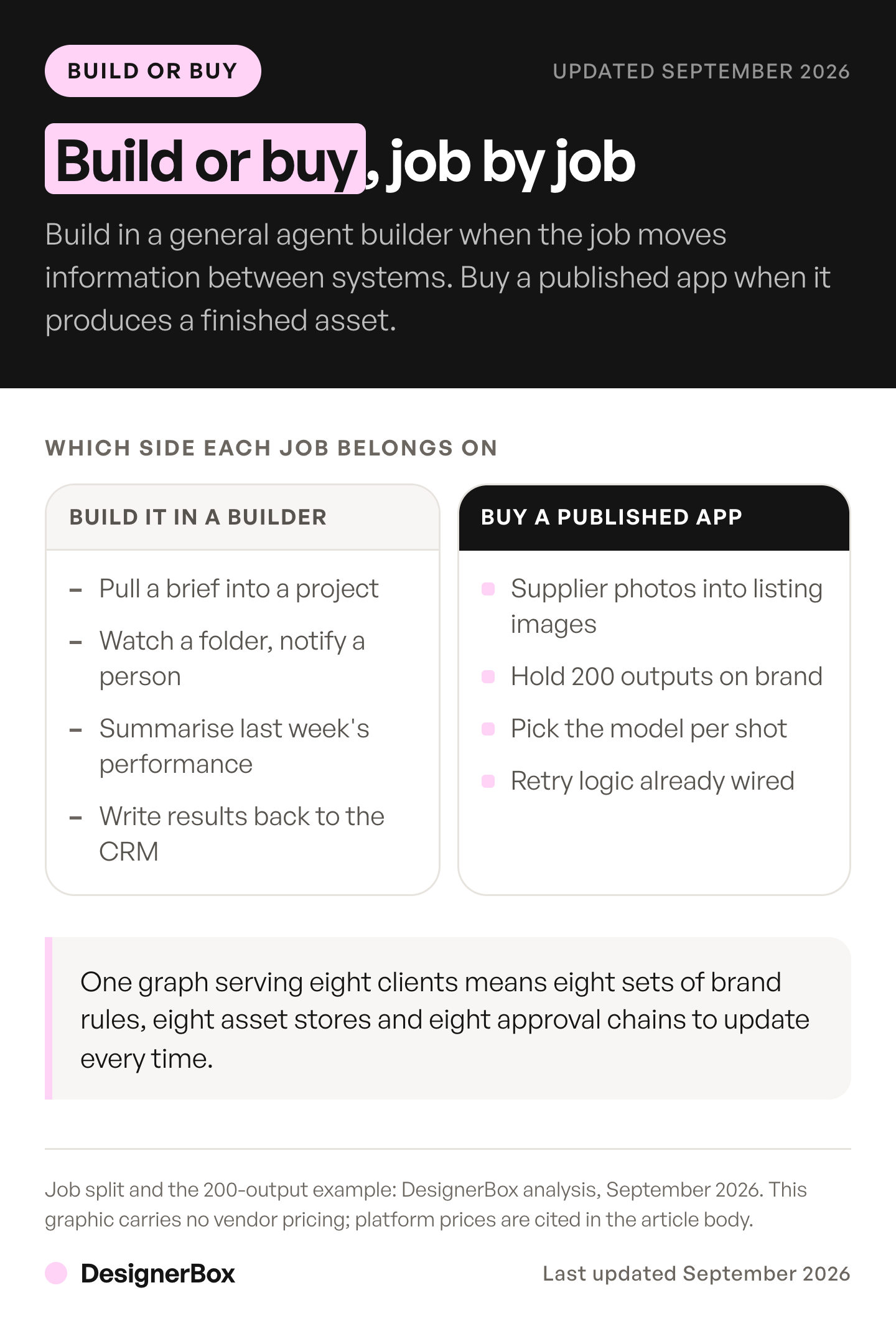
General builders win on everything that is not creative production, and they win comfortably. Pulling a brief out of a form and creating the project. Watching a folder and notifying the right person. Summarising last week’s performance into a document. Writing back to a CRM. Chasing an approval that has been sitting for three days. These are jobs with clear inputs, clear outputs and no taste involved, and Zapier, Make and n8n do them well and cheaply.
Published creative apps win where taste and consistency decide the outcome. A job that turns a supplier photo into on-brand listing images has a graph behind it that somebody already debugged, with the model selection, the retry logic and the brand rules already wired, and you run it again for the next product rather than rebuilding it. The Catalog Batch Processor skill is one example of that shape: a job definition your assistant runs, rather than a canvas you maintain.
Agencies sit in an awkward middle, and the deciding factor is client separation rather than capability. One graph serving eight clients needs eight sets of brand rules, eight asset stores and eight approval chains, and the usual way to express that in a general builder is eight near-identical copies of the same graph. Every rule change then has to be applied eight times, which is where the maintenance cost actually lives. A platform with brand profiles as first-class objects lets one job definition read a different client’s context per run, and that is worth more than any single feature on a comparison table.
Build genuinely custom only when the agent is part of what you sell. If the agent’s behaviour is the differentiator a client is paying for, own the code. If it is internal plumbing that saves your team six hours a week, buying it back is almost always cheaper than the engineering time plus the maintenance tail. Our read on where agents actually earn their keep across creative teams sits in the AI creative agents guide, and the ranked view of finished agent products is in the marketing agents roundup.
How do you connect an agent builder to your creative models?
Model Context Protocol is the connector layer to ask about, because it removes the per-pair integration work. A platform that exposes an MCP server can be called by any MCP client, so the same tools work from Claude, ChatGPT, Cursor or a builder’s MCP node. That removes the bespoke integration a builder would otherwise need per creative platform.
OpenAI’s Agent Builder ships MCP as one of its three tool nodes, described as calling third-party tools and services through connectors or custom servers (developers.openai.com, September 2026). That means a creative platform’s tools appear inside the agent graph as callable steps rather than as a separate manual stage a person has to run.
On the DesignerBox side that surface is 68 tools. They cover designs and search, image and video generation, avatars, brand profiles, assets and packs and templates, pipelines and workflows, whiteboards and chats, and teams, plan and discovery. One run can read the active brand profile, generate against it, and file the result in the library without a person moving files between tabs. The full MCP tool reference lists what each group exposes, and our launch write-up covers the connection steps.
One caution about connectors. Every tool you expose to an agent is a permission you have granted, and an agent that can write to your asset library can also overwrite. Grant the narrow scope first and widen it when the agent has earned it.
What breaks when a marketing agent runs without a person watching?
Three failures repeat. The agent produces confidently wrong output because its context was stale. The agent loops, either literally or by regenerating variations nobody asked for. And the agent publishes something that needed a second opinion. All three are cheap to prevent at design time and expensive to clean up after.

Stale context is the most common. An agent holding last season’s brand rules will keep producing last season’s assets and never flag it, because nothing in the run looks like an error. The fix is to make brand context a live reference the agent reads on every run rather than a value copied into the graph once. Anything you paste into a prompt is a snapshot, and snapshots rot.
Runaway loops are the most expensive. A While node with a weak exit condition, pointed at a paid generation step, is how a team discovers its credit ceiling on a Sunday. Cap the iterations explicitly, log every run, and set a spend alert at the platform level rather than trusting the graph’s own logic.
Unreviewed publication is the most damaging. The Human approval node exists for exactly this and costs one person about thirty seconds. Put it before anything customer-facing leaves the system. The Guardrails node covers a different risk, checking a step’s output for personally identifiable information, jailbreaks, hallucinations and other misuse (developers.openai.com, September 2026), and is worth turning on in the same pass. Keeping the output consistent across runs is a separate discipline, and the creative workflow guide covers where those chains break in practice.
How do you test an agent before it touches a live campaign?
Test on real inputs before the agent has permission to publish anything. Run the graph in preview against last quarter’s actual briefs and actual product photos, compare the output to what your team shipped, and count how many results you would have sent to a client. That number, not the demo, tells you whether the agent is ready.
Version the graph before every material change, and keep the previous version runnable. Serious platforms support this directly: OpenAI documents Agent Builder as a visual canvas for creating and versioning agent workflows, with Evals as a sibling building block (developers.openai.com, September 2026), and Google’s platform provides an Example Store and an evaluation service alongside its runtime (docs.cloud.google.com, September 2026). Use those rather than keeping a copy of the good version in a screenshot.
Then count the reject rate honestly and budget for it. If an agent produces four images to get one you would ship, your real cost per asset is four generations, not one. On the default image model at 14 credits that is 56 credits per usable output, so a 200-asset campaign is 11,200 credits rather than 2,800. Take your own ratio from a week of real briefs and multiply by it, because the gap between those two numbers is what a plan gets scoped against.
Finally, keep the agent’s scope small enough to reason about. A graph that does one job with six nodes is testable. A graph that does five jobs with forty nodes is a system, and it needs an owner, a changelog and a rollback plan. Splitting one large agent into three small ones costs slightly more to run and dramatically less to maintain. The four inputs an agent needs before any of this holds are set out in the agentic content guide.
FAQ
What is the best AI agent builder for a marketing team?
There is no single winner, because the shapes differ. Make lists the lowest entry price at $9 a month and keeps AI Agents on every plan. Zapier meters tasks and agent activities separately. n8n suits teams with hosting or data-residency rules. Gumloop includes unlimited seats on its entry paid plan. Pick on the job first, then on price.
Do I need to know how to code to build an AI agent?
No, for the platforms covered here. Make, Zapier, Gumloop, Lindy and n8n’s cloud product are all visual, and you assemble the agent from nodes rather than writing the orchestration loop. You will still meet expressions and data shapes, which is closer to spreadsheet formula work than to programming. Code-first frameworks like LangChain and CrewAI are a different commitment entirely.
How much does an AI agent builder cost?
Entry paid plans run roughly $9 to $37 a month, and several platforms keep a usable free tier. Make lists Core at $9 a month, Zapier’s Professional starts at $19.99 billed annually, n8n’s Starter is 20 EUR billed annually, Lindy’s Plus is $29.99 per user, and Gumloop’s Pro starts at $37 (vendor pricing pages, September 2026). Model usage is billed separately.
Can an AI agent generate images and video?
Only if you connect it to models that do. General agent builders orchestrate the steps and call out to a generation service for the asset itself. In DesignerBox an image is 4 to 22 credits depending on the model, a nine-image avatar set is 25, and video is priced per second, so an 8-second clip runs 40 to 560 credits. Budget the generation separately from the platform, and check the run cost before the run.
What happens if the agent builder I chose shuts down?
You lose the canvas, not necessarily the logic. OpenAI has scheduled Agent Builder to shut down on 30 November 2026 and points users to ChatKit and the Agents SDK instead (developers.openai.com, September 2026). Keep the prompts, the step sequence and the tool list documented outside the platform, and prefer builders whose connectors follow open standards like MCP.
How many people does it take to maintain an AI agent?
For a small marketing team, one named owner who checks the run log weekly. That person handles broken connectors, refreshes brand context each season, and reviews the reject rate. Budget an hour a week per active agent. Agents without a named owner drift quietly and are usually discovered when somebody notices the output stopped matching the brand.
Sources
- developers.openai.com/api/docs/guides/agent-builder. Agent Builder definition and the 30 November 2026 shutdown notice. Accessed September 2026.
- developers.openai.com/api/docs/guides/node-reference. The eleven Agent Builder node types across four groups. Accessed September 2026.
- developers.openai.com/cookbook/examples/agentkit/agentkit_walkthrough. AgentKit described as three interconnected building blocks: Agent Builder, ChatKit and Evals. Accessed September 2026.
- docs.cloud.google.com/vertex-ai/generative-ai/docs/agent-engine/overview. Gemini Enterprise Agent Platform runtime, sessions, Memory Bank, evaluation service, IAM agent identity, and supported frameworks. Accessed September 2026.
- zapier.com/pricing. Free plan at 100 tasks and 400 agent activities; Professional from $19.99/mo annual, $29.99/mo monthly, at 750 tasks with 1,500 agent activities. Accessed September 2026.
- make.com/pricing. Free plan up to 1,000 credits a month with no time limit; Core $9/mo at 10,000 credits; AI Agents in beta on all plans. Accessed September 2026.
- n8n.io/pricing. Starter 20 EUR/mo at 2,500 executions and Pro 50 EUR/mo at 10,000, both with unlimited users and workflows; Community edition free, self-hosted, Fair-code licence. Accessed September 2026.
- gumloop.com/pricing. Pro from $37/mo with 20,000 credits and unlimited seats, 14-day trial; Enterprise custom. Accessed September 2026.
- lindy.ai/pricing. Plus $29.99, Pro $99.99, Max $199.99 per user per month at 3,000, 15,000 and 35,000 credits; first week free for teammates joining through Slack. Accessed September 2026.
- DesignerBox live product configuration, read September 2026. Plans, per-model image credits, per-second video rates, model catalog, MCP tool count, feature gating.
Platform pricing, node vocabularies and agent capabilities verified from OpenAI, Google Cloud, Zapier, Make, n8n, Gumloop and Lindy documentation as of September 2026. Individual results vary.