
An agentic workflow is a multi-step process where a model plans and runs several generation, edit and check steps toward one stated outcome, instead of returning one asset per prompt. For a creative team it has five stages: input, branch, generate, review gate, export. The review gate is the stage that keeps the output usable, and it is the one most teams leave out.
A six-colourway drop is six product renders, three placements each, and eighteen files to name and file. Built by hand that is most of a Tuesday. Built as a chain it is one run, priced before it starts. The chain also fails quietly, which is why the Tuesday keeps coming back.
This guide covers the five stages, the patterns worth copying, where a creative chain breaks, how to test one on three products before you trust it with three hundred, and what a run costs in credits. Written for agency creative directors and marketing leads who already know what an agent is. If that part is still fuzzy, start with what AI creative agents do and where they break.
Key Takeaways
-
A workflow and an agent are different systems. Anthropic separates them: workflows are “systems where LLMs and tools are orchestrated through predefined code paths”, agents are “systems where LLMs dynamically direct their own processes and tool usage” (anthropic.com, December 2024). Creative production mostly wants the first one.
-
Five stages, and two of them get skipped. Input, branch, generate, review gate, export. Teams build the middle three and ship faster in the wrong direction.
-
Failures cluster in the system, not the model. The first published taxonomy of multi-agent breakdowns sorts 14 distinct failure modes into system design issues, inter-agent misalignment and task verification (arXiv 2503.13657, March 2025).
-
Your plan caps how wide a branch can run. Parallel generations go 1 / 1 / 4 / 8 / 16 across Free, Basic, Pro, Premium and Ultra. A six-way branch is two passes on Pro and a single pass on Premium.
-
Test on three inputs, one of them deliberately bad. Yield on a bad input predicts what happens at 300 SKUs. Yield on three clean inputs predicts nothing.
-
Credits per shipped asset is the budget line. There is no flat per-image price. The model sets it, from 4 credits on Seedream 5 to 22 on GPT Image 2, and your reject rate sets the rest.
-
The model choice moves the price more than the plan does. Pick it at the generate step. The same eight-call chain runs at 40 credits on one edit model and 112 on another, and the figure shows before the run.
-
Chat can drive the run. DesignerBox exposes 68 tools over its MCP server, including the ones that create and run pipelines.
What is an agentic workflow?
An agentic workflow is a chain of steps a model plans and runs toward one stated outcome, using tools, memory and a feedback step rather than a single prompt and a single reply. The unit of work changes with it. A prompt tool returns one file. A chain returns a finished set, so review stops being an afterthought and becomes the thing that decides whether the run was worth it.

Enterprise definitions agree on the shape. IBM describes these as AI-driven processes where agents make decisions, take actions and coordinate tasks with minimal human intervention, built on reasoning, planning and tool use (ibm.com, September 2026). Salesforce uses close to the same wording (salesforce.com, September 2026).
Both are written for IT operations, where success is a closed ticket. Creative work is judged on taste, brand fit and whether legal will sign it off, which changes what you build.
How is it different from automation, and from an agent?
Rules-based automation follows a fixed path someone wrote in advance. A chain routes between steps the model chooses, inside limits you set. A fully autonomous agent decides its own path, including which steps exist at all. Creative teams want the middle option, because a fixed path cannot handle a bad supplier photo and an open-ended agent cannot be reviewed.
| Rules-based automation | Agentic workflow | Autonomous agent | |
|---|---|---|---|
| Who picks the next step | The person who built it | The model, from a fixed set of steps | The model, with no fixed set |
| A bad input photo arrives | Passes it through or stops | Routes it to a repair step | Handled differently on each run |
| Same input twice | Same output | Close, within model variance | Not guaranteed |
| Where review sits | After the run | A named gate inside the run | Wherever you manage to catch it |
| Best creative fit | Resizing, renaming, exports | Production runs | Concepting and exploration |
Anthropic’s guidance is blunt about the trade: workflows give predictability and consistency for well-defined tasks, and agents are the better call when flexibility and model-driven decisions matter at scale. Campaign production is a well-defined task with a taste problem attached. That is a workflow with a human in it, not an autonomous system. Which platform you draw it in is the next decision, and six agent builders compared on published prices covers what each one bills per run.
The five stages of a creative chain
Every creative chain worth building has the same five stages: input, which is everything the run reads; branch, which turns one brief into many jobs; generate, which is the model calls; the review gate, which is the named check; and export, which is naming, sizing and filing. Most teams build branch, generate and export, then wonder why the output arrives fast and unusable.
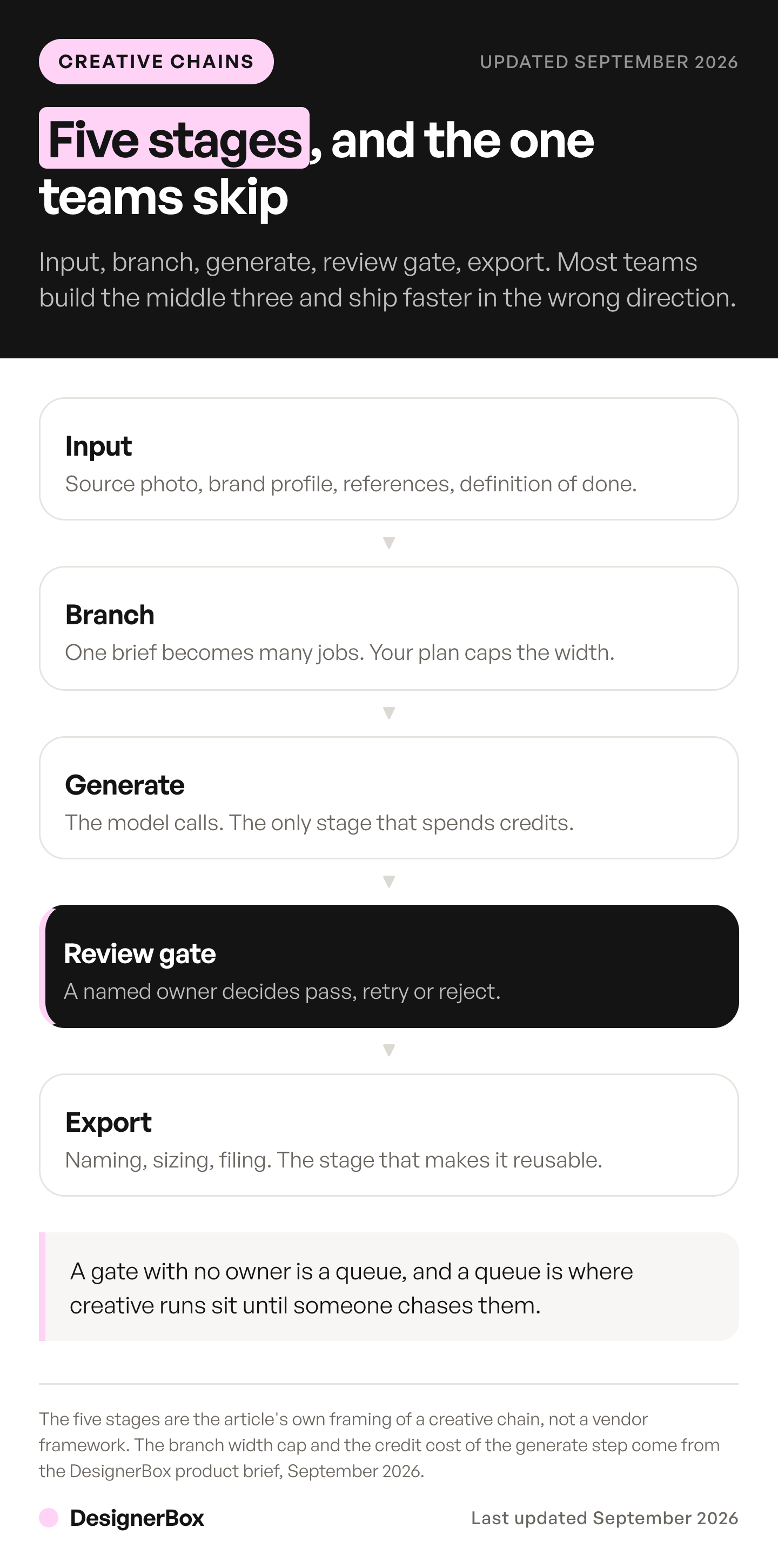
Input is the source photo, the brand profile, the reference set and the definition of done. This is the stage that decides output quality, and it is the only stage a model cannot generate for itself. The four inputs an agent has to be able to reach are covered in more depth in agentic AI for content creation.
Branch turns one brief into many jobs. Six colourways, twelve SKUs, four placements. Branch width is not free: parallel generations run 1 on Free and Basic, 4 on Pro, 8 on Premium and 16 on Ultra, so a twelve-way branch is three passes on Pro and two on Premium. Plan the branch around the number your plan gives you.
Generate is the only stage that spends money, and the model you attach to it sets the price. An image runs 4 to 22 credits depending on the engine, and video is charged per second of output. Keep the model choice at this stage rather than baked into the brief, so a shot that comes back wrong reruns on a different engine without rebuilding the chain, and so you can price the run before you start it.
The review gate is a named stop where a person or a check decides pass, retry or reject, before anything downstream runs. Name the owner and the criteria in the chain itself. A gate with no owner is a queue, and a queue is where creative runs sit until someone chases them.
Export is naming, sizing, filing and tagging. It is the boring stage, and the one that decides whether the run is reusable. If the output lands in a folder called “final v3”, the next person rebuilds the chain rather than reruns it. The Bulk Catalog Processor workflow is a worked version of this shape end to end.
Which patterns fit creative work?
Four patterns from Anthropic’s reference set map onto creative production without modification. Prompt chaining runs a fixed sequence where each step feeds the next. Routing sends different input types down different paths. Parallelization fans one brief into many variants at once. Evaluator-optimizer loops a generate step against a check step until the check passes.
Prompt chaining suits a known sequence: cut out, relight, place in scene, crop per placement. Routing earns its place the moment your inputs are inconsistent, which for anyone working from supplier photography is always. A photo on white goes one way, a phone snap goes to a repair step first.
Parallelization is the colourway and placement case, and it is where most of the time saving lives. Evaluator-optimizer is the pattern behind an automated brand check: generate, compare against the brand profile, retry on a miss. It works for measurable things like colour values, aspect ratio and text presence. It does not work for whether a shot looks expensive.
The fifth pattern, orchestrator-workers, is the one to leave alone until the other four run without supervision. It adds a planning layer that decides what the subtasks are, which is exactly the layer that is hardest to review when the output is wrong.
A worked example: one photo, six colourways
Take one flat product photo of a jacket and six colourways. The chain reads the photo and the brand profile, branches once per colourway, generates one edit per branch, stops at a review gate where a person approves or sends back, then exports the approved set at the three sizes you ship. Eight model calls in total, six plus two retries.
| Stage | What runs | Credits on Kontext Multi |
|---|---|---|
| Input | One product photo, one brand profile, one reference set | None |
| Branch | Six colourway jobs, 4 at a time on Pro | None |
| Generate | Six edits at 5 credits each | 30 |
| Review gate | A person approves four, sends two back | None |
| Regenerate | Two edits at 5 credits each | 10 |
| Export | Six approved files, sized for three placements | None |
| Total | 40 |
Only model calls move the credit line. The two rejects are illustrative arithmetic, not a measured reject rate, and yours will differ by product category and by how tight the brief is.
Swap the model and the same eight calls cost something else. Kontext Multi is 5 credits an edit, so the run is 40. Nano Banana Pro, which is the default, is 14, so the same run is 112. Seedream 5 at 4 credits makes it 32. Nothing about the chain changed. This is why the model belongs at the generate step and why you want the run priced before you press start, rather than reconstructed from a credit balance afterwards.
Video works the same way with a wider spread. An 8-second clip runs 40 credits on the lite model and 560 on Sora 2 Pro at 1080p, a 14x range across the same eight seconds.
Reuse is the real return. Saved as a workflow, the same chain runs for the next drop with a new source photo, which is the argument made at length in content batching.
Where creative chains break
Chains break in three places and none of them is the model. The brief is under-specified, so every branch interprets it slightly differently. The steps disagree with each other, so a colour value set in step two gets overwritten in step four. Nothing verifies the result, so a wrong output ships because no step was responsible for catching it.
That grouping is borrowed, not invented. Researchers analysed 150 traces across 7 multi-agent frameworks and clustered 14 distinct failure modes into three categories: system design issues, inter-agent misalignment, and task verification, with high inter-annotator agreement at kappa 0.88 (arXiv 2503.13657, March 2025). The study covers coding, maths and general agent tasks rather than creative pipelines, so treat the transfer as a map rather than a measurement. The three buckets still describe what goes wrong in a colourway run.
Three creative-specific versions are worth naming. Drift across the set: each asset is a separate job, so nothing enforces one lighting direction across six files that will sit in one carousel. Silent pass-through: a poor supplier photo goes in one end and comes out retouched, on brand and still wrong. And a missing stop condition, where the chain keeps generating because nothing told it what finished looks like.
None of these are fixed by a better model. They are fixed by a tighter input stage and a gate that has an owner. The build-side versions, the ones that live in the graph itself, are the three mistakes that break a node graph.
How do you test a chain before you trust it?
Run it on three inputs, not thirty. One clean, one typical, one deliberately bad. Count how many outputs you would ship untouched. That number is the chain’s real yield, and it is the only figure that predicts behaviour at 300 SKUs. Which chains are worth running at that scale is a catalogue question, answered job by job in five agent jobs a 200-SKU store can run. Decide the yield you will accept before the run, because deciding after is how a bad chain gets adopted.

The full test is five passes over the same small set.
- Three inputs, one broken on purpose. A clean packshot, a typical supplier photo, and something genuinely poor. The broken input is the one that tells you whether routing works.
- Run the same input twice. The difference between the two outputs is the chain’s noise floor. If two runs of the same brief disagree on background or crop, the brief is loose, not the model.
The third pass judges the set instead of the file. Put the outputs side by side at the size they will ship, because drift is invisible one file at a time and obvious in a row. The fourth pass removes an input on purpose: take the brand profile out and rerun. A chain that notices and stops has a working gate. A chain that ships a clean off-brand set has a verification hole.
The fifth pass is arithmetic. Divide credits spent by assets shipped. Cost per shipped asset is the number that survives a finance review, and credits per generation is a vanity figure next to it.
Log the results beside the chain. When someone asks in three months why a run yields four usable files out of six, the answer sits in the log rather than in an argument.
What does a run cost?
Cost is credits per shipped asset, not credits per generation. Two things set it: the model on the generate step, which runs 4 to 22 credits an image, and your reject rate. Video is charged per second of output rather than per file, so a chain with a video step needs its own line in the budget.
| Plan | Price a month | Credits a month | Parallel generations |
|---|---|---|---|
| Free | $0 | 112 | 1 |
| Basic | $15, billed monthly | 500 | 1 |
| Pro | $35 | 1,000 | 4 |
| Premium | $75 | 2,500 | 8 |
| Ultra | $200 | 8,000 | 16 |
Annual billing roughly halves those rates and grants the same allocation each month, reset monthly rather than paid out as a yearly lump. Read the billing toggle before you quote a figure, because the pricing page opens on the annual view and prints it under a per-month label.
Run the numbers against the chain rather than the plan. The forty-credit colourway run fits twelve times over inside Basic’s 500 a month and twenty-five times inside Pro’s 1,000. On the default image model the same run is 112 credits, so Basic holds four of them. Premium’s 2,500 covers seven 8-second clips on the premium video model, or 62 on the lite one.
Two gating details change what a chain can include. The commercial licence starts at Pro, so anything running into paid media needs that tier or higher. AI video and try-on start at Premium. Team collaboration, shared brand kits, white label and API access are Ultra only, which matters for an agency running one chain across several clients. The current numbers sit on the pricing page.
For a fuller build-out of how a reusable pipeline is assembled, including where the setup cost pays back, see AI creative workflow.
Where DesignerBox fits
DesignerBox is built around the shape this article describes: you build the chain once, against your brand profile and your own products, then run it again for the next drop with a new source photo. The branch, the generate step and the asset library are one system, so the standard set on the first colourway is the standard applied to the fortieth. Eight image models and thirteen video ones sit behind the generate step, so a call that comes back wrong reruns on a different engine without rebuilding the chain.
The connection layer is MCP, an open-source standard for connecting AI applications to external systems (modelcontextprotocol.io, specification version 2026-07-28). DesignerBox exposes 68 tools over its MCP server, including the ones that create, edit and run pipelines. Claude, ChatGPT or Cursor can start a run, read the library and file the output without anyone opening the app. The packaged version of that is the Campaign in a Chat skill.
The honest limits are worth stating. Everything below Ultra is a single seat, so a chain shared across a team needs the top tier. AI video and try-on start at Premium, so a video step puts your floor at $75 a month billed monthly. And no gate removes the taste call, which is the part of the run that stays yours.
When the chain is ready to run on real inventory rather than a test set, product photography is the use case page that maps to it.
FAQ
What is an agentic workflow in simple terms?
It is a chain of AI steps that runs toward one outcome instead of one prompt returning one file. The model plans and executes several steps, calls tools between them, and hands back a finished set. You define the steps and the checks. The model handles the work inside them.
What is the difference between an agentic workflow and an AI agent?
A workflow moves through steps you defined in advance, with the model choosing between them. An agent decides its own path, including which steps exist. Anthropic draws that line explicitly, and recommends workflows for well-defined tasks where predictability matters. Campaign production is a well-defined task, so a chain with a review gate fits better than autonomy.
Do these workflows replace creative teams?
No. They remove the repetitive middle of production, which is generation, resizing and filing. Brief writing, the definition of done, the reference set and the final judgment on whether output is on brand all stay with people. The bottleneck moves from making assets to checking them, so review capacity becomes the constraint.
How many steps should a creative chain have?
Few enough that someone can draw it on paper. In practice that is five to nine steps, including the review gate. Longer chains are harder to debug because a failure in step seven looks identical to a failure in step two. Split a long chain into two shorter ones with a checkpoint between them.
What is a review gate?
A named stop inside the run where a person or an automated check decides pass, retry or reject before anything downstream executes. It needs a named owner and written criteria. Without both, it becomes a queue rather than a gate, and work sits in it. It is the single stage most teams skip.
Can I run one of these from Claude or ChatGPT?
Yes, over MCP, which is an open-source standard for connecting AI applications to external systems. DesignerBox exposes 68 tools on its MCP server, including the ones that create and run pipelines, so an assistant can start a run, read the asset library and file the output. API access requires Ultra. Running it from a terminal agent instead is covered in Claude Code for marketing.
How much does a multi step AI generation run cost?
Measure credits per shipped asset, not per generation. The model sets the rate: a six-item run with two rejects is 40 credits on Kontext Multi at 5 an edit, and 112 on Nano Banana Pro at 14. Video is priced per second of output, and an 8-second clip runs 40 credits on the lite model up to 560 on Sora 2 Pro at 1080p. Price the run before you start it rather than reading it off a credit balance later.
Sources
- The workflows-versus-agents distinction, the five named patterns (prompt chaining, routing, parallelization, orchestrator-workers, evaluator-optimizer), and the guidance on when predictability beats flexibility: anthropic.com, December 2024
- 14 failure modes clustered into system design issues, inter-agent misalignment and task verification, from 150 annotated traces across 7 multi-agent frameworks at kappa 0.88: arXiv 2503.13657, March 2025
- MCP as an open-source standard for connecting AI applications to external systems, specification version 2026-07-28: modelcontextprotocol.io, September 2026
- Definition of these workflows as AI-driven processes built on reasoning, planning and tool use: (ibm.com, September 2026)
- Definition as structured processes where AI agents make decisions, solve problems and perform tasks with minimal human input: (salesforce.com, September 2026)
- DesignerBox plan prices, credit allocations, parallel-generation limits, credit costs per operation, MCP tool count and feature gating verified against live product configuration, September 2026
Definitions, patterns and failure-mode research verified from Anthropic engineering documentation, arXiv 2503.13657, the Model Context Protocol specification, IBM and Salesforce as of September 2026. DesignerBox product facts current as of September 2026. Individual results vary.