
AI pattern making software is garment pattern software with AI or automated features for drafting, grading or fitting sewing patterns. The name covers three jobs. 2D tools such as Lectra Modaris, Gerber AccuMark and Seamly2D draft and grade the pattern. 3D tools such as CLO, Browzwear and Style3D fit it on an avatar. Print tools such as PatternedAI design the repeat on the fabric.
The shared name costs time. A Google search for “best AI pattern making software” returns garment pattern vendors, a sewing forum and print pattern generators on the same page (US results, checked 16 September 2026). A brand that needs a graded pattern for its factory can start a trial of a tool built for prints. A print designer can start in a 3D fitting program.
The word AI adds a second layer. We read the documentation of 12 tools on 16 September 2026. Every vendor that automates grading describes it as rules and measurements. Two vendors, CLO and Style3D, ship a feature that drafts a starting pattern from a text prompt or an image. One is a beta. The other is a trial that Style3D staff turn on.
This guide sorts the tools by job, says what each vendor documents as AI, and shows what 2026 research says AI still cannot do. It is written for apparel brands with 20 to 500 styles that work with a freelance pattern maker or a factory. It lists no prices: each vendor publishes its own plans.
Key Takeaways
- Three jobs share one name: drafting and grading a pattern, fitting it in 3D and designing a repeat print need different tools, and each gives you a different file.
- For a factory pattern: Lectra Modaris, Gerber AccuMark, Optitex, Audaces and Tukatech TUKAcad draft and grade production patterns. Ask your factory which DXF layout it reads before you choose.
- Free options: Seamly2D and Valentina are open source under the GNU GPL version 3, and both export DXF in the AAMA and ASTM layouts.
- What AI does today: CLO’s AI Pattern Drafter (Beta) and Style3D’s AI Garment draft a starting pattern from text or an image. Grading is still a separate step.
- What research still misses: a sewing pattern generator published on 31 August 2026 still struggles with pockets and belt loops.
- After the sample: DesignerBox makes no patterns. It makes the product photos for each finished style, and it shows the cost before the run.
What is AI pattern making software?
AI pattern making software is any garment pattern program that drafts, grades or fits patterns with AI or with rule-based automation. A pattern maker drafts the base size once. The software makes the other sizes from grade rules or measurements, checks the pieces on a 3D avatar, and exports a file the factory cuts from. Much of that automation is older than the AI label.
Three terms appear in every tool on this list:
- Grading is “the process of scaling a base pattern up or down to create a complete size range” (audaces.com, June 2026).
- DXF in the AAMA or ASTM layout is the file format pattern systems use to exchange pattern pieces and grade rules. ASTM’s standard for that layout, D6673, describes pattern piece and grade rule exchange between CAD systems, and ASTM withdrew it in 2019 (ASTM, accessed September 2026). Tools still export both layouts.
- A marker is the cutting layout that places every pattern piece across the width of the fabric.
Which job are you buying for?
Start from the file you need at the end. A factory cuts from a graded pattern file, so you need a 2D drafting and grading tool. A development team that wants fewer physical samples adds a 3D fit tool after the pattern. A print or textile designer needs a repeat design tool, and that tool makes no sewing pattern at all.
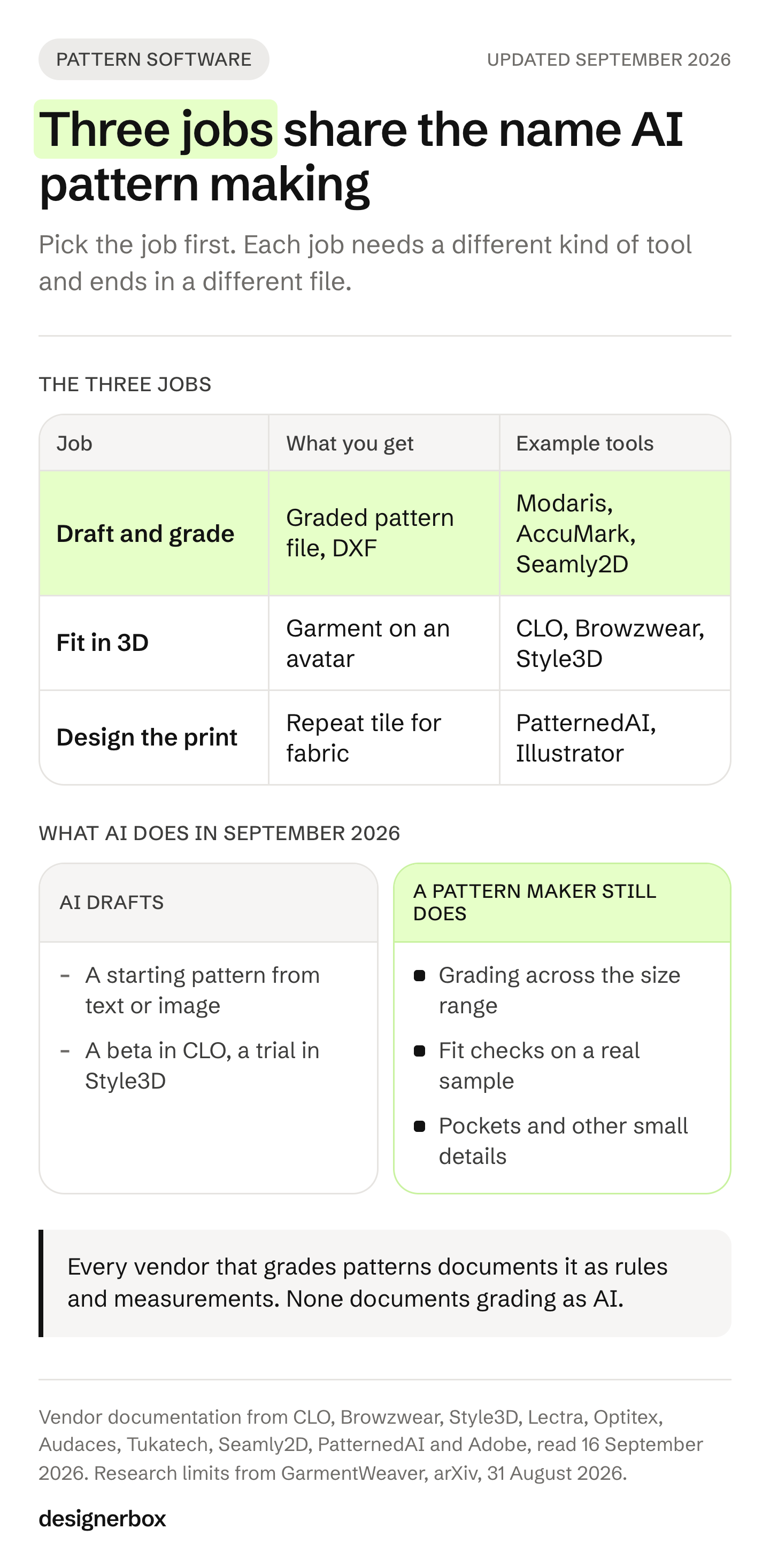
| Job | What you get at the end | Tools in this guide |
|---|---|---|
| Draft and grade the pattern | A graded pattern file, often DXF, and markers for cutting | Lectra Modaris, Gerber AccuMark, Optitex, Audaces, Tukatech TUKAcad, Seamly2D, Valentina |
| Fit the pattern in 3D | A 3D garment on an avatar, linked to its 2D pattern | CLO, Browzwear VStitcher, Style3D |
| Design a repeat print | One tile that repeats across the fabric, as an image or vector file | PatternedAI, Adobe Illustrator |
Many brands need only the first job, and a freelance pattern maker or the factory often does it for them. In that case the right software is the system your pattern maker already uses, because the files then move without a conversion step.
Which tools draft and grade garment patterns?
Lectra Modaris, Gerber AccuMark, Optitex, Audaces Pattern and Tukatech TUKAcad are production pattern systems. Each one drafts patterns, grades them across a size range and prepares them for cutting. Seamly2D and Valentina draft and grade for free, as open source programs. None of these vendors documents its grading as AI. Grading runs on rules and measurements, and a rule gives the same result every time.

Lectra Modaris
Modaris lets a pattern team “create, modify, grade and industrialize patterns”, and Modaris 3D keeps the 2D production pattern in sync with its 3D prototype (lectra.com, September 2026). The product page names no AI feature. Lectra’s Modaris brochure describes parametric design tools and automatic pleating tools (Lectra Modaris brochure, March 2023).
Gerber AccuMark
Gerber AccuMark is now a Lectra product, with modules for 2D patterns, 3D and made-to-measure. Lectra describes it as a suite to “create, grade, and industrialize patterns” through automated processes, and says the made-to-measure module “offers advanced automation functionality” (lectra.com, September 2026). The product page names no AI feature.
Optitex
Optitex combines 2D pattern design and 3D visualization in one program (optitex.com, September 2026). It lists functional grading for production patterns and automatic nesting for early costing. Its homepage and product page do not use the word AI.
Audaces Pattern
Audaces Pattern offers an automatic size table and faster grading, and Audaces Digiflash digitizes paper patterns (audaces.com, September 2026). Audaces writes that in its grading, “predefined rules apply across the entire size range” (audaces.com, June 2026). Its AI product, SOFIA, creates prints, garment variations and images inside Audaces Fashion Studio. SOFIA makes no patterns. Audaces offers a free 15-day trial.
Tukatech TUKAcad
TUKAcad lets a team create, modify and grade patterns and make markers (tukatech.com, September 2026). Its TUKA APM module generates a pattern from a spec sheet: you pick a template and enter the measurements and grade rules. Tukatech calls this automatic pattern making and does not call it AI. TUKAcad exports DXF in the AAMA and ASTM layouts, and PDF (tukaweb.com, September 2026). The TUKAcad Learning Edition is free to try for 14 days.
Seamly2D and Valentina
Seamly2D and Valentina are free, open source pattern programs under the GNU GPL version 3 (github.com/FashionFreedom/Seamly2D and gitlab.com/smart-pattern/valentina, September 2026). Seamly2D is built on Valentina’s code. Both draft from size tables or personal measurements, and both export DXF in the AAMA and ASTM layouts, and PDF. Neither has an AI feature. Seamly2D published a new release on 14 September 2026, and Valentina reached version 1.0 in August 2025 (smart-pattern.com.ua, August 2025).
Which tools fit a pattern in 3D before sampling?
CLO, Browzwear VStitcher and Style3D put the 2D pattern on a 3D avatar, so a team can check fit and drape on screen before it cuts a sample. All three also edit 2D patterns and export DXF. Most of the AI features on this list sit in these three tools. They draft starting patterns, stitch pieces together, and make avatars, textures and renders.
CLO
CLO combines 2D pattern making, 3D simulation and grading (clo3d.com, September 2026). Its AI Studio makes textures, graphics, renders and images. The AI Pattern Drafter (Beta) takes a text prompt or an image and drafts a pattern, and CLO says it works only on CLO avatars. Grading stays a separate step: you enter measurements, and Auto POM and Grading creates the points of measure and applies the grade (support.clo3d.com and clo3d.com, September 2026). CLO exports DXF in the AAMA and ASTM layouts, one size group per file. CLO offers a free trial.
Browzwear VStitcher
VStitcher builds “accurate virtual twins of physical garments” for design and development (browzwear.com, September 2026). Its Auto Stitch feature, which Browzwear calls AI stitching, became generally available in version 2026.1.2 in April 2026, for users who meet criteria Browzwear sets. Browzwear also offers AI avatars. In VStitcher you grade visually or by hand with grade points, and patterns export as DXF in the ASTM or AAMA layout (help.browzwear.com, September 2026).
Style3D
Style3D Studio links 3D simulation with 2D pattern editing (style3d.com, September 2026). Its AI Garment feature generates garment designs from text or images and returns 2D patterns and a 3D garment with sewing relationships. The feature covers women’s wear categories, and Style3D staff turn on the trial. Style3D also lists AI Fabric, AI Graphic and AI Trim, and it documents size and position grading as a separate feature (help.style3d.com, September 2026). Studio exports DXF.
Which tools design repeat prints for fabric?
PatternedAI and the Text to Pattern feature in Adobe Illustrator design repeat prints: one tile that repeats across a fabric without a visible join. These tools make no sewing pattern. A search for AI pattern making returns both kinds of tool, so check which job a tool does before you start a trial.

PatternedAI
PatternedAI generates repeat patterns from text, extracts patterns from images, fixes broken repeats, recolors and upscales designs, and converts them to vector files (patterned.ai, September 2026). It is free to try. When PatternedAI calls a file print-ready, it means a file for printing on fabric. A garment CAD vendor uses “production-ready” for a cut-ready pattern, which is a different thing.
Adobe Illustrator Text to Pattern
Text to Pattern turns a text prompt into vector patterns and saves each result as a pattern swatch. You find it in Illustrator under Object, Pattern, Generate Patterns (helpx.adobe.com, September 2026). Adobe calls it a generative AI capability powered by Adobe Firefly, and it launched as a beta in July 2024 (news.adobe.com, July 2024). Adobe says the patterns from its Firefly vector model tile with no break in the repeat (news.adobe.com, October 2023).
Can AI make a production-ready pattern from a sketch?
Not yet, as of September 2026. CLO and Style3D ship features that draft a starting pattern from text or an image. Neither vendor describes that result as graded or ready for production. Research systems also generate sewing patterns from sketches and text, and the newest papers still name missing details such as pockets. A pattern maker still grades the pattern and checks it on a sample.
What production-ready means
A factory needs more than the shape of each piece. A production pattern carries seam allowances, grainlines, notches and grade rules for every size, and it has passed a fit check on a real sample. A study published in August 2026 names those same elements as missing from the image dataset it used. Its authors describe what their results show as “geometric correspondence and virtual assembly feasibility rather than physical manufacturability or industrial production readiness” (Frontiers in Artificial Intelligence, August 2026).
What research systems can do
AIpparel, a multimodal model for sewing patterns, generates and edits patterns from text and images. Its authors note that “design elements like pockets require non-manifold structures”, which its pattern representation does not hold (arXiv, revised April 2025). GarmentWeaver, published on 31 August 2026, generates sewing patterns from sketches and text. Its authors write that it “still struggles with finer localized details”, and they name pockets and belt loops (arXiv, August 2026).
Lectra, which sells Modaris and AccuMark, wrote on 14 September 2026: “Human expertise remains essential, particularly in patternmaking, fitting and technical development” (lectra.com, September 2026).
The fair reading
The gap is closing. Two 3D vendors already ship text-to-pattern features as a beta or a trial, and two of the papers cited here appeared in August 2026. The accurate claim for 2026 is narrow. AI can draft a starting pattern, and a pattern maker still grades it and checks it on a body. If a vendor promises a factory-ready pattern from one sketch, ask to see a graded file and a fitted sample made from one of your own styles.
How should a small brand choose pattern software?
Choose by who drafts your patterns and what your factory reads. If a freelance pattern maker or the factory drafts for you, work in their system or accept their files. If you bring drafting in-house, start with 2D drafting and grading. Add 3D fit when sampling rounds cost you more time than the software takes to learn. Test any AI feature on one of your own styles first.
- Ask the factory for its file format. CLO, Browzwear, TUKAcad, Seamly2D and Valentina document DXF export in the AAMA and ASTM layouts. Ask which layout your factory reads, and send one graded test file before the first order.
- Match your pattern maker. Moving a pattern between two systems adds a conversion step. Send a graded test file in both directions before you commit.
- Start in 2D if nobody on the team drafts yet. A 3D fit check depends on a correct 2D pattern and on the fabric settings you enter.
- Read the limits on each AI feature. CLO’s AI Pattern Drafter is a beta that works on CLO avatars. Style3D’s AI Garment covers women’s wear, and staff turn on the trial. Browzwear’s Auto Stitch goes to users who meet its criteria.
- Start free where you can. Seamly2D and Valentina are free. CLO offers a free trial, Audaces a 15-day trial and Tukatech a 14-day trial of the TUKAcad Learning Edition.
Pattern software is the first stage of a longer production chain. For the stages after it, from on-model images to short video, see how fashion brands map AI tools to each production stage.
Product photos after the first sample
Pattern software ends when the sample fits. Then every style needs product photos in every color: front, back, a detail and a shot on a model. Amazon sets its own rules for clothing shots, and the clothing shot list for Amazon covers them. This part of the work already uses AI. McKinsey and The Business of Fashion report that more than 35 percent of executives already use generative AI in areas such as image creation, copywriting and online customer service (McKinsey, The State of Fashion 2026, accessed September 2026).
DesignerBox is AI creative production for agencies and brand teams. It does not draft, grade or fit patterns. It starts from a photo of the finished garment.
- Clothing catalogue turns one garment into four shots: front, three-quarter, back and a fabric close-up.
- Ghost mannequin shots show the shape of the garment with no model. The guide to three ways to make a ghost mannequin shot compares studio, Photoshop and AI.
- Virtual try-on shows the garment on a model. It starts on the Premium plan, at $75 a month billed monthly.
- Sketch to photo turns a garment sketch into a photo-style image for review. The result is a picture. Nobody can cut fabric from it.
Virtual try-on shows how a garment looks on a model. Fit simulation in CLO, Browzwear or Style3D checks how the pattern sits on a body. What the fit research says try-on can and cannot show explains where the two meet.
You set the brand once. The workflow reads it on every run. A saved workflow runs the same way on the next style, with the same brand rules, light and framing. The cost is shown before the run. The commercial license starts on Pro, at $35 a month billed monthly. See what DesignerBox does for fashion brands.
The first job, built once
Start from a template, add your brand and your products, and run it. The cost is shown before the run.
FAQ
What is the best AI pattern making software?
The best tool is the one built for your job. For graded production patterns, Lectra Modaris, Gerber AccuMark, Optitex, Audaces and Tukatech TUKAcad are built for factory work. For 3D fit, CLO, Browzwear VStitcher and Style3D carry the most AI features. For free drafting and grading, Seamly2D and Valentina are open source. For repeat prints, PatternedAI and Adobe Illustrator’s Text to Pattern design the tile.
Can AI make a sewing pattern from a sketch?
AI can draft a starting pattern. CLO’s AI Pattern Drafter (Beta) and Style3D’s AI Garment both take a text prompt or an image and return a drafted pattern. Neither vendor describes the result as graded or production-ready. A pattern maker still grades the pattern, adds the production details and checks the fit on a sample.
Can ChatGPT generate a sewing pattern?
A chat model can explain drafting steps and help you plan a size range. A factory needs a scaled pattern file with seam allowances, notches and grade rules, checked against a fitted sample. Pattern software exists to make that file. Use a chat model to plan, and pattern software to draft.
Is there free pattern making software?
Yes. Seamly2D and Valentina are free and open source under the GNU GPL version 3. Both draft from measurements or size tables and export DXF and PDF. CLO offers a free trial, Audaces a free 15-day trial and Tukatech a free 14-day trial of the TUKAcad Learning Edition.
Does AI grade patterns automatically?
Most pattern systems grade automatically, but their vendors document it as rules and measurements. CLO calls its feature Auto POM and Grading, Tukatech offers automatic half-size grading, and Audaces applies predefined rules across the size range. None of the vendors we checked documents grading as AI.
What file format does a factory need for patterns?
Pattern systems exchange patterns as DXF in the AAMA or ASTM layout. CLO, Browzwear, TUKAcad, Seamly2D and Valentina all export both. ASTM withdrew its D6673 standard for the layout in 2019, and the layouts are still in use. Ask your factory which one it reads, and send a test file first.
Does DesignerBox make sewing patterns?
No. DesignerBox makes the product photos after the sample: four shots from one garment photo, ghost mannequin shots and virtual try-on. You set the brand once, and the workflow reads it on every run. The cost is shown before the run.
Sources
- Search results for “best AI pattern making software”: Google US organic results, checked 16 September 2026
- Grading definition and rule-based grading: Audaces blog (audaces.com/en/blog/pattern-grading), June 2026
- Pattern data exchange standard: ASTM D6673-10, withdrawn 2019, accessed September 2026
- Lectra Modaris product page (lectra.com/en/fashion/products/modaris), September 2026, and Modaris brochure, March 2023
- Gerber AccuMark product page (lectra.com/en/fashion/products/gerber-accumark-fashion), September 2026
- Optitex 2D and 3D CAD product page (optitex.com/products/2d-and-3d-cad-software), September 2026
- Audaces Pattern, Digiflash and SOFIA product pages (audaces.com/en/solutions), September 2026
- Tukatech TUKAcad and TUKA APM product pages (tukatech.com/products), and export formats (tukaweb.com/services/data_conversion_info), September 2026
- Seamly2D license, source and release history (github.com/FashionFreedom/Seamly2D), September 2026
- Valentina source (gitlab.com/smart-pattern/valentina) and version 1.0 release notes (smart-pattern.com.ua), August 2025
- CLO features and release notes (clo3d.com/en/clo/features), AI Pattern Drafter, AI Studio and DXF export help (support.clo3d.com), September 2026
- Browzwear VStitcher product page (browzwear.com/products/v-stitcher), 2026.1.2 release notes (browzwear.com/blog), grading and file type help (help.browzwear.com), September 2026
- Style3D Studio homepage (style3d.com) and release notes for AI Garment, grading and DXF export (help.style3d.com), September 2026
- PatternedAI tools (patterned.ai), September 2026
- Adobe Illustrator Generate Patterns help (helpx.adobe.com), September 2026; Text to Pattern beta announcement (news.adobe.com), 23 July 2024; Firefly Vector Model announcement (news.adobe.com), 10 October 2023
- Limits of pattern generation from images: Alsabhi et al., Frontiers in Artificial Intelligence, 19 August 2026
- AIpparel limitations: Nakayama et al., arXiv 2412.03937, revised April 2025
- GarmentWeaver limitations: Lu et al., arXiv 2608.30550, 31 August 2026
- Human expertise in patternmaking: Lectra library article on fashion product development (lectra.com/en/library), 14 September 2026
- Generative AI use among fashion executives: McKinsey and BoF, The State of Fashion 2026, accessed September 2026
- DesignerBox features, plans and gating: DesignerBox pricing page (designerbox.ai/pricing), September 2026
Tool features, AI labels and export formats verified against each vendor’s own documentation as of 16 September 2026. Vendors add AI features often, so check the current documentation and run a trial on one of your own styles before you choose.