
Higgsfield’s strongest alternatives for agencies are Runway for cinematic shots, Adobe Firefly where legal has to sign off, HeyGen for presenter video, and DesignerBox for the product job you repeat every week. Higgsfield already has seats, brand kits and approvals, so features do not sort this shortlist. Three contract terms do: who may train on client work, who carries the indemnity, and what automation costs.
You carry nine client brands on fixed retainers. Two of them just asked for a refreshed video set this quarter, one has a drop with 40 new products, and the creative hours you have are the creative hours you have. So you start pricing AI tools, and every comparison you open ranks them on output quality and model count.
Neither of those is what ends up costing you money. What costs you money is a clause in the terms that lets a vendor train on a client’s unreleased product photography, an indemnity that turns out to be Enterprise only, and an unlimited tier that stops being unlimited the moment you automate the job.
The tooling decision is not a small one any more. Forrester, in work produced with the 4A’s, reports that about nine in ten US marketing agencies now use generative AI, and that 61% classify it as a cost of business with limited direct monetisation (forrester.com, June 2026). If it is a cost rather than a billable line, the contract terms around it are margin.
A note on bias. DesignerBox makes AI creative production software, so we are one of the options here. We say where Higgsfield is the better buy, and we publish a gap in our own terms further down.
This page is scoped to agencies weighing Higgsfield. For the general comparison without the agency filter, read the Higgsfield tool-by-tool comparison. If the work is specifically creator-style ad video, the UGC tools built for agencies covers seats, brand separation and white label across a different shortlist. For the two-name head-to-head, read OpenArt vs Higgsfield.
Key Takeaways
-
Higgsfield is not short of agency features. It sells Team, Scale and Enterprise plans, and carries folders, approvals, roles, a brand kit, a node canvas that saves a set of steps as a reusable template, an API, an MCP server and a CLI (higgsfield.ai, September 2026).
-
The default in this category is that vendors train on your inputs and outputs. Higgsfield’s terms and Runway’s terms both say so, in near-identical language, and both also decline to restrict commercial use (higgsfield.ai/terms-of-use-agreement and runwayml.com/terms-of-use, September 2026).
-
Higgsfield’s commercial-use clause is genuinely strong for agency delivery. Rights survive cancellation, and you may sublicense outputs to your clients (higgsfield.ai/terms-of-use-agreement, September 2026).
-
Adobe is the counter-example. Adobe says it does not train the foundational Firefly models on Creative Cloud customer content, and offers enterprise customers IP indemnification for select Firefly workflows with the right entitlement (adobe.com, September 2026).
-
Unlimited tiers usually mean manual use. Higgsfield states that unlimited and free generations apply only on higgsfield.ai, and that anything through MCP, CLI, Canvas or Supercomputer deducts credits at standard rates (higgsfield.ai, September 2026). DesignerBox meters API and MCP the same as the web app (designerbox.ai/terms, September 2026).
-
No-training protection is real, and it sits in the contract you negotiate. Runway’s enterprise terms state that “Runway may not use Customer Content as training data for the Services”, while its public terms grant a training license over inputs and outputs (runway.com/enterprise-terms and runwayml.com/terms-of-use, September 2026). The protection is not on the tier you buy online.
-
An enterprise IP indemnity usually covers the platform, not the picture. On several of the tools checked here the clause answers a claim that the service itself infringes. Runway’s excludes claims arising from inputs (runway.com/enterprise-terms, September 2026). Adobe’s is the exception: it covers generated content, triggered on export (adobe.com, September 2026).
-
Read the wording, not the summary. Higgsfield writes “SOC 2-aligned”, not certified (higgsfield.ai, September 2026). Procurement reads those differently.
What Higgsfield gives an agency today
Higgsfield describes itself as an AI-native creative suite, and its about page says it serves creators, marketing agencies and filmmakers. For agency work it already carries most of what a shortlist screens for, which is why the usual comparison points do not separate it from the field.
It sells three team plans by name: Team, Scale and Enterprise. Its help center puts Team at up to 9 seats on the standard queue, and says Scale raises the ceiling to 15 seats, moves the workspace to the priority queue and adds single sign-on plus member spend controls. Credits from each seat pool into a shared workspace balance. Sub-workspaces, each with its own owner and credit allocation, are Enterprise only (higgsfield.ai, September 2026).
The production surfaces are there too. Marketing Studio builds a brand kit from your website URL, taking the logo, colors, fonts, imagery and tone of voice. Soul ID trains a character from 20 or more photos and reuses it across variations. Canvas is a node board that runs models in parallel and saves a set of steps as a reusable template. Folders, comments, roles and approvals sit on the team plans, and there is a public API, an MCP server, a CLI and plugins for Figma, Photoshop, Premiere Pro, After Effects, DaVinci Resolve and Blender (higgsfield.ai, September 2026).
So the question a shortlist normally asks, whether the tool can hold a brand and repeat a job, does not sort this market. Higgsfield can do both. The sorting happens in the contract.
The three terms that decide an agency purchase
Run every tool on your list through these three questions before you book a test render. They live in the terms and the help center rather than the feature page, and each one turns into money on client work.

Who may train on your client’s material
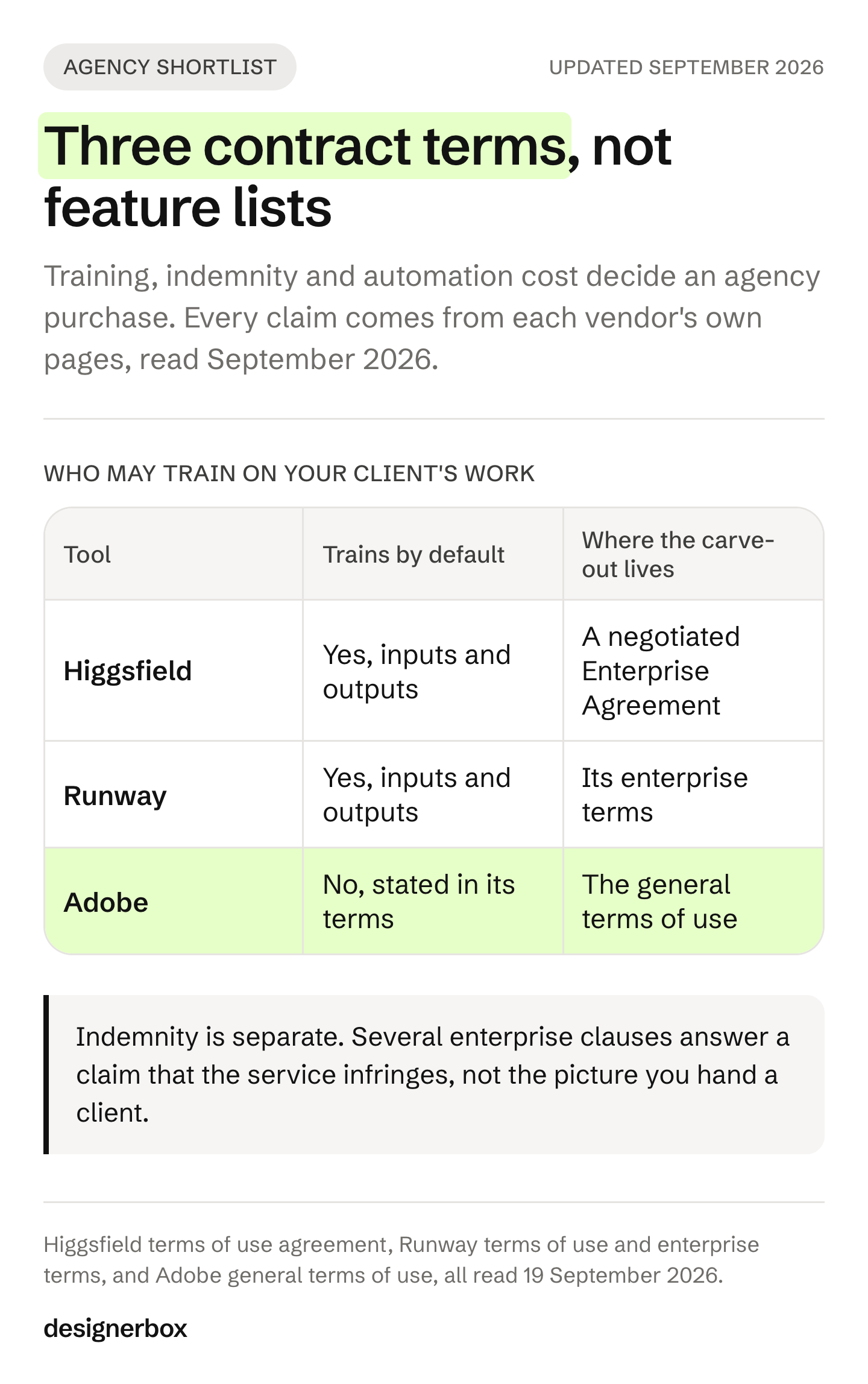
Higgsfield’s terms say your content, inputs and outputs “may be used by Company to train, develop, enhance, evolve, and improve its (and its affiliates’) AI models”. The same clause carves out enterprise and business customers on an Enterprise Agreement, for whom “Company does not use the customer’s content to train or improve its AI models, and that content is handled as confidential” (higgsfield.ai/terms-of-use-agreement, September 2026).
Read the carve-out closely, because it is not a plan you click. The terms define an Enterprise Agreement as “a separate written agreement between you and Company” (higgsfield.ai/terms-of-use-agreement, September 2026). If a client contract calls their unreleased products confidential, that is a negotiation, not a checkout.
This is the category default rather than one vendor’s quirk. Runway’s terms carry almost the same sentence: it does not claim ownership of inputs or outputs, does not restrict commercial use, and says inputs and outputs “may be used by the Company to train and improve its AI models” (runwayml.com/terms-of-use, September 2026). HeyGen’s policy says it may use input to train and enhance its models, and gives an objection route by email rather than a switch in the account (heygen.com/policy, September 2026).
Here is the pattern worth taking into every vendor call. The protection exists, and it attaches to the negotiated contract rather than the tier you buy online. Runway’s enterprise terms say that “Runway may not use Customer Content as training data for the Services” and that “As between the parties, Customer owns all rights, title, and interest in Customer Content”, while its public terms grant a training license over inputs and outputs (runway.com/enterprise-terms and runwayml.com/terms-of-use, September 2026).
Read the scope of a carve-out as carefully as its existence. LTX Studio’s public terms license content for training artificial intelligence models, and carve out only “the personal data of Individual Users”, a term its own definitions limit to a user “purchasing the Subscription to the Platform in its individual capacity and not on behalf of or acting for a business entity” (static.lightricks.com, LTX Terms of Service, last updated 13 May 2026). An agency contracting as a company sits outside that carve-out. Its enterprise page states that LTX Studio does not train on your inputs or outputs (ltx.io, September 2026), which is a different document again.
So ask two questions, not one. Which numbered clause carries the promise, and what does it cost to be on the document that contains it.
Adobe sits on the other side, and puts it in the contract rather than a help page. Its general terms of use say Adobe “will not use these rights to train generative AI models on your Content”, and the plain-English gloss in the same clause extends that to “your or your customers’ content” (adobe.com/legal/terms.html, September 2026). For an agency, the second phrase is the one that matters, because the material at risk belongs to a client. Adobe trains the Firefly models on licensed and public-domain content instead, and offers Custom Models that an organisation opts into with its own brand assets (adobe.com, September 2026).
We hold ourselves to the same test. DesignerBox’s terms assign you the rights to what you make and say we claim no intellectual property rights over what you upload, and the privacy policy says you retain all rights to your data (designerbox.ai/terms and designerbox.ai/privacy, September 2026). Neither page states whether customer content is used to train models. We are pointing at our own gap because you should ask us in writing before client material goes in, and you should ask every other vendor the same question and file the answer.
Who carries the indemnity
Ownership and indemnity are not the same purchase. Higgsfield’s ownership clause is unusually clear: it “does not claim ownership of any of your Inputs or Outputs, nor does it restrict your commercial use of Outputs”, those rights survive cancellation, and “you may transfer or sublicense your rights in Outputs to your clients or other third parties” (higgsfield.ai/terms-of-use-agreement, September 2026). For an agency handing finished work to a client, that clause is better than much of this market.
Two clauses in that quote are rarer than they look. Across seven tools checked for this piece, Higgsfield was the only one whose public terms explicitly said that output rights may be transferred or sublicensed to your clients and that they survive cancellation. The others were silent on both, and HeyGen addresses it only in the negative, barring free-tier output from being sold or sublicensed (heygen.com/terms, September 2026). For an agency, silence is the thing to resolve in writing, because handing rights to a client is the job.
Canva takes the other route and writes the permission down, which makes it a useful model for what to ask for. Its content license carries a clause covering client designs: you may transfer a design to a client provided you hold a written agreement with that client, you remain liable for their compliance, and the design goes to a single client only (canva.com/policies/content-license-agreement/, September 2026). That is the shape of a usable answer. Ask each vendor for it in those terms.
Indemnity is a separate line. Higgsfield lists legal indemnification against third-party intellectual property claims on Enterprise (higgsfield.ai, September 2026). Adobe is the most specific in this set: it publishes a list of eligible Firefly features and surfaces, ties indemnification to a qualifying plan or entitlement, and names the export as the trigger, covering the moment a provisioned user downloads the output (adobe.com, September 2026). Runway’s terms contain an indemnification section that runs the other way, with the customer indemnifying the company (runwayml.com/terms-of-use, September 2026).
Two more lines belong on the same sheet. Higgsfield’s help center notes that outputs are not exclusive and that other users may generate the same or similar outputs (higgsfield.ai, September 2026). Its security wording is “SOC 2-aligned” and “SOC2 & ISO42001 aligned” rather than certified (higgsfield.ai, September 2026). Put the vendor’s own words into the procurement form, not a paraphrase of them.
What automation costs
This one catches agencies that price a retainer before they read it, and it applies to any tool selling an unlimited tier.
Higgsfield states that unlimited access and free generations apply only on higgsfield.ai, that they are intended for manual use, and that anything generated through MCP, CLI, Canvas, Supercomputer or other automated tools deducts credits at standard rates. Its terms add that it may throttle or queue usage that is “automated or materially exceeds typical individual use”. On Team and Scale, unlimited bundles are bought per seat, cannot be shared, and are assigned once with no reassignment (higgsfield.ai and higgsfield.ai/terms-of-use-agreement, September 2026).
Now read that against how an agency actually scales. The moment a repeated job moves onto an API, a CLI or a node board, it is on the metered path. An agency that priced a retainer against the unlimited tier and then automated the work has priced the wrong surface.
We are not claiming a difference here. Access through an API or an MCP client consumes the same AI credits as the web application in DesignerBox too (designerbox.ai/terms, September 2026). The point is that the question belongs on the evaluation sheet, because the answer moves the margin on every retainer you renew.
Higgsfield alternatives for agencies, by what you are replacing
Pick by the job you are moving off Higgsfield, not by the tool with the longest feature list. Four options, each with the contract answer attached.
Replacing the cinematic shot: Runway
Best for: agencies where the deliverable is the film and the client is buying craft.
Runway builds its own models rather than reselling only third-party ones, which makes behavior more predictable across a campaign. Its terms match Higgsfield’s on the two clauses that matter most: no ownership claim over inputs or outputs, no restriction on commercial use, and training on inputs and outputs (runwayml.com/terms-of-use, September 2026).
One agency-specific catch worth knowing before you build on the API. Runway’s terms require that applications you build and make available to end users “prominently display ‘Powered by Runway’ and link to runway.com” (runwayml.com/terms-of-use, September 2026). If you were planning a white-labelled client-facing tool, read that clause first.
If Runway is the tool you are actually weighing, the Runway alternatives compared by job covers that field on its own terms.
Replacing the image engine where legal signs off: Adobe Firefly
Best for: agencies with regulated clients, procurement forms, or an in-house counsel who asks about training data.
Adobe’s position is the clearest in this bracket. It says the foundational Firefly models are trained on licensed and public-domain content, not on Creative Cloud customer content, and enterprise customers can obtain IP indemnification for select Firefly-powered workflows with the appropriate entitlement (adobe.com, September 2026). Custom Models let an organisation train on its own brand assets deliberately, rather than by default.
Firefly sits inside Creative Cloud apps, so it fits agencies already working in Photoshop and Premiere Pro. If your bottleneck is repeating one finished job across hundreds of products rather than editing, this is not the tool that solves it.
Replacing the presenter: HeyGen
Best for: talking-head, spokesperson and localised presenter video at volume.
HeyGen is built around avatar and presenter video rather than cinematic shots. Its policy says it may use the input you provide to train and enhance the models behind the service, and describes an objection route by contacting the company rather than an in-product setting (heygen.com/policy, September 2026). For client talent, check the consent and likeness terms before you record anyone.
Its commercial-use split is the clearest of the set, and it is tier-gated. On paid plans you own the rights in your input and output, and HeyGen does not restrict commercial use. On the free plan you hold a revocable license to the output, and its terms bar that output from being “sold, sublicensed, redistributed, monetized, or used in connection with commercial activities, advertising, client work” (heygen.com/terms, September 2026). Two words in that list are “client work”, so do not pilot a client brief on the free tier and assume it can ship.
We compared it against the wider field in our HeyGen alternatives guide.
Replacing the product job you repeat weekly: DesignerBox
Best for: agencies doing the brand’s job, where the same shot list lands again next month with different products.
This is our own product, so read the section with that in mind. It is covered under “Cost before the run” below, including the limits.
Where Higgsfield still wins for an agency
Three cases, and they are common ones.
The deliverable is the shot. Cinema Studio, Effects, and Genjutsu, which transfers motion and swaps objects inside an existing video, are built for cinematic output (higgsfield.ai, September 2026). When a client is buying a film, buy the tool built for films.
You want one roster instead of a stack. Its footer lists Seedance, Kling, Veo 3.1, WAN, Grok Imagine, Gemini Omni Flash, Nano Banana, Flux and GPT Image alongside its own Soul, DoP and Genjutsu models (higgsfield.ai, September 2026). One roster and one MCP server is a real operational saving. One planning note: the footer also lists Sora 2, and OpenAI removes sora-2, sora-2-pro and the Videos API from its API on 24 September 2026 (developers.openai.com, September 2026).
If your shortlist still has a general image and video platform on it, OpenArt and Higgsfield compared for teams sets those two side by side.
Pre-production is the product. Higgsfield positions the tool for directors and agencies working up storyboards and locking creative direction before a shoot (higgsfield.ai, September 2026). Concept volume before a pitch is a genuine strength, and it is a different purchase from production volume after the win.
Your still work is catalog work. Higgsfield runs an AI product photography page promising to turn one photo into a full shoot, covering studio, lifestyle, on-model and detail shots, and lists an AI Batch Catalog feature that generates shots across many products on a uniform backdrop (higgsfield.ai/ai-product-photography, September 2026). For catalog-wide runs today that is a real advantage on their side, and we would rather say so than leave you to find it.
The evaluation, in one week
Five steps, in this order. The contract work comes first on purpose, because a tool that fails step two cannot be fixed by a good test render.
- Pick one live client job, not a demo. The one that repeats.
- Send all three questions to each vendor in writing. Training, indemnity, automation metering. Keep the replies with the client file.
- Price the automated path, not the headline tier. Ask what the job costs through the API or MCP, because that is where it will run by month three.
- Run the same brief through two tools and compare accepted results, not first results. The number that matters is cost per result a client approves.
- Check seats and access last. It is the easiest thing to change and the one most shortlists start with.
For the retainer maths that sits underneath this, see how agencies price creative when AI cuts the hours. For keeping each client’s look separate once you run more than one brand through the same tool, managing creative for multiple clients covers the mechanics.

Cost before the run
DesignerBox is AI creative production for brands and agencies. You build the job once with your brand, your products and your rules. A saved workflow then runs the same way on the next product.
One workflow, four ways to run it. A template is a workflow somebody already built: open one, add your photo and run it. Your own workflow holds a client’s brand and products. You publish it as an app, so an account manager completes a form and presses Run without opening the workflow. Batch runs that same workflow over a whole sheet of products, and you review the results in one pass. Each client’s stills, clips, brand records and finished files sit in one place. The full workflow from the first product photo to the finished ad, in one subscription.
Every run shows its cost before you start it, which is the part that matters against a fixed fee. For video, an 8-second clip costs 40 to 560 credits, depending on the model. An avatar run returns nine fixed poses for 25 credits. Three critic steps score the results of a run, and best-of-N keeps the best one.
Our limits, stated plainly, because you are buying for a team. Every plan below Ultra is one seat, so an agency needs the Ultra plan, which is where team features, shared brand kits, white label and the API sit. The commercial license starts on the Pro plan. AI video and virtual try-on start on the Premium plan. The free plan cannot make video, and its results carry a watermark. Publishing out to a client’s store is not built, so you download the results or send them with a webhook or an S3 step. And as above, our public terms do not address model training, so put that question to us in writing. Plans and credits are on the pricing page.
If the shot itself is the deliverable, Higgsfield is the better buy. More of this bracket is covered in the DesignerBox tool comparisons.
A first job for one client
Start from a template, add one client’s brand and products, and run it. The cost is shown before the run.
FAQ
What is the best Higgsfield alternative for an agency?
There is no single answer, because agencies buy different jobs. Runway fits when the deliverable is a cinematic shot. Adobe Firefly fits when legal has to sign off on training data and indemnity. HeyGen fits presenter video. DesignerBox fits the product job that repeats every week across clients.
Does Higgsfield have a plan for teams?
Yes. Higgsfield sells Team, Scale and Enterprise plans. Team covers 2 to 9 seats and Scale covers 5 to 15, with each seat’s credits pooling into a shared workspace balance. Single sign-on is on Scale and Enterprise, and sub-workspaces are Enterprise only (higgsfield.ai, September 2026).
Can an agency use Higgsfield output in client work?
Higgsfield’s terms say it does not claim ownership of inputs or outputs, does not restrict commercial use, and that you may transfer or sublicense your rights in outputs to your clients. Those rights survive cancellation (higgsfield.ai/terms-of-use-agreement, September 2026). Read the training clause in the same section before uploading confidential client material.
Do AI creative tools train on the work an agency uploads?
Often yes, by default, and the exception is usually a negotiated contract rather than a plan. Higgsfield and Runway both state it in their terms, HeyGen describes an objection route by email, and Adobe says it does not train the foundational Firefly models on Creative Cloud customer content (higgsfield.ai, runwayml.com, heygen.com and adobe.com, September 2026). Ask in writing and keep the answer.
Why does an unlimited plan stop being unlimited for an agency?
Because unlimited usually describes manual use in the browser. Higgsfield states that unlimited and free generations apply only on higgsfield.ai and that automated surfaces deduct credits at standard rates (higgsfield.ai, September 2026). Automating a repeated job moves it onto the metered path, so price that path.
How much does an 8-second AI video clip cost?
In DesignerBox an 8-second clip costs 40 to 560 credits, depending on the model you pick, and the cost is shown before the run. Platforms meter differently, so compare the cost of a finished result a client accepted rather than a headline rate.
Is Higgsfield worth it for a small agency?
If the client work is cinematic video, effects or pre-production concepts, it is a strong fit, and its commercial-use terms suit agency delivery. If the work is the same product job repeated weekly across clients, price the automated path rather than the unlimited tier.
Sources
- Higgsfield terms of use, ownership, training, and unlimited-use clauses (higgsfield.ai/terms-of-use-agreement, accessed 19 September 2026)
- Higgsfield team, enterprise, about and help-center pages: plans, seats, brand kit, Canvas, API, MCP, CLI, indemnification, security wording (higgsfield.ai, accessed 19 September 2026)
- Runway terms of use: ownership, commercial use, model training, attribution requirement (runwayml.com/terms-of-use, accessed 19 September 2026)
- Adobe Firefly business and legal pages: training data, enterprise IP indemnification, custom models (adobe.com, accessed 19 September 2026)
- HeyGen policy: model training and objection route (heygen.com/policy, accessed 19 September 2026)
- DesignerBox terms of service and privacy policy: content ownership, data rights, API and MCP credit metering (designerbox.ai/terms and designerbox.ai/privacy, accessed 19 September 2026)
- HeyGen terms of service: tier-gated commercial use and the free-tier sublicensing bar (heygen.com/terms, accessed 19 September 2026)
- Runway pricing page: the enterprise “no training on your data” listing, read against the published terms (runway.com/pricing, accessed 19 September 2026)
- LTX Studio enterprise page: statement on not training on inputs or outputs (ltx.io, accessed 19 September 2026)
- Forrester with the 4A’s, “The State Of AI Inside US Marketing Agencies, 2026”, published 24 June 2026 (forrester.com, accessed 19 September 2026)
- OpenAI API deprecations: sora-2, sora-2-pro and the Videos API removal on 24 September 2026 (developers.openai.com, accessed 19 September 2026)
- DesignerBox plans, credits and feature gating (DesignerBox pricing, September 2026)
Competitor terms, plan structures and policy claims verified from each company’s own pages as of September 2026. This article is general information, not legal advice. Individual results vary.