
Runway alternatives split into two groups, and picking the wrong group costs you a month. The first group is other video models. You can reach most of those without leaving Runway, because its developer API already runs Veo 3.1, Seedance 2.0, Wan 3 and Hailuo 3 alongside its own Gen-4.5. The second group is a different system around the model, for teams that make the same creative work every week.
Almost every “Runway alternatives” list answers the first question and ignores the second. That is why the lists feel unhelpful. If you left because one clip looked wrong, a different model fixes it. If you left because you had 40 products to shoot and the tool made one clip at a time, no model fixes that.
This article sorts the options by the job. It uses Runway’s own published API rates, checked in September 2026, and it says plainly where Runway is the better pick.
Key Takeaways
- Runway is not a single-model tool. Its developer API runs Gen-4.5, Gen-4 Turbo, Aleph 2.0, Veo 3.1, Seedance 2.0 and 2.5, Wan 3, Hailuo 3, Grok Imagine 1.5, HappyHorse 1.0 and Gemini Omni Flash (Runway API pricing, September 2026). Switching model rarely means switching tool.
- Gen-4.5 lists at $0.12 a second on that API, so an 8-second clip is $0.96. Gen-4 Turbo lists at $0.05 a second, and Veo 3.1 with audio at $0.40 (Runway API pricing, September 2026).
- Gen-4.5 delivers ProRes, 10-bit masters, true HDR with HDR10 metadata, and OpenEXR sequences for ACES pipelines (Runway models, September 2026). That is finishing gear for film and VFX.
- If your output is a product listing, a static ad or a social post, you will never touch those formats. The scope difference, not the quality, is what decides this.
- Runway also ships plugins for Premiere Pro and After Effects, an MCP connection to AI chats, and virtual try-on (runway.com, September 2026). Do not pick a tool on features Runway already has.
- Runway says it is used by more than 60 million people (runway.com, September 2026). It is a mature product, and “alternative” here means different fit, never worse.
- In DesignerBox a model is one step in a workflow. An 8-second clip costs 40 to 560 credits, depending on the model, and the cost is shown before the run.
Why people look for a Runway alternative
Four reasons come up. Only two of them are about Runway at all.

The first is cost at volume. One clip is cheap. Sixty clips for a catalog drop is a budget line, and per-second pricing makes the total hard to guess before you commit.
The second is the unit of work. Runway generates a clip. A product team needs a set: a hero, three angles, a lifestyle frame and a marketplace crop, for every item. Making that one generation at a time is the complaint, and it is not a complaint about output quality.
The third is who runs it. Runway is a creative tool built for people who make things for a living. When the person who needs the asset is a merchandiser or a client services lead, handing them a generation interface does not work.
The fourth is model fit for one shot. That one is genuinely about the model, and it usually has the simplest answer.
What Runway does well
Runway built this category. It released Gen-1, the first publicly available video generation model, and it has shipped every year since (runway.com, December 2025).
Gen-4.5 is a frontier model. Runway ranked it first on the Artificial Analysis text-to-video leaderboard at 1,247 Elo when it launched, measured against that leaderboard as of 30 November 2025 (runway.com, December 2025). Leaderboards move every few weeks, so treat that as a launch-date reading and check the current board before you quote it.
Three things stand out for anyone doing film, advertising or VFX work.
Finishing formats. Gen-4.5 outputs ProRes with selectable profiles, PNG and OpenEXR frame sequences, 10-bit Rec.709 masters, and true HDR graded into BT.2020 with measured HDR10 metadata. The EXR delivery reads as scene-referred ACEScg for ACES 1.3 pipelines (Runway models, September 2026). No other part of this market publishes that list.
Editing an existing shot. Aleph 2.0 takes video plus text or an image and edits the footage you already have. Runway describes changing a frame and applying it across the rest of the video (runway.com, September 2026). That is a different job from making a new clip, and it is what most post-production work actually involves.
Where the work already lives. Runway ships plugins for Premiere Pro and After Effects, so generation happens inside the edit (runway.com, September 2026).
If your finished file goes to a colorist, a broadcast spec or a timeline in After Effects, stop reading the alternatives lists. Runway is the answer.
What Runway’s API costs a second
Runway Dev bills in credits, and it sells them at $0.01 each in the developer portal (Runway API pricing, September 2026). The table converts the published rates to dollars so you can price a shot.
| Model on Runway Dev | Rate a second | One 8-second clip |
|---|---|---|
| Gen-4 Turbo | $0.05 | $0.40 |
| Gen-4.5 | $0.12 | $0.96 |
| Aleph 2.0 | $0.28 | $2.24 |
| Veo 3.1, no audio | $0.20 | $1.60 |
| Veo 3.1, with audio | $0.40 | $3.20 |
| Veo 3.1 Fast, with audio | $0.15 | $1.20 |
| Wan 3, 720p | $0.10 | $0.80 |
| Wan 3, 1080p | $0.20 | $1.60 |
| Hailuo 3, 768p | $0.10 | $0.80 |
| Gemini Omni Flash | $0.10 | $0.80 |
| HappyHorse 1.0, 720p | $0.15 | $1.20 |
| Seedance 2.0, 1080p | $0.40 | $3.20 |
| Seedance 2.0, 4K | $1.50 | $12.00 |
Source: Runway API pricing, accessed September 2026. Rates are per second of generated video on the developer API. Aleph 2.0 carries a minimum charge per generation, and the professional and HDR output formats add a surcharge on top of the model rate. These are API rates, not the subscription plans in the Runway app. Runway lists those on its own pricing page (runway.com/pricing, September 2026).
Two things fall out of this table.
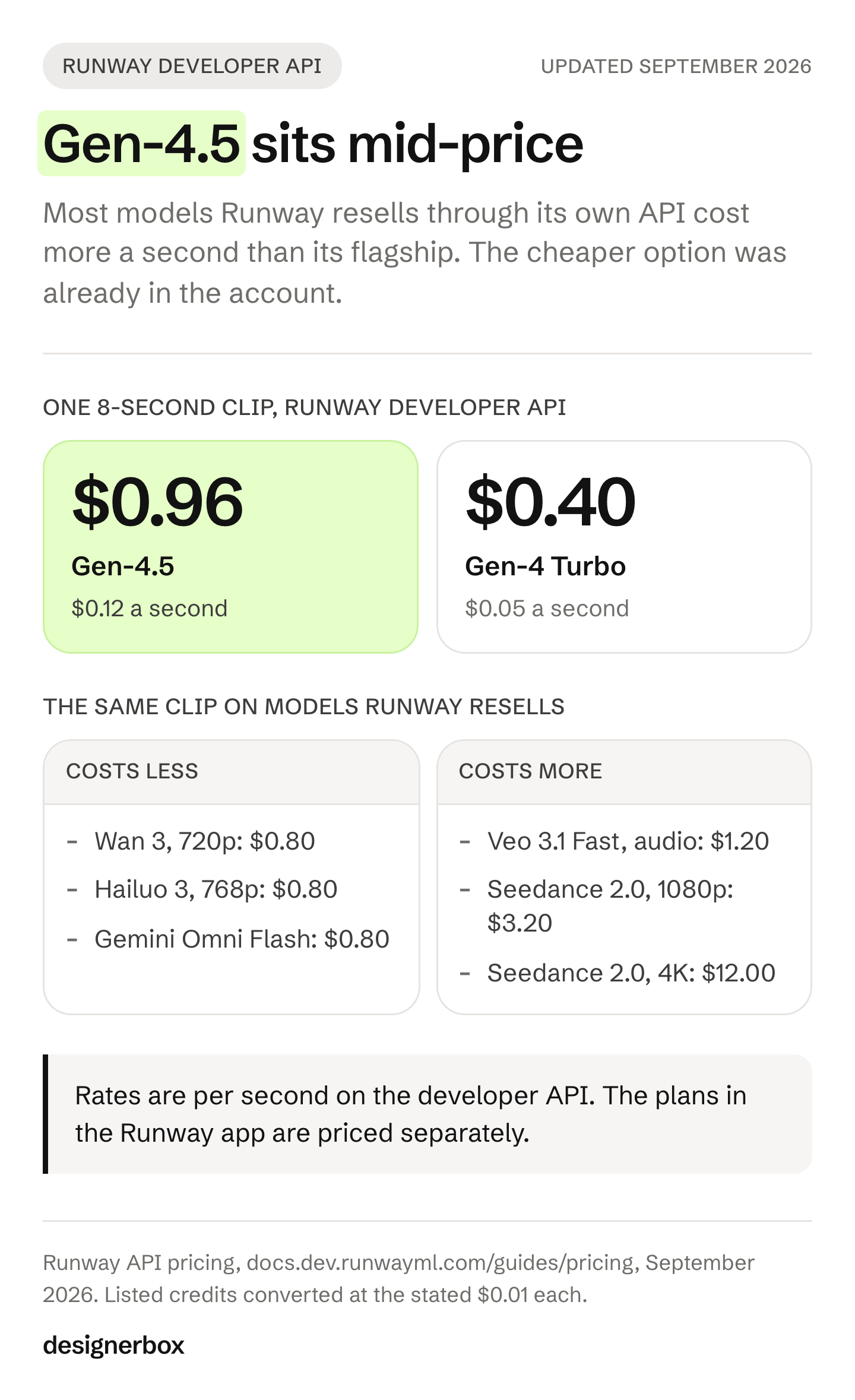
Gen-4.5 is mid-priced on its own platform. Most of the models Runway resells cost more a second than Gen-4.5 does. If your reason for leaving was cost, the cheaper option was already in the account.
And a full shot list is where the money goes. One 8-second Gen-4.5 clip is under a dollar. Sixty of them, with the three takes you discard for each, is a different conversation. That arithmetic, not the per-clip rate, is what people are really reacting to. We work through it in what AI video costs.
The two meanings of “alternative”
Sort your own case before you shortlist anything.
You want a different model. Pick on the shot. A continuous take longer than 8 seconds, sound coming out of the same generation, a specific aspect ratio, a reference image that has to hold. We compare the video models on published specs in Veo alternatives and Seedance alternatives, and on consistency in the most reliable AI video generator. Note that Runway’s API carries several of these models already, so “switch model” is often a dropdown, not a migration.
You want a different system. The model is fine. The problem is everything around it: the same brand rules on every item, a colleague who needs to run the job without learning the tool, a review pass over hundreds of results, and knowing the cost before you commit. No model choice fixes any of that, which is why model comparisons feel beside the point when this is your case.
What to use for each job
The table sorts the common jobs. The right-hand column is the honest pick, and for several rows it is Runway.
| The work | Where to look |
|---|---|
| Agencies, one workflow for each client | DesignerBox for agencies |
| Brand teams, one standard on every piece | DesignerBox for brand teams |
| Performance marketers, new variants from your winners | DesignerBox for performance marketers |
| Creative studios, finished sets sold under your name | DesignerBox for creative studios |
| Ecommerce brands, the same shot for every product | DesignerBox for ecommerce brands |
| Fashion brands, on-model sets for every colorway | DesignerBox for fashion brands |
| Furniture and homeware, room scenes from one photo | DesignerBox for furniture and homeware brands |
| Solo founders, a brand without a designer | DesignerBox for solo founders |
| Product imagery: packshots, on-model shots and scenes | AI product photography |
| Static ads in your brand’s look | AI ad generator |
| A short video ad from one product photo | AI video ads |
| Creator-style clips with a presenter | AI UGC |
| Carousels and posts for the feed | Social creatives |
| Moodboards and storyboards | Campaign concepts |
| Mockups, icons and a brand kit | Brand assets |
| Resize and translate every ad | Automations |
| A film or broadcast deliverable, ProRes, HDR or ACES | Runway Gen-4.5 |
| Editing footage you already shot | Runway Aleph 2.0 |
| Generation inside Premiere Pro or After Effects | Runway plugins |
| One strong clip, now and then | Any single model, including Runway |
The last four rows matter as much as the rest. A tool that says it wins every row is not describing a real product.
Work that repeats every week
DesignerBox is AI creative production for brands and agencies. It sells the run, the review and the delivery, and it shows the cost before the run. Templates, workflows, apps, batch, the image editor, the video editor, brand and Assets sit in one place: the full workflow from the first product photo to the finished ad, in one subscription.
The spine is one workflow with four ways to run it. A template is a workflow somebody already built, so you open it, add your photo and run it. A workflow is your own set of steps, built once with your brand and run again. An app is a workflow with a form, so a colleague completes it and presses Run without opening the workflow. Batch is live, and it puts one workflow over a whole sheet of products. Nothing is rebuilt between the four. Each one widens who can run it.
Three things follow from that shape, and they are the reason a catalog team ends up here rather than on a generation tool.
Brand rules are a record, not a prompt. You set the brand once, with voice, logos, fonts, palette and rules. The workflow reads it on every run, so the tenth product matches the first. Pasting a style paragraph into a prompt box each time cannot hold that.
The cost appears before you press Run. Billing is the loudest complaint in this category, and it is the one nobody else has claimed. An 8-second clip costs 40 to 560 credits, depending on the model, and you see the number before you commit.
Review is part of the workflow. Three critic steps score the results of a run, and best-of-N keeps the best one. With batch you keep or discard item by item, and re-run a single row on its own.
Where DesignerBox overlaps Runway, say so plainly. Both run a catalog of models. The workflow picks the image or video model for each step, with Runway Gen-4.5 in it as Studio Video. Both connect to an AI chat over MCP, and DesignerBox has 68 tools over MCP plus an API on the Ultra plan. Both have a Figma plugin and virtual try-on. None of that is the reason to pick either one.
Be just as plain about the limits. Publishing out is not built, so you download the results or send them with a webhook or an S3 step. Every plan below Ultra is one seat, which is real friction for an agency. The commercial license starts on the Pro plan. AI video and virtual try-on start on the Premium plan, and the free plan cannot make video. Plans and credits are on the pricing page.
If you need a broadcast master, an ACES sequence or an edit of footage you already shot, none of the above helps and Runway does.
How to choose in one pass
Answer three questions in order and the shortlist writes itself.
- What is the finished file? A ProRes or HDR master points at Runway. A PDP image, a listing video, a static ad or a feed post points at a production setup.
- How many of them, this month? One or two a month means any single model is fine. Forty products with four assets each means the system around the model decides your week.
- Who presses the button? A designer or editor can drive a generation tool. A merchandiser or an account manager needs a form with your rules already in it.
Most teams get a clear answer by question two.

A free plan for your first run
Start from a template, add your brand and your products, and run it. The cost is shown before the run.
FAQ
Is Runway being replaced by its own alternatives?
No. Runway resells several competing models through its developer API, including Veo 3.1, Seedance 2.0, Wan 3 and Hailuo 3, and bills each at that model’s rate (Runway API pricing, September 2026). Trying a different model is usually a setting inside Runway rather than a move to another product.
What does Runway Gen-4.5 cost?
On the developer API, Gen-4.5 lists at $0.12 a second, so an 8-second clip is $0.96. Gen-4 Turbo lists at $0.05 a second (Runway API pricing, September 2026). Professional and HDR output formats add a surcharge. The subscription plans in the Runway app are priced separately, and Runway lists them on its own pricing page (runway.com/pricing, September 2026).
Is there a free Runway alternative?
Several models carry a free tier through their own vendors, and terms change often, so check the vendor’s page in the week you need it. DesignerBox has a free plan, and it cannot make video. We cover the free options in free AI video generation.
Does DesignerBox replace Runway?
For catalog and ad production, it does a different job: it runs a saved workflow with your brand on every product and shows the cost first. For film finishing, VFX and editing existing footage, it does not replace Runway, and Runway Gen-4.5 runs inside DesignerBox as Studio Video.
Which alternative handles the longest clip?
Clip ceilings move with each model release, so check the vendor’s own documentation in the writing week rather than a listicle. We compare published limits in Veo alternatives and Seedance alternatives.
What should an agency with many clients use?
Look for brand rules saved per client and applied automatically, and for a way to hand a junior a form instead of a workflow. In DesignerBox, team features, shared brand kits, white label and API access all sit on the Ultra plan. That is the honest gating note before you plan around it.
Sources
- Runway Gen-4.5 research announcement, Runway, December 2025, accessed September 2026
- Runway API pricing, Runway, accessed September 2026
- Runway models and output formats, Runway, accessed September 2026
- Runway product page, Runway, accessed September 2026
- DesignerBox pricing and plans, DesignerBox, September 2026