
AI marketing automation is the use of machine learning to run marketing tasks that used to follow fixed rules. Classic automation fires a message when a condition is met. AI automation predicts what a person wants, picks the message, and adjusts as results come in. It works across four layers: data, decisioning, delivery and creative. Three of those run themselves. The fourth is still made by hand.
CMOs put 15.3% of marketing budget into AI this year, and only 30% say their organisation is mature enough to scale it (gartner.com, May 2026). The budget is committed. What most guides on this topic leave out is where it stops working.
Every major explainer in this category defines the term as decisioning: who to target, when to send, which message wins, when to move budget. That definition is correct and incomplete. A system that decides between 40 versions of a campaign needs 40 versions to decide between, and the layer that produces them is the one nobody automated. This guide maps all four layers, shows what each one already does, and puts a number on the gap. Written for a marketing lead who owns both the automation stack and the creative calendar.
Key Takeaways
- The definition turns on prediction. Classic automation executes a rule a person wrote. AI automation infers the rule from behaviour and changes it while the campaign runs.
- Four layers sit under one phrase. Data, decisioning, delivery, creative. Almost every tool sold under this label works in the middle two.
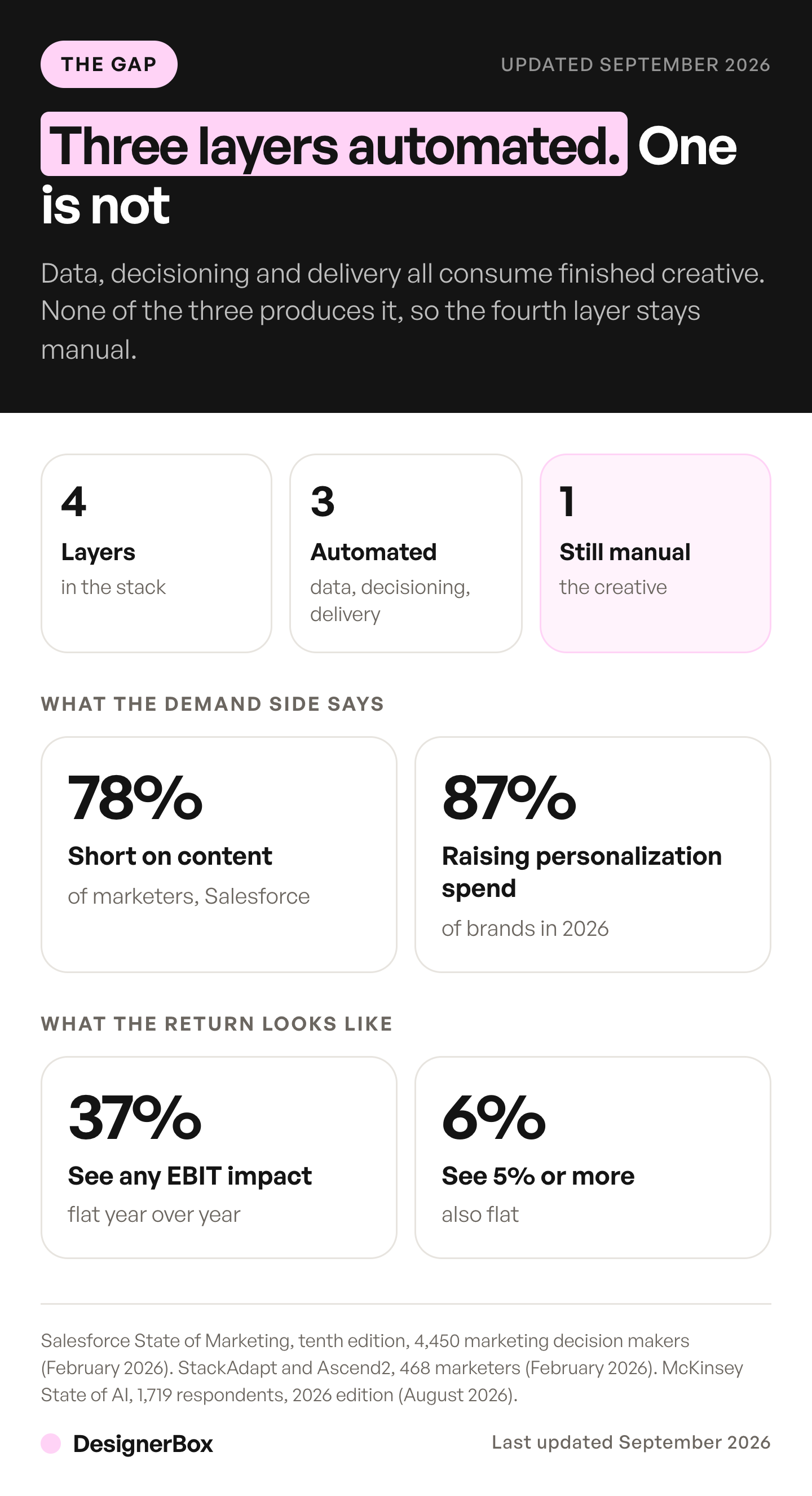
- The demand is structural, not a trend. 87% of brands plan to increase personalization spend in 2026, and 78% of marketers already say they need more personalized content than they can produce.
- Automating decisions raises creative demand. Addressing 40 segments instead of four does not need a better rule engine, it needs 40 sets of creative. What these platforms generate is text: copy, subject lines, translations. The photograph and the video are still made by hand.
- Adoption is near-universal, measured return is not. 37% of organisations attribute any EBIT impact to AI and 6% attribute 5% or more, both flat year over year.
- Cost per variant is knowable before you run it. A 40-asset set runs 160 credits on the cheapest DesignerBox image model and 880 on the most expensive, and the number shows before you press generate. Build the set once and the same workflow reruns it for the next campaign.
- Disclosure is now part of the workflow. Fewer than half of advertisers using generative AI always disclose it, and three jurisdictions now require a label.
What is AI marketing automation?
AI marketing automation is software that uses machine learning to run and adjust marketing tasks with minimal human input. It replaces fixed if-then rules with models that predict behaviour, score intent, choose timing, and reallocate budget while a campaign is live. The person sets the goal and the guardrails. The system decides the steps and revises them as results arrive.
The category has a settled definition and the major sources agree on it. IBM describes it as the use of AI to run marketing tasks automatically with minimal human input (ibm.com, September 2026). Braze frames it as machine learning plus real-time decisioning to deliver personalized engagement at scale (braze.com/resources/articles/ai-marketing-automation, September 2026). ActiveCampaign describes systems that analyse behavioural patterns and adjust campaigns in real time (activecampaign.com/blog/ai-marketing-automation, September 2026).
Read those three definitions together and the common noun is the decision. Targeting, timing, sequencing, budget. That is what the category means by automation, and it is the part that works.
How is AI marketing automation different from classic marketing automation?
Classic marketing automation is deterministic. A person writes the rule, the software executes it exactly, and it keeps executing until someone edits it. Send the welcome email three days after signup. Move the lead to sales at 80 points. The logic is visible, testable and static.

The AI version is probabilistic. The model reads behaviour, estimates what happens next, and picks the action with the best expected outcome. Nobody wrote “send this one at 7:14pm on a Thursday.” The system inferred it.
| Classic automation | The AI version | |
|---|---|---|
| Logic | Rules a person writes | Models that infer patterns from data |
| Timing | Fixed delay or trigger | Predicted per person |
| Segments | Defined by hand, static | Generated from behaviour, shifting |
| Adjustment | Someone edits the workflow | Adjusts while the campaign runs |
| What you audit | The rule | The inputs, the outputs and the guardrails |
| Fails by | Doing the wrong thing consistently | Doing a plausible thing for a reason nobody can see |
The last row is the one that changes how a team works. A broken rule is findable. A model quietly optimising toward a proxy metric is not, which is why the maturity gap in the Gartner number is about process rather than software. 70% of CMOs call becoming an AI leader critical for 2026 while 30% report the readiness to scale it (gartner.com, May 2026).
The four layers of AI marketing automation
The phrase covers four distinct jobs. Confusing them is why two teams can buy into the same category and end up with products that share almost nothing.
| Layer | What it automates | What it needs to work | Who operates here |
|---|---|---|---|
| 1. Data | Identity resolution, event collection, audience building | Clean events, consistent IDs, consent | CDPs, warehouses, reporting tools |
| 2. Decisioning | Segments, lead scores, next best action, send time, budget pacing | History with enough volume to learn from | Salesforce, HubSpot, Braze, ActiveCampaign |
| 3. Delivery | Sending, bidding, placement, format adaptation | A connected channel and a live budget | Meta, Google, TikTok, email platforms |
| 4. Creative | The asset itself: the image, the video, the ad frame | A real product photo and brand rules | Largely unautomated in this stack |
Layers one to three are mature, competitive and improving every quarter. A team that buys well across them gets real results. The trouble is that layers one to three all consume the output of layer four, and none of them produces it.
Layer two is where the category concentrates. For a ranked view of the platforms that operate there, including which of them can be driven from outside their own interface, see the ten best AI marketing agents ranked by layer.
What do AI marketing automation examples look like in practice?
Five jobs come up in almost every deployment, and all five sit in the decisioning and delivery layers.
- Audience segmentation. The system groups people by behaviour rather than by a filter someone wrote, then keeps regrouping as behaviour changes.
- Predictive lead scoring. Models rank accounts on likelihood to convert and flag churn risk before a human notices the pattern.
- Send-time and channel selection. Each person receives the message on the channel and at the hour their own history favours.
- Adaptive nurture sequences. The next step in the journey is chosen per person rather than fixed in a flowchart.
- Budget pacing and creative fatigue detection. Spend shifts toward what is working, and the system flags an ad whose performance is decaying.
That last one is worth sitting with. Creative fatigue detection is a solved, automated, well-understood job. The system watches frequency climb and cost per result rise, and it tells you the creative is spent. The output of that automation is a request. Someone now has to make a new ad.
The platforms put a clock on that request. TikTok advises advertisers to keep three to five unique creatives per ad group and to upload new ones whenever fatigue is detected, roughly every seven days (ads.tiktok.com, September 2026). That is the demand signal reaching a creative team, generated automatically, on a weekly cycle, per ad group.
The gap: automated decisions create creative demand nobody automated
Here is the loop as it actually runs. The decisioning layer gets better at addressing people individually. Better addressing means more variants: more segments, more offers, more formats, more languages. The delivery layer can serve all of them. The creative layer produces them at the speed a designer works.
The numbers describe the squeeze from both ends. 87% of brands plan to increase their spend on personalization in 2026, from a survey of 468 brand and agency marketers (stackadapt.com, February 2026). At the same time 78% of marketers say they need more personalized content than they are able to produce, and 84% still describe their campaigns as generic, from 4,450 marketing decision makers surveyed for the tenth State of Marketing report (salesforce.com, February 2026). Spend on personalization is rising against a content supply that is already short.
The category is honest about this if you read the feature lists closely. What the platforms generate is text. Social posts, emails, subject lines, product descriptions, translations. All genuinely automated, all genuinely useful. The photograph is not on that list, and neither is the video.
The creative layer does have automation, just not inside the marketing automation stack. 83% of ad executives say their company has deployed AI somewhere in the creative process, up from 60% in 2024, concentrated in social ads at 85% and display at 73% (iab.com, January 2026). It lives in a separate set of tools, bought separately, with its own logins and its own bills. That separation is the gap. The decision engine and the thing that makes the asset are not connected, so the handoff between them is a person exporting files.
For the mechanics of producing those assets from a template or a source photo, creative automation is the term that names layer four directly, and it has its own three rungs of maturity.
What does closing the creative gap cost?
Work it forward from the variant count rather than from a subscription price. A campaign addressing ten segments, in two formats, with two offers is 40 assets. That is a small campaign by the standards of a stack that can address people individually.

There is no flat per-image price to multiply by 40. In DesignerBox the cost depends on the model you pick: 4 credits on Seedream 5, 5 on FLUX Pro 1.1, 7 on Nano Banana 2, 14 on Nano Banana Pro, which is the default, and 22 on GPT Image 2. The same 40-asset set is 160 credits on the cheapest model and 880 on the most expensive. The run cost shows before you press generate, so the model choice is a budget decision you make in advance instead of a surprise on the invoice.
Plans run Free at 112 credits, Basic $15 a month billed monthly for 500, Pro $35 for 1,000, Premium $75 for 2,500 and Ultra $200 for 8,000. Every plan reads the same catalog of 8 image models and 13 video models rather than one house model. Two floors matter more than the credit count: importing your own product photo starts on Pro, and so does the commercial licence you need before an asset runs as a paid ad.
Video is priced per second of output, and the model moves the price by 14x. An eight-second clip runs 40 credits on the lite model, 320 on the premium one, and 560 at the top of the range. Premium’s 2,500 credits a month covers seven premium eight-second clips or 62 lite ones. Size the plan against the model you will actually use, not against an average that mixes stills and video.
Two limits belong in the same paragraph as the prices. Team collaboration, shared brand kits and API access sit on the Ultra plan at $200 a month, and every plan below Ultra is a single seat. A team that needs shared brand kits across five people is looking at Ultra or at a different tool. Full current pricing is on the DesignerBox pricing page.
The connection back to the automation stack matters more than the per-asset price. An asset that has to be exported, renamed and uploaded by hand puts a person back in the middle of an automated loop. DesignerBox exposes its models and apps through 68 MCP tools, so an assistant or agent already running in the stack can generate the variant set directly, and a saved workflow reruns the campaign that worked for the next product without rebuilding the brief. The agent skills cover the same ground from a chat client. Which parts of a marketing workflow that actually covers, and which it does not, is mapped in Claude for marketing.
What to automate first, and what to keep human
One number should govern the sequencing, and it is the least flattering one in this article. In McKinsey’s 2026 State of AI survey of 1,719 respondents, 37% of organisations attribute at least some EBIT impact to AI and 6% attribute 5% or more, both flat against the previous year, while 80% of individuals report AI improved their own productivity (theregister.com reporting McKinsey, August 2026). Near-universal adoption, widespread personal productivity gains, and financial return that has not moved. That is what an unfinished handoff looks like in aggregate, and it is the argument for fixing the sequence rather than buying another layer.
Sequence by what breaks if it is wrong. Data quality first, because every layer above it inherits the error. Decisioning second, because that is where the mature products are. Creative supply third, and only once the decisioning layer is actually asking for more variants than the team can make. Automating creative production before anything is consuming it produces volume nobody uses.
Three things stay human, and they are not the same three that were human five years ago.
The claim. Whether the offer is accurate, legal and defensible is a signature, not an inference. No model owns that.
Brand judgment. A model can produce 40 on-spec assets that are individually fine and collectively drift. Someone has to look at the set, not the file.
Disclosure. Fewer than half of advertisers who use generative AI always disclose it, essentially unchanged from 2024 (iab.com, January 2026). Google states that AI regulations in the European Union, India and New York require ads with certain AI-generated or edited assets to carry a disclosure or label, and it rolled out an AI label setting across Google Ads, Display & Video 360 and Merchant Center in July 2026. Google also states that using its label setting does not by itself guarantee compliance with any specific regulation (support.google.com, July 2026), so the obligation stays with the advertiser. Treat the label as part of the workflow rather than a legal review at the end.
The pattern that holds across all three: automate the production, keep the approval. For the wider version of this argument across a whole toolchain, the six-tool AI stack walks through what each handoff between tools costs in practice, and producing ad variants at scale covers the volume side in detail. When the decisioning layer starts asking for more variants than your team can make, start at ad creation: build the set once on one product, then rerun it for the next campaign.
FAQ
What is AI marketing automation in simple terms?
It is marketing software that decides for itself instead of following a rule you wrote. Classic automation sends an email three days after signup because someone set that delay. AI automation predicts the best moment for each person and sends it then, then changes its mind as it learns more.
What is the difference between marketing automation and AI marketing automation?
Marketing automation executes rules a human defines. AI marketing automation infers the rules from behaviour and adjusts them while the campaign is running. The practical difference is auditability: you review a rule in classic automation, and you review inputs, outputs and guardrails in the AI version.
What are the best AI marketing automation tools?
It depends which of the four layers you are buying. Salesforce, HubSpot, Braze and ActiveCampaign operate in decisioning. The ad platforms handle delivery. Data platforms handle identity and events. Creative production is a separate category with separate tools, which is the part most shortlists leave out.
Will AI replace marketers?
It replaces specific tasks: segmenting, scoring, timing, pacing, flagging fatigue. It does not replace the judgment calls. Approving a claim, deciding whether a set of assets reads as your brand, and owning disclosure are all still someone’s signature.
Can these platforms create the ad creative too?
The decisioning platforms generate text: copy, subject lines, product descriptions and translations. Images and video come from a separate set of tools. Connecting the two is the unsolved part of the workflow, and it is usually a person exporting and uploading files.
How much does AI marketing automation cost?
The decisioning platforms price differently enough that a single figure would mislead. Salesforce publishes three models side by side for Agentforce: per action through Flex Credits, per conversation, and per user per month (salesforce.com, September 2026). Braze publishes named editions and its pricing dimensions, monthly active users plus action credits, without dollar figures (braze.com, September 2026). Read the vendor’s current page rather than a roundup. The creative layer prices per asset, and the price is set by the model rather than by a flat rate: 4 to 22 credits an image in DesignerBox. A 40-asset variant set runs 160 to 880 credits, and the figure shows before you generate. Pro at $35 a month billed monthly is the practical floor, because importing your own product photo and the commercial licence both start there.
What should we automate first?
Data quality, then decisioning, then creative supply. Fix identity and events before anything else, because every layer above inherits the error. Add creative automation once the decisioning layer is asking for more variants than the team can produce, not before.
Sources
- Gartner, 2026 CMO Spend Survey, 401 CMOs and marketing leaders in North America, the UK and Europe, fielded January to March 2026 (gartner.com, May 2026)
- IAB, The AI Ad Gap Widens, 104 ad industry executives and 505 consumers (iab.com, January 2026)
- StackAdapt and Ascend2, The State of Personalization in Digital Marketing, 468 brand and agency marketers (stackadapt.com, February 2026)
- Google, Updates to AI labeling requirements (support.google.com, July 2026)
- Salesforce, State of Marketing, tenth edition, 4,450 marketing decision makers (salesforce.com, February 2026)
- McKinsey, The State of AI, 2026 edition, 1,719 respondents, as reported by The Register (theregister.com, August 2026)
- TikTok, Creative best practices (ads.tiktok.com, September 2026)
- IBM, Utilizing AI in Marketing Automation (ibm.com, September 2026)
- Braze, What Is AI Marketing Automation (braze.com, September 2026)
- ActiveCampaign, AI Marketing Automation in Action (activecampaign.com, September 2026)
- DesignerBox pricing, credits and model catalog, from the product brief, September 2026
Platform capabilities and statistics verified from the sources above as of September 2026. Vendor pricing changes often, so check the current page before you budget. Individual results vary.