
Add up six AI creative subscriptions and you get a number somewhere between $100 and $400 a month per seat. That number is real, and it is the smallest part of the cost. The larger part is the seams: the work your team redoes every time an asset crosses from one tool to the next, and the drift that survives the crossing.
Six tools means six logins, six billing dates, and six places an asset can be sitting when someone asks where it is.
The subscriptions are the visible number. They arrive on a card statement once a month, they are easy to audit, and they are the only part of the stack anyone ever puts in a spreadsheet. The rework is the real one, and it never gets invoiced, because it is your own team’s hours.
This breaks down what a stitched stack charges you, why the line items understate it, and what changes when the seams go away.
Key Takeaways
- The subscriptions are the auditable cost, not the largest one. Six line items are trivial to total. The hours spent moving assets between them are not, so they never get counted.
- Brand drift is a per-crossing tax. Every paste between tools loses context, and someone corrects it downstream or ships it and hopes.
- Assets scatter by default. Six tools produce six download folders, and the search for last quarter’s hero shot is an unbudgeted recurring cost.
- Every model has its own prompt box. The skill you build in one tool does not transfer, and it depreciates when that tool ships a new model.
- Published pricing is harder to verify than it should be. Several tools in a typical stack could not be confirmed to a source for this piece, so their numbers were cut rather than guessed.
- Consolidation is not automatically cheaper. It is fewer crossings. If your stack has no crossings, it has no seams to remove.
- Video is the exception that breaks the math. It is the most expensive operation anywhere, including here, and it deserves its own budget line.
| The stitched stack | DesignerBox |
|---|---|
| Six subscriptions, six bills, six logins | One bill, every top image and video model |
| Brand drifts every time you paste between tools | Workflows rerun your best campaign for every new product |
| Downloads scattered across drives and DMs | One searchable library for every asset |
| A new prompt box to learn for every model | One canvas, model picked for you or by you |
That table is the argument in four rows. The rest of this piece is the arithmetic behind it.
What does a six-tool AI stack cost?
A representative stack has six jobs in it: generate images, generate video, remove backgrounds, upscale, design and lay out, and store the results. Six jobs is usually six vendors, because almost nobody sells all six well. Priced per seat, per month, list rates land in the low hundreds. Priced you also have to count the hours between them.
Here is the part worth being upfront about. Verifying list pricing for this category in July 2026 is harder than it should be. Two of the six could be confirmed against the vendor’s own site. Four could not, because the aggregator pages that rank for their pricing contradicted each other, and a number that three sites report three different ways is not a number.
So the four are cut. Guessing them would make the table prettier and the article worse.
| Job in the stack | Verified list price | Source |
|---|---|---|
| Design and layout (individual) | Creative Cloud Pro, $69.99/month, annual plan billed monthly, North America | adobe.com, July 2026 |
| Design and layout (team) | Canva Business, $20 per person per month | canva.com, July 2026 |
| Image generation | Not verified to source, cut | None found |
| Video generation | Not verified to source, cut | None found |
| Background removal | Not verified to source, cut | None found |
| Upscaling | Not verified to source, cut | None found |
Both of those tools are good at what they sell. Creative Cloud Pro covers 20-plus applications and is the deepest layout and compositing set in the category. Canva Business is built so a non-designer can ship a correct asset without opening a design application at all. Neither is the problem. The problem is that they are two of six, and the four you cannot price are still charging you.
If the design layer is the seat you are reconsidering first, the Canva alternatives comparison prices seven of them against each other and covers the AI allowance limits that decide when a plan stops being enough.
Take the two confirmed anchors and one seat is already $90 a month before a single image is generated. Add four unpriced tools and the honest answer to “what does the stack cost” is: more than you can currently prove.
Why does brand consistency break when you paste between tools?

Because context does not survive the crossing. Your brand lives in a palette, a set of type rules, a lighting preference, and a hundred judgments nobody wrote down. A file crossing from a generator to an editor to a layout tool carries pixels. It does not carry any of that. Each tool re-decides, and each re-decision drifts a little further from the thing you approved. The layout hop is the most frequent one, which is why keeping the finishing step next to the generation removes more drift than any single subscription you cancel.
Drift is not one large failure. It is a compounding series of small ones, and the compounding is what makes it expensive.
The generator picks a warmth. The upscaler sharpens in a way that changes the texture. The layout tool applies a colour profile. No single step is wrong enough to reject. Six steps later the asset is off, nobody can point to which step did it, and the fix is to redo the chain rather than repair the output.
That is the tax. It is charged per crossing, it is paid in your designer’s afternoon, and it does not appear in any tool’s pricing. The mechanics of keeping generated assets on brand across a campaign are worth understanding separately, because the failure mode is specific and it is fixable.
Where do the generated assets go?
Into six download folders, and then into DMs. This is the least dramatic cost in the stack and one of the most persistent. Each tool has its own storage, its own naming, and its own retention policy. Nobody standardises across them, because there is no shared layer to standardise into. So the working copy of every asset ends up wherever the person who made it put it.
The recurring version of this cost is the search.
Someone asks for the hero shot from the spring campaign. It exists. It is in one of six tools, or in a Slack thread, or on the drive of somebody who has since left. Finding it takes twenty minutes, and twenty minutes is cheaper than regenerating it, so somebody spends the twenty minutes. This happens every week and it is never on a budget line.
The second-order cost is worse: assets that cannot be found get remade. You pay to generate the same image twice, and the second one is slightly different from the first, which feeds straight back into drift.
What does it cost to learn six prompt boxes?
It costs the thing you cannot buy more of, which is your team’s attention, and it depreciates faster than the subscriptions do. Every model has its own prompt grammar. What works in one produces something unrelated in another. The skill your team builds in tool three is worth nothing in tool four, and it is worth nothing in tool three either once tool three ships a new model version.
This is the cost that people consistently rate as trivial and consistently pay the most of.
A model update is not a neutral event when your team has built habits on the previous one. Prompts that produced a reliable result stop producing it. Nobody schedules the relearning, so it happens ad hoc, mid-campaign, under deadline. Multiply by six vendors on six independent release cycles and some portion of every month is spent recovering fluency somebody already had. That deadline pressure is measurable: 54% of surveyed marketing teams use three to five tools for a single asset, and most of them missed a launch date last year.
None of that is the vendors behaving badly. Shipping better models is the job.
Worth being explicit about this, because it is easy to misread the argument. Google, OpenAI, ByteDance, Black Forest Labs, Kuaishou, and Runway are not the competition. They build the models, including the 13 in this catalog, and a stack built on their work is built on the best work in the category. The competition is the six-way seam between them. What costs you is holding those relationships one at a time and absorbing every release cycle individually.
How do you price the seams?
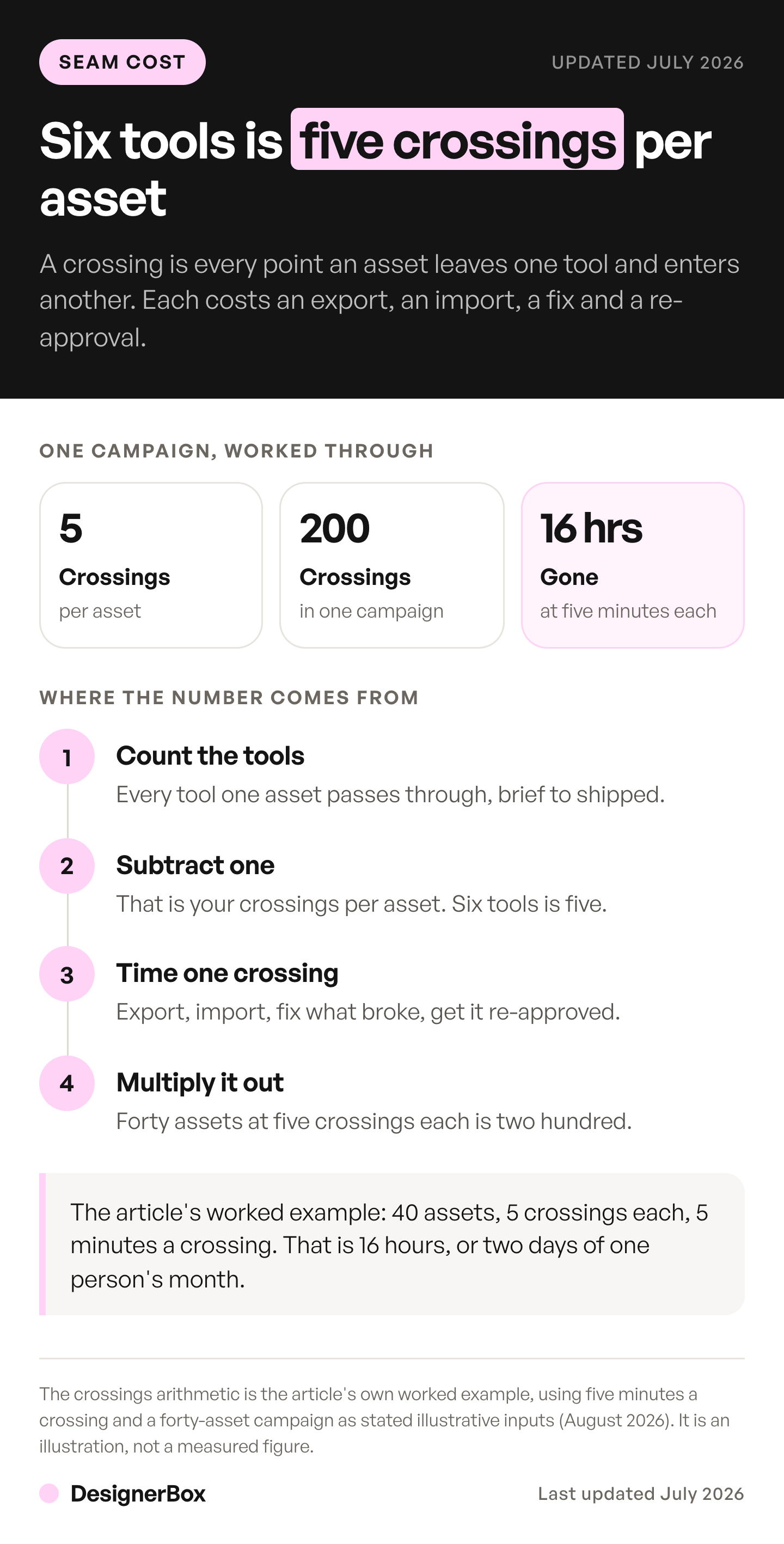
Count crossings, not tools. A crossing is any point where an asset leaves one tool and enters another, and each one has a predictable cost: an export, an import, a re-decision, and a review. Six tools in a linear chain is five crossings per asset. Multiply by assets per campaign and campaigns per quarter and you have a number that is usually larger than the subscription total.
Try it on your own numbers.
- Count the tools an asset passes through from brief to shipped. Not the tools you own, the ones a single asset touches.
- Subtract one. That is your crossings per asset.
- Time one crossing. Export, import, fix what broke, get it re-approved. Five minutes is optimistic.
- Multiply by assets per campaign. A campaign with 40 assets and 5 crossings each is 200 crossings.
- Multiply by your loaded hourly rate. That is the seam cost of one campaign.
Most teams find step 4 is where the number stops being ignorable. Two hundred crossings at five minutes is sixteen hours, which is two full days of somebody’s month, spent entirely on moving files between tools that all work fine individually. That count peaks in a seasonal push, when the same catalogue ships a sale version and a holiday version in one quarter, which is why the tools a seasonal launch needs are worth comparing on the seams they add, not just their sticker price.
For an agency those crossings are billable hours, so removing them shrinks the invoice as well as the waste, which is why pricing creative work per asset instead of per hour has to come first.
That is the whole argument. The real cost isn’t the subscriptions. It’s the seams.
What changes when the stack consolidates?

The crossings go to near zero, and the cost moves from a variable you cannot see to a fixed one you can. That is the honest claim. It is not that consolidation is automatically cheaper per seat, because depending on your stack it might not be. It is that a chain with no crossings has no drift tax, no scatter, and one prompt box instead of six.
DesignerBox includes 13 canonical models across six providers on one bill. Generating or editing an image costs 5 credits. Basic is $15 a month for 500 credits, which is 100 images. Pro is $35 for 1,000, Premium $75 for 2,500, Ultra $200 for 8,000. The free plan is 112 credits with no credit card.
Three mechanics do the actual work of removing seams. Every asset derives from your real product photo, so nothing comes out looking generic AI. Saved workflows rerun your best campaign against the next product, which is the drift fix, because the decisions are stored rather than remembered. And 43 MCP tools mean Claude, ChatGPT, or Cursor drive the same models without a new interface. The full model catalog and the workflow mechanic are both worth reading before you take my word for any of this. If your stack currently starts and ends with a chat app, ChatGPT vs Gemini for product images covers what that costs at volume.
Where this fits a broader plan to get more creative output without adding headcount is the question most teams are asking when they audit their stack. If the audit comes down to comparing published tiers, what AI ad generators charge per ad sets the verified numbers side by side.
At the smaller end the arithmetic is starker still, because a $15 plan and a six-tool stack are not close. What each tier produces in assets is broken down in AI creative tools for small business.
When does another tool fit better?
Consolidation is a trade, and it is not the right trade for everyone. Two cases where a stitched stack is the correct answer, stated plainly.
You need exactly one model and nothing else. If your entire creative operation runs on a single model and always will, a single-model subscription is likely cheaper than a catalog you will not use. Breadth you do not need is not a feature, it is a line item.
You produce video at volume. Video is priced per second of output and it is by far the most expensive operation here. A Veo 3 clip with audio at 8 seconds costs 6,400 credits, which is more than Premium’s entire 2,500 monthly allocation. If video is your primary output, run the credit math on your actual clip volume before you switch. It may not work, and it is better to find that out now.
The rest of the honest list, because it belongs here rather than buried:
- Team collaboration, shared brand kits, white label, and API access are Ultra only, at $200 a month. If your reason for consolidating is team governance, that is the tier, and there is no cheaper way to it.
- Try-on clothes and AI video need Premium, at $75 a month. Not available on Basic or Pro.
- Free through Premium are single seat. Ultra is 5 users, plus $19 per additional seat.
Any of those that is a dealbreaker is a real dealbreaker. Consolidation is worth it when your problem is crossings. If your problem is something else, buy the tool that solves the something else.
For one worked example of a stitched stack priced tool by tool, see how a fashion and beauty brand assembles its stack across concepting, on-model, video, presenter and versioning. The seams cost different amounts depending on your team shape, which we break down across the five team types that use AI creative tools.
The tool consolidation audit runs this exercise on your own stack and prices the result.
FAQ
How much does a six-tool AI creative stack cost per month?
List pricing for a full stack lands in the low hundreds per seat per month, but a precise total is harder to source than it should be. Two anchors verified for July 2026: Creative Cloud Pro at $69.99 a month on the annual plan billed monthly in North America, and Canva Business at $20 per person per month. Image, video, background removal, and upscaling pricing could not be confirmed to vendor sources and was cut rather than estimated.
What are the hidden costs of running multiple AI tools?
Four, and none appear on an invoice: brand drift charged at every crossing between tools, time spent locating assets scattered across six storage systems, regeneration of assets that could not be found, and the relearning cost each time one of six vendors ships a model update on its own release cycle. All four are paid in your team’s hours.
Is consolidating AI tools cheaper?
Not automatically, and per seat it may not be. Consolidation removes crossings rather than reducing rates. The saving is real when an asset currently passes through several tools before shipping. If a single tool already covers your whole chain, there are no seams to remove and consolidation buys you nothing. Our shortlist of eleven consolidated and single-purpose tools prices both sides of that decision.
How do I calculate what tool sprawl costs my team?
Count the tools one asset passes through from brief to shipped, subtract one for crossings per asset, time a single crossing including the export, import, fix, and re-approval, then multiply by assets per campaign and your loaded hourly rate. A 40-asset campaign with 5 crossings each is 200 crossings, or roughly sixteen hours at five minutes apiece.
Does DesignerBox replace my whole creative stack?
It replaces the generation and asset-management layers by putting 13 models across six providers on one bill with one library. It does not replace a layout and compositing application, and it does not remove the need for one accurate photo of your real product, which is what every generated asset is built from.
Why does brand consistency break across AI tools?
Because a file carries pixels, not context. Palette rules, type rules, and lighting preferences do not cross between tools, so each tool re-decides independently. No single step is wrong enough to reject, and after several steps the compounded result is off with no identifiable cause, so the chain gets redone rather than repaired.
What is the most expensive part of using AI creative tools?
Video, everywhere, including in DesignerBox. It is priced per second of output rather than per asset. An 8-second Veo 3 clip with audio costs 6,400 credits, more than the entire 2,500 monthly allocation on the $75 Premium tier. Video should be budgeted as its own line rather than absorbed into a general credit allowance.
Sources
All accessed July 2026.
- Creative Cloud Pro list price of $69.99 a month, annual plan billed monthly, North America: (adobe.com, July 2026)
- Canva Business list price of $20 per person per month: (canva.com, July 2026)
- Image generation, video generation, background removal and upscaling list prices could not be confirmed to a vendor source and were cut rather than estimated
- DesignerBox credit costs, plan allocations, model catalog and feature gating verified against live product configuration, July 2026
Third-party list pricing verified at adobe.com and canva.com as of July 2026; four further categories were checked and cut for lack of a confirmable vendor source. DesignerBox credit costs, plan allocations, model catalog, and feature gating verified against live product configuration, July 2026. Stack composition and crossing counts vary by team. Individual results vary.