
Claude for marketing covers briefs, campaign plans, brand reviews, competitive positioning, performance reports, SEO audits and email sequences. Anthropic’s own Marketing plugin ships exactly seven commands and every one of them writes or analyses text (claude.com, accessed September 2026). None of them produces an image. That gap matters, because the visual half is where the creative budget goes.
Read any guide on the subject and you get the same list: draft the blog post, review the copy, audit the site, read the CRM export. All useful, all text. Then Thursday arrives and you need nine ad frames in three aspect ratios, a packshot on a clean background and a garment on a model, and the chat window has nothing to offer.
This guide covers what Claude genuinely does for a marketing team today, what Anthropic itself says it cannot do, and how the connector layer closes the gap. Written for marketing leads and agency teams who already use Claude for copy and want the production half in the same window.
Key Takeaways
Claude does not render photos. Anthropic’s help centre states it plainly: “Claude doesn’t generate photos or illustrations the way image-generation tools do” (support.claude.com, updated March 2026).
The official Marketing plugin is seven text commands. Draft content, campaign plan, brand review, competitive brief, performance report, SEO audit, email sequence (claude.com, accessed September 2026).
Claude Design composes, it does not shoot. Anthropic’s own page promises “landing pages, social assets, and campaign visuals, ready for a designer to polish” (claude.com, accessed September 2026). Layout, not photography.
Marketers are already the main users. Content creation and copywriting was the second largest category of Claude Cowork sessions at 16.4%, measured across 1.2 million sessions from more than 600,000 organisations (claude.com, July 2026).
AI use collapses before launch. 82% of performance creatives use AI during ideation and 7% use it at launch, in a survey of more than 380 DTC marketers (motionapp.com, accessed September 2026). The drop happens where assets get made.
Connectors are the fix and they are five clicks. Custom connectors using remote MCP work on Free, Pro, Max, Team and Enterprise, with Free capped at one (support.claude.com, accessed September 2026).
The brief already lives in the chat. You argue about the angle in Claude, then leave to make the asset somewhere else. Connecting a generation server removes that round trip.
What Claude does for marketing teams today
Anthropic publishes a Marketing plugin built in house and carrying an “Anthropic Verified” badge. It installs into Claude Cowork. The full command list is the clearest statement anyone has made about the intended scope of Claude for marketing.
| Command | What it produces | Asset type |
|---|---|---|
| /draft-content | Blog posts, social, email, landing pages, press releases, case studies | Text |
| /campaign-plan | Objectives, channel strategy, content calendars, success metrics | Text |
| /brand-review | Content checked against your brand voice and style guide | Text |
| /competitive-brief | Competitive positioning briefs | Text |
| /performance-report | Marketing performance reports | Text |
| /seo-audit | Site audits | Text |
| /email-sequence | Multi-email nurture sequences | Text |
Source: claude.com, accessed September 2026.
Seven commands, seven text outputs. The page never mentions images, photography or video. Its one route to anything visual is a single line telling you to “connect tools like Slack, Canva, Figma, HubSpot, Amplitude, Ahrefs, and Klaviyo via MCP for a richer workflow.”
That line is the whole argument of this article, printed on Anthropic’s own page. The visual half arrives through a connector or it does not arrive.
Brand control follows the same shape. The plugin asks you to “configure your brand voice and style guide in local settings for automatic brand standards enforcement.” Voice and style, held as text. Not a product photo, not a colour-managed logo file, not a reference shot of the garment.
What Anthropic’s own marketing team automated
The most useful case study on Claude for marketing comes from Anthropic’s growth marketing team, and it is more instructive than the headline suggests.

They cut ad creation from 30 minutes to 30 seconds. The mechanism was not image generation. They used Claude Code to build a Figma plugin that duplicates a frame and swaps the headline copy across variations (claude.com, January 2026). The terminal side of this, including how Codex compares and the four routes to a generated asset, is covered in Claude Code for marketing.
Read that again. Claude wrote the tool. The tool moved text around inside a file. The pixels underneath, the photograph, the product, the composition, all came from a designer’s Figma file that already existed.
Other numbers in the same post follow the pattern. Influencer marketing freed more than 100 hours a month. Customer marketing took case studies from 2.5 hours to 30 minutes. Product marketing saved 5 to 10 hours per launch. Every one is a text, coordination or analysis win.
None of them is a shot that did not exist before.
The drop-off is measurable
The pattern is not specific to Anthropic. It shows up in survey data across the whole discipline: teams adopt AI heavily at the thinking end of the workflow and barely at all at the shipping end.
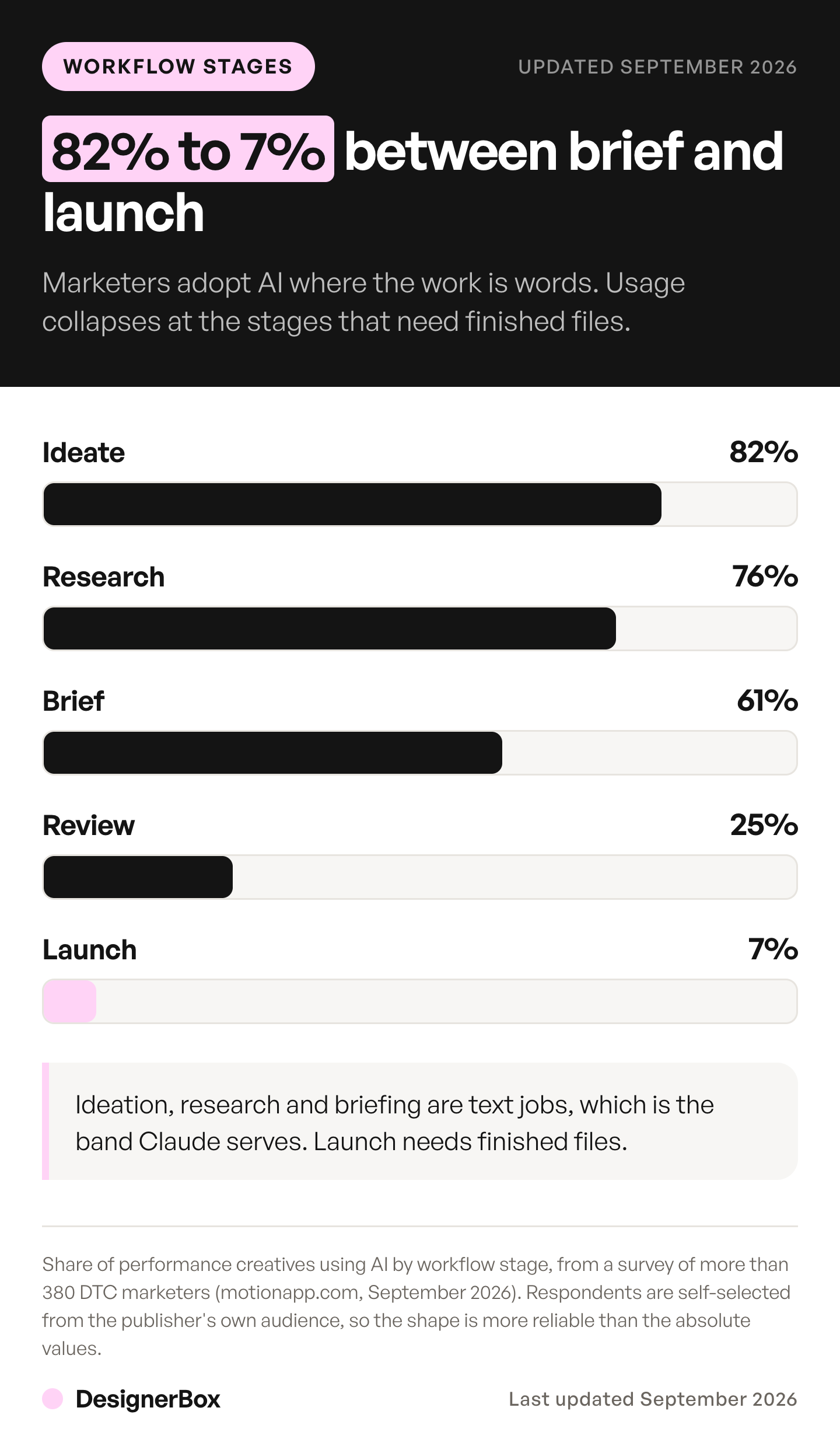
Motion surveyed more than 380 DTC marketers on where AI enters their creative process. Usage by stage:
| Workflow stage | Share using AI |
|---|---|
| Ideation | 82% |
| Research | 76% |
| Briefing | 61% |
| Evaluation | 25% |
| Launch | 7% |
Source: motionapp.com, accessed September 2026. Respondents are self-selected from Motion’s own audience, so read the shape rather than the absolute values.
A 75 point fall between briefing and launch is the shape worth noticing. Ideation, research and briefing are text jobs, and that is precisely the band Claude serves well. Evaluation and launch need finished files.
The broader adoption numbers agree on the front half. In The CMO Survey’s 35th edition, content creation was the most common marketing use of AI at 73.9% among companies using it, from 308 responding US marketing leaders, 97% of them VP level or above, fielded in January 2026. IAB reports 83% of ad executives saying their company has deployed AI in the creative process, up from 60% in 2024, though on a base of 104 executives at companies spending $1M or more on media (January 2026).
Adoption at the top of the funnel is settled. The production step is where the workflow still leaves the chat window.
Where the workflow stops
Claude is a text and reasoning model with vision for reading images you upload. It is genuinely good at three things a marketing team needs, and it has a hard edge.
What it makes natively. Claude builds diagrams, charts and interactive visuals directly in a conversation. Anthropic is careful about what those are: “Custom visuals aren’t photos or illustrations. Claude builds them using HTML, the same building blocks as web pages, so they’re interactive and specific to your question rather than static images” (support.claude.com, updated April 2026).
What Claude Design adds. Anthropic Labs shipped Claude Design in April 2026, in research preview for Pro, Max, Team and Enterprise subscribers (anthropic.com, April 2026). It makes designs, prototypes, slides and one-pagers, and it exports to Canva, PDF, PPTX or standalone HTML.
Be precise about what that covers. The product page offers “marketing collateral: landing pages, social assets, and campaign visuals, ready for a designer to polish” (claude.com, accessed September 2026). The concession sits inside the sentence. It composes a layout and hands it on.
So the honest version of the limit is narrow and worth stating carefully. Claude composes, arranges, exports and reviews. It never produces the shot. Every visual capability Anthropic ships transforms assets that already exist somewhere.
For a marketing team, the assets that do not exist yet are the expensive ones. The product on a clean white background. The same product in a styled scene. The garment on a model in three sizes. The 15 second clip for Reels. Those need a photoshoot, or a generation model.
The mechanics of closing that gap are covered in full in our companion guides on the Claude AI image generator and the Claude AI video generator, including what a shot costs and where each loop breaks.
The connector layer, and why it is five clicks
Anthropic does not need to ship image generation for Claude to drive it. The Model Context Protocol is an open standard Anthropic published for building two-way connections between AI tools and outside systems (anthropic.com, November 2024). A remote MCP server exposes a set of tools. Claude reads their descriptions, picks one, fills in the arguments and calls it.
Custom connectors are available on Free, Pro, Max, Team and Enterprise plans, with Free users limited to one (support.claude.com, accessed September 2026). For an individual on Pro the setup is short:
- Open Customize, then Connectors.
- Click the plus, then “Add custom connector”.
- Enter the remote MCP server URL.
- Add OAuth credentials under Advanced settings if the server needs them.
- Click Add, then enable it per conversation from the plus menu.
On Team and Enterprise an owner adds the connector under Organization settings first, and members connect individually after that.
DesignerBox exposes 68 tools over MCP, covering image and video generation, avatars, brand profiles, assets and templates, and saved pipelines. The server address and the client setup live at designerbox.ai/mcp/connect. Our DesignerBox MCP launch post walks the connection start to finish.
The point is that the gap in Claude for marketing has a documented, supported, first-party mechanism for closing it, and most guides on the subject never mention it.
What a full loop looks like
Once a generation server is connected, the marketing workflow stops splitting across tabs. Here is the shape of it, with the layer that owns each step.
| Step | Owner | Output |
|---|---|---|
| Campaign angle and audience | Claude | Brief |
| Copy, headlines, CTA variants | Claude | Text |
| Product shot, flat lay, styled scene | Connected image model | Image |
| Garment on a model | Connected image model | Image |
| 15 second cut for Reels | Connected video model | Video |
| Frame sizing for each placement | Claude plus connector | Files |
| Brand check against the profile | Brand profile on the server | Pass or fail |
| Performance read after launch | Claude | Report |
Two details decide whether this holds together in practice.
The source image. A text-only brief makes the model invent a product that resembles yours. Upload the real packshot and edit from it, and the object in the ad is the object that ships. This is the difference between creative you can run and creative your ops team rejects.
The brand profile. Voice held as text in a settings file governs copy. It does nothing to a photograph. A brand profile that travels with the generation request is what keeps the tenth asset looking like the first, which is the failure our guide on AI brand consistency covers in detail.
For teams that want the loop pre-built rather than assembled by hand, DesignerBox publishes named agent recipes such as Campaign in a Chat and the Ad Variant Iterator, which run the brief-to-variants sequence as one job.
The value only shows up on the second run. Getting one good asset out of a chat is a novelty; getting the same asset out for the next 40 SKUs is the job a marketing team actually has. So build the loop once, with your brand profile, your source photos and your placement sizes fixed, then hand it the rest of the catalogue. The fortieth product gets the same treatment as the first, because nobody is making those decisions again. The catalogue batch processor is the version of that recipe written for a whole product list.
What it costs
Two bills, and they are unrelated. Claude charges for the assistant. The connected model charges for the pixels.

Claude plans, from Anthropic’s pricing page (claude.com, accessed September 2026):
| Plan | Price | Note |
|---|---|---|
| Free | $0 | One custom connector |
| Pro | $17 a month billed annually, $20 monthly | Includes Claude Code, Cowork and Design |
| Max | From $100 a month | 5x or 20x more usage than the entry paid plan |
| Team | $20 per seat billed annually, $25 monthly | For teams of 2 to 150 |
| Team Premium | $100 per seat billed annually, $125 monthly |
Generation is billed separately by whatever server you connect. In DesignerBox that is credits, and the rate is set by the model you pick rather than by the operation. An image runs 3 to 22 credits, from Seedream 5 at 4 up to GPT Image 2 at 22, with the default Nano Banana Pro at 14. An avatar set of nine images is 25. Video is priced per second, so an 8-second clip lands between 40 and 560 credits depending on the model and the resolution. That 14x spread is the number to plan against, and the run cost appears before you press generate.
Monthly allocations run 112 on Free, 500 on Basic at $15 a month billed monthly, 1,000 on Pro at $35, 2,500 on Premium at $75 and 8,000 on Ultra at $200. Full detail sits on the pricing page.
Worth knowing before you plan a video-heavy quarter: AI video needs the Premium tier or higher, and the commercial licence starts at Pro. Our breakdown of ad variants at scale has the volume maths for a normal testing month.
Three jobs to hand over first
Do not connect everything at once. These three have the clearest before and after.
Resize an approved campaign. One approved frame into every placement size. It is mechanical, it eats a designer’s afternoon, and a wrong output is obvious in a second.
Variant sweeps on a winner. When an ad works, you want ten more of it with a different headline, background or model. Claude writes the variants and the connected model renders them from the same source image. Size the batch to your spend tier rather than to a headline number: Motion’s Creative Benchmarks 2026 puts the smallest Meta spend tier at 2.80 new creatives a week and the largest at 18.85, across 578,750 creatives and 6,015 accounts (motionapp.com, accessed September 2026).
Catalogue backfill. New SKUs arrive without lifestyle shots. One packshot in, a set of angles and scenes out, applied across the batch rather than one product at a time.
Hold back anything where a mistake ships quietly. Hero imagery for a launch, anything with a face and a licence attached, and any claim a regulator would read. Those keep a human on the approval, which is where the judgement belongs regardless of the tool.
FAQ
Is Claude good for marketing?
For text and analysis, yes, and Anthropic’s own numbers back it. Content creation and copywriting was the second largest category of Claude Cowork use at 16.4% of 1.2 million sessions across more than 600,000 organisations. For visual production it needs a connector, because Claude does not render photographs by itself.
Can Claude generate images for my campaign?
Not on its own. Anthropic’s help centre states that Claude does not generate photos or illustrations the way image tools do. It builds diagrams and charts in HTML, and Claude Design composes layouts and slides. To get a product photograph or a video ad you connect an image or video model over MCP.
What is the Claude Marketing plugin?
An Anthropic-built plugin for Claude Cowork with seven commands: draft content, campaign plan, brand review, competitive brief, performance report, SEO audit and email sequence. It covers content and analysis. For visual assets it points you to connect external tools via MCP.
Which Claude plan do I need for marketing work?
Free covers text drafting and one custom connector, which is enough to test a generation server. Pro at $17 a month billed annually adds Claude Code, Cowork and Design. Team starts at $20 per seat billed annually and is where shared organisation connectors are managed.
Can Claude keep my brand consistent?
For copy, yes, by reading a voice and style guide from settings. For imagery, text rules do not reach the pixels. Consistency across generated assets comes from the generation layer holding a brand profile and from working off your real product photo rather than a written description.
Does Claude work with Figma for marketing creative?
Yes, through Figma’s own MCP server, which is a design and code bridge. Its toolset reads design context and writes layers, variables and diagrams back to the canvas, and it can upload images into a file. It does not generate a photograph. Anthropic’s growth marketing team used Claude Code to build a Figma plugin that swapped copy across duplicated frames.
How do agencies use Claude for marketing across clients?
The pattern that holds is one brand profile per client on the generation side, with Claude handling briefs and variants. Separation matters more than speed, because the failure mode is one client’s look bleeding into another’s. Our guide on creative for multiple clients covers the operating model.
Sources
- Anthropic, “Marketing Plugin” (claude.com, accessed September 2026)
- Anthropic, “Can Claude produce images?” (support.claude.com, updated March 2026)
- Anthropic, “Custom visuals in chat” (support.claude.com, updated April 2026)
- Anthropic, “Claude Design” (anthropic.com, April 2026) and (claude.com, accessed September 2026)
- Anthropic, “How Anthropic’s Growth Marketing team uses Claude” (claude.com, January 2026)
- Anthropic, “How people are using Claude Cowork” (claude.com, July 2026)
- Anthropic, “Get started with custom connectors using remote MCP” (support.claude.com, accessed September 2026)
- Anthropic, “Introducing the Model Context Protocol” (anthropic.com, November 2024)
- Anthropic, “Pricing” (claude.com, accessed September 2026)
- Figma, “Guide to the Figma MCP server” (help.figma.com, accessed September 2026)
- AI usage by creative workflow stage, survey of 380+ DTC marketers, and creative volume per Meta spend tier from Creative Benchmarks 2026 (motionapp.com, accessed September 2026)
- The CMO Survey, 35th edition, Duke University Fuqua School of Business with Deloitte and the American Marketing Association (cmosurvey.org, March 2026)
- IAB and Sonata Insights, “The AI Ad Gap Widens” (iab.com, January 2026)
Claude features, plan availability and pricing verified against Anthropic’s own documentation as of September 2026. This category changes monthly. Individual results vary.