
Creative automation, in the marketing and advertising sense of the phrase, is the production of campaign assets at scale from one master template or one source asset. A person sets the rules once: locked layout, brand fonts, legal text. Software then produces every size, language and variation the campaign needs, to the same standard on the first asset and the two hundredth. The output is hundreds of finished ads instead of hundreds of hours of resizing.
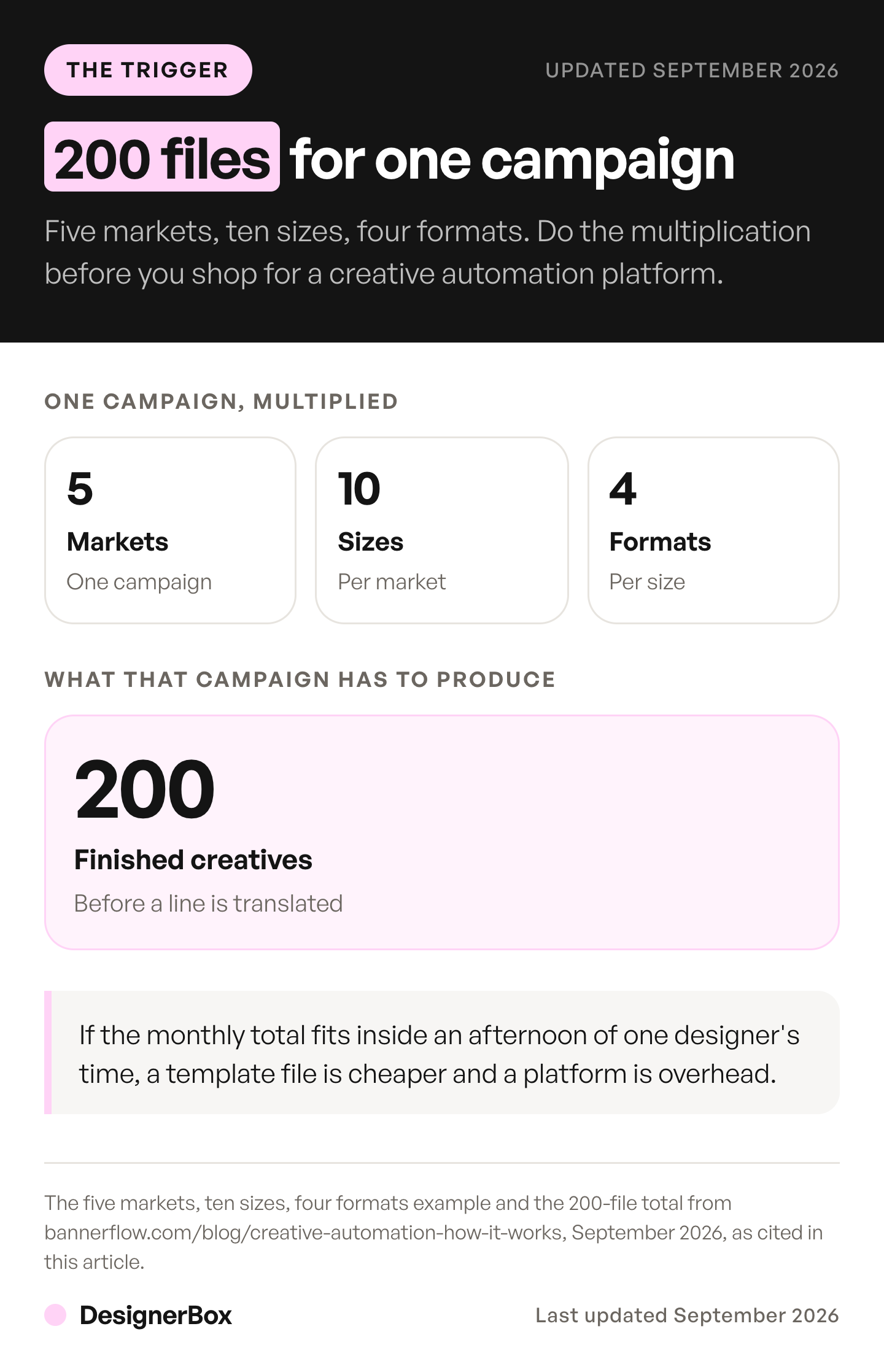
The arithmetic forces the decision long before the theory does. One campaign across five markets in ten sizes and four formats is 200 creatives before anyone translates a line of copy (bannerflow.com/blog/creative-automation-how-it-works, September 2026). Across the industry, 83% of ad executives say their company has deployed AI somewhere in the creative process, up from 60% in 2024 (iab.com, September 2026).
This guide covers the definition, the three rungs of maturity behind one word, the mechanism, the line between this and dynamic creative optimization, what a variant set costs, and the labelling rules that landed in 2026. It is written for a marketing lead who owns the creative calendar.
Key Takeaways
- The marketing sense of the term means producing ad and campaign assets at scale from a template, a data feed or a source photo. The bare phrase also names an industrial robotics field.
- Three rungs sit under one word. Resizing, then variation from structured data, then generation from a source asset. Many tools sell rung one while the buyer hears rung three.
- The trigger is arithmetic. Five markets, ten sizes, four formats is 200 assets for one campaign.
- DCO is a separate job. Automation makes the variations. Dynamic creative optimization decides which one a given person sees.
- Labels are required in three jurisdictions. EU AI Act Article 50 has applied since 2 August 2026, and Google names the European Union, India and New York.
- Cost per asset is knowable before the run. The model you pick sets the price. A 36-asset variant set runs 144 credits on the cheapest image model in DesignerBox and 504 on the default one, and the figure is on screen before you generate.
- The review gate stays human. Approving the claim, the offer and the brand fit is still someone’s signature.
What is creative automation?
Creative automation is the use of software to produce many finished campaign assets from one approved starting point. A designer builds a master template and marks which elements are locked and which can change. Data or a source photo fills the rest. The system outputs every size, language and audience variation, then publishes them to the ad platform without a manual export.
The definitions the category publishes agree on the mechanism. Bynder describes using technology to scale content production so assets ship quickly and in high volume, and lists shorter production cycles, faster time to market, brand consistency, faster localisation and more room for A/B testing as the benefits (bynder.com/en/glossary/creative-automation-definition, September 2026). Marpipe frames it as scaling ad production with design templates, structured data and automation tools, removing resizing, reformatting and content swapping (marpipe.com/blog/what-is-creative-automation, September 2026). Storyteq describes automating the adaptation of banner and video content, including size and format (storyteq.com/blog/what-is-creative-automation, September 2026).
The category came out of display advertising, which is why the vocabulary is banners, HTML5 sizes and formats.
The three rungs, and which one a tool is selling
Three different jobs travel under one word. Rung one adapts finished assets: sizes, formats and element swaps. Rung two generates variations from structured data, so a product feed populates a template. Rung three generates the asset itself from a source photo and a brief. A tool that resizes approved files is doing real work at rung one. Ask which rung before you compare prices.
| Rung | What it automates | What you feed it | What it does not do |
|---|---|---|---|
| 1. Resizing and recombination | Sizes, formats, element swaps across finished assets | Approved images, headlines, logos, legal text | Produce a shot nobody took |
| 2. Variation from structured data | Copy, price, product and market per version | A product feed or a spreadsheet, plus a master template | Change the photography |
| 3. Generation from a source asset | The image itself: scene, angle, background, model | One real product photo and a brief | Judge whether the result is on brand |
Rung one now ships inside the ad platforms. Google’s responsive display ads take uploaded images, headlines, logos, videos and descriptions and generate combinations for sites, apps, YouTube and Gmail, adjusting the size, appearance and format of the ad to fit the space available (support.google.com, September 2026).
Rung three is there too. Google Ads asks advertisers to provide one or more images of their product so its AI can create lifestyle imagery faithful to that specific product, including people interacting with or wearing it, and the product shown in different orientations (support.google.com, September 2026). TikTok’s Symphony Creative Studio generates a range of video options with different layouts and scripts from brand or product details the advertiser imports from a URL (ads.tiktok.com, September 2026).
Google’s version starts from the advertiser’s own product photos rather than from a prompt alone. DesignerBox works the same way, and adds the part one generation cannot do on its own: the brand rules, the model and the framing get set once and applied to every row that follows, so the hundredth asset matches the first.
How does creative automation work, step by step?
The mechanism has five parts. A designer builds a master template with locked and editable elements. Brand rules for fonts, palette, logo placement and legal text are set centrally so every output inherits them. Data connects: a product feed, a spreadsheet, or a live signal such as price or location. The system generates every specified combination across sizes, languages and audience segments. The last step publishes them.

Bannerflow describes the same five steps and adds the test most teams fail. Automating production while still exporting files by hand to get them live solves half the problem (bannerflow.com/blog/creative-automation-how-it-works, September 2026). Publishing to the ad server, the DSP or the social channel is part of the definition, not an add-on. Where the files then live is a separate question, usually a DAM or asset library. The naming, approval and retirement rules that keep those files findable are the four stages of marketing asset management.
Teams get stuck upstream of all five steps. A template with the wrong brand rules produces 200 wrong files faster than a person produces two. Mapping the creative workflow end to end is worth doing before any tool goes on the shortlist.
What is the difference between creative automation and dynamic creative optimization?
Automation makes the variations. Dynamic creative optimization decides which variation a given person sees, usually assembled by the ad server at the moment of the impression. Generative AI is one possible input to either. A team can run automation with no DCO at all, and a DCO setup needs a supply of components that something has to produce first. The assembly side, including what Meta and Google ask you to supply, is set out in the guide to dynamic creative optimization.
Bannerflow draws the same line (bannerflow.com/blog/creative-automation-how-it-works, September 2026). The practical version for a paid social team: personalisation by audience segment is a targeting decision, and asset supply is a production decision. Buying a tool for one and expecting the other is how a creative calendar slips. How many ad variants a month a given spend tier needs is answered by benchmark data, not by how many a tool can produce.
When does a team actually need it?
Do the multiplication before you shop. Count markets, then sizes, then formats, then products. One campaign across five markets in ten sizes and four formats is 200 files. A 500-SKU catalogue on three platforms is a different order again. If the monthly total fits inside an afternoon of one designer’s time, a template file is cheaper and a platform is overhead.
Marpipe’s worked example is the honest trigger: a brand selling 500 SKUs across Meta, TikTok and Google cannot hand-build an ad for every product, audience and placement, so a product feed populates pricing, reviews and messaging variations into templates that fit each platform’s specs (marpipe.com/blog/what-is-creative-automation, September 2026). The second trigger is repetition rather than volume: if the same campaign shape runs for every new product or every new client, the value is in the rerun. Scaling creative production without adding headcount is mostly a question of what you can rerun. A third trigger comes from upstream: creative automation is the fourth layer of the wider AI marketing automation stack, and a decisioning engine that can address forty segments will ask for forty sets of creative.
What can you automate, and what still needs a person?
Automate the mechanical work: resizing, reformatting, copy swaps per market, feed-driven product swaps, and the base shot generated from a product photo. Keep the offer, the claim, the art direction and the legal sign-off with a person. The review gate is the part that does not scale, and removing it is how 200 wrong files ship at once instead of one.

Bynder frames the category as supporting designers rather than replacing them, by taking the repetitive parts such as ad variations for localisation or for different placements (bynder.com/en/glossary/creative-automation-definition, September 2026). The template is a design artefact, and someone decides what it locks.
Motive is worth watching. IAB measured cost efficiency becoming the top cited benefit in 2026 at 64%, up from fifth place in 2024, while creative innovation slipped to 61% from 64%. IAB’s own read is that this raises a question about whether some advertisers are using AI mainly to cut production cost in a way that could undermine quality (iab.com, The AI Ad Gap Widens, September 2026). An ad generator and a design app answer different halves of that job.
Do you have to disclose an ad made with AI?
In several markets, yes. Google states that AI regulations in the European Union, India and New York require ads with certain AI-generated or edited assets to carry disclosures or labels. EU AI Act Article 50 has applied since 2 August 2026. Meta applies a label when its own generative tools significantly edit an image or video. The obligation sits with the advertiser, not with the tool that produced the file.
Google ships the setting across five products. Google Ads, Display & Video 360, Campaign Manager 360, Merchant Center and Ads Editor all carry an AI label control, labelled ads show a disclosure in the “How this ad was made” section of My Ad Center, and campaigns targeting the European Union, India or New York also get a visible overlay on the ad itself (support.google.com, September 2026). Article 50 of the EU AI Act applies from 2 August 2026. The European Commission states that providers must mark synthetic image, audio, video and text in a machine-readable format, and that the marking duty does not apply where the system performs an assistive function for standard editing (digital-strategy.ec.europa.eu, September 2026).
Meta places its AI label behind the three-dot menu or next to the Sponsored label, and uses the Sponsored-label position when the output includes a photorealistic AI-generated human. In an update dated 1 June 2026 it said it is rolling out an “About this ad” destination on every ad and will begin automatically detecting ads created or edited with third-party AI tools through industry-standard signals (about.fb.com, September 2026). Practice lags the rule: 89% of advertisers using generative AI for ads at least sometimes disclose, and under half always do, unchanged from 2024 (iab.com, The AI Ad Gap Widens, September 2026). New York’s own announcement covers the synthetic performer disclosure (governor.ny.gov, September 2026). The full rule set is in the four AI disclosure rules now in force.
What does a variant set cost to build?
Price the set, not the seat. Three headlines by four images by three formats is 36 finished assets. In DesignerBox the model you pick sets the price: those 36 images cost 144 credits on Seedream 5, 504 on the default Nano Banana Pro, and 792 on GPT Image 2. The spread is the useful part. You choose the model before the run and the cost is on screen before you press generate, so a variant set is a budget line rather than a number you learn from the invoice.
Video sits on the same axis and moves further. Eight seconds of generated video runs 40 credits at the cheapest rate and 560 at the highest, a 14x spread across the video catalogue. Use a light model for a feed test and a premium one for the hero cut. AI video starts at the Premium plan, $75 a month billed monthly, and its 2,500 credits cover 62 lite eight-second clips or seven premium ones.
Comparing that against the category is not straightforward. Several platforms here do not publish list pricing, a point one vendor makes about itself and a named peer (bannerflow.com/blog/creative-automation-how-it-works, September 2026). A published rate can be budgeted before a sales call. An enterprise quote cannot.
The rerun is what makes the arithmetic repeat. Build the campaign once, save it as a workflow, and the team runs it again for the next product, drop or client with the same brand rules applied. The campaign variant generator is that pattern written out, and the rest of the workflow library covers catalogue processing and multi-platform export. Getting approved files onto the ad platform is still an export step at the end, not something the workflow does for you. Plan rates sit on the DesignerBox pricing page.
FAQ
What is a creative automation platform?
A platform that stores master templates, holds the brand rules, connects a data source, generates every required variation, and publishes the results to ad platforms. The category’s own roundups name products including Hunch, Celtra, Marpipe, Bannerflow, Innervate, SundaySky, Adacado and Madgicx (hunchads.com/blog/top-creative-automation-tools, September 2026). Depth and scope vary by product.
Does creative automation replace designers?
No. It removes repetitive adaptation work: resizing, reformatting and swapping copy per market. The template, the brand rules, the art direction and the approval still come from people. Bynder frames the category as supporting designers rather than replacing them (bynder.com/en/glossary/creative-automation-definition, September 2026). Output volume goes up and the judgment stays where it already sat.
What is creative automation in marketing?
It is the marketing and advertising sense of a phrase that also names an industrial robotics field. In marketing it means producing ad and campaign assets at scale from templates, data feeds or a source photo. The outputs are display banners, social ads, product imagery and video versions, sized and localised for each placement.
Is it the same as a creative management platform?
Not quite. A creative management platform is the product-category name several vendors use for the whole suite: template building, asset storage, generation, approval and publishing in one place. Automating the adaptation work is one function inside that suite. A team can buy the function alone, or get a version of it inside an ad platform’s native tools.
What does this software cost?
Published prices are rare in this category. One vendor states in its own comparison that neither it nor a named peer publishes list pricing (bannerflow.com/blog/creative-automation-how-it-works, September 2026). Credit-priced tools are the exception: DesignerBox publishes a rate per model and starts at $15 a month billed monthly on Basic, with a free plan to test on. A published rate lets you price a 36-asset set before you book a call with anyone.
Sources
- Responsive display ads, Google Ads Help: how uploaded assets are combined and resized by the platform (September 2026)
- Create images for your campaigns, Google Ads Help: generation of lifestyle imagery from an advertiser’s own product photos (September 2026)
- About AI labels for ads, Google Ads Help: the European Union, India and New York disclosure requirement and the label setting across five Google products (September 2026)
- Transparency obligations under Article 50 of the AI Act, European Commission: Article 50 applies from 2 August 2026, marking and labelling duties (September 2026)
- Generative AI transparency in Meta’s ads products, Meta Newsroom: AI labelling of significantly edited ads, updated 1 June 2026 (September 2026)
- Advertisements including AI-generated synthetic performers, New York State: the disclosure requirement for synthetic performers in advertising (September 2026)
- Symphony Creative Studio, TikTok for Business: video generation from brand or product details imported from a URL (September 2026)
- The AI Ad Gap Widens, IAB and Sonata Insights: 83% creative-process deployment, 64% cost efficiency, 89% sometimes disclose, published 15 January 2026 (September 2026)
- bynder.com/en/glossary/creative-automation-definition: category definition and stated benefits (September 2026)
- bannerflow.com/blog/creative-automation-how-it-works: the five-step mechanism, the DCO distinction, the pricing transparency note (September 2026)
- marpipe.com/blog/what-is-creative-automation: definition and the 500-SKU worked example (September 2026)
- storyteq.com/blog/what-is-creative-automation: definition of automated adaptation for banner and video content (September 2026)
- hunchads.com/blog/top-creative-automation-tools: the products named inside the category in 2026 (September 2026)
Platform policy, regulation and industry data verified from support.google.com, digital-strategy.ec.europa.eu, governor.ny.gov, about.fb.com, ads.tiktok.com and iab.com as of September 2026. Individual results vary.