
AI UGC ads are creator-style video ads, shot to look phone-filmed rather than studio-produced, where the presenter is generated instead of hired. In the United States, the FTC says its rule on reviews and testimonials contains no blanket ban on AI avatars. What the rule prohibits is a fabricated claim of consumer experience. So the line is about what your character says, and a synthetic character is allowed.
That distinction decides whether a batch of ads is routine creative work or a problem with a maximum civil penalty of $53,088 per violation. A generated presenter holding your product and describing what it does is an advertisement. The same presenter saying “I have used this for three months and my skin cleared up” is a consumer testimonial from a consumer who does not exist.
This guide covers where that line sits under the FTC rules, what Meta and TikTok each ask you to label, what the evidence on performance says, and how to budget a batch. It is written for an ecommerce brand or paid social lead, or the agency running their account, deciding whether to put generated presenters into a live ad account. This is general information, not legal advice.
Key Takeaways
-
The FTC does not ban AI presenters. Its staff Q&A on the Consumer Reviews and Testimonials Rule states the rule “has no blanket prohibition on the use of AI-generated avatars in marketing” and was drafted so as not to prohibit virtual influencers (ftc.gov, September 2026).
-
The prohibited act is the fabricated experience. 16 CFR 465.2 makes it unlawful to materially misrepresent that a reviewer exists, or that they used the product (ecfr.gov, September 2026). The violation is the invented customer story.
-
Penalties are per violation. The maximum civil penalty is $53,088 per violation, the 2025 figure, which still applies in 2026. Penalties apply to knowing violations (ftc.gov, September 2026). The FTC sent warning letters to ten companies about this rule on 22 December 2025.
-
Meta and TikTok set different rules. Meta asks advertisers to disclose AI only in ads about social issues, elections or politics (transparency.meta.com, September 2026). TikTok asks for a label on ads with fully AI-generated or heavily AI-edited media, and requires creators to label realistic AI-generated people in organic content (tiktok.com, September 2026).
-
Meta may label your ad whether you disclose or not. Meta’s ad policy says its automated detection of third-party AI in ads began on 1 June 2026. When it finds a signal, it adds an “AI info” label. Meta says the feature may not be available in every region (facebook.com, September 2026).
-
Click-through rate is the wrong metric for this format. The only peer-reviewed field test we could find, 67 campaigns on one product, found brand-made creative won click-through at 3.06% to 2.26%, while creator-style content won conversion rate at 3.30% to 0.12% and won on ROAS (mdpi.com, February 2025). We could not trace a source for the popular “4x CTR” claim.
-
The base rate is low and the brand often goes missing. Kantar found only 6% of creator content across 15,000 assets is strong on both engagement and brand-building (kantar.com, June 2026). System1 found only 61% of creator ads carry a brand cue in the first two seconds (system1group.com, June 2026).
-
Cost is decided by model choice. In DesignerBox, an 8-second clip costs 40 to 560 credits, depending on the model. The cost of a run is shown before you press Run.
What is an AI UGC ad?
For the wider format, including what creator-made versions cost and where each option fits, see our UGC ads guide. An AI UGC ad borrows the visual grammar of user-generated content and replaces the creator. Handheld framing, domestic lighting, a person talking to a front camera, on-screen captions, no studio polish. The format signals a peer recommendation rather than a brand broadcast, which is why performance marketers reach for it.

Three things get generated, and they are worth separating because the rules treat them differently. The presenter is a synthetic person. The setting is a generated or composited room. The product should be your real SKU, carried into the frame from a photograph you own.
That third element is where most implementations go wrong. A model asked to invent your product will invent a plausible neighbour of it, with the wrong closure, the wrong label and the wrong proportions. The fix is to start from a real photograph and let the model place it, which is the same discipline that governs UGC style product photography for stills.
Are AI UGC ads legal?
In the United States, the FTC says its rule does not ban AI UGC ads, with conditions that attach to the script rather than the character. The FTC addressed synthetic presenters directly, so it is worth quoting the source. This is general information, not legal advice.
The FTC’s Rule on the Use of Consumer Reviews and Testimonials, 16 CFR Part 465, took effect on October 21, 2024. The Commission’s staff Q&A page addresses AI avatars by name:
“The rule has no blanket prohibition on the use of AI-generated avatars in marketing. As discussed in our Federal Register notice, Section 465.2 of the rule is drafted specifically so as to not prohibit companies from using virtual influencers.”
That carve-out was deliberate. In the rulemaking notice the Commission wrote that without an express reference to material misrepresentations, the provision “could be interpreted to prohibit other potentially non-deceptive speech, such as the use of virtual influencers,” and that it was clarifying the section to avoid that outcome (federalregister.gov, accessed September 2026).
The same Q&A draws the boundary in one sentence: a company’s use of an avatar “would be prohibited under the rule only if the underlying testimonials were fake or false” (ftc.gov, accessed September 2026).
One caveat on scope. The text of the codified Endorsement Guides at 16 CFR Part 255 does not use the words “artificial intelligence” or “avatar” (ecfr.gov, accessed September 2026). The FTC said its June 2023 update changed the endorsement definition to clarify how far it covers virtual influencers (ftc.gov, accessed September 2026). A guide that says the Endorsement Guides have a written AI provision is describing an inference.
What turns an AI UGC ad into a fake testimonial?
An AI UGC ad becomes a fake testimonial when the presenter claims a personal experience they never had. Two provisions do the work, and both are about representation rather than production method.
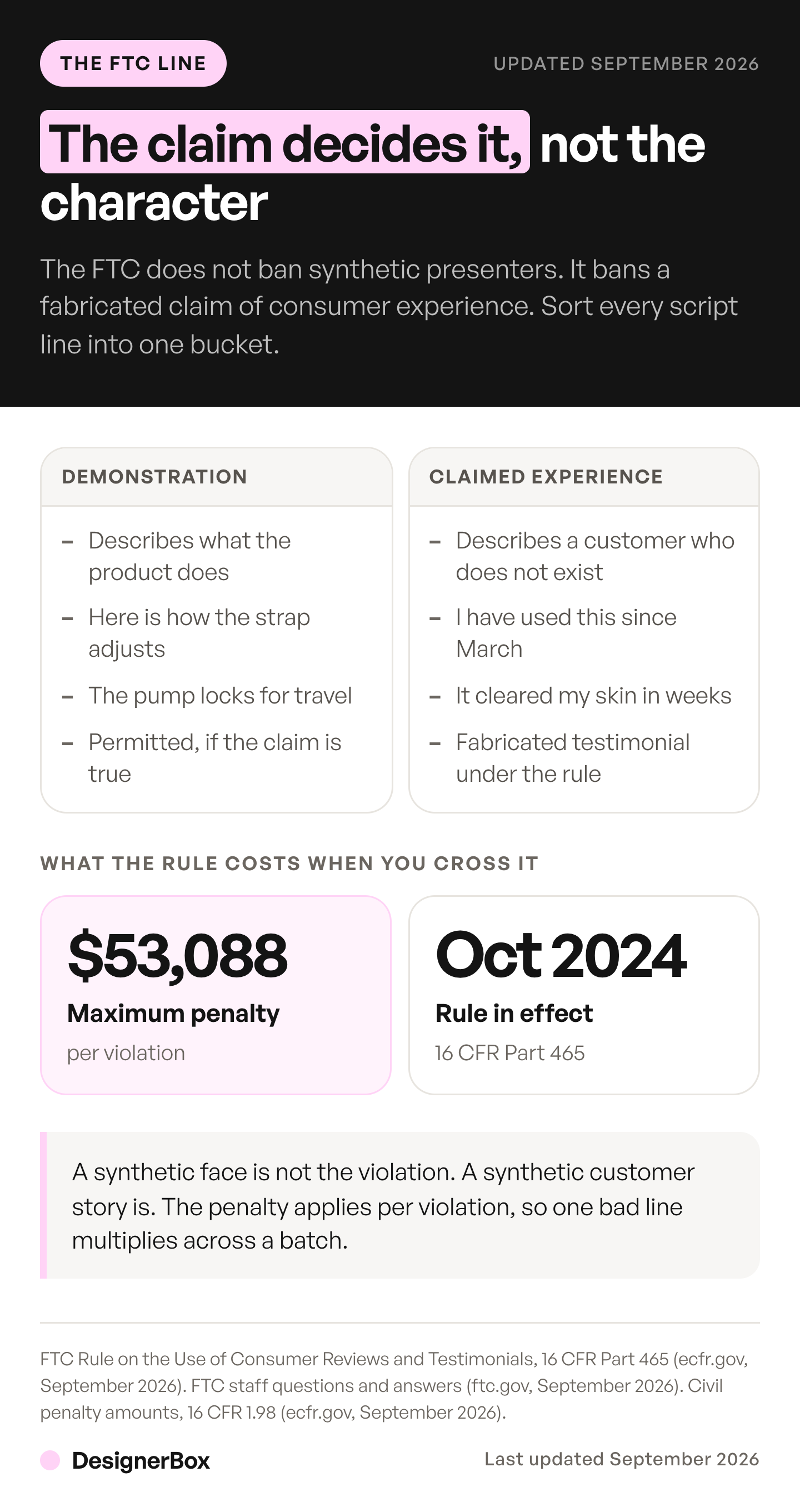
16 CFR 465.2 makes it an unfair or deceptive practice to write, create or sell a review or testimonial that materially misrepresents “that the reviewer or testimonialist exists,” or “that the reviewer or testimonialist used or otherwise had experience with the product, service, or business” (ecfr.gov, accessed September 2026). Section 465.2(b) extends this to disseminating a testimonial the business knew or should have known was fake.
The Endorsement Guides add the disclosure route. Under 16 CFR 255.2(c), ads presenting endorsements by what are represented to be actual consumers “should utilize actual consumers in both the audio and video, or clearly and conspicuously disclose that the persons in such advertisements are not actual consumers” (ecfr.gov, accessed September 2026).
Read together they produce a workable test. Sort every line in your script into one of two buckets.
| Script line | What it is | Risk under the FTC rules |
|---|---|---|
| ”This bottle holds 500ml and the pump locks for travel” | Product demonstration | Permitted, if true |
| ”Here is how the strap adjusts” | Product demonstration | Permitted, if true |
| ”I have been using this every day since March” | Claimed personal experience | Likely prohibited under 16 CFR 465.2 |
| ”It cleared my skin in two weeks” | Claimed personal result | Likely prohibited, plus a health claim |
| ”Everyone in my office asks where I got it” | Claimed social proof | Likely prohibited under 16 CFR 465.2 |
The first two describe the product. The last three describe a customer, and there is no customer. Rewriting a first-person result into a demonstrated attribute keeps the format and removes the exposure.
The penalty is worth stating plainly because it scales with volume. The maximum civil penalty is $53,088 per violation. That is the 2025 figure, and it still applies in 2026 because the 2026 inflation adjustment was cancelled (ftc.gov, accessed September 2026). Penalties apply to knowing violations. On 22 December 2025 the FTC sent warning letters to ten companies about possible breaches of this rule (ftc.gov, accessed September 2026). A batch of forty ad variants built on one bad script line can be more than one exposure.
What do Meta and TikTok require you to label?
Meta and TikTok ask for different things, and the difference is easy to miss. Meta’s advertiser disclosure rule covers ads about social issues, elections or politics. TikTok’s ads policy asks for a label on ads with fully AI-generated or heavily AI-edited media, and its Community Guidelines cover organic content showing realistic AI people. Rules like these change, so read this as of September 2026.
| Requirement | Meta | TikTok |
|---|---|---|
| Advertiser disclosure on an ecommerce ad | No. Required only in ads about social issues, elections or politics | Yes, when the ad has fully AI-generated or heavily AI-edited media: the AIGC label or your own clear disclaimer |
| Organic post with a realistic AI person | Disclosure required for photorealistic video or realistic audio, not for images | Label required for realistic-looking people or scenes |
| Platform labels it for you | Yes, when it detects third-party AI signals such as C2PA, since 1 June 2026, and not in every region | Yes, for content with Content Credentials or made with TikTok AI effects |
| Result of no disclosure | A social issue, election or political ad is rejected | Ads are rejected or restricted; organic content may be removed, restricted or labelled |
Meta’s ad standards say advertisers “must also disclose when a social issue, elections, or political ad contains a photorealistic image or video, or realistic sounding audio, that was created or edited using third-party generative AI tools” (transparency.meta.com, accessed September 2026). An ecommerce product ad sits outside that policy.
You may still get labelled. Meta checks ads for signs of third-party AI, such as C2PA metadata. Meta’s ad policy says this automated detection began on 1 June 2026, and Meta says the feature may not be available in every region. When Meta finds a signal, it adds an “AI info” label, which sits in About this ad in the three-dot menu (facebook.com, accessed September 2026). The label moves next to the “Ad” label in two cases only: an ad made with Meta’s own AI tools that shows a photorealistic AI person, or an advertiser in the European Region, California, New York, India or Taiwan who chooses to disclose (meta.com, accessed September 2026). Meta renamed its “Sponsored” label to “Ad”.
TikTok’s ads policy covers the paid side. It allows ads with AI-generated or heavily AI-edited media if you apply the AIGC label or add your own clear disclaimer, caption, watermark or sticker, and it rejects or restricts ads with undisclosed AI content (ads.tiktok.com, accessed September 2026).
TikTok’s Community Guidelines cover the organic side. They require creators to label AI-generated or significantly edited content “that shows realistic-looking scenes or people,” and state that unlabelled content may be removed, restricted or labelled by TikTok. Colour correction, reframing, anime-style art and generic text-to-speech need no label. TikTok does not allow using the likeness of private figures without consent (tiktok.com, accessed September 2026). TikTok updates its Community Guidelines on 24 September 2026, and the AI labelling section is the same in both versions. Re-check the page before shipping a campaign.
If you run in the EU, a further rule applies regardless of platform. Article 50(4) of the EU AI Act requires deployers to disclose deep fakes: realistic AI images, audio or video that could pass as real (ai-act-service-desk.ec.europa.eu, accessed September 2026). Article 50 has applied since 2 August 2026. The Commission’s guidelines, published on 20 July 2026, list “realistic AI-generated human avatars or personas” as persons, so a realistic AI presenter is likely in scope. The guidelines are not binding (digital-strategy.ec.europa.eu, accessed September 2026). Our wider breakdown of AI disclosure rules now in force covers the state-level laws alongside these.
Do AI UGC ads actually convert?
Creator-style ads convert better and click worse. The only peer-reviewed field test we could find, 67 Meta campaigns across 861,465 impressions, found brand-made creative won click-through rate at 3.06% against 2.26%, while creator-style content won conversion rate at 3.30% against 0.12% (mdpi.com, February 2025). The format changes which metric moves, and the figure everyone quotes for it points the wrong way.
The most-repeated claim in this category is that UGC ads earn four times the click-through rate at half the cost per click. We traced it to an aggregator citing an aggregator, and found no study, no sample and no date behind it. Alongside it sit vendor-blog uplifts of 27%, 33% and 48% that disagree with each other, and at least one labels its own source as an agency composite. Treat the whole genre as marketing.
The only peer-reviewed field experiment we could find on the question reports the opposite of the popular claim. Researchers ran 67 paid Meta campaigns for a single publisher, 26 using directed consumer-generated content and 41 using traditional brand-made creative, all promoting the same product to the same broad audience across 861,465 impressions. Brand-made creative won click-through rate at 3.06% against 2.26%. Creator-style content won conversion rate at 3.30% against 0.12%, and won on return on ad spend, both at p < 0.01 (mdpi.com, February 2025).
Read that with its limits attached. One product, one category, the Greek market, and 67 campaigns, a sample the authors themselves call relatively small. It is one study, and the question is still open.
The mechanism the authors propose is the useful part. Polished ads carry less information, so they buy curiosity clicks, while informative creator content pre-qualifies the click before it happens. If that holds even directionally, click-through rate is the wrong metric to judge this format on, and a UGC batch optimised for clicks selects against the thing the format is good at.
| Metric | Brand-made creative | Creator-style creative |
|---|---|---|
| Click-through rate | 3.06% | 2.26% |
| Conversion rate | 0.12% | 3.30% |
| Return on ad spend | Lower | Higher |
Two further findings frame the AI version specifically. A study of more than two million ad-day observations, over 16 billion impressions and 116 million clicks from over 7,000 advertisers found AI-generated ads matched human-made ads on click-through rate overall, and beat them only where viewers did not perceive the image as AI (business.columbia.edu, working paper dated January 2025). That measured display advertising, so read it as evidence about perceived synthetic-ness rather than a video result.
And the base rate is sobering. Kantar scored 15,000 branded creator assets across TikTok, YouTube Shorts and Instagram and found “only 6% of creator content delivers both strong platform engagement and strong brand-building potential” (kantar.com, June 2026). The same release notes that figure rises to 27% if you loosen the bar to medium-to-high on both. A separate Kantar analysis, run with the creator agency Whalar on 101 of its creator videos, found 62% drove brand impact on both long-term brand equity and short-term sales likelihood, against a Kantar benchmark of 27% (kantar.com, June 2025). That sample is one agency’s own work, so read the 15,000-asset figure as the wider base rate. Good creator creative beats norms and average creator creative does not, which is equally true of studio work.
A larger matched comparison adds a craft warning. System1, WPP Media and TikTok tested 620 creator ads against 597 brand-made ads across eight markets and 23.6 billion impressions. Creator ads delivered 23% more Brand Memory Lift, and only 61% of creator ads carried a brand cue in the first two seconds (system1group.com, June 2026). Two caveats travel with it. Brand Memory Lift measures recall rather than sales. And the study is TikTok-only and co-produced with TikTok, which has a commercial interest in the finding, so weigh it accordingly.
That 61% is the most actionable number in the evidence. The style that earns attention is the style most likely to omit the brand. Kantar reached the same conclusion independently, reporting that 27% of creator content currently ties back to the brand (kantar.com, June 2026). If your generated presenter gets two seconds in without your product or name on screen, the ad is working for the format rather than for you.
The practical reading: the format buys a native-looking placement and cheap variant volume, and the evidence suggests it earns its keep further down the funnel than the click. Judge a batch on conversion rate and ROAS rather than CTR or engagement. Label the AI where a platform or the law asks, and fix the visual tells that make a presenter look generated. Our guide to ad creative testing covers why nine ads in one ad set is not a readable test.
Cost of a batch of AI UGC ads
A batch of AI UGC ads costs whatever the video model costs, and the spread is wider than most teams expect. In DesignerBox, an 8-second clip costs 40 to 560 credits, depending on the model. Images are priced per model too. The cost of every run is shown before you start it.
One operation has a fixed price. An avatar run returns nine fixed poses for 25 credits, which gives you a presenter reference you reuse across the batch.
The spread starts at the model vendors. Google’s Gemini API lists Veo 3.1 Lite at $0.05 a second at 720p and Veo 3.1 at $0.40, both with audio (ai.google.dev, September 2026). Six 8-second clips cost $2.40 on the first and $19.20 on the second, eight times as much for the same script. That arithmetic is illustrative and uses vendor API prices. DesignerBox bills in credits.
The model list names the 8 image models and 13 video models DesignerBox runs. Read the cost before the run rather than after it, and draft on a fast model. The AI video cost guide breaks the video side down further.
A batch is also where the build-once argument pays. The script sort, the product photograph, the presenter reference, the model and the result size are decisions you make once. Save them as a workflow and the next product runs the same steps in the same order, so ad forty holds the same standard as ad one instead of reading as a fortieth attempt.
Two gates to know before budgeting. AI video starts on the Premium plan, at $75 a month billed monthly. The commercial licence starts at Pro, at $35 a month billed monthly. Plans run Free at 112 credits a month, Basic at $15 a month billed monthly for 500, Pro at $35 for 1,000, Premium at $75 for 2,500 and Ultra at $200 for 8,000. Yearly billing lowers the rate and grants the same monthly allocation, reset monthly, so check which view the pricing page is showing you before you quote a figure.
For comparison on the human side, Collabstr’s 2026 influencer marketing report, drawn from more than 21,000 collaborations on its platform, gives a $154 average for a UGC collaboration, with 80% of engagements under $300 (collabstr.com, September 2026). Read that carefully before doing arithmetic with it. The report does not define a collaboration as a single video, and does not break out usage rights, whitelisting or variation counts, so it is a floor for one collaboration rather than a per-video rate.
Whatever tool you use, check where its commercial rights start before you build a batch on the entry tier, and check whether the price on screen is the monthly or the annual rate. Pricing pages often open on the annual view.
How to build an AI UGC ad that ships
Eight steps, in the order that keeps cost and exposure down.
-
Write the script first and sort every line. Demonstration or claimed experience. Cut or rewrite everything in the second bucket before a single frame is generated. Fixing this after a batch renders is where the money goes.
-
Start from your real product photograph. Never let the generator draw your SKU. Upload the shot you own so the label, closure and proportions are yours.
-
Build the presenter once and reuse them. An avatar run returns nine fixed poses for 25 credits, and gives you a presenter reference for the whole batch, which matters more than any single clip. The model creator template is the reusable version of this, and our guide to AI avatars for brands covers what holds and what drifts.
-
Generate the still before the video. An image edit costs a small part of an 8-second clip, and a clip costs 40 to 560 credits, depending on the model. The same correction costs far more once it is moving. Fix hands, product placement and framing in the still. Hands holding a product is the shot that breaks most often, and why hands and faces break in AI video lists the tells to check.
-
Pick the cheapest model that clears the bar. Draft the batch on a fast model, then run only the winner again on a stronger one.
-
Put a brand cue in the first two seconds. Product on screen, name visible, or both. Only 61% of creator ads manage this, and it is the cheapest fix on the list because it costs a frame rather than a re-render.
-
Run the disclosure check per placement. Meta may label it for you when it detects AI signals. TikTok asks you to label AI ad media yourself. In the EU, a realistic AI presenter likely needs a deployer disclosure. One asset, three different duties.
-
Test the batch as a batch. Enough spend per arm to read a result, and one variable changed at a time.
The static ad templates and the social ad template cover the still ads that run next to the video. DesignerBox has 68 tools over MCP, so an AI chat such as Claude can run the same workflow. If you want to feed the resulting variants into platform-side assembly, our guide to dynamic creative optimization covers what Meta and Google ask you to supply.

When the question is which generator to buy rather than how to build the ad, see our comparison of ten AI UGC video generators.
One workflow for every product ad
DesignerBox is AI creative production for agencies and brand teams. You set the brand once, and the workflow reads it on every run. A saved workflow runs the same way on the next product, with the same presenter, the same script rules and the same sizes. Publish the workflow as an app, and a colleague adds the next product photo and presses Run. Batch, one workflow over a whole sheet of products, is coming.
Start from a template, add your brand and your products, and run it. The cost is shown before the run. See the templates.
FAQ
Are AI UGC ads legal?
In the United States, the FTC says its rule does not ban them. The FTC’s staff Q&A on the Consumer Reviews and Testimonials Rule states the rule has no blanket prohibition on AI-generated avatars in marketing, and the Commission drafted section 465.2 specifically so it would not prohibit virtual influencers (ftc.gov, September 2026). What is prohibited is materially misrepresenting that a reviewer exists or that they used the product, under 16 CFR 465.2. This is general information, not legal advice.
Do I have to disclose that an ad uses an AI presenter?
Each platform and market sets its own rule. Meta asks advertisers to disclose AI only in ads about social issues, elections or politics. Meta’s ad policy says it began detecting third-party AI in ads on 1 June 2026, and it adds an “AI info” label when it finds a signal. Meta says the feature may not be available in every region (facebook.com, September 2026). TikTok asks for a label on ads with fully AI-generated or heavily AI-edited media. In the EU, Article 50(4) of the AI Act has required deployers to disclose deep fakes since 2 August 2026, and a realistic AI presenter is likely in scope (ec.europa.eu, September 2026).
What is the penalty for a fake AI testimonial?
The maximum civil penalty is $53,088 per violation. That is the 2025 figure, and it still applies in 2026 (ftc.gov, September 2026). Penalties apply to knowing violations, and a large variant batch built on one non-compliant script line can multiply the exposure. The FTC sent warning letters to ten companies about this rule on 22 December 2025.
Do AI UGC ads convert better than studio ads?
The metric decides the answer, and the popular claim points the wrong way. The only peer-reviewed field experiment we could find, covering 67 Meta campaigns for a single product, found brand-made creative won click-through rate at 3.06% against 2.26%, while creator-style content won conversion rate at 3.30% against 0.12% and won on ROAS (Systems 13(2) 124, February 2025). Judge the format on conversions rather than clicks. We could not trace a primary source for the widely quoted “4x CTR” figure.
Can I use an AI version of a real customer or influencer?
Not without consent. TikTok does not allow using the likeness of private figures without consent. Beyond platform policy, a synthetic version of a real person raises right-of-publicity questions and, if they appear to endorse something they never endorsed, deception exposure under the Endorsement Guides. This is general information, not legal advice.
How much does a batch of AI UGC ads cost?
In DesignerBox, the video model decides most of it. An 8-second clip costs 40 to 560 credits, depending on the model, and the cost of each run is shown before you start it. An avatar run returns nine fixed poses for 25 credits. AI video needs Premium, at $75 a month billed monthly, which includes 2,500 credits a month. The commercial licence starts at Pro, at $35 a month billed monthly.
Does my product have to be real in the shot?
It has to be yours. A generated approximation of your SKU carries the wrong label, closure and proportions, and a product misrepresentation is a separate deception problem from the testimonial rules. Upload the real photograph and let the model place it in the scene.
Sources
- FTC, Consumer Reviews and Testimonials Rule: Questions and Answers, ftc.gov, accessed September 2026
- 16 CFR Part 465, Rule on the Use of Consumer Reviews and Testimonials, ecfr.gov, accessed September 2026
- 16 CFR Part 255, Guides Concerning the Use of Endorsements and Testimonials, ecfr.gov, accessed September 2026
- 89 FR 68049, Federal Register rulemaking notice, federalregister.gov, accessed September 2026
- FTC, inflation-adjusted civil penalty amounts for 2025, ftc.gov, accessed September 2026
- FTC, warning letters to 10 companies about the Consumer Review Rule, ftc.gov, 22 December 2025
- FTC, updated Endorsement Guides announcement, ftc.gov, June 2023
- Meta, Social Issue, Elections and Politics advertising standards, transparency.meta.com, accessed September 2026
- Meta Business Help Center, AI info labels on ads, facebook.com, accessed September 2026
- Meta Help Center, AI info on ads, meta.com, accessed September 2026
- TikTok ads policy, misleading and false content, ads.tiktok.com, accessed September 2026
- TikTok Community Guidelines, Integrity and Authenticity, tiktok.com, accessed September 2026
- EU AI Act Article 50, ai-act-service-desk.ec.europa.eu, accessed September 2026
- European Commission, guidelines on Article 50 transparency obligations, digital-strategy.ec.europa.eu, accessed September 2026
- European Commission, Article 50 FAQ, digital-strategy.ec.europa.eu, accessed September 2026
- Exner, Hartmann, Netzer and Zhang, “AI in disguise”, working paper dated January 2025, business.columbia.edu, accessed September 2026
- Directed consumer-generated content field experiment, Systems 13(2) 124, mdpi.com, February 2025
- System1, WPP Media and TikTok, creator effectiveness playbook, system1group.com, June 2026
- Kantar, creator content engagement and ROI release, kantar.com, June 2026
- Kantar, LINK suite and creator content effectiveness gap, kantar.com, June 2026
- Kantar and Whalar, creative effectiveness meta-analysis of 101 creator assets, kantar.com, June 2025
- Google Gemini API pricing, ai.google.dev, accessed September 2026
- Collabstr, 2026 influencer marketing report, collabstr.com, accessed September 2026
- DesignerBox plans, monthly credits, the video credit range, the avatar price and feature gating: DesignerBox pricing page (designerbox.ai/pricing), September 2026
Regulatory and platform policy checked against primary sources as of September 2026. This is general information, not legal advice. Rules change, and TikTok has a Community Guidelines update taking effect on 24 September 2026. Re-check before publishing a campaign. Individual results vary.