
UGC ads are paid social ads produced to look like a customer filmed them on a phone, rather than a studio commercial. In 2026 they come from four routes: a creator you hire direct, a content marketplace, a subscription platform plus creator fees, or a generated presenter. A single creator video averages $150 to $212, according to Influee’s rate guide (influee.co, accessed September 2026). Generated clips cost credits instead.
A brand testing five hooks a month on Meta and TikTok needs sixty creator videos a year. At a median rate of $175 a video that is $10,500 before usage rights, before revisions, and before a single one of those sixty is any good. Many teams find that number in month two, when the media buyer asks for more variants than the budget was built for.
This guide sets out how each of the four production routes charges, the formats that earn the spend, and how to budget a test when you generate part of the batch. It is written for a paid social lead, an agency or a marketing manager deciding where the creative budget goes next quarter.
Key Takeaways
- The median creator video is about $175. Average rates run $150 to $212 for a single video, before usage rights (influee.co, accessed September 2026).
- Marketplace packs lower the per-video price as the pack grows. Trend sells prepaid packs, and its own pricing page shows the per-video rate for each pack (trend.io/pricing, September 2026). The total still rises with volume.
- Platform subscriptions sit on top of creator pay. Insense says creator payments are not covered by its plans and must be budgeted separately, and it adds a marketplace fee to each creator payment (insense.pro/pricing, September 2026).
- Generated presenters move the cost from per video to per month. AI UGC tools sell monthly plans with a credit allowance. In DesignerBox, the cost of each run is shown before the run.
- The model you pick moves the video price. In DesignerBox, an 8-second clip costs 40 to 560 credits, depending on the model. You see the cost before you press Run, not on next month’s bill.
- The format decides the route. An unboxing needs a real package and real hands. A talking-head hook needs a face and a first line, which is the cheapest thing to vary.
- Disclosure is two separate rules. Paid creators need a material connection disclosure, and realistic generated content can need a platform label. They are different obligations.
What are UGC ads?
A UGC ad is a paid advertisement built in the visual language of user-generated content: phone framing, a real room, natural light, one person talking to the lens. The brand commissions it, pays for it and owns it. That gap between how it looks and where it came from is what makes the production route, the licence and the disclosure worth getting right before the media budget goes live.
The category is now a real line item. US creator economy ad spend more than doubled from $13.9 billion in 2021 to $29.5 billion in 2024, and was projected to reach $37 billion in 2025, growing about four times faster than the media industry overall (iab.com, November 2025). Nearly half of ad spenders in that study, 48%, now rank creators a must buy, behind only social media and paid search.
That growth is why the production question moved from “can we get one” to “what does one cost at volume”.
What does a UGC ad cost in 2026?
Four routes, four cost shapes. A direct creator hire is priced per video. A marketplace pack is prepaid and priced per pack. A campaign platform charges a subscription and leaves the creator fee outside it. A generated presenter charges a monthly credit allowance and no per-video fee at all. The table below sets out how each route charges, from each vendor’s own published page this month.
| Route | What you pay for | How it is priced | Per video |
|---|---|---|---|
| Hire a creator direct | One video, filmed and edited | Set by the creator | $150 to $212 average, about $175 median (market rate) |
| Content marketplace pack | A prepaid bundle of deliverables | Per pack, prepaid | Falls as the pack grows |
| Campaign platform plus creator fees | Software seat, then creator pay | Monthly plan | Plan cost, plus creator fee, plus a marketplace fee |
| Generate the presenter | A monthly credit allowance | Monthly plan | No per-video fee, credits per run |
Sources: influee.co/blog/ugc-price, trend.io/pricing, insense.pro/pricing, all read September 2026.
Read the right-hand column. Three routes carry a marginal cost for video sixty-one. The fourth does not, and it brings its own set of problems, covered below.
What do UGC creators charge per video?
A single creator video averages $150 to $212, with a median around $175. Experience, platform and deliverable all move the number. Rates track the deliverable more than the creator’s follower count, which is what separates a creator brief from an influencer deal. Bundles discount the rate: two videos take 5% to 10% off, three or four take 10% to 15%, and five or more take 15% to 25%.

Those benchmarks come from Influee, a creator marketplace that publishes its own rate research. Its guide is dated April 2025 (influee.co/blog/ugc-price, accessed September 2026). One worked example on that page: a creator at $200 a video prices a five-video bundle at $810 instead of $1,000, which lands at $162 a video.
Usage rights are the line most budgets miss. The base fee covers filming, editing, basic revisions and delivery. Running it as a paid ad, past the agreed window, or on a channel outside the brief is a separate negotiation. Price the licence at brief time.
What do UGC marketplaces and platforms charge?
Marketplaces and campaign platforms solve sourcing, briefing, contracts and payment, which is genuine work a small team would otherwise do by hand. They price it two different ways. A content marketplace sells prepaid packs of deliverables. A campaign platform sells a software subscription and leaves the creator payment to you, so the plan price is only the starting point.
Trend sells prepaid packs in four sizes. Its own page shows the per-video rate for each pack, and the rate falls as the pack grows. The page also notes that credits expire 12 months after purchase (trend.io/pricing, September 2026).
Insense prices the software separately. It offers a one-month trial, plus Brand and Agency plans billed quarterly or yearly. The page states that creator payments are not covered and must be budgeted separately. It also adds a marketplace fee to each creator payment, and the percentage is lower on the higher plans (insense.pro/pricing, September 2026).
Both shapes are honest, and they answer different questions. Packs suit a fixed quarterly volume. A subscription suits a team running continuous campaigns that needs contracts, ad-account connections and reporting in one place.
What does it cost to generate a UGC ad?
Generated creator-style video replaces a per-video fee with a monthly allowance. AI UGC tools such as Creatify and Invideo sell monthly plans with a credit allowance, and each lists its plans on its own pricing page (creatify.ai/pricing and invideo.io/pricing, September 2026).
DesignerBox also works on a monthly credit allowance. A run starts from a product photo you add, so the item in the frame is the one you sell. The free plan has 112 credits a month. Billed monthly, Basic is $15 for 500 credits, Pro is $35 for 1,000, Premium is $75 for 2,500, and Ultra is $200 for 8,000. An 8-second clip costs 40 to 560 credits, depending on the model. For images, the cost is shown before the run.
Plan a variant batch against that cost. The model you pick moves it more than the length does, and you see the total before you press Run. Frames cost less again, which is why part of a test plan ships as stills: where a static frame beats a clip sets out which placements accept it.
Two honest gates travel with that. AI video needs Premium or higher, and the commercial licence starts at Pro. If the plan is to run the result as a paid ad, price the plan that grants the licence. The cheapest plan that makes a file may not include it. Full plan detail sits on the DesignerBox pricing page.
For a longer shortlist, ten AI UGC video generators compared covers the tool market without the route comparison.
Which UGC ad formats are worth producing?
Five formats cover most creator-style ad briefs: unboxing, testimonial, product demo, problem-and-solution skit, and the talking-head hook. They differ on one axis that decides everything downstream, which is what physically has to be in frame. A real package and real hands cannot be generated from a product photo. A first line delivered to camera can be varied fifty times for the price of one shoot day.
| Format | What has to be in frame | Route that fits |
|---|---|---|
| Unboxing | The real package, hands, first reaction | Creator or marketplace |
| Testimonial | A person claiming their own experience | Creator, with disclosure |
| Product demo | The product doing the thing it does | Creator, or generated from a product photo |
| Problem and solution skit | A scene, a beat, a payoff | Generate variants, film the winner |
| Talking-head hook | A face and an opening line | Generate, cheapest thing to vary |
Match the route to the format and the budget stops fighting the brief. Hooks and skits are where variant volume pays, since you are testing a sentence rather than a set. Unboxings and testimonials earn the creator fee, because the reaction is the product. To see which of the five your category already runs, start with the free platform ad libraries, and the ad research databases compared covers the paid ones that search across networks.
The same creator-style work can run from an AI chat such as Claude, through DesignerBox’s 68 MCP tools.
Where generated UGC ads fall short
Three limits are worth naming before a batch goes live. Generated clips do not produce a genuine consumer experience, so any line that claims one is a testimonial from a person who does not exist. Fine physical detail, hands interacting with a small object and label text under motion, still needs checking frame by frame. And the reject rate is real: you generate several to ship one, which is the multiplier most budgets leave out.
Voice is where a batch gets thin, because a read that sits half a beat wrong turns a good script into an obvious ad. The three production paths for AI voiceover on a creator-style ad each carry a different read-length ceiling. Resolution, captions and the opening second are cheaper to fix before you generate than after, and the ranked list of which quality fixes cost what covers all six.
Do UGC ads need a disclosure?
Two separate rules apply and teams routinely conflate them. The first covers the paid relationship between a brand and the person on screen. The second covers synthetic media, meaning realistic content a model generated. A single ad can trigger both, one, or neither, and each one changes what goes on screen. This is general information, not legal advice.
On the paid relationship, the FTC’s position is that when a connection between an endorser and a marketer exists that a significant minority of consumers would not expect and that would affect how they evaluate the endorsement, it should be disclosed clearly and conspicuously. The advertiser cannot pass that responsibility to someone else: “Your company is ultimately responsible for what others do on your behalf” (ftc.gov, accessed September 2026).
On fabricated experience, the FTC’s rule at 16 CFR 465.2 says a business must not write, create or sell a consumer testimonial that materially misrepresents that the testimonialist exists, that they used the product, or what their experience with it was (law.cornell.edu, accessed September 2026).
On platform labels, the rules differ between ads and posts, as of September 2026. TikTok’s ads policy allows AI-generated or heavily AI-edited media when the ad carries TikTok’s AIGC label or the advertiser’s own clear disclaimer, and it rejects or restricts ads with undisclosed AI content (ads.tiktok.com). For organic posts, TikTok requires creators to label AI-generated or heavily edited content that shows realistic people or scenes (tiktok.com).
Meta asks advertisers to disclose AI only in ads about social issues, elections or politics (transparency.meta.com). For other ads, Meta adds an “AI info” label itself when an ad was made with its own AI tools, or when it detects signals of third-party AI such as C2PA metadata (facebook.com). For organic posts, Meta requires people to disclose photorealistic AI video or realistic AI audio, and may apply penalties if they do not. That rule does not apply to images (transparency.meta.com).
Where the line sits for a generated presenter specifically, with the penalty detail and the platform-by-platform breakdown, is set out in the guide to the FTC line on generated presenters.
How to budget a creator-style ad test
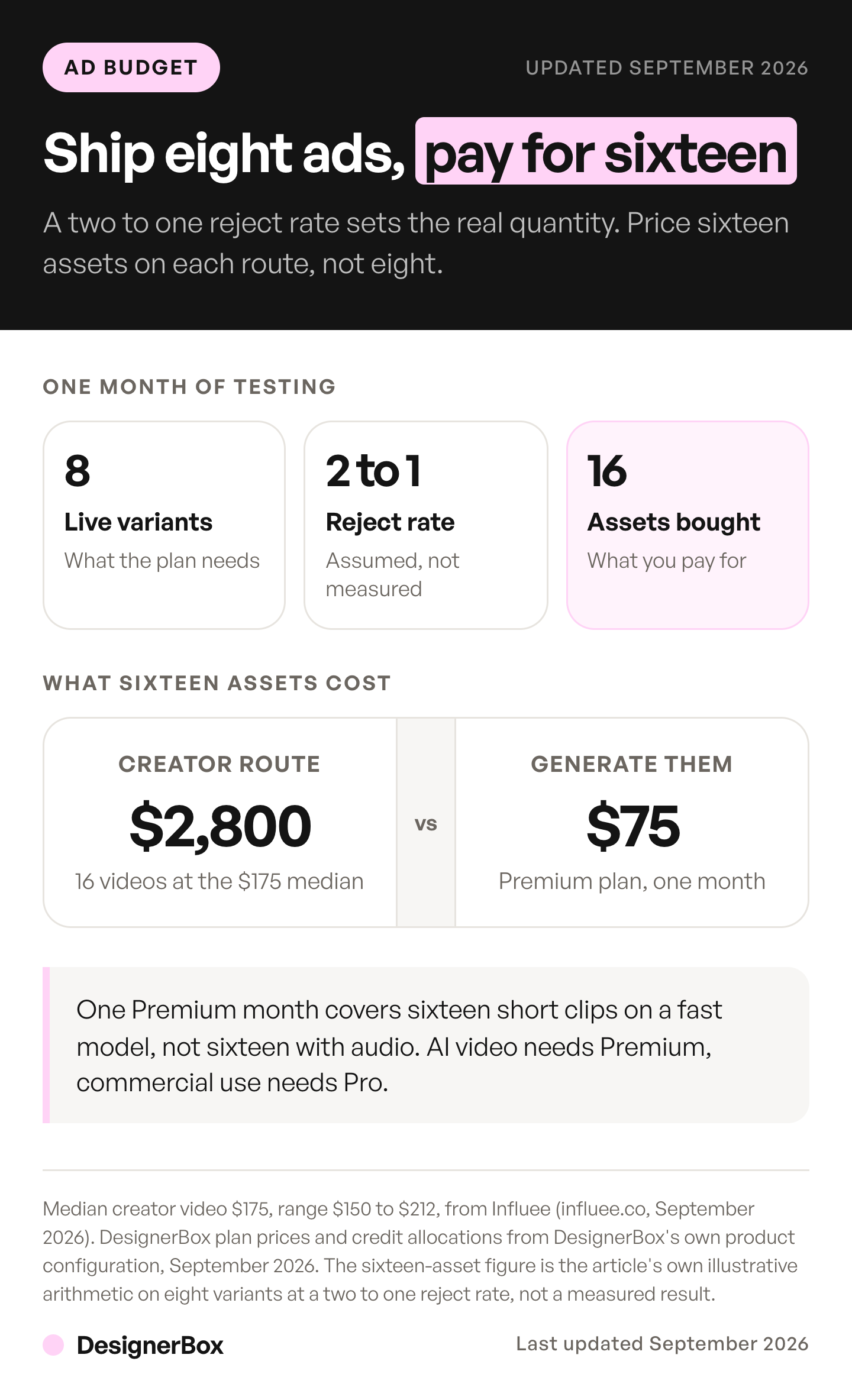
Budget per shipped ad, not per asset. The same arithmetic in dollars per second, with the reject multiplier built in, sits in what one shipped AI video ad costs. Pick the number of live variants the media plan needs, multiply by the reject rate you measure in the first batch, then price that quantity on each of the four routes. A team shipping eight variants a month with a two-to-one reject rate is buying sixteen assets, which is $2,800 at the median creator rate. In DesignerBox, an 8-second clip costs 40 to 560 credits, depending on the model, and every run shows its cost before you start it.
Then split the plan by format rather than buying one route for everything. Hooks and skits generate. Unboxings and testimonials get filmed. The winners from the generated half become the briefs you hand a creator next quarter.
Build the winning frame once as a workflow. A saved workflow runs the same way for the next hook, the next size and the next product. Static ad templates make creator-style frames, product ads and platform sizes from one product photo.
Start from a template, add your brand and your products, and run it. The cost is shown before the run. See the templates.
FAQ
How much does a UGC ad cost?
A single creator video averages $150 to $212, with a median around $175, according to Influee’s rate guide (influee.co, accessed September 2026). Marketplace packs lower the per-video rate as the pack grows (trend.io/pricing, September 2026). Generated clips replace the per-video fee with a monthly credit allowance.
What are the typical UGC rates for a beginner creator?
Beginner rates sit at the bottom of the published range rather than at a separate price point. Influee’s rate guide puts the median single video at about $175, with experience, platform and usage rights moving it either way (influee.co, accessed September 2026). Bundles discount it further: five or more videos commonly take 15% to 25% off the single-video rate.
Are UGC ads legal?
Creator-style advertising is legal. Two FTC rules constrain it. Paid relationships need a clear material connection disclosure, and the advertiser stays responsible for it (ftc.gov, accessed September 2026). Testimonials that misrepresent that the person exists, used the product, or had the stated experience are prohibited under 16 CFR 465.2 (law.cornell.edu, accessed September 2026). This is general information, not legal advice.
Do I have to label an AI-generated ad?
It depends on the platform and the ad, as of September 2026. TikTok asks for its AIGC label or your own clear disclaimer on ads with AI-generated or heavily AI-edited media, and rejects or restricts ads without one (ads.tiktok.com). Meta asks advertisers to disclose AI only in ads about social issues, elections or politics, and labels other ads itself when it detects AI signals (transparency.meta.com). Check both platforms’ current rules before a campaign goes live.
Is user-generated content advertising worth the spend?
The money says brands think so. US creator economy ad spend was projected to reach $37 billion in 2025, growing about four times faster than the media industry overall, with 48% of ad spenders ranking creators a must buy (iab.com, November 2025). Results depend on the creative, so budget for variants rather than for one hero asset.
Which formats should I test first?
Start with the talking-head hook and the problem-and-solution skit, because both test a sentence rather than a set, so variant volume is cheap. Add an unboxing and a testimonial once a hook wins, since those need a real package and a real person. Product demos work either way, depending on whether the product has to be handled.
Can I use my own product in a generated ad?
In DesignerBox, yes. A run starts from a product photo you add, so the item in frame is the one you sell. For images, the cost is shown before the run. An 8-second clip costs 40 to 560 credits, depending on the model. The commercial licence starts on the Pro plan at $35 a month, and AI video starts on Premium at $75 a month, both billed monthly.
Sources
- IAB, 2025 Creator Economy Ad Spend & Strategy Report press release, iab.com, November 2025
- FTC, Endorsement Guides: What People Are Asking, ftc.gov, accessed September 2026
- 16 CFR 465.2, Rule on the Use of Consumer Reviews and Testimonials, law.cornell.edu, accessed September 2026
- TikTok Ads Policy, Misleading and false content, ads.tiktok.com, accessed September 2026
- TikTok Community Guidelines, Integrity and authenticity, tiktok.com, accessed September 2026
- Meta, Social issue, election and political ads, transparency.meta.com, accessed September 2026
- Meta Business Help, AI info labels on ads, facebook.com, accessed September 2026
- Meta Community Standards, Misinformation, transparency.meta.com, accessed September 2026
- Influee, UGC rates guide (dated April 2025), influee.co/blog/ugc-price, accessed September 2026
- Trend, content packs, trend.io/pricing, September 2026
- Insense, plans and marketplace fee, insense.pro/pricing, September 2026
- Creatify, plans, creatify.ai/pricing, September 2026
- Invideo, plans, invideo.io/pricing, September 2026
- DesignerBox plans, credits and the video cost range: DesignerBox pricing page (designerbox.ai/pricing), September 2026
Creator rates and vendor pricing models checked on each vendor’s own page, and disclosure rules from FTC, Meta and TikTok primary sources, as of September 2026. This is general information, not legal advice. Individual results vary.