
An AI UGC video generator turns a script or a product photo into ads that look like customer-shot phone footage, using synthetic actors instead of hired creators. As of July 2026, list prices run from $19 a month at the low end to $499 a month at the high end, with HeyGen at $29 and Creatify at $39. The pick comes down to one question: does your actual product need to be in frame?
Every price on this page was read off the vendor’s own pricing page in July 2026. That turned out to matter more than expected.
Several of the generators most commonly recommended in this category quote an annual-billed rate that review sites repeat as a monthly one. Two are running countdown-timer promotions that make the “price” temporary by design. And one tool that still appears in published “best of” lists no longer exists: ugcfarm.com is now a parked domain listed for sale through HugeDomains (ugcfarm.com, July 2026).
This guide covers ten generators: what each costs at list, what a single finished ad costs once you do the credit math, what the tool generates beyond the clip, and the two rules that decide whether the ad you just made is allowed to run.
Key Takeaways
- Prices in this category are widely misreported. HeyGen’s Creator plan is $29 for 600 credits and Pro starts at $49 for 1,000, not the $99/200 several review sites list (heygen.com, July 2026). Check the vendor page, not the roundup.
- The cheapest headline number is often an annual rate. Topview’s Pro reads $16 a month, which is $192 billed annually against a $29 monthly list price (topview.ai, July 2026). Predis.ai goes further and opens on the annual view, so $19 is the headline and $32 is the real month-to-month (predis.ai, July 2026).
- A generator makes more than the clip. The script, the hook, the captions, and the aspect ratios are where the ad is won or lost, and they vary more between tools than the render engine does.
- The range is enormous. Shhots AI starts at $19 a month. Poolday starts at $499 a month (poolday.ai, July 2026). These are not the same product category despite the same label.
- Credits per month and credits per year are different things, and Topview mixes both across its own tiers. Read the unit before comparing.
- AI actors are not banned. The FTC’s rule “has no blanket prohibition on the use of AI-generated avatars in marketing” and was drafted specifically so as not to prohibit virtual influencers (ftc.gov, July 2026). What it prohibits is a fake or false underlying testimonial.
- Meta now detects AI ads on its own. It applies an “AI info” label to ads it identifies as made with third-party generative tools, using industry-standard signals (about.fb.com, July 2026). You do not opt into that label.
- Split the decision by what carries the ad. A synthetic person talking to camera and your real product in frame are two different jobs, and almost no tool is the cheapest at both.
What an AI UGC video generator does
The category name is doing a lot of work. In practice these generators do one of two jobs, and the difference decides which one you want.
The first job is the synthetic actor. You write a script, pick a face from a library, and the tool renders a person delivering that script to camera in a bedroom or a kitchen. The product may appear as an inserted image, or not at all. This is what most tools in the category mean by UGC. When the presenter starts from one portrait rather than a stock library, making a photo talk with AI covers the models and the consent that route needs.
The second job is the product-led ad. The input is your product photo. The output is your actual SKU in a scene, in motion, cut to the placements each channel wants. The person is optional.
Most tools claim both, and their pricing tells you which one they were built for. Charging per finished video means an actor tool. Charging per credit across images and video means a campaign tool. Our guide to what an AI ad generator does separates the four types worth knowing apart.
What a UGC ad generator makes besides the video
The word generator is doing more work than tool. A generator does not just render a clip. It writes the script, opens on a hook, adds a voiceover, burns in captions, and exports the file at the aspect ratio each placement wants. The clip is the last step, not the only one.
That matters because the parts you cannot see decide whether the ad works. The hook in the first two seconds sets the scroll-stop rate. The captions carry the message with the sound off, which is how most feeds play. The aspect ratio decides whether the ad fills a 9:16 Reel or sits letterboxed and ignored.
Most generators automate all of it from one input. You paste a product URL or upload a photo, and the tool drafts the script, picks a hook pattern, generates the voiceover, times the captions, and renders vertical, square, and 4:5 in one pass. What separates them is how much of that you can steer: whether you can rewrite the hook, swap the voice, or lock the caption style to your brand.
So read a generator by its creative layer, not its render engine. Two tools running the same underlying video model ship very different ads, because the script and the hook are where the ad is won.
The ten generators, and what they cost

Each price below was read from the vendor’s own pricing page in July 2026. Where a vendor shows a crossed-out list price next to a promotional one, both are stated. This category changes tiers frequently, so verify on the day you buy.
Shhots AI
Publishes the clearest credit math in the category. Every plan states what a finished asset costs before you pay: an AI UGC ad is 551 credits at 10 seconds and 826 at 15 seconds, and a product image is 11 credits (shhots.ai, July 2026). Plans run $19 a month for 2,000 credits, $49 for 6,000, and $99 for 12,000, with annual options at $199, $499, and $999. Commercial licence and watermark-free exports are on every tier, including the $19 one.
Scope note: UGC is generated in 12 languages on the Starter tier.
Topview AI
Priced for low-volume entry, and the only tool here shipping a credit-free generation mode. All paid plans include unlimited “Relax Generation” at lower priority, which does not draw down credits (topview.ai, July 2026).
Read the tiers carefully. Pro displays $16 a month against a $29 list price, which is $192 billed annually for 960 credits per year. Business displays $44 against a $75 list, at $528 annually for 3,000 credits per year. Ultra is $50 against a $150 list and switches the unit to 500 credits per month, expiring monthly. Credits per year on two tiers and credits per month on another is unusual, and it makes tier-to-tier comparison harder than it looks. The page was running a “Flash Sale Week” when checked.
HeyGen
The most established avatar platform of the group, and the only one with a genuinely free tier that produces usable video: 3 videos a month at $0 (heygen.com, July 2026). Creator is $29 a month for 600 credits at 1080p. Pro is $49 for 1,000 credits and adds 4K export. Business is $149 a month plus $20 per seat for 1,500 credits, 60-minute videos, and 5 custom digital twins.
Scope note: HeyGen is an avatar and presenter platform rather than an ecommerce ad tool. Product-in-frame work sits outside what its plans describe.
Creatify
Built specifically for performance marketers, and the feature list reflects it: a competitor ad tracker covering up to 10 brands, and an Ad Launcher that pushes creative to Meta, TikTok, and AppLovin from inside the tool (creatify.ai, July 2026). If it is your incumbent, the Creatify alternatives comparison covers what else fits the same job.
The free plan includes 10 credits a month, enough for 2 video ads or 20 image ads, with 300 AI actors and a watermark on exports. Starter is $39 a month for 100 credits, 300 AI actors, and video up to 2 minutes. Pro scales from 300 to 5,000 credits with 1,500 actors and video up to 10 minutes. The page advertises up to 50% off annual plans, so confirm which billing period your quoted figure assumes.
MakeUGC
One of the few tools that names product-in-hand video as a distinct feature rather than a side effect, and it is gated to the Pro tier (makeugc.ai, July 2026).
Pricing was mid-promotion when checked. Every platform tier carried a standing “50% OFF” badge, and the displayed rates were $59 a month for 500 credits (Startup), $79 for 1,000 (Growth), and $149 for 2,000 (Pro), with a $1 first month. MakeUGC does not clearly state its undiscounted list, so treat these as promo-gated numbers rather than durable ones, and read the badge before you buy. A separate API plan runs $99 a month for 2,000 credits and $299 for 6,000.
EzUGC
Names product-in-hand as its headline feature, not a footnote. In its own words, an AI creator can hold your product in their hands, built from an uploaded product photo or a pasted URL that shapes the script and the setup (ezugc.ai, July 2026).
Plans are month-to-month at $99 for 10 videos, $199 for 20, and $399 for 50, with roughly 17% off on annual billing. There is no free tier, only a signup with a 3-day refund. Commercial use is included on every paid tier with no separate licence fee, and each tier bundles static ads and avatar images alongside the video.
Scope note: priced per finished video, so it reads as an actor tool with real-product support rather than a broad campaign studio.
Magic Hour
A general AI video and image suite with a dedicated UGC ad generator inside it, so the same subscription also covers face swap, lip sync, and image-to-video. In the UGC tool, an avatar can hold your real product when you upload it into the first frame (magichour.ai, July 2026).
USD plans from its own docs are $15 a month for Creator, $45 for Pro, and $99 for Business, or $10, $30, and $66 billed annually. A free tier gives 400 credits on signup plus 100 a day, watermarked and non-commercial. Commercial rights start on any paid plan, and API access is included on all of them. Its marketing page renders in local currency, so confirm your figure and billing period on the day.
Scope note: capacity is quoted in hours of output, not a flat per-clip price, so do the credit math for the model you will run.
Predis.ai
Sits on the social-post side of the category. It turns a product photo, a URL, or a text prompt into UGC-style ad creative with customisable avatars, aged and styled to fit. It takes your product image as input, though it does not claim the actual product appears held in frame the way EzUGC and Magic Hour do (predis.ai, July 2026).
Its pricing page is the clearest annual-default trap in this roundup. It opens on the annual view, so the prominent price is the yearly rate: Core reads $19 a month, Rise $40, Enterprise+ $212. The real month-to-month prices are the struck-through numbers beside them, at $32, $79, and $249. A limited-time 40% extra-credits offer was running when checked.
Scope note: read the billing toggle before you copy a number, because the visible one is the annual rate.
Poolday
Priced and built for teams that want workflows built for them, not a self-serve editor. Starter is $499 a month and includes $200 a month in credits for one user, with a weekly group onboarding call. Business is $1,250 a month with $500 in credits and a skill built for you. Enterprise is $2,500 a month with $2,000 in credits, API access, SSO, and a custom automated workflow (poolday.ai, July 2026).
Scope note: this is an order of magnitude above everything else here. It belongs on a shortlist only if a managed workflow is what you are buying.
Arcads
Runs a library of 1,000+ AI actors and supports making them hold your product, show your app, or wear your clothes, with emotion control and translation across 30+ languages (arcads.ai, July 2026).
Scope note: Arcads does not publish pricing on its site. The /pricing path returns a 404 as of July 2026, and figures circulating on review sites could not be confirmed against any Arcads-owned page, so none are quoted here. Ask them directly.
AI UGC ad tools compared
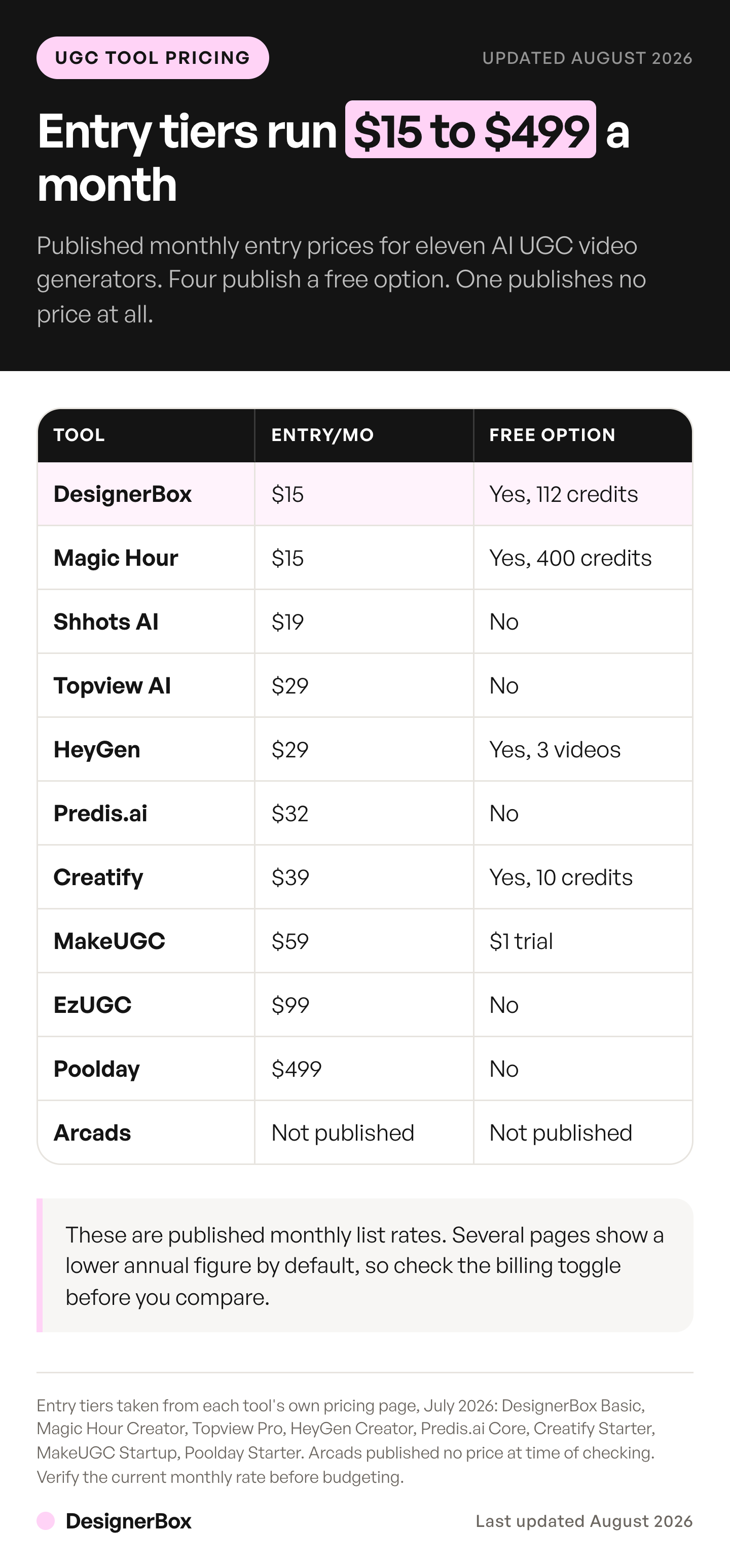
| Tool | Best for | Entry price (monthly list) | Free option | Product in frame |
|---|---|---|---|---|
| Shhots AI | Brands that want per-clip cost stated upfront | $19 | No | Yes |
| Topview AI | Low-volume testing on a credit-free queue | $29 (Pro) | No | Varies |
| HeyGen | Presenter and avatar video at 4K | $29 (Creator) | Yes, 3 videos/mo | Outside scope |
| Creatify | Performance teams launching straight to Meta and TikTok | $39 (Starter) | Yes, 10 credits/mo | Yes |
| MakeUGC | Product-in-hand actor video | $59 (Startup)* | No, $1 trial | Yes, Pro tier |
| EzUGC | Real product held by an AI actor | $99 | No | Yes |
| Magic Hour | A video suite with a UGC generator built in | $15 (Creator) | Yes, 400 credits | Yes, in the UGC tool |
| Predis.ai | Social-first ad creative from a product URL | $32 (Core) | No | Input only |
| Poolday | Teams buying a managed workflow | $499 (Starter) | No | Varies |
| Arcads | Large actor libraries with emotion control | Not published | Not published | Yes |
| DesignerBox | Campaigns where one product photo feeds every asset | $15 (Basic) | Yes, 112 credits | Yes |
All figures read from vendor pricing pages, July 2026. Entry price is the lowest paid tier billed monthly. The MakeUGC figure marked with an asterisk was displayed under a standing 50%-off badge; several other vendors were running promotions when checked.
What a finished UGC ad really costs
Plan price is the wrong unit. The number that matters is cost per finished clip, and it is the number this category is quietest about.
Shhots publishes it directly, which makes it a useful reference point: at 826 credits for a 15-second UGC ad, the $49 plan’s 6,000 credits produce roughly 7 finished 15-second ads a month (shhots.ai, July 2026). The $19 plan’s 2,000 credits produce 2, which the vendor states plainly on the page.
That ratio is the thing to reproduce for any tool you are considering. Take the plan’s credit allowance, divide by the cost of the asset you ship, and ignore everything else. A $19 plan that yields 2 ads is more expensive per ad than a $49 plan that yields 7.
Video is the expensive operation in every tool here, and the gap over static is wide. Vendors did not choose that freely: it reflects what the underlying models charge, so it shows up everywhere.
DesignerBox prices the same way and the numbers are worth stating plainly. An image is 5 credits. A set of nine avatar images is 25. Video is charged per second of output: a 5-second Seedance Pro Fast clip at 720p is 150 credits, a Sora 2 clip at 720p for 8 seconds is 1,600, and 8 seconds of Veo 3 with audio is 6,400.
Plans run from a free tier with 112 credits, through Basic at $15 a month for 500, Pro at $35 for 1,000, Premium at $75 for 2,500, and Ultra at $200 for 8,000, listed on the DesignerBox pricing page.
Sit with that 6,400 figure. Eight seconds of the most expensive model costs more than the entire monthly allocation on the $75 Premium plan. Premium is also the first tier that includes AI video, so a video-first buyer starts at $75, not $15. Budget static and video separately, in every tool, not only this one.
The baseline worth beating is not another tool’s plan price. It is what you spend now. Our breakdown of what a product photoshoot costs puts the studio-day and reshoot numbers next to it.
Whether your AI UGC ad can run
This is the part the rest of this SERP leaves out, and it is the part that decides whether the file you just paid for becomes an ad.
Start with the fear, because it is usually stated backwards. The common claim is that the FTC’s fake-review rule bans AI actors in ads. It does not. The FTC’s own guidance is unusually direct on this point: the rule “has no blanket prohibition on the use of AI-generated avatars in marketing,” and Section 465.2 “is drafted specifically so as to not prohibit companies from using virtual influencers” (ftc.gov, July 2026).
What the rule reaches is narrower and sharper. An AI stock avatar is not giving a “consumer review” as the rule defines it. Its use might count as a testimonial, and that “would be prohibited under the rule only if the underlying testimonials were fake or false.” The rule addresses misrepresenting a testimonialist’s experience with a product, meaning what happened when they used it, and explicitly does not reach their opinion of it.
Using a celebrity avatar without permission to speak favourably about a product does violate the rule. The rule took effect on 21 October 2024 and lets the FTC seek civil penalties against knowing violators (ftc.gov, July 2026).
Read that against a script. A synthetic actor saying your moisturiser feels light is an opinion, and outside the rule’s reach. A synthetic actor describing a specific experience they never had, because they do not exist, is closer to the line. The avatar is not the problem. The claim it makes is.
Platform rules apply on top, and they are not optional. Meta applies an “AI info” label to ads created or significantly edited with generative tools, and has begun automatically detecting ads made with third-party AI tools through industry-standard signals, surfacing the label in the “About this ad” panel (about.fb.com, July 2026). That detection is not something you opt into or out of. For ads about social issues, elections, or politics, Meta requires the advertiser to disclose AI use directly.
TikTok requires creators to label AI-generated content containing realistic images, audio, or video, and allows the label, a sticker, or a caption as the disclosure method (newsroom.tiktok.com). Our guide to what an AI ad generator is covers the IAB and wider platform picture in more detail.
Google joined them in July 2026. When advertisers use Google’s own generative-AI ad tools, a disclosure is added automatically, and Google added a control for advertisers to indicate AI use from other tools. It surfaces in the “How this ad was made” panel across Search, YouTube, and Discover (blog.google, July 2026). The pattern across all three platforms is the same: mandatory disclosure targets election and political ads that depict real people synthetically, not routine commercial creative. Ordinary product UGC does not need an AI label just because it was generated.
The practical read: the tool you pick has almost no bearing on any of this. The script does.
Housing is the exception, and it is a big one. A generated presenter in a real estate ad runs into fair housing casting rules, the FTC testimonial rule, and state alteration disclosure at the same time, which rules out two of the formats the category markets hardest. AI UGC video for real estate works through which formats survive.
How to pick
Four questions, in the order that matters.
- Does the product need to be in frame? If yes, an avatar platform is the wrong shape regardless of price. If no, an avatar platform is the cheapest path.
- What does one finished clip cost? Divide plan credits by the cost of the asset you ship. Never compare plan prices directly.
- Which billing period is that number? Several tools here display an annual rate by default, Predis.ai most aggressively. Others display a promotional rate on a countdown.
- What happens to the ad after it renders? The clip is one asset. The campaign needs stills, sizes, and the next variant.
Running this for clients rather than one brand changes the answer, because white-label and seat costs start to dominate. Our companion piece on AI UGC video tools for agencies works the same math at agency volume.
Where DesignerBox fits, and where it does not
DesignerBox is a campaign tool, not an actor tool, and the honest version of that distinction matters here.
If your job is 20 talking-head ads a month with a synthetic presenter and no product in frame, a purpose-built actor tool will cost less per clip. Creatify at $39 and MakeUGC from $59 are built for exactly that, and the credit math favours them. Say so plainly: this is not the cheapest way to buy that specific output.
The better fit is when the UGC clip is one output of a campaign rather than the whole campaign. You start from one product photo, and that same photo produces the product stills, the on-model shots, the styled scenes, and the video, in one workspace, all built from your real SKU rather than a lookalike. Thirteen image and video models across six providers sit on one subscription, so a shot that needs a different model does not need a different bill. The model catalogue lists what is included.
Two apps are the direct entry points: Social Media Ad Studio for social ads, and Product Ad Generator for turning a product photo into a finished ad creative. Save the campaign that worked as a workflow and the team reruns it for the next product or drop.
Whichever tool you land on, the finishing decisions are the same ones. Which fixes are worth paying for, and when to apply them, is worked through in UGC video quality ranked by cost.
The honest limitations, stated once. AI video needs Premium at $75 a month, not the $15 Basic tier. The commercial licence starts at Pro, $35. Team collaboration, shared brand kits, and API access are Ultra at $200. And video burns credits fast, as the numbers above show.
The real cost was never the subscriptions. It is the seams: the brand drift every time you paste between six tools, the assets nobody can find, and the prompt box you relearn for each one. That is what to price.
A UGC creator persona keeps one creator identity across a batch, the UGC ad prompts library covers the scripts, and DesignerBox vs HeyGen sets avatar-first against product-first.
FAQ
What are the best AI UGC ad generators in 2026?
It depends on whether your product needs to be in frame. For synthetic presenters, HeyGen at $29 a month and Creatify at $39 are the established options. For product-in-frame ads, Shhots AI at $19, EzUGC at $99, and Magic Hour’s UGC tool from $15 name it as a feature. For campaigns where the clip is one asset among many, DesignerBox starts at $15 a month with AI video from $75. All prices are list, verified July 2026.
What makes a good AI UGC ad generator?
The render engine matters less than the creative layer around it. A good generator writes a script, opens on a hook that stops the scroll, generates a voiceover, times captions for sound-off viewing, and exports vertical, square, and 4:5 in one pass. It also lets you steer those parts: rewrite the hook, swap the voice, lock the caption style to your brand. Two tools on the same video model ship different ads because of that layer. The voice part of that layer is worth pricing separately, and AI voiceover for UGC ads breaks down the three ways to produce it.
Are there free AI UGC ad tools?
Four of the tools reviewed here have a free tier. HeyGen gives 3 videos a month at no cost. Creatify gives 10 credits a month, enough for 2 video ads or 20 image ads, with a watermark on exports. Magic Hour gives 400 credits on signup plus 100 a day, watermarked and non-commercial. DesignerBox gives 112 credits with no credit card, which covers 22 images at 5 credits each. Topline free tiers in this category are trial-shaped and watermark output is common.
How much does an AI UGC ad cost per video?
Ask for the per-clip number, because plan prices hide it. Shhots publishes 551 credits for a 10-second UGC ad and 826 for 15 seconds, so its $49 plan yields roughly 7 fifteen-second ads a month. In DesignerBox, video is charged per second: an 8-second Veo 3 clip with audio is 6,400 credits, more than the entire $75 Premium monthly allocation. Divide credits by asset cost before comparing anything.
Is it legal to use AI actors in ads?
Yes. The FTC’s consumer reviews and testimonials rule “has no blanket prohibition on the use of AI-generated avatars in marketing” and was drafted specifically so as not to prohibit virtual influencers (ftc.gov, July 2026). It bites when the underlying testimonial is fake or false, meaning it misrepresents an experience the speaker never had, or when a celebrity avatar is used without permission. The rule took effect 21 October 2024 and carries civil penalties for knowing violators.
Do I have to disclose an AI-generated ad?
Partly, and less of it is your choice than you would think. Meta applies an “AI info” label itself, and has begun automatically detecting ads made with third-party generative tools through industry-standard signals (about.fb.com, July 2026). TikTok requires creators to label AI content containing realistic images, audio, or video, and accepts a label, sticker, or caption (newsroom.tiktok.com). Meta requires direct advertiser disclosure on social issue, election, and political ads. Check the platform’s live policy before launch.
What is the difference between an AI UGC tool and an AI ad generator?
An AI UGC tool generates footage that looks creator-shot, usually a synthetic person talking to camera. An AI ad generator is broader: it turns a product photo, URL, or brief into finished creative across images, video, copy, and placement sizes. UGC is one format inside the ad-generator category, and it is the format with the sharpest disclosure exposure because it depicts a person who does not exist.
Why do review sites disagree about these prices?
Because most of them are not reading the vendor page. Several tools display an annual-billed rate as the default headline, which gets repeated as a monthly price. Predis.ai is the clearest case: its page opens on the annual view, so $19 gets quoted when the real month-to-month is $32.
Two vendors were running countdown promotions when this article was checked, so the visible number was temporary by design. One tool still appearing in published roundups, UGCFarm, is now a parked domain listed for sale. Verify on the vendor’s live page on the day you buy.
Sources
All accessed July 2026.
- Shhots AI plan prices, credit allowances, per-clip credit costs and licence terms: (shhots.ai, July 2026)
- Topview AI tier prices, annual-billed display, credit units and Relax Generation: (topview.ai, July 2026)
- HeyGen plan prices, free tier, credit allowances and export resolutions: (heygen.com, July 2026)
- Creatify plan prices, free tier, AI actor counts, competitor ad tracker and Ad Launcher: (creatify.ai, July 2026)
- MakeUGC promotional tier prices, product-in-hand gating and API plans: (makeugc.ai, July 2026)
- EzUGC per-video prices, product-in-hand feature and commercial use terms: (ezugc.ai, July 2026)
- Magic Hour USD plan rates, free tier and product upload into the first frame: (magichour.ai, July 2026)
- Predis.ai annual-default pricing display and the month-to-month prices behind it: (predis.ai, July 2026)
- Poolday tier prices, included credits and what each tier bundles: (poolday.ai, July 2026)
- Arcads actor library, emotion control, translation, and the absence of published pricing: (arcads.ai, July 2026)
- UGCFarm now a parked domain listed for sale: (ugcfarm.com, July 2026)
- FTC consumer reviews and testimonials rule: no blanket prohibition on AI avatars, Section 465.2 and virtual influencers, what counts as a fake or false testimonial, celebrity avatars, the 21 October 2024 effective date and civil penalties: (ftc.gov, July 2026)
- Meta’s “AI info” label, automatic detection of ads made with third-party generative tools, and direct advertiser disclosure on social issue, election and political ads: (about.fb.com, July 2026)
- TikTok’s requirement to label AI-generated content containing realistic images, audio or video, and the accepted disclosure methods: (newsroom.tiktok.com, July 2026)
- Google’s automatic disclosure on its own generative ad tools, the advertiser control for other tools, and the “How this ad was made” panel: (blog.google, July 2026)
- DesignerBox pricing, credit costs, plan allocations, video credit examples and feature gating verified against live product configuration, July 2026
All competitor pricing read directly from each vendor’s own pricing page in July 2026: shhots.ai, topview.ai, heygen.com, creatify.ai, makeugc.ai, ezugc.ai, magichour.ai, predis.ai, poolday.ai, arcads.ai. Arcads does not publish pricing, so none is quoted. Magic Hour figures are its USD documentation rates; its marketing page renders in local currency. Policy claims verified against ftc.gov, about.fb.com, newsroom.tiktok.com, and blog.google as of July 2026. Several vendors were running promotional pricing when checked; list prices are stated where both appear. DesignerBox credit costs and plan allocations are current as of July 2026. This is not legal advice. Individual results vary.