
Static ads are single-frame image ads with no motion and no sound. They win when you need creative volume, because a frame needs no shoot, no edit pass and no sound design. In DesignerBox the cost of each image run is shown before the run, and an 8-second clip costs 40 to 560 credits, depending on the model. At a fixed budget the cheaper unit buys more shots at the problem, so the format question is a budget question before it is a performance question.
Look at a real plan. DesignerBox Premium is $75 a month billed monthly and issues 2,500 credits, and it is the first plan with AI video. The image model you pick changes the cost of a still, and the video model changes the cost of a clip. The model choice inside each format moves the cost a long way, and format debates often skip that part.
This guide covers what counts as a static, what each format costs per variant, which placements accept which asset, and how to plan a month of testing around the cheaper unit. It is written for a marketing lead or an agency buying paid social. It does not debate whether video is a good idea in general.
Key Takeaways
-
Static is the cheap unit of iteration. A frame needs no shoot, no edit pass and no sound. In DesignerBox the cost of each image run is shown before the run, and an 8-second clip costs 40 to 560 credits, depending on the model.
-
The video model moves the price. DesignerBox shows the run cost before you run it, so the choice is arithmetic rather than a surprise.
-
Meta accepts images almost everywhere. Meta’s Ads Guide lists the image format for Facebook Feed, Marketplace, Search results, Stories and Reels, and for Instagram Feed, Stories, Reels and Explore (facebook.com, September 2026).
-
TikTok takes images in the feed as carousels. A TikTok Carousel Ad runs in the TikTok feed with 2 to 35 images, and music is required (ads.tiktok.com, September 2026). TikTok’s image ad specifications also cover the Global App Bundle apps and the Pangle ad network.
-
One image covers a lot of ground. Meta’s recommended Facebook Feed image is 1440 x 1800 pixels at 4:5, JPG or PNG, under 30 MB (facebook.com, September 2026).
-
Commercial rights start at Pro. In DesignerBox the commercial licence starts on Pro, at $35 a month billed monthly, and AI video starts on Premium, at $75 a month billed monthly. Check the plan before you run generated creative as paid media.
-
Static does not replace video. Demonstration and sound-led hooks both want motion. The honest split is by placement and by what the product needs to show.
What is a static ad?
A static ad is a single-frame image advertisement. Nothing moves, nothing plays, and the whole message has to land in one look: product, claim, and reason to tap. The category covers product-on-colour hero frames, typography-led claims, before and after splits, comparison charts, testimonial cards and offer graphics. Carousels are a sequence of statics. Dynamic feed ads render statics from a catalogue.
The format is old and boring, which is exactly why it is cheap. No shoot day, no creator to brief, no edit pass, no sound design. One person can produce and ship a set in an afternoon.
Static ads vs video ads: what does one variant cost?
The cost gap is the case for static. A static is one frame. A video needs motion, timing and often sound, and some takes get thrown away. In DesignerBox, the image model you pick sets the cost of a still, and the video model sets the cost of a clip. Every run shows its cost before you start it (DesignerBox pricing, September 2026).
| Asset | What sets the cost in DesignerBox | Plan note |
|---|---|---|
| Image, one frame | The image model you pick. The cost is shown before the run | Commercial licence from Pro |
| Video, 8 seconds | The video model: 40 to 560 credits, depending on the model | AI video from Premium |
The video row is where format arguments often go wrong. There is no single video price to hold a static against. The same eight seconds can cost 40 credits or 560, depending on the model. Native audio is a real capability: Google says Veo 3.1 natively generates audio with video, and one Veo 3.1 generation is 8 seconds at most (ai.google.dev, September 2026). The wider picture across plans sits in what AI video costs in credits.
When does static beat video?
Static wins whenever the constraint is the number of angles you can afford to try. At a fixed budget the cheaper asset buys more independent shots at the problem, and creative testing is a volume game long before it is a craft game. Static also wins when the message is a price, a claim, a comparison or an offer, because those read faster as a frame than as a clip.
The pattern behind all three is the same. Static is what you spend when you are still buying information, and video is what you spend once you have it. Three situations where the maths is not close:
- You have never tested this audience. You do not know the winning angle yet, so buy breadth. Twenty statics beat two films when the goal is to find out what the market responds to.
- The product is visually simple. A candle, a supplement, a T-shirt, a book. There is nothing to demonstrate in motion that a good frame does not already say.
- You are refreshing a working ad. Swapping the headline and the background on a proven frame is one edit, and you see its cost before the run. Reshooting the equivalent clip is a production.
Volume has a floor and a ceiling worth respecting. Shipping thirty near-identical frames is not thirty tests, and neither the platform nor the report will treat it as one. Why most creative tests cannot be read covers the sample sizes involved.
When is video the right call?
Video earns its cost when motion carries information the frame cannot. Demonstration, assembly, texture, fit, scale, before and after in one take, and anything where the sound is the hook. On TikTok, images reach the feed as Carousel Ads with music, so a TikTok-led plan still needs a sound choice for every image set. Video suits a proven angle you already want to scale.

Sequence the two formats instead of choosing between them. Find the angle with cheap frames, then spend the video budget on the winner. That order protects the expensive asset from being the thing you use to discover you were wrong about the message. Spending a premium clip on a claim you have not validated is a slow way to learn the claim was wrong. Counted in dollars rather than credits, one shipped video ad runs to about 45 generated seconds once the discarded takes are in the total.
Where can static ads actually run?
Placement coverage is where the two formats stop being interchangeable. Meta lists the image format across most of its inventory, including Facebook Feed, Marketplace, Search results, Stories, Instagram Feed and Instagram Reels. On TikTok, images run in the feed as Carousel Ads, with music. TikTok’s single image specifications cover the Global App Bundle apps and the Pangle ad network, which sit outside the TikTok app.
| Format | Meta placements | TikTok placements |
|---|---|---|
| Image | Listed for Facebook Feed, Marketplace, Search results, Stories and Reels, and Instagram Feed, Stories, Reels and Explore | TikTok feed as Carousel Ads: 2 to 35 images, music required. Global App Bundle apps CapCut and Fizzo, across App Open, in-feed, banner, interstitial and native. Plus the Pangle ad network |
| Video | Listed for the same main placements, including Facebook in-stream video | The TikTok in-feed placement. 9:16 at 540 x 960 recommended, 16:9 and 1:1 also accepted |
The specs themselves are short. Meta recommends 1440 x 1800 pixels at 4:5 for a Facebook Feed image, JPG or PNG, up to 30 MB, with primary text at 50 to 150 characters and a 27-character headline (facebook.com/business/ads-guide, September 2026). TikTok’s in-feed video ads take .mp4, .mov, .mpeg, .3gp or .avi, up to 10 minutes and 500 MB, with 9:16 at 540 x 960 recommended and 16:9 or 1:1 also accepted (ads.tiktok.com/help, September 2026). Image ads on the bundle and Pangle inventory take JPG, JPEG or PNG within 100 MB (ads.tiktok.com, September 2026). TikTok Carousel Ads take JPG, JPEG or PNG images and need music of at least 2 seconds (ads.tiktok.com, September 2026).
Read the table as a budget instruction. If Meta is the majority of your spend, a static-heavy plan covers your placements. If TikTok is, plan for video, or for image carousels with music.
Static ads vs dynamic ads: what is the difference?
Static describes the asset. Dynamic describes the assembly. A static ad is one fixed frame that every viewer sees identically. A dynamic ad is a template that pulls product images, prices and copy from a catalogue feed and renders a different combination per viewer. The pieces a dynamic ad assembles are usually statics, so the two are layers of the same stack rather than rival formats.
The practical difference is where the work goes. A static campaign spends effort on distinct creative angles. A dynamic campaign spends it on feed quality and template design, then lets the system permute. What each platform asks you to supply for that assembly is set out in the guide to dynamic creative optimization. A catalogue-driven account often runs both, and the template still needs one good frame underneath it. Choosing which image model renders legible in-frame text is a real decision here. Test the same short headline on two or three models from the model list before you settle it.
Which static ad formats are worth making?
Six shapes cover most of what works in a paid social feed: product on a colour block, lifestyle scene, comparison split, typography claim, testimonial card and offer frame. They are worth naming because a set of thirty variants needs structural variety across those shapes. Thirty colour swaps of one layout is one idea repeated, and the report will read it that way.
- Product on a flat colour block. The default. Clean packshot, one claim, high contrast.
- Lifestyle or in-use scene. The product in a real setting, which answers scale and context in one frame.
- Comparison split. Yours against the old way, or before against after. Strongest when the delta is visible.
- Typography-led claim. No product hero at all. The sentence is the ad.
- Testimonial card. A quote, an attribution, a small product inset.
- Offer and promo frame. Price, discount, deadline, product. The bluntest of the six, and the one that leans on the offer rather than on the creative.
Pick three of the six and build every set across them, rather than producing eight versions of whichever shape your designer likes most. A feed that shows a viewer the same layout four times in a week has spent four impressions making one argument. Vary the shape, not the shade. Thirty frames that differ only in background colour test one idea thirty times. They are also how a set starts to look like AI slop to the people who scroll past.
Static variants without a designer
Start from your real product photo rather than a text prompt, because an ad has to show the thing you sell. DesignerBox is AI creative production for agencies and brand teams. You start from one product photo. Then you run templates for packshots, angles, flat lays, styled scenes and ad frames. The image model you choose changes the cost of each run, and the cost is shown before the run. The Free plan carries 112 credits a month, Basic is $15 a month billed monthly for 500, Pro is $35 a month billed monthly for 1,000, and the commercial licence starts on Pro.
Build the set as a grid. Three angles by three visual shapes by two offers is eighteen variants from one source photo. Save the combination that wins as a workflow. Then run it again on the next product. That is how a good month becomes a repeatable one. The workflow applies the same brand rules, light and framing to product forty as to product one, and how many ad variants a month needs sets the realistic volume. Generating each frame from your own product photo is the third rung of creative automation, where the software makes the shot rather than resizing one you already had.
One 1440 x 1800 master crops to the square placements without a re-render. The multi-size ad template makes one ad in every size the ad platforms need, and the static ads template makes ad frames with room for the words. Check the credits on each plan before you commit to a set size.
What a static-first test month looks like
Week one, ship twelve frames across four angles and three shapes, all on one product. Week two, kill the bottom half on cost per result and ship six variations of what survived. Week three, take the single best angle and spend the video budget on it, one clip, not four. Week four, refresh the winning frame with new copy and a new background and let it run.
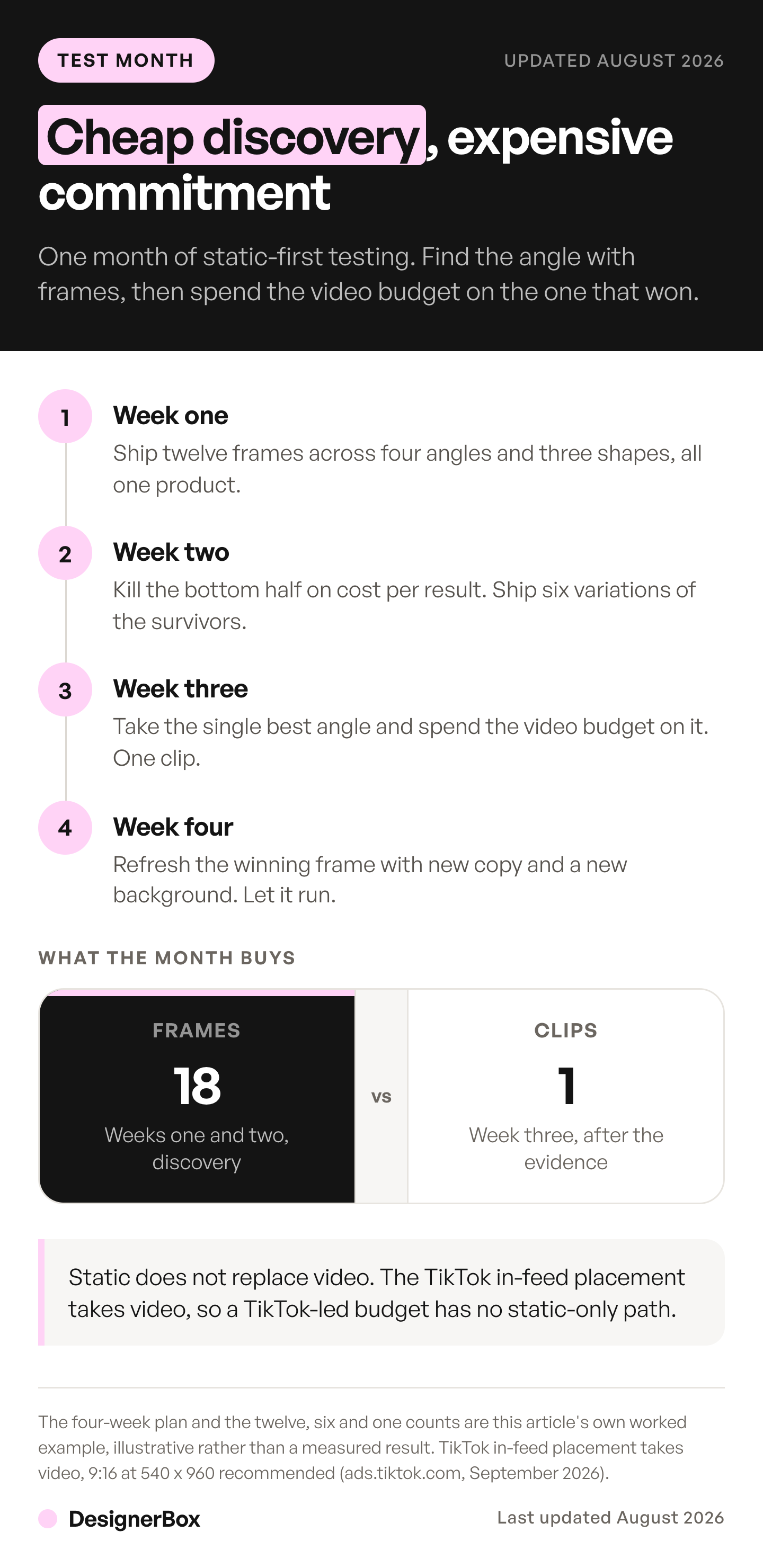
In DesignerBox, the eighteen frames and the one clip each show their cost before the run. The clip is the line item you actually choose. An 8-second clip costs 40 to 560 credits, depending on the model, and Premium carries 2,500 credits a month at $75 billed monthly. So the decision is which video model the winning angle deserves. You see that number before the run, so you commit after you have the evidence.
FAQ
What is a static ad in digital marketing?
A static ad is a single image advertisement with no motion, animation or sound. Everything the viewer needs sits in one frame: the product, the claim and the call to action. Product hero frames, typography cards, comparison splits, testimonial cards and offer graphics are all statics. Carousel ads and catalogue-driven dynamic ads are assembled from static frames underneath.
Are static ads still worth running in 2026?
Yes, and platform inventory is the reason. Meta lists the image format across most of its placements, including Feed, Marketplace, Stories and Instagram Reels, so a static-heavy plan still reaches most Meta placements. The economics reinforce it: a static needs no shoot, no edit pass and no sound, so a fixed budget buys more angles to test.
Do static ads cost less than video ads to make?
Usually, and the size of the gap depends on the model you pick in each format. A static is one frame, with no motion or sound. In DesignerBox the cost of each image run is shown before the run, and an 8-second clip costs 40 to 560 credits, depending on the model. AI video starts on the Premium plan.
What size should a static ad be on Meta?
Meta’s Ads Guide recommends 1440 x 1800 pixels at a 4:5 aspect ratio for a Facebook Feed image ad, as a JPG or PNG under 30 MB, with primary text of 50 to 150 characters and a headline around 27 characters (facebook.com, September 2026). One 4:5 master crops cleanly to the square and vertical placements without regenerating the asset.
Can static ads run on TikTok?
Yes, with limits. In the TikTok feed, images run as Carousel Ads, with 2 to 35 images and music required (ads.tiktok.com, September 2026). TikTok’s image ad specifications also cover the Global App Bundle apps CapCut and Fizzo, across App Open, in-feed, banner, interstitial and native slots, and the Pangle ad network takes image assets too (ads.tiktok.com, September 2026). TikTok in-feed video ads recommend 9:16 at 540 x 960.
How many static variants should I test at once?
No published number fits every account, because the answer is set by budget and by how fast the platform accumulates conversions. The rule that does hold: every frame in the set has to differ in angle or visual shape, never only in background colour. Sample size is the binding constraint, so check what a readable test costs before you call a winner.
Do AI-generated image ads need a commercial licence?
In DesignerBox the commercial licence starts on the Pro plan, at $35 a month billed monthly. AI video sits higher, on Premium at $75 a month billed monthly. Confirm the plan before a generated frame goes into a campaign, and check each ad platform’s own disclosure rules for AI-generated creative.
Sources
- Meta Ads Guide, image and video format placements: facebook.com/business/ads-guide/image and facebook.com/business/ads-guide/video, accessed September 2026
- Meta Ads Guide, Facebook Feed image ad specifications: facebook.com/business/ads-guide/image/facebook-feed, accessed September 2026
- TikTok Ads Manager, video ad specifications: ads.tiktok.com, accessed September 2026
- TikTok Ads Manager, Carousel Ads specifications: ads.tiktok.com, accessed September 2026
- TikTok Ads Manager, Global App Bundle image ad specifications: ads.tiktok.com, accessed September 2026
- TikTok Ads Manager, Pangle ad asset specifications: ads.tiktok.com, accessed September 2026
- Google, Veo 3.1 in the Gemini API, native audio and clip length: ai.google.dev, accessed September 2026
- DesignerBox pricing page (designerbox.ai/pricing), September 2026: plans, credits, the video credit range and feature gates
Ad format specifications verified from Meta’s Ads Guide, TikTok Ads Manager help and Google’s Gemini API docs as of September 2026. Individual results vary.