


AI voiceover for UGC ads comes from one of three places. The video model generates it with the picture, an avatar platform speaks it through a synthetic presenter, or a standalone voice engine makes an audio file you drop onto finished footage. The three differ on cost, on how long the read can run, and on whether the voice and the performance were ever in the same generation.
Voice tools often lead with how many languages they speak. That number decides almost nothing about a paid social ad. Your ad runs in one market, in one language, for fifteen to thirty seconds. Whether it sounds right depends on something the language column never shows.
This covers the three production paths, how each one charges, the read-length ceiling each one imposes, and when voice cloning is worth the consent paperwork it brings. It is the voice layer only, so if the whole ad is still open, start with the four ways to produce a UGC ad.
Key Takeaways
-
Generation order decides how the ad sounds. A voice produced in the same pass as the picture can be emphasized against a gesture. A voice added afterwards has nothing to react to, and no amount of voice quality fixes that.
-
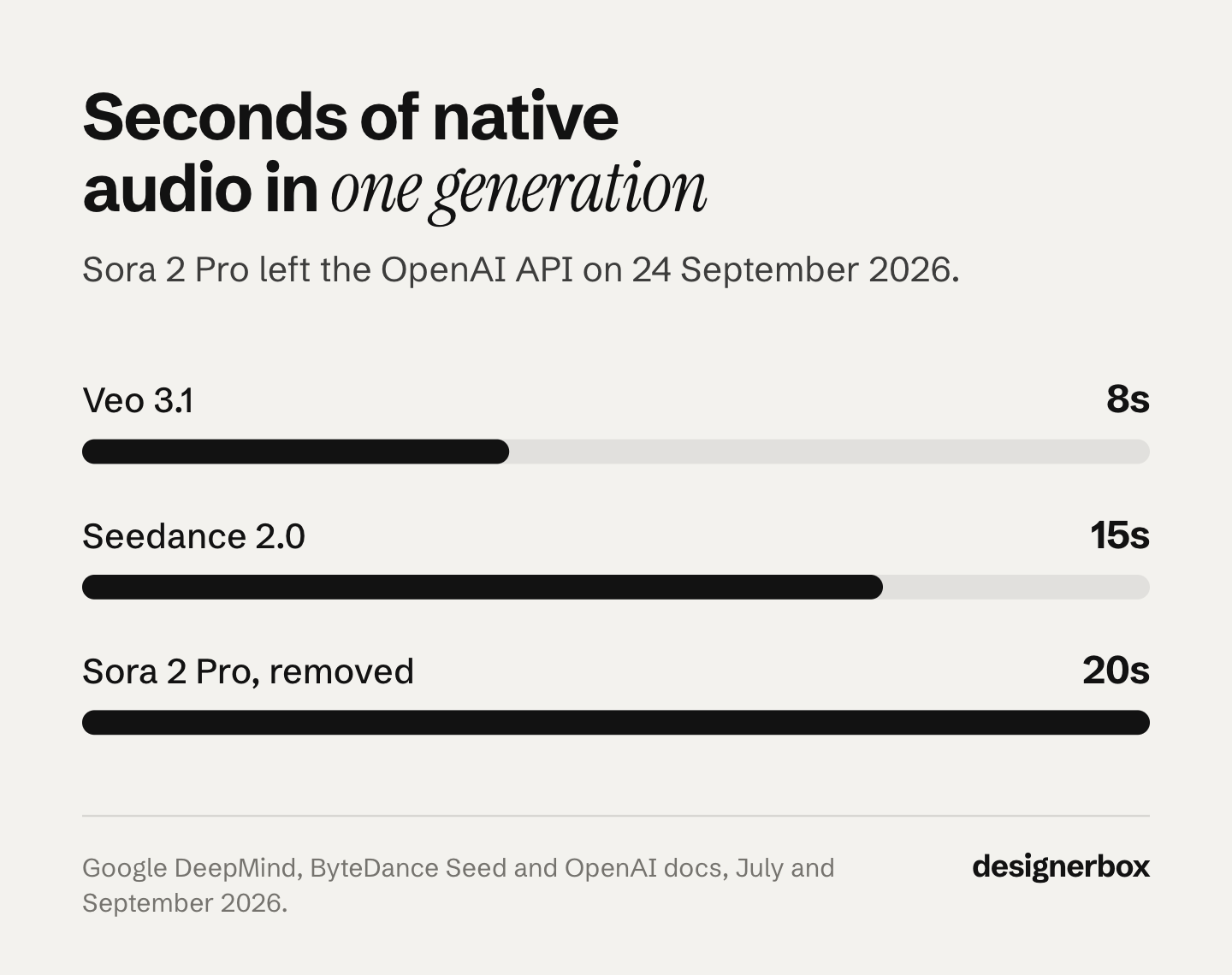
Duration caps matter more than language count. Veo 3.1 makes clips of up to 8 seconds, with audio always on in the Gemini API (ai.google.dev, September 2026). Seedance 2.0 runs up to 15 seconds (docs.byteplus.com, September 2026). OpenAI removed Sora 2 and Sora 2 Pro from its API on 24 September 2026 (OpenAI API deprecations, accessed September 2026). Until then, OpenAI’s video guide listed generations of up to 20 seconds.
-
Standalone voice engines sell an audio file rather than a finished shot, so they fit a read over footage you already have. ElevenLabs meters use in monthly credits and lists a free plan (elevenlabs.io/pricing, September 2026).
-
Avatar platforms bundle the voice into a presenter. HeyGen lists 175 languages and dialects with 1,000+ voices (heygen.com/pricing, September 2026). Synthesia lists 160+ languages (synthesia.io/pricing, September 2026).
-
Voice cloning is a consent decision before it is a feature decision. California Civil Code section 3344 names voice explicitly and requires prior consent for advertising use. Preset voices avoid that consent step.
Where does AI voiceover for UGC ads come from?
Three places, and they sit at different points in the pipeline. Path one generates audio and picture together inside the video model. Path two runs a synthetic presenter on an avatar platform that supplies the voice as part of the render. Path three treats voice as a separate asset: a text-to-speech engine makes a file, and an editor lays it under footage that already exists.
The difference matters because it decides what the voice can respond to. In path one the model has the line while it is drawing the face, so a stressed word can land on a raised eyebrow. In path three the footage is finished before the voice exists, so the performance and the read were never negotiated with each other. That gap is what viewers register as wrong without being able to name it, and it is the same root cause behind why AI talking video reads as fake.
Path 1: audio generated with the video
The video model writes the speech, the sound effects and the ambient track in the same pass that produces the frames. No second tool, no sync step, no editor. Our guide to AI video generators with sound lists the models that work this way.
Google’s DeepMind page says Veo can add sound effects, ambient noise and dialogue, generating all audio natively. The same page is direct about the limits: “creating videos with natural and consistent spoken audio, particularly for shorter speech segments, remains an area of active development” (deepmind.google, September 2026). Budget for a second run rather than assuming a first take ships.
ByteDance’s Seedance 2.0 launch post describes multi-track parallel output, covering background music, ambient effects and character voiceovers in multi-shot clips (seed.bytedance.com, September 2026). Its API returns mono audio and runs any whole number of seconds from 4 to 15 (docs.byteplus.com, September 2026). Until 24 September 2026, OpenAI’s video guide listed Sora 2 and Sora 2 Pro generations of up to 20 seconds, extendable to 120 seconds across up to six extensions (OpenAI video generation guide, September 2026). The models that replace Sora 2 for clips with native audio are in Sora alternatives.
The trade-off is the clip length. A 15 second ceiling covers a hook, a demo beat and a call to action. It does not cover a 45 second explainer read. If the script is long, this path forces you to cut the script rather than the tool. Scripts with word counts for 15, 30 and 60 seconds are in the ad script examples.
Path 2: voice bundled into an avatar platform
An avatar platform pairs a synthetic presenter with a voice library and renders both together. Here the presenter is the product, and the voice ships with it.
HeyGen lists 175 languages and dialects and more than 1,000 AI voices, and its paid plans include a monthly credit allocation (heygen.com/pricing, September 2026). Synthesia lists 160+ languages, and its plans run on monthly credits shared across features, including minutes of video (synthesia.io/pricing, September 2026). Creatify lists 75+ languages and meters video in credits (creatify.ai/pricing, September 2026).
Check how each one meters use. Each vendor lists its plans on its own pricing page. Check whether a page shows the monthly or the annual rate.
The scope limit is worth stating plainly rather than as a flaw: an avatar platform puts a person on screen. If the ad needs your actual product held, worn or demonstrated in frame, the presenter is the wrong starting point, and the broader tool comparison in AI UGC ad generators covers that split in detail. An agency can compare the same platforms on seats and white label in AI UGC video tools for agencies.
Path 3: a standalone voice engine, added after
A text-to-speech engine produces an audio file. You take it into an editor and place it under footage you already have. It is the most flexible path on script length.
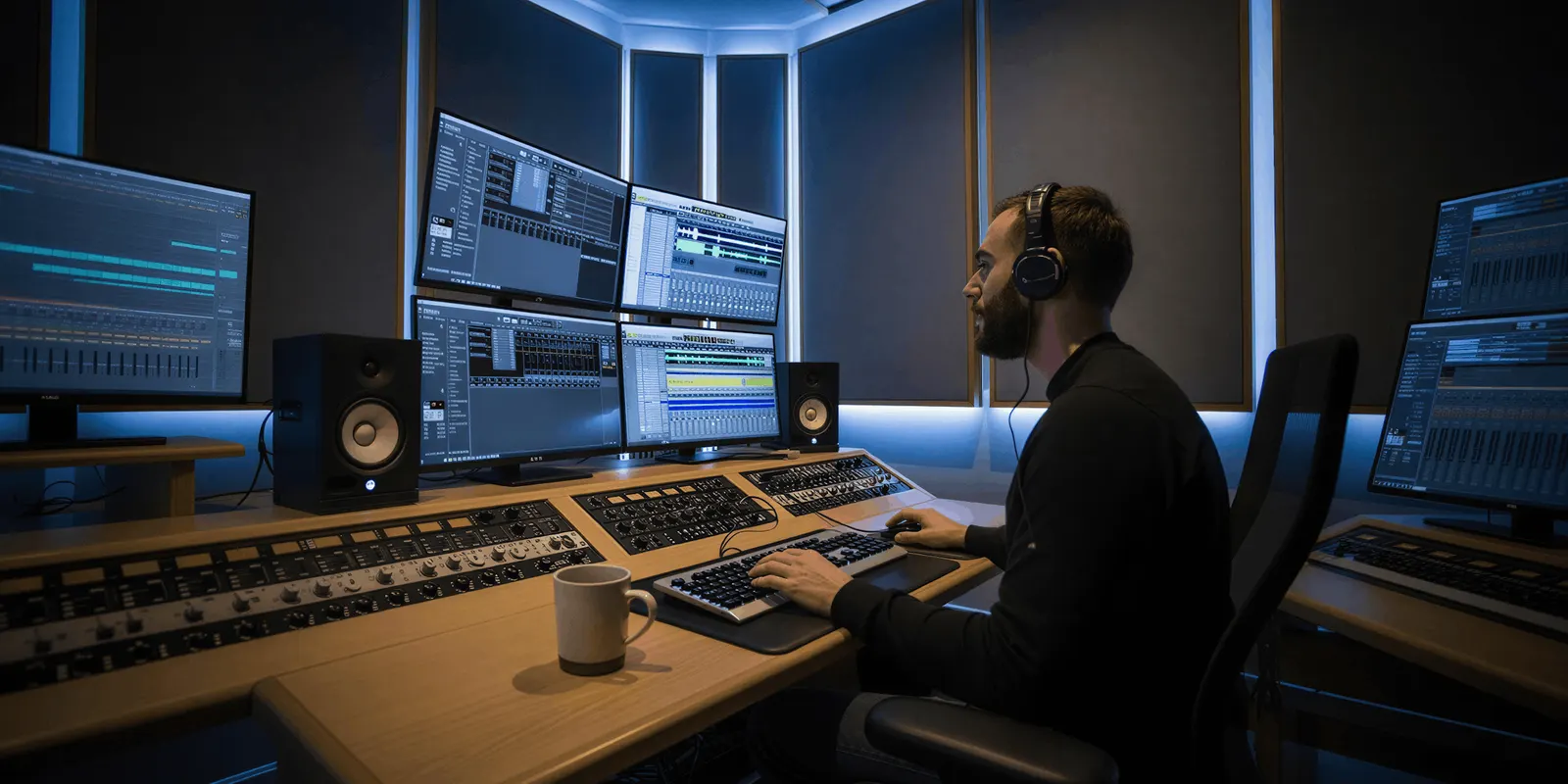
ElevenLabs lists a free plan and paid plans metered in monthly credits (elevenlabs.io/pricing, September 2026), and its docs list 70+ languages for the Eleven v3 model (elevenlabs.io/docs/overview/models, October 2026). Captions lists AI Voiceover, AI Voice Clone and AI Lipdub among its features (captions.ai/pricing, September 2026). Both list their plans on their own pricing pages. If you are choosing between voice engines, ElevenLabs alternatives sorts them by job.
What you give up is synchronization. Dropping a clean read under finished footage works when nobody is speaking on camera. The moment a face is visible and talking, you need a lip sync or dubbing pass to reconcile the two, which is a separate tool and a separate cost. When a video ad needs a lip sync pass covers where that line sits and the consent rules attached to it.
What each path costs
Here is how each path charges, checked on each vendor’s own pricing page in September 2026. Each vendor lists its prices there.
| Path | Example tool | How it charges | What you get | Read length ceiling |
|---|---|---|---|---|
| Generated with the video | DesignerBox catalog models | Credits per run, set by the model | A finished shot with the voice inside it | Up to 15s on one run, by model |
| Bundled with an avatar | Creatify | Monthly credits | An avatar ad | Set by the render |
| Bundled with an avatar | HeyGen | Monthly credits | A presenter clip | Set by the render |
| Bundled with an avatar | Synthesia | Monthly credits shared across features | A presenter clip | Set by the render |
| Added afterwards | ElevenLabs | Monthly credits | An audio file | No practical limit |
| Added afterwards | Captions | Monthly credits | An audio file or a dubbed clip | No practical limit |
The three paths buy different scope. A voice engine sells you a file. A video model sells you a finished shot with the voice already inside it.
Why language count is the wrong number to compare
A UGC ad runs in one market at a time. One hundred and seventy-five languages and seventy-four languages perform identically on a Meta ad set targeting the United Kingdom, because both numbers are larger than one.
Language count earns its place in a different job: a training library, a product help center, a support video localized into every market at once. Those are real workloads and the count is the right axis for them. They are not paid social ads.
If you are localizing an ad, check one thing before the language count. Does the tool re-sync the speaker’s mouth to the translated audio, or does it only swap the track? Those are two different products, priced differently, and a tool can list two hundred languages while doing only the second one.
The number to compare is the read-length ceiling. It decides whether your script fits in one generation.
When you need voice cloning
Rarely, and the answer is legal before it is creative. Cloning is worth it when the voice itself is the brand asset: a founder who already fronts the account, a spokesperson audiences recognize, a series with an established narrator. In those cases the voice carries recognition that a preset cannot replicate. AI voice cloning for brand video covers consent and how a cloned voice stays the same across clips.

For everything else, a preset voice does the job without that consent step. California Civil Code section 3344 names voice explicitly and requires prior consent for advertising use, with damages of $750 or the actual loss, whichever is greater, plus profits and legal fees (California Legislative Information, September 2026). From 1 January 2027 the same law names digital replicas: California signed SB 1111 on 30 September 2026, and it says a person’s voice or likeness includes a digital replica (California SB 1111, accessed October 2026). New York Civil Rights Law section 50 requires a person’s written consent before you use their voice in advertising (New York State Senate, September 2026). The FTC finalized a rule against impersonating governments and businesses in February 2024. It has proposed a similar rule for impersonating individuals, and that rule was not final as of October 2026 (FTC, accessed October 2026). This is general information, not legal advice.
Where cloning sits in the plans, if you decide you need it: ElevenLabs lists Instant Voice Cloning from its Starter plan and Professional Voice Cloning from Creator (elevenlabs.io/pricing, September 2026). HeyGen lists voice cloning on its paid plans (heygen.com/pricing, September 2026).
Voice in DesignerBox
DesignerBox is AI creative production for brands and agencies. Scale your images, ads and video with AI and keep your brand on every piece: build the workflow once with your brand rules, run it on every product, see the cost before each run, and keep everything from the first product photo to the finished ad in one place. The AI UGC page shows the presenter workflow from product photo to finished clip.
DesignerBox has a step for each of the three paths. Several of its video models generate audio in the same pass as the picture, which is path one. A talking avatar with lip sync is path two. A text to speech step with 20 voices is path three, and transcription turns a read into text for captions. You pick the model for each step when you build the workflow, and every run after that uses it. A template comes with its model already picked. The model list shows what each one is for.
The model you pick moves the video cost. An 8-second clip costs 40 to 560 credits, depending on the model.
Uploading your own photos and the commercial license start on the Pro plan. AI video, virtual try-on, upscaling, the image editor and the video editor start on the Premium plan. Plans and credits are on the pricing page. If your ad is one still product shot with a voice read, a standalone voice engine and an editor fit that job better.
What the plan buys is the repeat. Build the shot once with your product, your light and your read, and save it as a workflow. The read length, the voice and the framing then stay set for the next product, so ad twenty sounds and looks like ad one. The video editor is a real timeline, with several tracks, transitions, animated text and audio, so you trim the read against the picture there. How video credits work is covered in AI video cost.
Burned-in captions matter more than voice on muted autoplay, and the video editor handles captions too. To start, open one of the templates, add your brand and your product, and run it.
FAQ
Which AI voiceover tool is best for UGC ads?
There is no single answer, because the tools do different jobs. For a talking presenter, HeyGen or Synthesia covers it, and the comparison of the two avatar tools shows which fits which job (heygen.com and synthesia.io, September 2026). For a read laid under existing footage, a standalone voice engine such as ElevenLabs fits, because it sells an audio file (elevenlabs.io, September 2026). For a voice generated inside the shot with your product in frame, a native-audio video model is the only path that does it in one pass.
Can AI voiceover match a specific accent?
Preset voice libraries are organized by language and regional accent, so most tools let you pick a regional variant directly. Matching one specific person’s accent is a different request and needs voice cloning. California Civil Code section 3344 requires that person’s prior consent for advertising use, and New York Civil Rights Law section 50 requires written consent.
How long can an AI voiceover be in a generated video?
The model’s clip ceiling sets it. Veo 3.1 makes clips of up to 8 seconds (ai.google.dev, September 2026), and Seedance 2.0 runs up to 15 seconds (docs.byteplus.com, September 2026). Until 24 September 2026, when OpenAI removed Sora 2 and Sora 2 Pro from its API, OpenAI’s guide listed generations of up to 20 seconds, extendable to 120 seconds total across up to six extensions (developers.openai.com, September 2026). A standalone voice engine has no comparable limit, because it is producing an audio file rather than a shot.
Do I need voice cloning for UGC ads?
Usually not. Cloning earns its cost when the voice is itself a recognized brand asset, such as a founder who already fronts the account. For a standard product ad, a preset voice does the same job without collecting a person’s consent to clone their voice.
Is AI voiceover good enough for paid ads?
Often, yes. When a native-audio clip fails review, check sync and performance before you blame the voice. That is why generation order matters more than voice selection. Google says on its own model page that natural and consistent spoken audio for shorter speech segments remains an area of active development (deepmind.google, September 2026), so plan for a second run on native-audio clips.
Do I have to disclose an AI voice in an advert?
The answer changes by jurisdiction and by whether a real person’s likeness is involved. New York General Business Law section 396-b has applied since 9 June 2026. It requires conspicuous disclosure where a synthetic performer appears in an advertisement and the producer has actual knowledge, and audio-only advertisements are exempt (nysenate.gov, September 2026). Check the rules for every market the ad runs in.
Does DesignerBox include AI voiceover?
Yes, in three ways. Several of its video models generate audio with the picture, including Veo 3.1 and Seedance 2.0. A talking avatar with lip sync speaks a script. A text to speech step offers 20 voices for a read you add to a clip. AI video starts on the Premium plan.
Sources
All accessed September 2026 unless a later date is shown.
- Veo 3.1 clip lengths and audio always on in the Gemini API: Gemini API Veo guide
- Veo’s native audio and Google’s note on consistent spoken audio: DeepMind Veo
- Sora 2 and Sora 2 Pro API removal on 24 September 2026: OpenAI API deprecations
- Sora 2 and Sora 2 Pro generations of up to 20 seconds, extendable to 120 seconds across up to six extensions: OpenAI video generation guide
- Seedance 2.0 multi-track audio output: Seedance 2.0 launch post. Durations of 4 to 15 seconds and mono API audio: BytePlus ModelArk video API
- ElevenLabs free plan, credit metering, Eleven v3 language count, and the Instant and Professional voice-cloning plans: (elevenlabs.io/pricing, September 2026)
- HeyGen 175 languages and dialects, 1,000+ voices, credit metering and voice cloning: (heygen.com/pricing, September 2026)
- Synthesia 160+ languages and monthly credits shared across features: (synthesia.io/pricing, September 2026)
- Creatify 75+ languages and credit metering: (creatify.ai/pricing, September 2026)
- Captions AI Voiceover, Voice Clone and Lipdub features and credit metering: (captions.ai/pricing, September 2026)
- FTC impersonation rule, finalized February 2024: FTC press release. The proposed rule for impersonation of individuals, not final as of October 2026: FTC rule page, accessed October 2026
- California SB 1111, digital replicas in Civil Code section 3344 from 1 January 2027: California Legislative Information, accessed October 2026
- New York General Business Law section 396-b synthetic-performer disclosure and the audio-only exemption: New York State Senate
- Prior consent for using a voice in advertising: California Civil Code section 3344 and New York Civil Rights Law section 50
- Plans, the video cost range and feature gating: DesignerBox pricing page (designerbox.ai/pricing), September 2026
Tool features checked on elevenlabs.io, heygen.com, synthesia.io, creatify.ai and captions.ai as of September 2026. This article prints no competitor prices; each vendor lists its plans on its own pricing page. Model specifications verified from Google, OpenAI and ByteDance documentation as of September 2026. The FTC rule page and California SB 1111 were re-checked on 2 October 2026. This is general information, not legal advice.