
AI video ads are paid social and display creative where the footage is generated by a model instead of filmed on a set. In September 2026, Google lists its Veo 3.1 models at $0.05 to $0.60 per second of output, with audio included, so one 8-second clip costs between $0.40 and $4.80. The number that decides your budget is different: what a single shipped ad costs once you count the clips you threw away.
A 15-second ad cuts three or four shots. Generate three takes of each shot to get one you would run, and one finished ad has consumed about 45 seconds of model output. At Google’s list rate for Veo 3.1 that is $18 of generation for one ad, before a caption exists or a single impression is served.
This guide prices video creative the way a media buyer budgets it, per shipped ad rather than per clip. It covers the published per-second rates, the credit range inside DesignerBox, the rework nobody plans for, the platform labels, and when filming still costs less. Written for brand teams and agencies with a paid social calendar and a fixed creative line.
Key Takeaways
- List price runs $0.05 to $0.60 a second on Veo 3.1. Veo 3.1 Lite is $0.05 at 720p, Veo 3.1 Fast is $0.10 at 720p, and Veo 3.1 at 4K is $0.60 (Gemini API pricing, September 2026).
- Budget per shipped ad, not per clip. Three shots at three takes each is 45 generated seconds for one 15-second spot.
- The reject ratio is yours to measure. No vendor publishes one, so treat any multiplier you read, this one included, as an assumption.
- The model sets the price. Inside DesignerBox an 8-second clip costs 40 to 560 credits, depending on the model.
- You see the cost before the run. How many ads a plan carries is a choice you make shot by shot, not a surprise on the invoice.
- Both platforms label generated creative. TikTok rejects or restricts undisclosed AI content. Meta adds an AI info label when it detects third-party AI (as of September 2026).
- The performance evidence is real and modest. A study of more than 21,000 consumers found personalized AI video took 9.4% higher click-through than personalized image ads.
- Decide in stills, then pay per second. Approving the frame before you animate it is one of the largest savings available.
What are AI video ads?
An AI video ad is paid creative where the moving footage comes from a generative model rather than a camera. Three formats cover most of what runs: a product still animated into motion, a synthetic presenter reading a script, and a fully generated scene. The brief, the offer and the edit stay human. The model replaces the shoot day.
Format sets how many clips you need. The model sets the rate you pay for each one. Multiply the two and you have the budget, which is why turning one product photo into a video ad begins with a shot list of stills.
What does one AI video ad clip cost?
Published list rates in September 2026 run from $0.05 to $0.60 per second of generated video on Google’s Veo 3.1 models, with audio included. Veo 3.1 Lite lists at $0.05 a second at 720p, Veo 3.1 Fast at $0.10, and Veo 3.1 at $0.40 at 720p or 1080p. Kuaishou and Runway price in the same unit. That puts an 8-second Veo 3.1 clip between $0.40 and $4.80 at list.
| Model | Provider | Published rate | 8-second clip |
|---|---|---|---|
| Veo 3.1 Lite, 720p | $0.05 per second, audio included | $0.40 | |
| Veo 3.1 Fast, 720p | $0.10 per second, audio included | $0.80 | |
| Veo 3.1, 720p or 1080p | $0.40 per second, audio included | $3.20 | |
| Veo 3.1, 4K | $0.60 per second, audio included | $4.80 | |
| Kling 2.6, 720p, silent | Kuaishou | $0.042 per second | No 8-second option: 5 or 10 seconds |
| Kling 2.6, 1080p with audio | Kuaishou | $0.14 per second | No 8-second option: 5 or 10 seconds |
| Runway Gen-4.5, 720p | Runway | $0.12 per second | $0.96 |
Rates verified from Gemini API pricing, Kling API pricing and Runway API pricing, September 2026. Runway prices its API in its own credits, which work out at $0.12 a second for Gen-4.5. OpenAI is removing Sora 2 and Sora 2 Pro from its API on 24 September 2026 (OpenAI API deprecations, accessed September 2026), so this table leaves out their per-second rates.

The same clip in DesignerBox credits
Subscription tools price the same result in credits. In DesignerBox an 8-second clip costs 40 to 560 credits, depending on the model. A model is one step in the workflow, so you choose it per shot.
The number that matters is that this is visible before the run, not on the invoice afterwards. Billing surprises are the loudest complaint in this category, and the fix is a number you can read in advance. The model list shows what each video model is built for. AI video cost in credits covers how plan credits work, and what a single generation costs prices the operation on its own.
Stills depend on the model too. There is no flat price per asset in either direction, and the cost is shown before the run.
How many clips does one finished ad take?
A 15-second ad is normally three or four shots. Most image-to-video models return one continuous shot per generation, so one ad is three or four clips before any rework. Kling 3.0 can cut 1 to 6 shots inside one clip (Kling 3.0 API, September 2026), which changes the count but not the need for takes. Add the takes you discard for a warped hand, a wrong product detail or a bad camera move, and nine to twelve generations per finished ad is a realistic planning figure.
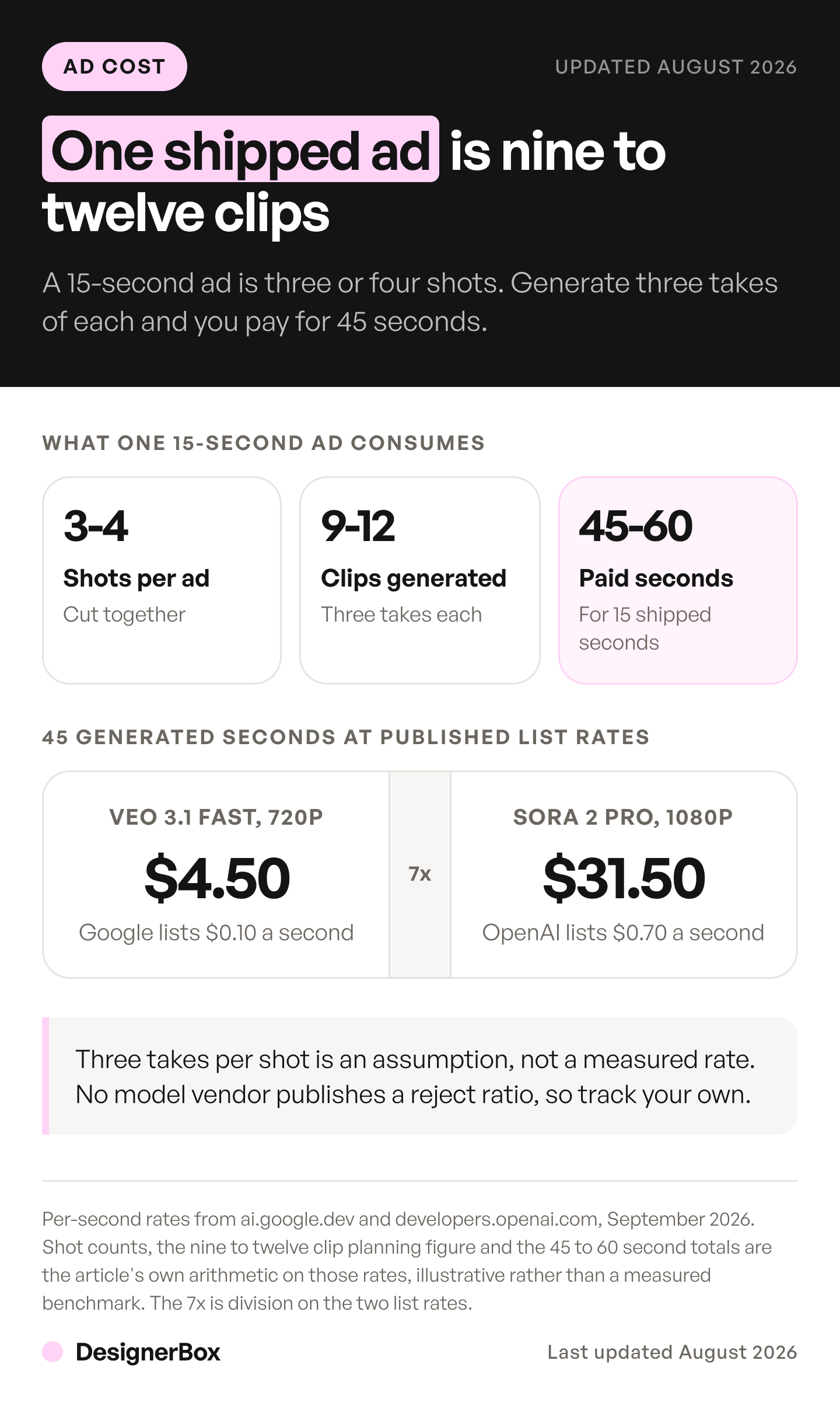
That is 45 to 60 paid seconds for 15 seconds of ad. At 45 seconds, the list-price table turns into this:
| Model | 45 generated seconds | Shipped ads per $100 of generation |
|---|---|---|
| Veo 3.1 Lite, 720p | $2.25 | 44 |
| Veo 3.1 Fast, 720p | $4.50 | 22 |
| Runway Gen-4.5, 720p | $5.40 | 18 |
| Kling 2.6, 1080p with audio | $6.30 | 15 |
| Veo 3.1, 720p | $18.00 | 5 |
That table is illustrative arithmetic on published rates, not a measured benchmark. No model vendor publishes a reject rate, and this article will not invent one. Three takes per shot is an assumption. Track your own ratio across two months and replace it, because it multiplies every figure in the column.
Shipped ads on a credit plan
Nine 5-second generations per finished 15-second ad is 45 generated seconds, on any plan. In DesignerBox, the model you pick for those seconds sets the credit cost, and the cost is shown before each run.
Read that as the actual budgeting decision. The plan does not decide how many ads you ship. The model you pick inside it does, and you can mix them: test on a lower-cost model, and spend the higher rate on the cut that already won.
A month of ad creative on a plan
Take a paid social calendar that needs five shipped 15-second spots a month. At nine 5-second clips an ad, that is 45 clips, or 225 generated seconds. At Google’s list rates, that is $11.25 on Veo 3.1 Lite and $90 on Veo 3.1, both at 720p.
Inside DesignerBox, the same month is priced in credits. You see the cost of each run before you start it, so you can check the month against your plan’s allocation as you go. For a fixed calendar, the model you pick moves the bill most.
| Plan | Price | Credits a month | AI video |
|---|---|---|---|
| Free | $0 | 112 | No |
| Basic | $15 billed monthly | 500 | No |
| Pro | $35 billed monthly | 1,000 | No |
| Premium | $75 billed monthly | 2,500 | Yes |
| Ultra | $200 billed monthly | 8,000 | Yes |
AI video starts at Premium and the commercial licence starts at Pro, so a paid video ad needs Premium or higher. Annual billing lowers the monthly rate and grants the same allocation, reset monthly.
Two costs sit outside that line. Editing and captioning take a person’s time either way, and the video editor is where that time goes: a real timeline, with several tracks, transitions, animated text and audio. Media spend dwarfs both. The 2026 AI creative cost benchmark puts those ratios side by side, and sizing an ad pack before it runs shows what a full variant pack costs.
Do AI video ads perform as well as filmed ads?
The published evidence points one direction and the effect size is modest. In a study of more than 21,000 consumers, personalized AI-generated video ads took click-through rates 9.4% higher than personalized image ads and 6.5% higher than generic video. The research was run by Madhav Kumar and Anuj Kapoor and published in Marketing Science.
Adoption is well ahead of that evidence. IAB reported that 86% of buyers are using or planning to use generative AI to build video ad creative, that 50% of advertisers already do, and that 42% use it to create versions for different audiences (iab.com, 2025 Digital Video Ad Spend and Strategy report, July 2025).
Personalization carries its own risk. The same summary cites Gartner: almost half of customers see personalized communications as irrelevant or intrusive (ide.mit.edu, September 2026). A cheap variant that lands wrong still costs impressions, which is what the four-gate review before creative ships catches.
Do you have to label an AI video ad?
The two big platforms handle this differently. TikTok allows AI-generated and heavily AI-edited ad content when you apply the AIGC label or add your own clear disclaimer, caption, watermark or sticker. Meta labels ads made with its own generative tools, and it detects third-party AI to add an AI info label (as of September 2026).
TikTok’s advertising policy puts the consequence plainly: “If we identify AI-generated content that has not been disclosed, your ad will be rejected or restricted” (ads.tiktok.com, September 2026). Changes to lighting, brightness or colour do not require the label. Fully AI-made media, showing someone doing something they did not do, and voice cloning do.
Meta says a label appears when an image or video is created or significantly edited with its generative AI features in advertiser tools, and that it detects ads created or edited with third-party AI tools through industry-standard signals (about.fb.com, September 2026). Meta also says the experience may vary by region.
Getting this wrong costs a rejected ad and a restarted review cycle, which is days of a launch window, not dollars of generation. The TikTok specs and label toggle shows where it sits in Ads Manager.
When is filming still the cheaper option?
Generation loses when the ad needs a specific real person, a real place, or proof that only footage supplies. A founder to camera, a named customer testimonial, a demonstration of a physical mechanism, a regulated claim that needs documented evidence: film those. Rights and likeness questions get expensive faster than any per-second rate. A hired creator carries its own rate card, and what a UGC creator video costs is the figure to weigh against the tables above.
Volume decides the rest. Generation wins where you need many variants of one idea, because variant nine costs only another 45 seconds of generation. It wins less on one hero asset a quarter, since a filmed spot amortises across the campaign and carries no disclosure step.
There is also a floor on quality control. Every generated second needs a person to check the product, the claim and the placement spec. That time is fixed per asset, so past a few dozen variants review, not generation, is the constraint.
How do you lower the cost per shipped ad?
The cost per shipped ad falls fastest when you move decisions earlier and cheaper. A still costs a fraction of a clip, and every take you avoid is a second you never pay for. Five moves carry most of the saving, in rough order of size.
Decide everything in stills first. Approve the frame, the product angle and the lighting as stills, then animate the one that passed. An AI storyboard generator does that job across a whole cut, twelve shots as frames instead of twelve clips.
Split the model by job once the frame is locked. Test on a lower-cost model, and spend the higher rate only on the cut that already won. On Google’s list, that is $0.05 a second on Veo 3.1 Lite against $0.40 on Veo 3.1.
Fix the source photo before you blame the model. Many rejects trace back to the input, and a clean, sharp product shot gives every later step a better start.
Cut the ad length before the take count, because a 6-second version needs fewer shots, and that removes whole generations rather than individual takes.
Save the setup as a workflow. Build the job once with your brand, your product and your model choice, then run it again for the next SKU instead of rebuilding it. A saved workflow runs the same way on the next product. You set the brand once, and the workflow reads it on every run. The product video template is one place to start.
Measure your own take ratio on one real product before you set a budget. Two months of that number beats any benchmark here. Start from a template, add your product, and see the cost before you run it.
FAQ
How much does one AI video ad cost?
At Google’s list rates, generating a 15-second ad costs $2.25 to $18 on the Veo 3.1 models at 720p, depending on the model, assuming three shots at three takes each. That covers generation only. Editing, captioning and review are people time, and media spend usually dwarfs both. Inside a credit plan, the cost of each run is shown before you start it.
Which AI model is cheapest for video ads?
Of the models in this guide, Kling 2.6 at silent 720p lists lowest, at $0.042 a second, and Veo 3.1 Lite lists $0.05 a second at 720p with audio (Kling API and Gemini API pricing, September 2026). Veo 3.1 at 4K is the highest Veo rate, at $0.60. Cheapest per second is not always cheapest per shipped ad, because a model that needs more takes costs more in total.
Do you have to label AI video ads on Meta and TikTok?
TikTok asks for the AIGC label or your own clear disclaimer on ads with AI-generated or heavily AI-edited media, and says undisclosed AI content gets the ad rejected or restricted. Meta labels ads built with its own generative tools and applies an AI info label when it detects third-party AI. Colour or lighting changes need no label on TikTok, and Meta does not label minor edits such as colour correction (as of September 2026).
Do generated video ads perform as well as filmed ones?
One study of more than 21,000 consumers found personalized AI-generated video ads took 9.4% higher click-through than personalized image ads and 6.5% higher than generic video. That measures click-through, not revenue, and it tested personalization rather than generation on its own. Treat it as directional evidence for testing, not a guarantee for your category.
How many video ads can one plan produce a month?
The model you pick decides that more than the plan does. Premium includes 2,500 credits a month and Ultra includes 8,000, and an 8-second clip costs 40 to 560 credits, depending on the model. The cost of each run is shown before you start it, so you can plan the month shot by shot. AI video starts at Premium.
Can you use generated video ads commercially?
In DesignerBox the commercial licence starts at the Pro tier and AI video generation starts at Premium, so a paid ad needs Premium or higher. Rights on the underlying models come from each provider’s own terms, which change, so check the current terms for the specific model before a campaign ships.
What makes a generated video ad get rejected?
Four things, in this order: the product in frame is wrong, the scene claims something the offer cannot support, the asset is off brand, or the file breaks the placement spec. Undisclosed AI content is a fifth on TikTok and a labelling event on Meta. The first two are rejections. The last two are edits.
Sources
- Gemini API pricing - Veo 3.1, Veo 3.1 Fast and Veo 3.1 Lite per-second pricing, September 2026
- Kling API pricing - Kling 2.6 per-second list prices, September 2026
- Runway API pricing - Gen-4.5 credit cost and API credit price, September 2026
- Kling 3.0 API - Kling 3.0 multi-shot clips, 1 to 6 shots per clip, September 2026
- OpenAI API deprecations - removal of Sora 2 and Sora 2 Pro from the API on 24 September 2026, September 2026
- ide.mit.edu - MIT Initiative on the Digital Economy summary of the Kumar and Kapoor study of over 21,000 consumers, September 2026
- iab.com - 2025 Digital Video Ad Spend and Strategy report, generative AI adoption for video creative, July 2025
- ads.tiktok.com - TikTok advertising policy on edited media and AI-generated content, September 2026
- about.fb.com - Meta on generative AI transparency and AI info labels in ads products, September 2026
- DesignerBox plan prices, credit allocations, the 8-second video credit range and feature gating: DesignerBox pricing page (designerbox.ai/pricing), September 2026
Model pricing, platform labelling rules and adoption data verified from Google, Kuaishou, Runway, OpenAI, MIT IDE, IAB, TikTok and Meta as of September 2026. Individual results vary.