
An AI ad generator makes finished ad creative from a product photo and a brief. Design software gives you a canvas and expects you to build each file. Adobe Creative Cloud, Canva, Figma and DesignerBox all include an AI allowance in their plans, and all of them meter generation.
The category split matters less than it used to, because Photoshop, Canva and Figma all ship AI generation now. The question worth answering is whether generation sits inside a canvas you still operate file by file, or inside a workflow you build once and run on every product.
Every comparison of these two things says the same sentence: AI is fast, design software gives you control. That sentence has been true and useless since 2023. It does not tell you how either option meters use, how many files your campaign needs, or what happens in week three when the allowance runs out.
This guide compares how each side meters AI use, from vendor pages read this month. It counts the files one campaign actually requires using the ad platforms’ own published specs, and names the licensing detail that decides whether the output is safe to run.
Key Takeaways
- The category boundary has dissolved. Photoshop, Canva and Figma all generate images now. Comparing “AI” to “design software” compares a feature to a product.
- Canva sells extra AI use as a separate add-on. AI Pass is priced per person, on top of the plan (canva.com/help/ai-pass, September 2026).
- Google publishes the file count. One Demand Gen campaign at Google’s recommended level needs 10 images across three aspect ratios and 9 videos, plus text.
- Running out behaves differently everywhere. Figma blocks you, Canva slows you with pauses, Adobe blocks premium features and leaves standard ones running.
- Adobe indemnifies eligible Firefly output, within limits. Capabilities Adobe marks as powered by non-Adobe models, and beta or trial features, sit outside the cover (helpx.adobe.com, published 27 August 2026).
- The efficiency case is contested. Gartner records marketing labour rising to 24.5% of budget, not falling.
- The repeat decides it. A canvas fixes the first draft. A workflow you build once fixes the twenty files after it, and next month’s twenty for the next product.
What an AI ad generator does
An AI ad generator takes a product image, brand assets and a short brief, then returns ad creative sized for the placements you name. You approve or regenerate. You do not open a layout tool to make the first version.
The category covers three shapes. Platform-native generators sit inside your ad account: Meta’s Advantage+ creative adjusts the media you upload, for example cropping an image or a video so it fits more placements, and shows a personalised variation to each person (facebook.com/business/help, September 2026). Standalone tools sell a subscription and a credit balance. Workflow tools, which is where DesignerBox sits, start from your real product photo. You build the steps once, and the same workflow makes stills, on-model shots, video and ad frames in one workspace.
The shared trait is that the tool owns the first draft. That is the whole proposition, and it is worth separating from the claim that the draft is finished.
What design software does now
Design software gives you a canvas, layers, type objects and export control. For any file where placement precision matters, that control is the product, and nothing about AI has changed it.

What has changed is that all three major tools now generate. Adobe ships Firefly across Photoshop, Illustrator, InDesign and Premiere, with generative credits metered per plan. Canva sorts its AI tools into Standard, Premium and Ultra tiers with a monthly allowance (canva.com/help/ai-access, September 2026). Figma includes AI credits with every seat and charges them per action, so a small edit draws fewer credits than a larger one (help.figma.com, September 2026).
So the honest description of “traditional design software” in 2026 is a canvas with a generator attached. It is not the manual-only alternative that comparison articles keep describing.
Why “AI vs design software” stopped being the question
Both options now generate images. The difference is what happens to the image next.
In a canvas tool, generation fills one frame. You still place the type, apply the brand marks, resize for each placement and export every variant. Generate 40 product shots and you have 40 frames to lay out. The generator sped up one step in a sequence you still run by hand.
In a workflow tool, one input drives a set. The product photo becomes the pack shot, the on-model image, the styled scene and the ad frame. You build that sequence once with your brand rules, your product and your framing. Then you run the same workflow again for the next product, and it runs the same way. The unit of work is the run.
That is the choice worth making, and it maps to a real question about your team: is your bottleneck the first draft, or the forty files after it? A canvas fixes the first. A workflow fixes the second. Our breakdown of what a generated image is still missing covers the layout work neither one removes.
AI limits by tool
Each vendor lists its plans and AI allowances on its own pricing page. This table leaves the prices there and compares what each plan is built for and how it meters AI use.
| Tool | Best for | How AI use is metered |
|---|---|---|
| Adobe Creative Cloud Pro | Teams that design across Photoshop, Illustrator, InDesign and Premiere | Monthly generative credits for premium features. Standard features are unlimited |
| Adobe Photoshop single app | Photo editing and compositing in one app | A monthly generative credit allowance |
| Adobe Firefly Standard | Generation-first work inside Adobe | Monthly premium credits. Standard features are unlimited |
| Canva Pro | Solo layout work from templates | Standard AI tools do not use the allowance. Premium and Ultra tools share a monthly allowance, per member |
| Canva Business | Teams that share brand kits in Canva | A larger shared allowance for Premium and Ultra tools, per member |
| Figma Professional, Full seat | Product and interface design teams | Monthly AI credits with each seat, charged per action |
| DesignerBox | Agencies and brand teams that repeat the same creative for each product | Monthly credits by plan. The cost is shown before the run |
Sources: helpx.adobe.com generative credits FAQ, adobe.com/products/firefly/plans, canva.com/help/ai-access, help.figma.com, September 2026.
Two details matter more than the plan name.
Adobe changed single-app credits. Photoshop on its own carries a much smaller generative credit allowance for anyone who subscribed on or after 17 June 2025 (helpx.adobe.com, September 2026). The same plan can carry a different allowance depending on the signup date.
Canva sells extra AI use separately. AI Pass is a monthly add-on priced per person (canva.com/help/ai-pass, September 2026). Canva allowances are also per member and are not pooled, so the cost grows with headcount rather than with output.
DesignerBox meters AI use in credits. The free plan includes 112 credits a month. Basic includes 500 credits a month at $15 a month, billed monthly, and Pro includes 1,000 at $35 a month, billed monthly. The credit cost of an image depends on the model, and the cost is shown before the run. AI video starts on Premium, at $75 a month billed monthly, and an 8-second clip costs 40 to 560 credits, depending on the model. You see the cost before you press Run, so a campaign budget can hold for a month. Our guide to how AI ad tools charge for use covers the credit models tool by tool.
How many files one campaign actually needs
This is the number that settles the argument, and the ad platforms publish it.
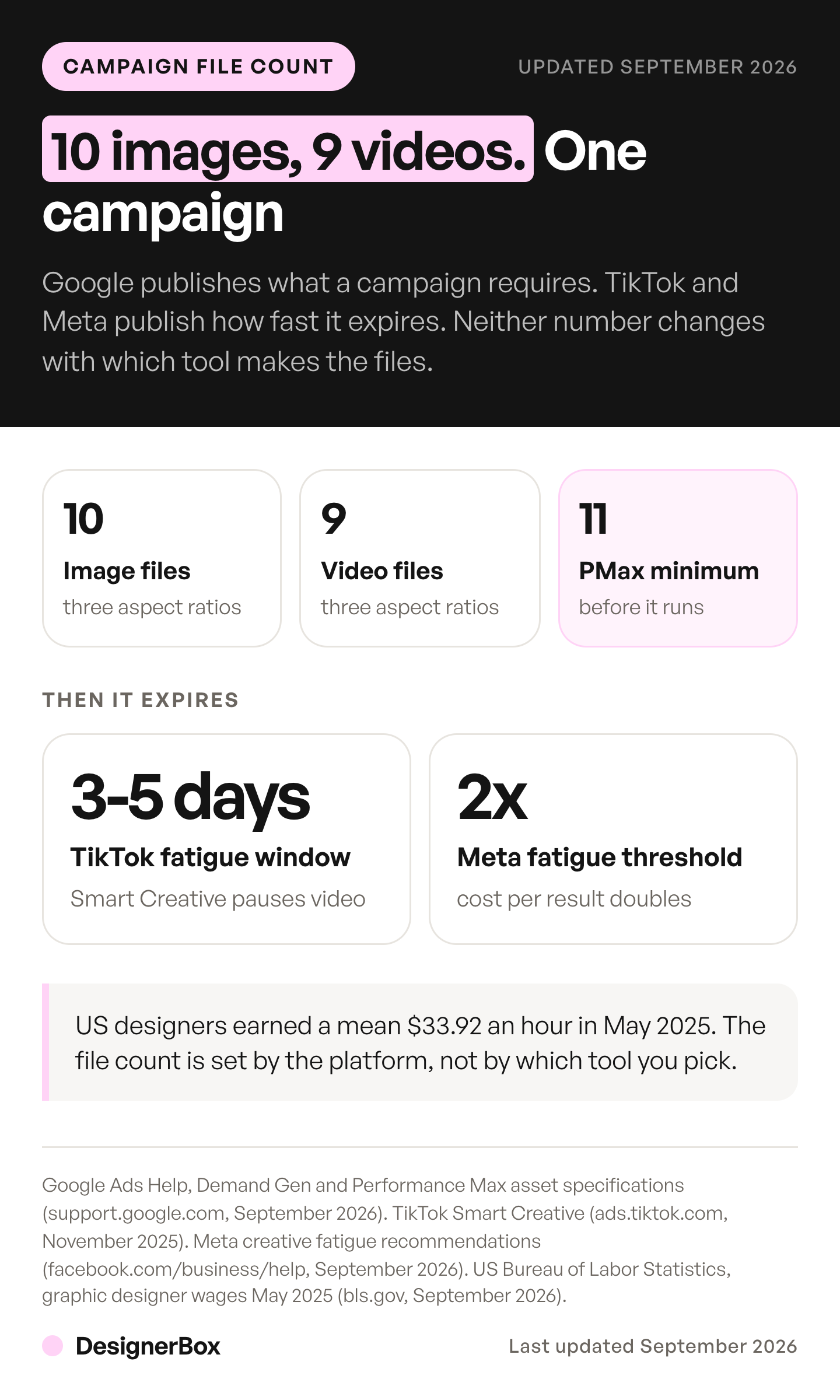
A Google Demand Gen campaign at Google’s own recommended level takes 5 headlines, 3 descriptions, 3 horizontal images, 3 square images, 3 vertical images, 1 logo and 3 videos in each of three orientations (support.google.com, September 2026). That is 10 image files and 9 video files for one campaign.
Performance Max asks for more images per asset group. Google recommends 4 or more horizontal images, 4 or more square images, 2 or more vertical images and a square logo, which is 11 image files. Horizontal and square images and the square logo are required (support.google.com, September 2026).
Then the set expires. TikTok suggests 3 to 5 different creatives per ad group and 3 to 5 ad groups per campaign (ads.tiktok.com, September 2026). Its Smart Creative system observes new videos for 3 to 5 days and pauses the ones that show signs of fatigue in that time (ads.tiktok.com, September 2026). Meta publishes creative fatigue recommendations in Ads Manager, and describes creative fatigue as what happens when an audience has seen the same creative too many times (facebook.com/business/help, September 2026).
Set that against the labour. US graphic designers earned a median $30.27 an hour, or $62,960 a year, in May 2025 (bls.gov, September 2026). At 20 files per campaign and 30 minutes of layout and export each, one campaign costs roughly 10 hours, or about $303 of designer time. That arithmetic is illustrative, not a surveyed figure, and your own rate and file count will move it. The shape holds regardless: the file count is fixed by the platform, the refresh cadence is fixed by fatigue, and neither is negotiable by choosing a different tool.
What happens when the AI allowance runs out
Every tool meters generation. What differs is what happens when the allowance is gone.
| Tool | When the allowance is gone | Rollover |
|---|---|---|
| Figma | Blocked. No further AI actions until reset or an admin adds credits | None |
| Canva | Standard tools on paid plans keep running. Pro and Teams users can keep using AI tools with short pauses, or buy more | Resets monthly |
| Adobe | Premium features blocked. Standard generations stay unlimited on Pro and Firefly plans | None |
| DesignerBox | No new runs until the monthly reset, or buy a credit pack on a paid plan: 100 credits for $5, 500 for $20, 1,500 for $50 | Packs expire after 12 months |
Sources: help.figma.com, canva.com/help/ai-access, helpx.adobe.com generative credits FAQ, September 2026, plus the DesignerBox pricing page.
Figma’s Make feature is the one to check before you commit. Figma publishes approximate credit examples for Make, and a large task such as making an app from a prompt draws far more credits than a small edit such as changing a font (help.figma.com, September 2026). Read that page against the allowance on your seat.
The licensing line worth reading before you ship
Adobe offers indemnification on Firefly output, and it is a genuine advantage for teams that need it. The cover has limits, and they are worth reading before you ship.
Adobe’s Firefly product description, published 27 August 2026, applies to customers whose agreement with Adobe links to that page. It excludes “capabilities that Adobe may develop that are denoted in the user interface as being powered or provided by non-Adobe trained models”, and any features designated as “beta” or “trial” (helpx.adobe.com/legal/product-descriptions/adobe-firefly.html, September 2026). Adobe also offers partner models inside some features, such as Generative Fill in Photoshop (adobe.com, September 2026), so check which model made a file.
The cover is tied to an export event. In Photoshop, Illustrator, InDesign and Premiere, that is when a user on a qualifying plan downloads or exports the content, and placing an output on the canvas does not count. So the covered moment is the export, under a qualifying agreement.
DesignerBox grants a commercial license from the Pro plan, at $35 a month billed monthly. A license is a different mechanism from indemnity, and the two are not equivalent. Check the current terms on the pricing page before you publish a licensing claim of your own, on any tool.
Whichever you use, the disclosure requirements apply to the output. Our guide to AI ad generators and the rules that govern them covers the labelling side.
How to choose between them
Answer four questions in order.

Is your bottleneck the first draft or the file count? If one good concept is the hard part, a canvas with AI in it is enough, and you already own one. If twenty files per campaign is the hard part, a canvas does not help.
How many people need to generate? Canva and Figma meter per member, so the AI bill grows with headcount. A pooled credit balance behaves differently at five seats than at one. In DesignerBox, every plan below Ultra is one seat, and team features start on Ultra.
Does the output have to be your actual product? A general image model produces a plausible product. A workflow built on your uploaded photo starts from the real one. For ecommerce and paid social this is usually the deciding line, and it is why DesignerBox starts from an upload. Still check every result for warped prints, garbled logos and missing details. In a workflow, critic steps score the results, and best-of-N keeps the best one.
Does the campaign repeat? If next month’s drop needs the same set with a different product, a workflow you built once is worth more than a faster canvas or a cheaper generator. A saved DesignerBox workflow runs the same way on the next product. The static ad templates are a place to start, and the ads resizer makes one ad in every size the ad platforms need.
Most teams keep both. Generation handles the draft and the volume, the canvas handles the final file, and the honest version of this comparison says so instead of picking a winner.
Two findings are worth holding against the efficiency case. Gartner’s 2026 CMO Spend Survey of 401 marketing leaders found labour claiming a larger share of marketing budget, 24.5% in 2026 against 21.9% in 2025, and said AI value depends on people, skills and execution, not only technology (gartner.com, June 2026). Forrester reported that nine in ten US marketing agencies use generative AI, with analyst Jay Pattisall warning the industry risks “mistaking efficiency for effectiveness” (forrester.com, June 2026). Faster creative is not automatically better creative, and the tool does not settle that.
For the tool-by-tool view, our Canva alternatives comparison covers the wider field, and the DesignerBox and Canva comparison covers the switch.
If the repeat is what you are buying for, start from a template, add your brand and your products, and run it. The cost is shown before the run. See the templates.
FAQ
Is an AI ad generator cheaper than design software?
Not reliably. The plan price rarely decides your bill. Generation volume does, because every tool meters AI use in credits or uses. Each vendor lists its prices on its own pricing page. In DesignerBox the cost is shown before the run, and an 8-second clip costs 40 to 560 credits, depending on the model.
Can I use AI-generated ads commercially?
The answer changes by tool and by plan, and the details matter. Adobe indemnifies eligible Firefly features under qualifying agreements, excluding beta or trial features and capabilities Adobe marks as powered by non-Adobe models (helpx.adobe.com, published 27 August 2026). DesignerBox grants a commercial license from the Pro plan. Read the current terms for whichever tool you use rather than assuming they match.
Do AI ad generators replace graphic designers?
The evidence points to a change in the work rather than a removal of it. The US Bureau of Labor Statistics projects graphic designer employment to decline 2% from 2025 to 2035, and says automated design tools, such as AI, are projected to make designers more productive and reduce the need for these workers (bls.gov, September 2026). Gartner records marketing labour taking a larger budget share, not a smaller one.
How many ad creatives does one campaign need?
Google recommends 10 image files, including a logo, and 9 videos across three orientations for a Demand Gen campaign, and recommends 11 image files per Performance Max asset group. TikTok recommends 3 to 5 creatives per ad group and 3 to 5 ad groups per campaign. Those are the published figures from each platform.
Does Canva charge extra for AI?
Every paid Canva plan includes an AI allowance, and Canva sells AI Pass separately as a monthly add-on, per person (canva.com/help/ai-pass, September 2026). Allowances are per member rather than pooled, so five people need five allowances.
What happens when I run out of AI credits?
Each tool handles it differently. Figma blocks further AI actions until reset. Canva lets Pro and Teams users keep using AI tools with short pauses, and Standard tools on paid plans do not use the allowance. On Creative Cloud Pro and Firefly plans, Adobe spends credits only on premium features, and standard generations stay unlimited. In DesignerBox, new runs wait for the monthly reset, and paid plans can add a credit pack.
Should I use both an AI generator and design software?
For most teams, yes. Generation covers the draft and the volume the platforms demand. The canvas covers the final file: type you can edit, brand marks, the legal line and the export sizes. The workflow question is where the handoff sits.
Sources
- US Bureau of Labor Statistics, Occupational Outlook Handbook, Graphic Designers, median pay May 2025, projections 2025 to 2035 (bls.gov, accessed September 2026)
- Google Ads Help, Demand Gen campaigns specs and format requirements (support.google.com, accessed September 2026)
- Google Ads Help, Performance Max specs and format requirements (support.google.com, accessed September 2026)
- TikTok Business Help Centre, About Smart Creative (ads.tiktok.com, last updated November 2025, accessed September 2026)
- TikTok Business Help Centre, Creative best practices for performance ads (ads.tiktok.com, last updated June 2025, accessed September 2026)
- Meta Business Help Centre, Creative Fatigue Recommendations (facebook.com/business/help, accessed September 2026)
- Meta Business Help Centre, About Advantage+ Creative (facebook.com/business/help, accessed September 2026)
- Gartner, 2026 CMO Spend Survey, 401 marketing leaders surveyed January to March 2026 (gartner.com, 8 June 2026)
- Forrester, The State Of AI Inside US Marketing Agencies, 2026 (forrester.com, 24 June 2026)
- Adobe Firefly plans page, Photoshop Generative Fill page and the generative credits FAQ, last updated 3 September 2026 (adobe.com and helpx.adobe.com, September 2026)
- Adobe Firefly Product Description, indemnity scope, exclusions and export events (helpx.adobe.com, published 27 August 2026)
- Canva Help Center, Understanding your AI usage and Understanding AI Pass (canva.com, September 2026)
- Figma Help Center, How AI credits work (help.figma.com, September 2026)
- DesignerBox pricing page (designerbox.ai/pricing), September 2026
Plan details and platform specifications verified from each vendor’s own documentation as of September 2026. Vendor terms change frequently; check the current page before relying on a figure. Individual results vary.