AI copyright infringement happens when an AI result copies protected work closely enough to count as a copy. The risk does not stay with the AI company. Under US law, the person who prompts and publishes an infringing image could be liable too. For a brand, three rights are at stake in every AI picture: copyright in someone’s artwork, a trademark on a logo or name, and a real person’s likeness.
Here is how it goes wrong. An agency needs a holiday mascot for a client by Friday. Someone types “a cheerful cartoon fox in the style of” a famous studio, picks the best result and ships it to 30 placements. The fox looks a lot like a character the studio owns. Nobody checked, because nobody thought an original prompt could make a copy.
This guide separates two questions people mix up: whether you can own an AI image, and whether it can infringe someone else’s rights. It covers the three rights, what courts have decided by October 2026, who pays when a claim arrives, and a five-step check to run before you publish. It is written for agencies and brand teams. This is general information, not legal advice.
Key Takeaways
-
Two questions get mixed up. Can you own an AI image, and can it infringe someone else’s work. The answers are different, and the second one is where brands get claims.
-
The user can be liable. The US Congressional Research Service says both “the AI user and the AI company could potentially be liable” for an infringing output.
-
The test is access plus similarity. An output can infringe if the model had access to the work and the result is “substantially similar” to it.
-
Three rights, three checks. Copyright covers artwork, photos and characters. Trademarks cover logos and brand names. Likeness covers real people.
-
You usually cannot own the pure AI part. The US Copyright Office says purely AI-generated material is not protected, and the Supreme Court declined the Thaler appeal on 2 March 2026.
-
The big output cases are still open. Disney and Universal sued Midjourney in June 2025 over images of their characters, and Warner Bros. followed in September 2025.
-
Scanners help, and promise nothing. OpenArt’s terms, for example, make no warranty on the accuracy of its own IP Safety Check.
What is AI copyright infringement?
AI copyright infringement comes in two kinds. The first is about training: rights holders sue AI companies for copying their work to train a model. The second is about output: a generated picture copies a protected work closely enough to count as a copy. A brand has no control over the first. The second is about the pictures you choose to publish, so it is the one you can check.
Most news coverage is about the first kind, because that is where the large lawsuits against model makers sit. For a marketing team, the second kind matters more. A model can return a picture that echoes a character, a logo or a famous photograph without anyone asking for a copy. The rest of this guide is about that output risk.
Can I be sued for using AI-generated images?
Yes, in principle. The Congressional Research Service, which writes legal analysis for the US Congress, puts it plainly: “If a generative AI output infringes a copyright in an existing work, both the AI user and the AI company could potentially be liable under current law” (CRS Legal Sidebar LSB10922, updated 18 July 2025).
The same paper explains how a claim works. A copyright owner has to show two things. First, that the AI program “had access to their works”, for example because the work was in the training data. Second, that the output is “substantially similar” to the work. Courts describe that test in different ways, such as a “substantially similar total concept and feel”.
CRS says the user “might be directly liable for prompting the AI program to generate an infringing output”. It also notes that a user’s case can be hard to analyze, because the user may not even know the protected work exists. The AI company could face a separate claim of vicarious infringement.
So the brand that publishes is not shielded by the fact that a model made the picture. You are the one who chose to put it in an ad.
Three rights an AI image can break
Copyright is only one of the three. An AI ad can break a trademark or a person’s likeness rights without copying any artwork at all.
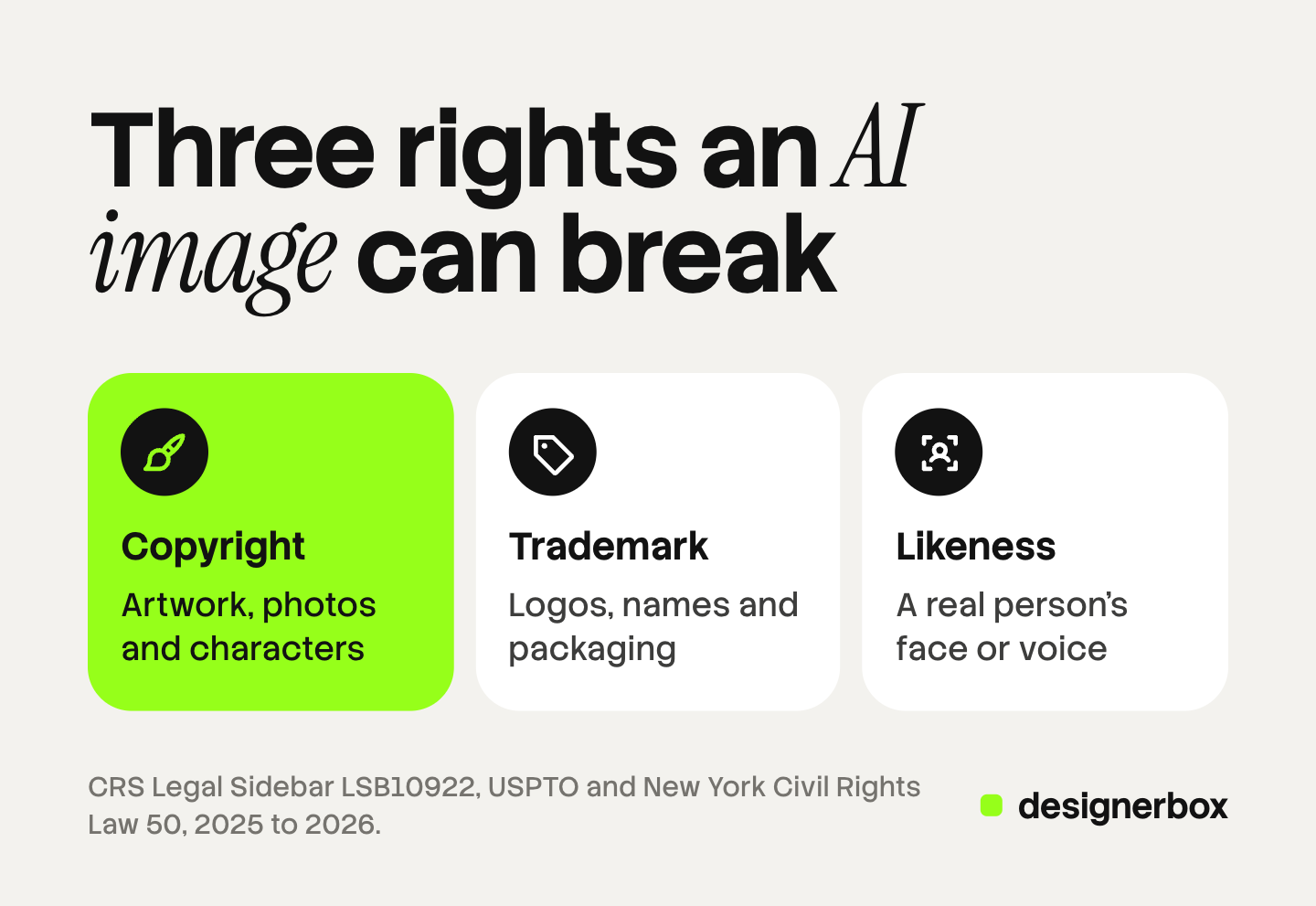
| Right | What it protects | How an AI image can break it | The check |
|---|---|---|---|
| Copyright | Artwork, photographs, illustrations and characters | A result that is substantially similar to a protected work, often after a prompt that names an artist, a film or a character | A reverse image search, and a person who looks for known characters |
| Trademark | Logos, brand names, product shapes and packaging | A real brand’s logo or a look-alike mark appears in the picture, on a product, a sign or a T-shirt | A trademark search for every logo or word mark in the frame |
| Likeness | A real person’s face, voice and name | A generated person who looks like a celebrity or a real person, used in an ad | Written consent from any real person, and a synthetic person who resembles nobody |
Trademarks do not need an exact copy. The USPTO explains that if a mark is confusingly similar to another and the goods are related, “consumers are likely to mistakenly believe these goods or services come from the same source” (USPTO, accessed October 2026). It adds that “Trademarks don’t have to be identical to be confusingly similar.” An AI model that adds a half-readable logo to a sneaker can create exactly that problem.
Likeness is state law in the US. New York requires written consent before you use a living person’s name, portrait, picture or voice in advertising, and a breach is a misdemeanor (NY Civil Rights Law 50, accessed October 2026). California requires prior consent to use a person’s name, voice, photo or likeness in ads, with damages of at least $750 (California Civil Code 3344, accessed October 2026). From 1 January 2027 that California law names digital replicas too (California SB 1111, signed 30 September 2026). Tennessee’s ELVIS Act, in force since 1 July 2024, protects a person’s voice as well as their likeness (Tennessee Public Chapter 588).
A federal bill, the NO FAKES Act of 2026 (S.4591), was on the Senate calendar and not yet law in the latest record we found (govinfo, record updated 10 August 2026).
What courts have decided by October 2026
The courts have answered the ownership question and only started on the output question.
Ownership. The US Copyright Office refused to register a work made entirely by AI, and the courts upheld the refusal in Thaler v. Perlmutter. On 2 March 2026 the Supreme Court denied review (Supreme Court docket 25-449).
Trademarks in outputs. On 4 November 2025 the High Court of England and Wales ruled in Getty Images v. Stability AI (judiciary.uk, [2025] EWHC 2863 (Ch)). Getty’s secondary copyright claim failed. The trademark claim partly succeeded: older versions of Stable Diffusion (v1.x and v2.x) produced some images carrying Getty and iStock watermarks, and that could infringe Getty’s marks. Later versions did not (Taylor Wessing, November 2025). A watermark in an output is a trademark problem, whoever made the picture.
Characters in outputs. Disney and Universal sued Midjourney in the Central District of California on 11 June 2025 (CourtListener, case 2:25-cv-05275). The complaint is about images of the studios’ own characters. Warner Bros. filed its own case on 4 September 2025 (CourtListener, case 2:25-cv-08376). These are allegations, and we found no final ruling in either case in October 2026.
Training. The Copyright Office’s report on generative AI training is still a pre-publication version, released on 9 May 2025. The Office says a final version “will be published in the future, without any substantive changes expected” (copyright.gov/ai, accessed October 2026).
Can you own an AI image?
Usually not the AI-made part, in the US. The Copyright Office says “Copyright does not extend to purely AI-generated material, or material where there is insufficient human control over the expressive elements” (Part 2 report, 29 January 2025). It also says prompts alone do not make you the author of the output, with the technology available today.
Human work still counts. You can own copyright in your creative selection and arrangement of AI material, and in creative changes you make to it. If you register a work that contains AI material, you must say so and exclude the AI parts that are more than a tiny amount (registration guidance, 88 Fed. Reg. 16190).
Ownership and infringement are separate. An image you cannot register can still infringe someone else’s rights. And a tool’s terms can give you its rights in a picture, but they cannot create a copyright the law does not give. Whether you may use AI images commercially at all depends on the tool’s terms, which our guide to using AI images commercially compares with stock photo licenses.
Who pays if a claim arrives
Read three things in your AI tool’s terms: who owns the output, who indemnifies whom, and what the tool promises about its own checks.
Indemnity from the vendor. Some model makers offer to defend business customers against claims about output, with conditions. Google says its generative AI output indemnity “only applies if you didn’t try to intentionally create or use generated output to infringe the rights of others” (Google Cloud blog, October 2023). Google’s offer names specific Google Cloud and Workspace services, so check which product and plan your team actually uses.
Indemnity from you. Terms often run the other way for what you upload. DesignerBox’s terms, for example, ask you to confirm that the material you upload does not infringe anyone’s rights, and to cover DesignerBox against third-party claims about it (designerbox.ai/terms, October 2026). Read this clause in every tool before a client’s material goes in.
Checks with no promise. Some tools now scan results for possible conflicts. OpenArt’s IP Safety Check screens prompts and output for potential intellectual property conflicts. Its terms also say OpenArt makes no warranty on “the accuracy of the ‘IP Safety Check’ feature” and that you are “solely responsible” for relying on it (openart.ai/terms, October 2026). A scan is a useful first filter. It does not move the risk off your desk.
For agencies, the same three questions belong in every client contract. Our guide to creative tool terms lists the clauses that decide them.
A five-step check before you publish
Run these five steps on every AI picture that goes into an ad, a listing or a client deliverable. None of them needs a lawyer. A lawyer is the next step when one of them finds something.
- Start from your own material. Use your own product photo, your logo and your own reference pictures as the input. A picture built around your real product has your product at its center, and the model only draws the scene.
- Keep names out of the prompt. Leave out artists, studios, films, characters, brands and real people. A name asks the model for something close to that work, and closeness is what a claim has to prove.
- Search by image. Run the result through a reverse image search. Google Lens returns “Websites with the image or a similar image” (Google Search Help, accessed October 2026). Look hard at characters and famous photos.
- Check every mark in the frame. Look for logos, letters and packaging on products, signs and clothes. Search any mark you are unsure about in the USPTO trademark search, and remove marks that are not yours.
- Clear every face. A real person needs written consent and a release. A generated person should look like nobody in particular, and may need an AI label where the rules ask for one. Our model release form guide covers the consent side, and the AI labels guide covers the label.
Keep a record of each picture: the source photos, the prompt, the model and the date. It shows what you started from if a question comes later, and it supports any human authorship you want to register. This check is one step of a wider AI creative workflow that runs from brief to approved file.
Your own product at the center of the run
Anyone can make an AI picture. Making hundreds that still look like your brand is the hard part. The same habit that keeps the brand consistent also keeps the rights simpler: every run starts from your own material.
DesignerBox is AI creative production for brands and agencies. You save the brand once as a brand profile: products with a photo each, your logo, your colors and fonts, and up to 12 reference pictures. A workflow starts from your product photo and places it in the scene you need. Assets keeps every picture you make or upload, and you can open any picture to see the prompt and the model that made it. That is the record step five asks for.
Critic steps score the results of a run, and best-of-N keeps the best one. Then a person checks them, and Reviews sends a page of pictures to a client as a link. The client opens it with no account, chooses the pictures and sends the choice back.
The brand, the pictures and their prompts sit in one account, so the record for each picture stays with it. Here are the limits. DesignerBox does not run an IP or trademark scan on results, so steps three to five above stay with your team. Uploading your own photos and the commercial license start on the Pro plan. Plans and credits are on the pricing page.
Start from a template, add your brand and your products, and run it. The cost is shown before the run. See the templates.
FAQ
Can I be sued for using AI-generated images?
Yes. The Congressional Research Service says that if an AI output infringes a copyright, both the AI user and the AI company could be liable under current US law. The user might be directly liable for prompting the program to make the infringing output. The owner of the work has to show the model had access to it and the result is substantially similar.
Who is liable when an AI image infringes copyright?
Possibly more than one party. The user who prompts and publishes the image could be directly liable. The AI company could face a claim of vicarious infringement. Your tool’s terms decide who pays whom: some vendors offer an output indemnity on business plans, and many make you responsible for what you upload.
Can an AI image infringe a trademark?
Yes. If a picture shows a real brand’s logo or a mark that is confusingly similar, it can cause trademark trouble whoever made it. In Getty Images v. Stability AI, the UK High Court found trademark infringement where early model versions produced images carrying Getty and iStock watermarks. Check every logo and word mark in the frame before you publish.
Can I copyright an AI-generated image?
Not the purely AI-made part, in the US. The Copyright Office says copyright does not extend to purely AI-generated material, and that prompts alone are not enough. Your own creative selection, arrangement and changes can be protected. The Supreme Court declined to review the Thaler case on 2 March 2026.
Is it legal to use an AI image of a real person in an ad?
Only with their consent. New York requires written consent to use a living person’s name, picture, likeness or voice in advertising. California requires prior consent and, from 1 January 2027, names digital replicas in the same law. Use a synthetic person who resembles nobody, or get a signed release.
Do AI tools protect you from copyright claims?
Some help, none guarantee. Google, for example, offers an output indemnity to business customers that applies only if you did not try to infringe on purpose. Scanning features flag possible conflicts, but OpenArt’s terms state it makes no warranty on its own check’s accuracy. Your own review is still the last step.
Does naming an artist in a prompt make the image infringing?
The legal test looks at the result. A copyright owner has to show the model had access to the work and the output is substantially similar to it. A named artist, film or character in the prompt asks the model for something close to that work, so brand teams leave names out of prompts.
Sources
- Congressional Research Service, “Generative Artificial Intelligence and Copyright Law”, Legal Sidebar LSB10922, updated 18 July 2025: congress.gov
- US Copyright Office, Copyright and Artificial Intelligence: copyright.gov, accessed October 2026
- US Copyright Office, Part 2 report, Copyrightability, 29 January 2025: copyright.gov
- US Copyright Office, registration guidance for works containing AI material, 88 Fed. Reg. 16190: copyright.gov
- Supreme Court of the United States, docket 25-449, Thaler v. Perlmutter, petition denied 2 March 2026: supremecourt.gov
- Judiciary of England and Wales, Getty Images v. Stability AI, [2025] EWHC 2863 (Ch), 4 November 2025: judiciary.uk
- Taylor Wessing, summary of the trademark findings in Getty v. Stability, November 2025: taylorwessing.com
- CourtListener, Disney Enterprises Inc. v. Midjourney Inc., C.D. Cal. 2:25-cv-05275, filed 11 June 2025: courtlistener.com
- CourtListener, Warner Bros. Entertainment Inc. v. Midjourney, Inc., C.D. Cal. 2:25-cv-08376, filed 4 September 2025: courtlistener.com
- USPTO, Likelihood of confusion: uspto.gov, and trademark search: uspto.gov, accessed October 2026
- New York Civil Rights Law section 50: nysenate.gov, accessed October 2026
- California Civil Code section 3344: leginfo.legislature.ca.gov, and SB 1111, signed 30 September 2026: leginfo.legislature.ca.gov
- Tennessee Public Chapter 588, the ELVIS Act: tnsosfiles.com
- NO FAKES Act of 2026, S.4591, bill status record updated 10 August 2026: govinfo.gov
- Google Cloud, “Protecting customers with generative AI indemnification”, 13 October 2023: cloud.google.com
- Google Search Help, Search with an image on Google: support.google.com, accessed October 2026
- OpenArt terms of service, last updated 30 July 2026, section 7.2 on the IP Safety Check (openart.ai/terms, October 2026)
- DesignerBox terms of service, on content you upload (designerbox.ai/terms, October 2026)
- DesignerBox brand, assets and pricing pages (designerbox.ai/product/brand, designerbox.ai/product/assets and designerbox.ai/pricing), October 2026
Laws, court records and vendor terms checked on their own pages as of October 2026. Lawsuits named here are allegations unless a court has ruled. The five-step check is our framework, not a legal standard. This is general information, not legal advice. Talk to a lawyer before you rely on any of it for a specific campaign.