




AI labels are notices that tell people a picture, video or text was made or changed with AI. On ads and social posts, the platform adds most of them. Meta, TikTok, YouTube, Pinterest, LinkedIn and Google read hidden marks such as C2PA data, and several run their own detection. The part you control is the line you write yourself, and that line decides whether the label builds trust or costs it.
Picture an agency that ships 40 AI-assisted ads for a client in one month. Some carry Meta’s “AI info” note in the ad menu. Some get TikTok’s label at the bottom of the video. Some carry nothing at all. Then a customer comments “is this even real?” under the best performer, and the client asks what the policy is.
This guide covers who adds each AI label, where people see it, what the 2026 research says about labels and trust, and how to write a label that helps. It is written for agencies and brand teams that publish AI creative every week. This is general information, not legal advice.
Key Takeaways
-
Most AI labels come from the platform. Meta, TikTok, YouTube, Pinterest, LinkedIn and Google add their own, from C2PA data, their own AI tools or detection.
-
Shoppers want labels. In Fractl’s Q2 2026 survey of 1,008 US consumers, 90% want AI images labeled. Only 20% of the marketers’ organizations always disclose AI use.
-
A bare label can cost trust. A 2026 experiment with 683 people found negative trust effects for every task-specific AI disclosure it tested.
-
Oversight earns it back. In a Chilean experiment with 2,145 people, human oversight and disclosure were the strongest positive predictors of credibility.
-
Say what AI did and who checked it. Interview and focus-group studies found people value labels that show human oversight, and want clear, detailed disclosures.
-
For product ads, the label cuts both ways. A 2026 ad study found labels raised perceived novelty and lowered perceived authenticity. For practical products, the gain was larger and the loss smaller.
-
The EU icons are optional, the duty is not. Article 50 has required deployers to disclose deep fakes since 2 August 2026. In EU testing, the icon worked better with a short text label.
What are AI labels?
AI labels are visible notices that content was made or changed with AI. There are four kinds. A platform adds one automatically. You turn one on in a platform setting. A law requires one for certain content. Or you write your own line in the caption or on the picture. Hidden marks such as C2PA Content Credentials and SynthID are signals that platforms read. People do not see them as labels.
The hidden marks matter because they decide which platform labels appear. A Content Credential is signed data inside a file. It records where the file came from, how it was edited and whether AI was used (C2PA explainer, accessed October 2026). Anyone can remove it, and social platforms often remove metadata when they process a file (C2PA guidance, accessed October 2026). SynthID is Google’s invisible watermark for content from its AI products. Google says it is built to survive cropping, filters and compression (deepmind.google, accessed October 2026).
A hidden mark is never your label. The European Commission says deployers “cannot simply rely on the machine-readable marking embedded in the content by the provider” (Commission FAQ on Article 50, accessed October 2026). If a person has to see the label, a person has to be able to see it without special tools.
Who adds an AI label to your ads
Each ad platform has its own trigger, its own place for the label and its own rule on removing it. This table covers paid ads, read on each platform’s own pages in September and October 2026.
| Platform | What triggers the label | Where people see it |
|---|---|---|
| Meta | Meta’s own AI tools, such as Background Generation, or third-party AI it detects through signals such as C2PA | ”AI info” under “About this ad” in the three-dot menu. Next to the “Ad” label for ads made with Meta’s tools that show a photorealistic AI person, or when an advertiser in the European Region, California, New York, India or Taiwan chooses to disclose |
| TikTok | Fully AI-generated or heavily AI-edited images, video or audio | Your AIGC label or your own disclaimer, at the bottom of the in-feed ad. Undisclosed AI ads are rejected or restricted |
| Google Ads | Your AI label setting, or labels Google adds to some assets made with Google AI tools | A text or visual label inside the creative |
| What the advertiser states, or a flag from Pinterest’s own detection | Behind the ellipsis next to the ad, with the other ad details |
Sources: Meta Business Help, TikTok ads policy, Google Ads policy update, July 2026 and Pinterest Help, accessed October 2026.
Three details catch teams out. Meta says its detection “may not be available in your region”, so the same file can carry a label in one country and none in another. TikTok resets the AI disclaimer toggle on every new or duplicated campaign (TikTok Ads Manager, accessed October 2026). And Google says rules in the European Union, India and New York require labels on some AI ads, but that its AI label setting “doesn’t guarantee compliance with specific regulations”.
Who adds an AI label to your posts
Organic posts follow different rules from ads, and the labels sit in different places.
| Platform | What triggers the label | Where people see it |
|---|---|---|
| Instagram, Facebook, Threads | C2PA or IPTC signals, or your own disclosure. You must disclose photorealistic video and realistic audio, not images | ”AI info” on the post. For content AI only changed, the note sits in the post menu |
| Instagram profiles | You add the “AI-generated profile” label, available since 31 August 2026 | On the profile. Instagram limits the reach of profiles that feature an AI person and do not add it |
| TikTok | You label realistic AI content. TikTok adds a label itself for its own AI effects or for files with Content Credentials | On the video. An automatic label cannot be removed |
| YouTube | You disclose photorealistic AI with the “AI use” setting. Since May 2026, YouTube also labels content its systems detect | Below the player, or over the video on Shorts |
| Images and video that carry C2PA data, rolling out gradually | A Content Credentials icon on the image or video |
Sources: Meta Help, Instagram for Creators, TikTok Support, YouTube Help and LinkedIn Help, accessed October 2026.

YouTube moved its label in May 2026. For photorealistic AI content, the label now sits directly below the player, above the description, and as an overlay on Shorts (YouTube Official Blog, 27 May 2026). Content that is unrealistic, animated or only slightly altered keeps the note in the expanded description. You cannot change a YouTube label that came from C2PA data, YouTube’s own tools or a manual review.
Removing metadata does not reliably avoid a label. TikTok, YouTube and Pinterest all run their own detection as well. Leave the marks in the file.
Do AI labels reduce trust?
AI labels can lower trust on their own, and the research from 2026 explains when. People want to know when AI was used. When a label only says “AI”, many trust the content less. When the label shows a person checked the work, trust holds up better. Most studies so far test news and policy messages, and only a few test ads, so read them as direction, not as a forecast for your account.
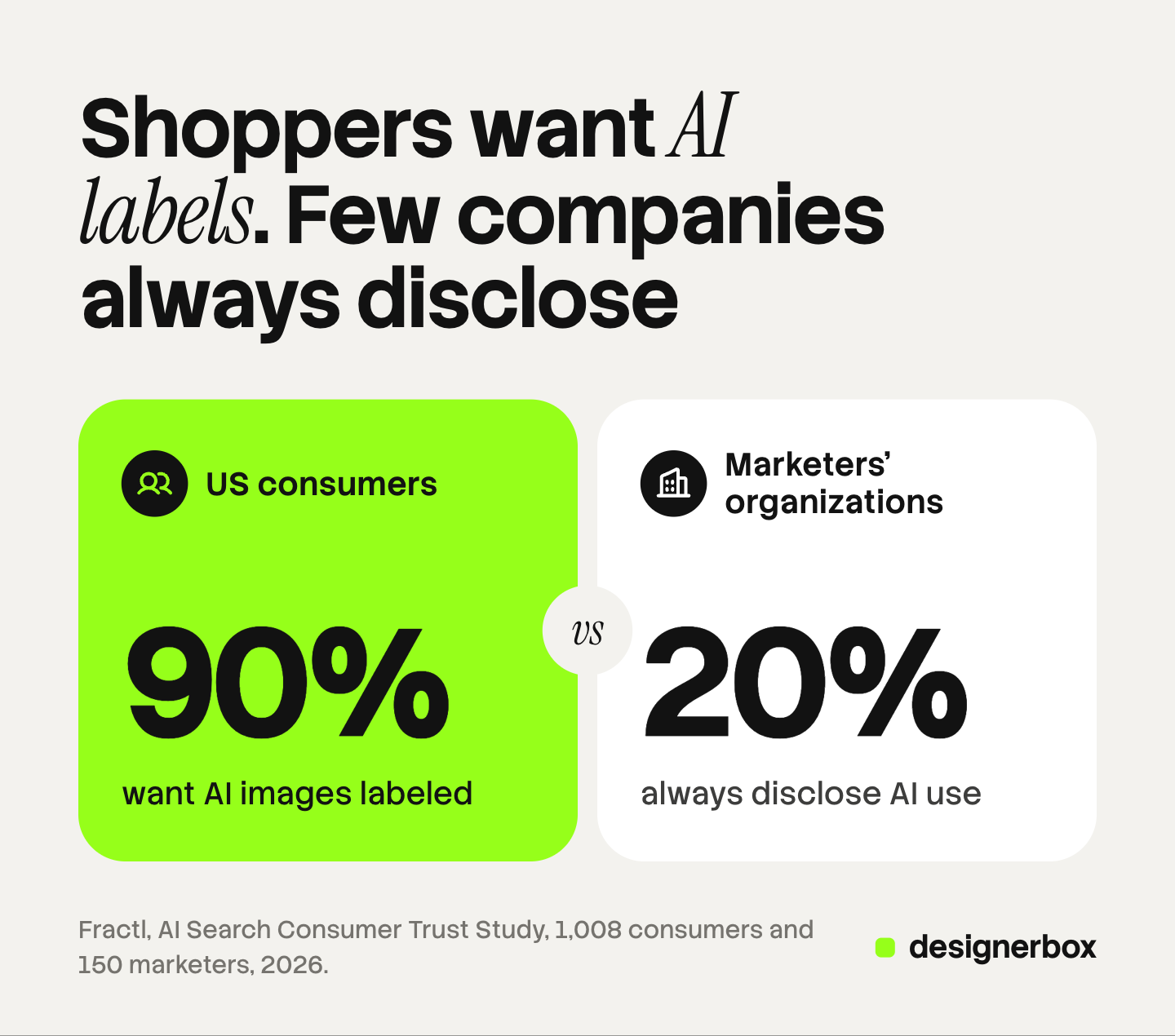
The demand side is clear. Fractl surveyed 1,008 US consumers and 150 marketers in Q2 2026. 84% want written AI content labeled, 91% want video labeled, 90% images and 87% audio. Only 20% of the marketers’ organizations always disclose AI use, and 33% never do (Fractl, updated August 2026). In the same survey, 40% said heavy AI use would lower their trust in a favorite brand, up from 20% in 2025.
Seven studies show what the label does once it is there.
| Study | People | What it found |
|---|---|---|
| Valenzuela and others, Digital Journalism, 2026 | 2,145 in Chile, conjoint experiment | Human oversight and disclosure were the strongest positive predictors of credibility and of choosing an outlet. Fully automated content lowered both a little |
| Mattis, Kieslich and de Vreese, Digital Journalism, 2026 | 683, conjoint experiment | Every task-specific AI disclosure lowered perceived trustworthiness. The size of the effect varied by person |
| Zier and Diakopoulos, Digital Journalism, 2026 | 20 US news readers, interviews | People valued labels that signal human-AI collaboration and visible human oversight |
| Cools and others, Digital Journalism, 2026 | 21, focus groups | People asked for clear, visible and detailed disclosures, with contrasting visual markers |
| Shi and Jiang, SAGE Open, 2026 | Three online experiments on ad images | Labels raised perceived novelty and lowered perceived authenticity. For practical products, the novelty gain was larger and the authenticity loss smaller |
| Stanford HAI, 2025 | More than 1,500 US adults | A label changed who people thought wrote a message. It did not change how persuasive the message was |
| Weikmann and others, Digital Journalism, 2026 | 1,018 in the Netherlands | AI labels on false visuals worked no better than fact-check labels or community notes |
The Chilean study puts the finding in one line: audience responses “are shaped less by the mere presence of GenAI than by the accountability structures governing its use” (Valenzuela and others, March 2026). A label that says “AI” answers one question. The reader often has a second one: did a person check this, and is the product real?
For brands, the ad study is the closest match. It tested labels on advertising images and found two forces at once (Shi and Jiang, 2026). A label makes the ad feel new, which helps. It also makes the ad feel less authentic, which hurts. Products people buy for a practical job showed more of the first and less of the second. That is one study, so test it on your own audience before you build a rule on it.
How to write an AI label that keeps trust
A useful AI label says three things in plain words: what AI made, what is real, and who checked it. Put it where people see it first, and keep the platform’s own label as well. Four rules follow from the research above and from the EU’s own guidance on its icons.
- Name the part AI made. “Background created with AI” tells the reader more than “Made with AI”, and it is true for more of your work.
- Name what is real. “The bag is our real product” answers the question a shopper asks next.
- Name the check. “Checked by our team against the real product” is the human oversight the studies found people look for.
- Put it where people look first. The EU’s guidance for its icons asks for a label that is clear “at the latest at the time of first exposure”, in plain language, and visible when the content is shared or downloaded (EU icons page, updated 13 October 2026).
The EU offers free icons for AI labels in four versions: black, white, and both at 50% transparency. Using them is optional. The Commission says user testing found “performance improved across all measures when the basic icon was accompanied by a text label”. It also says the icons do not prove compliance on their own.
Here is how the three parts read on common assets. Adjust the words to your brand voice.
| The asset | A label that says what happened |
|---|---|
| A real product photo on an AI background | ”Background created with AI. Product photographed by our team.” |
| An AI model wearing your real garment | ”AI-generated model. The dress is our real product, checked against the sample.” |
| A video made from your product photos | ”Video made with AI from our product photos. Reviewed before posting.” |
| An AI presenter reading your script | ”AI presenter. Script written and checked by our team.” |
Never present an AI person as a real customer. The FTC’s rule on reviews and testimonials prohibits testimonials that misrepresent that the reviewer exists or used the product (FTC Q&A, accessed October 2026). A label does not fix a fake testimonial.
When an AI label is required
Some labels are not your choice. Three rules come up most for brands, and the full detail is in our guide to AI disclosure rules in ads.
The EU AI Act. Article 50 has applied since 2 August 2026. It requires deployers to disclose deep fakes: realistic AI images, audio or video that could pass as real people, objects, places or events. The Commission’s guidelines give a real product on an AI background, in an ad that does not mislead about the product, as an example that is not a deep fake. They give an AI product image that makes the product look better than it really is as an example that is (Commission guidelines, C(2026) 5054, published 20 July 2026, non-binding). Fines can reach EUR 15 million or 3% of worldwide annual turnover, whichever is higher (AI Act Service Desk, Article 99, accessed October 2026).
New York. Since 9 June 2026, an ad that contains a synthetic performer must say so, where the person who makes the ad knows it. The civil penalty is $1,000 for a first violation and $5,000 for each later one (NY General Business Law 396-b, accessed October 2026).
TikTok ads. Ads with fully AI-generated or heavily AI-edited images, video or audio need the AIGC label or your own clear disclaimer. Changes to lighting, color, backgrounds and noise do not.
Fashion brands have one more layer, because a person is often in the frame. Labeling AI-generated fashion images goes asset by asset through a drop.
What a label cannot fix
A label tells the reader that AI was involved. It does not make a misleading picture honest. If the AI version of a serum bottle shows a different cap, a fuller color or a label that does not exist, the shopper sees that when the box arrives. The EU’s own example of a deep fake is an AI product image that misleads about how the product really looks.

So the review step comes before the label. Check every picture against the real product: the shape, the color, the logo and the text on the pack. Our brand compliance review standard sets out what to check and who signs it off. Ads built this way are covered in more depth in the AI generated ads guide, including what platforms and studies show about AI creative results.
Labels and review at catalog scale
Anyone can make an AI picture. Making hundreds that still look like your brand is the hard part. Labels add one more thing to keep the same across those hundreds: the words.
DesignerBox is AI creative production for brands and agencies. You save the brand once as a brand profile, with its voice and rules. Put your label lines there too, so every person on the team uses the same words. The workflow reads the brand on every run. Batch runs one workflow over a sheet of up to 200 rows, and you keep or discard each result.
The review is where the trust comes from. Critic steps score the results of a run, and best-of-N keeps the best one. Then a person checks them. Reviews sends a page of pictures as a link. The client opens it with no account, chooses the pictures and sends the choice back. A review costs no credits, and the link works for 30 days. Every picture in Assets shows the prompt and the model that made it, so you can say what AI made when you write the label.
The pictures, the brand rules and the review all sit in one account, so the label lines and the files stay together. DesignerBox does not place ads or posts on Meta, TikTok or Google, so the platform’s own label setting stays your step. You download the results and upload them yourself. The commercial license and uploading your own photos start on the Pro plan. Plans and credits are on the pricing page.
Set your brand once, open a template, add your product and run it. The cost is shown before the run. See the templates.
FAQ
Do AI labels hurt ad performance?
Platforms say a label alone does not cut reach. TikTok says turning on the AI-generated content setting “won’t affect the distribution of your video”, and YouTube says a disclosure label alone does not change how a video is recommended or whether it can earn money. Trust is a separate question. 2026 studies found that a bare AI label can lower trust, while a label that shows human oversight holds up better.
Can I remove an AI label that a platform added?
Often not. TikTok says you cannot remove an automatic label. YouTube says you cannot change a label added from C2PA data, from its own tools or after a manual review. Pinterest lets you appeal a label through its support team. Removing the metadata from a file does not reliably help, because these platforms also run their own detection.
What is the difference between an AI label and C2PA?
An AI label is a notice people see. C2PA Content Credentials are signed data inside a file that record where it came from and whether AI was used. Platforms such as Meta, TikTok, YouTube and LinkedIn read that data and may add their own label. Under the EU AI Act, a hidden mark does not count as the label a deployer must show.
Are the EU AI label icons mandatory?
No. The EU’s icons are free and optional, in four versions. The labeling duty under Article 50 is not optional, and the Commission says using the icons does not prove compliance on its own. In the EU’s user testing, the icon worked better with a short text label beside it.
Do I need to label AI product photos?
It depends on the picture and the place. Under the EU AI Act, a real product on an AI background is usually not a deep fake, if the ad does not mislead about the product. An AI image that makes the product look better than it really is can be one. TikTok ads need a label for fully AI-generated or heavily AI-edited media, and Meta labels ads itself when it detects AI signals. This is general information, not legal advice.
What should an AI label say?
Say what AI made, what is real and who checked it. “Background created with AI. Product photographed by our team” is clearer than “Made with AI”. Put it where people see it first, and keep the platform’s own label too.
Do consumers want AI content labeled?
Yes, by a wide margin. In Fractl’s Q2 2026 survey of 1,008 US consumers, 84% want written AI content labeled, 91% video, 90% images and 87% audio. Only 20% of the marketers’ organizations in the same study always disclose AI use.
Sources
- Fractl, AI Search Consumer Trust Study, 1,008 US consumers and 150 marketers, Q2 2026: frac.tl, published June 2026, updated August 2026, accessed October 2026
- Valenzuela, Bachmann, Borah and Solís Valdés, “The Effects of Generative AI in News on Media Credibility and Selectivity: Evidence from a Conjoint Experiment in Chile”, Digital Journalism, March 2026: doi.org
- Mattis, Kieslich and de Vreese, “Feeling Iffy About Generative AI: Investigating Audiences’ Trustworthiness Perceptions of Task-Specific AI Disclosures”, Digital Journalism, July 2026: doi.org
- Zier and Diakopoulos, “Beyond the Byline: Audience Expectations for AI Disclosure in News Media”, Digital Journalism, April 2026: doi.org
- Cools and others, “Transparency is More Than a Label: Audiences’ Information Needs for AI Use Disclosures in News”, Digital Journalism, August 2026: doi.org
- Weikmann, Tulin, Hameleers and de Vreese, “No Easy Fix to Countering AI-Generated Visual Disinformation”, Digital Journalism, August 2026: doi.org
- Shi and Jiang, “Consumer Responses to AI Disclosure Labels: The Role of Novelty and Authenticity”, SAGE Open, 2026: doi.org
- Stanford HAI, “Labeling AI-Generated Content May Not Change Its Persuasiveness”, July 2025: hai.stanford.edu
- European Commission, EU icons for labelling AI-generated content, last updated 13 October 2026: digital-strategy.ec.europa.eu
- European Commission, FAQ on transparency obligations under Article 50: digital-strategy.ec.europa.eu, accessed October 2026
- European Commission, Guidelines on Article 50, C(2026) 5054, published 20 July 2026: ec.europa.eu
- AI Act Service Desk, Article 99: ai-act-service-desk.ec.europa.eu, accessed October 2026
- New York General Business Law section 396-b: nysenate.gov, accessed October 2026
- FTC, Consumer Reviews and Testimonials Rule: Questions and Answers: ftc.gov, accessed October 2026
- Meta Business Help, AI info labels on ads: facebook.com, accessed October 2026
- Meta Help, AI info on posts: meta.com, accessed October 2026
- Instagram for Creators, AI-generated profile label: creators.instagram.com, accessed October 2026
- TikTok, ads policy on misleading and false content, and adding disclaimers to ads: ads.tiktok.com and ads.tiktok.com, accessed October 2026
- TikTok Support, AI-generated content: tiktok.com, accessed October 2026
- YouTube Official Blog, “Improving AI labels for viewers and creators”, 27 May 2026: blog.youtube
- YouTube Help, disclosing altered or synthetic content: support.google.com, accessed October 2026
- Google Ads policy, updates to AI labeling requirements, July 2026: support.google.com, accessed October 2026
- Pinterest Help, Gen AI labels: help.pinterest.com, accessed October 2026
- LinkedIn Help, Content Credentials: linkedin.com, accessed October 2026
- C2PA specification 2.4, explainer and guidance: spec.c2pa.org and spec.c2pa.org, accessed October 2026
- Google DeepMind, SynthID: deepmind.google, accessed October 2026
- DesignerBox brand, batch, assets and pricing pages (designerbox.ai/product/brand, designerbox.ai/product/batch, designerbox.ai/product/assets and designerbox.ai/pricing), October 2026
Platform label rules and the EU icons page verified on each platform’s or regulator’s own page as of October 2026. The studies are cited from their published abstracts. Most test news or policy content, and one tests ad images, so results for your audience may differ. The example labels are illustrations, not legal wording. This is general information, not legal advice.