
Can I use AI generated images commercially? Yes, in most cases. The permission comes from the terms of the tool you used, and those terms differ by tool and by plan. A stock photo works the other way: you buy a license with listed limits and a warranty. In the US, an image made only by AI also has no copyright, so you cannot stop a competitor from copying it.
Most comparisons of AI images and stock photos score them on speed, cost and how original they look. Those are real differences. They are also the easy ones. The question that stops an ad from running is a rights question: who gave you permission, what does it cover, and who pays if someone makes a claim.
This guide is for brands and agencies that put images into paid ads every week. It compares the two sources on six rights checks, with the wording of the licenses and terms as read in October 2026. It is general information, not legal advice.
Key Takeaways
- Yes, with a condition. You can use AI images in ads when the tool’s terms allow commercial use on your plan. Read the terms once per tool.
- Stock is a license. AI is terms of use. A stock license lists what you may do and warrants the image. AI terms usually pass you whatever rights exist and promise less.
- Pure AI images have no US copyright. The US Copyright Office protects work made by a human. A prompt alone does not make you the author.
- Stock has limits people forget. The license is non-exclusive, editorial images cannot go in ads, sensitive uses are restricted, and print runs are often capped at 500,000.
- A warranty for AI images is mostly a business-plan feature. OpenAI and Google Cloud put it in their API and business terms, with exclusions.
- Neither source shows your product. For a product ad, the third option is your own product photo with an AI scene around it.
Can I use AI generated images commercially?
Yes. You can use AI generated images commercially when the terms of the tool allow it for your plan and your use. Most large vendors pass their rights in the image to you. What they cannot give you is a copyright the law does not grant, a release from a real person, or the right to show another company’s trademark. Those three gaps are where an AI image in an ad creates risk.
The vendor wording is direct. OpenAI’s terms say you “own the Output” and that OpenAI assigns you “all our right, title, and interest, if any” in it (OpenAI Terms of Use, accessed October 2026). Google’s Gemini API terms say “Google won’t claim ownership over that content” (Google AI for Developers, effective 23 March 2026). Black Forest Labs says “We claim no ownership rights in and to Your Content” (Black Forest Labs, accessed October 2026).
Read the two words “if any” in the OpenAI sentence. A vendor can pass you the rights it has. It cannot create a right that copyright law does not give.
Where does the permission come from?
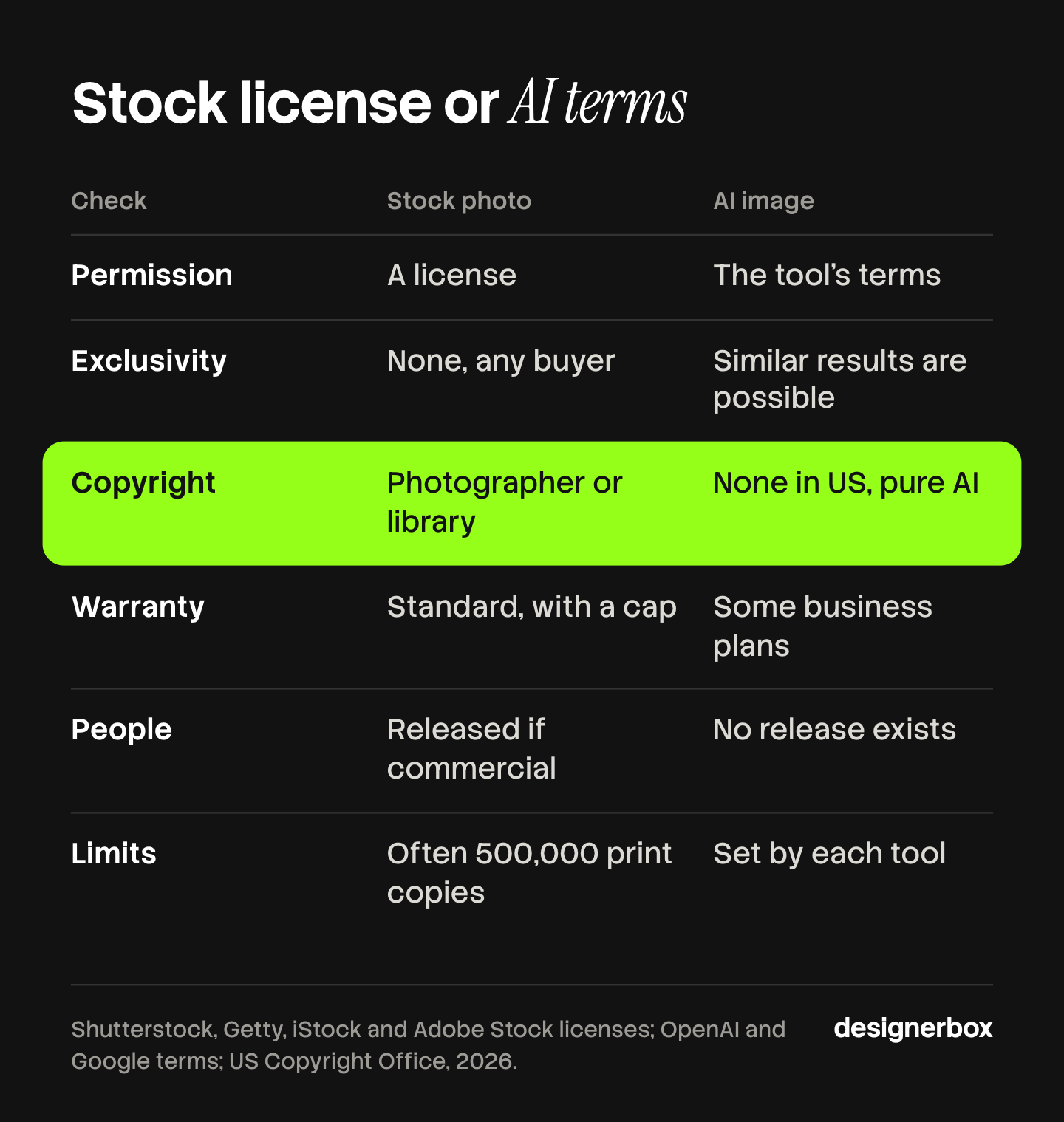
A stock photo comes with a license from the library, which holds permission from the photographer and, for commercial images, from the people in the frame. An AI image comes with the tool’s terms of use. One is a contract that warrants the image. The other is a contract that mostly says the vendor will not claim it.
| Check | Stock photo | AI image |
|---|---|---|
| Who gives permission | The library, under a license | The tool, under its terms of use |
| Who else can use it | Any other buyer | Nobody else has your file, but similar results are possible |
| Copyright | The photographer or library holds it | None in the US for a pure AI image |
| Warranty if someone claims | Standard on paid libraries, with a cap | On some API and business plans, with exclusions |
| People in the frame | Released, when the image is marked for commercial use | No release exists. Label rules can apply |
| Listed limits | Editorial only, sensitive use, print caps, no logos | Set by each tool, and sometimes by plan |
The rest of this guide takes the rows one at a time.
What does a stock photo license allow in an ad?
A standard royalty-free license allows a stock photo in online ads, social posts and print, worldwide and with no end date. It does not make the image yours. Four limits matter for advertisers, and all four are in the license text of the large paid libraries.
It is non-exclusive. Getty Images says its license means “you do not have exclusive rights to use the content. Getty Images can license the same content to other customers” (gettyimages.com/eula, read October 2026). In 2004 a trade newsletter reported that Dell and Gateway both picked images of the same model from the same shoot for their back-to-school ads (Selling Stock, 30 July 2004). Nothing in either license was broken.
Editorial images cannot go in ads. iStock’s license says content marked “editorial use only” may not be used “for any commercial, promotional, advertorial, endorsement, advertising” purpose, and that this content “is not model or property released” (istockphoto.com/legal/license-agreement, read October 2026). A photo of a real event or a public figure usually has this mark.
Sensitive uses are restricted. Shutterstock’s license bars showing a model “as suffering from, or medicating for, a physical or mental ailment”, or in a political ad (shutterstock.com/license, read October 2026). Getty and iStock allow some of these uses only with a note that the person is a model. A health or supplement brand meets this limit first.
Print and audience caps exist. Shutterstock, iStock and Adobe Stock cap a standard license at 500,000 printed copies. Shutterstock and Adobe Stock also cap some audience sizes outside websites and social media (stock.adobe.com/license-terms, read October 2026). Online ads carry no impression cap in the Shutterstock grant.
One more: the image cannot become your logo. Getty’s license bars using content “as the distinctive or distinguishing feature of a trademark”.
Free libraries give you less protection. Unsplash allows commercial use and says it “cannot make any guarantees about the scope of permitted uses” where people or trademarks appear (help.unsplash.com, read October 2026). Pexels states “we offer no warranty, explicit or implied, regarding any content” (pexels.com/terms-of-service, read October 2026). For how the four license variables work on a commissioned shoot, see image licensing and usage rights.
What do AI tool terms give you?
AI tool terms usually give you the vendor’s rights in the image and permission to use it commercially. They rarely give you exclusivity, and they can attach conditions to a plan or a model. Check three things in every tool.
- The plan. Some tools tie ownership or commercial use to a paid plan. Midjourney’s terms say you own the assets you create, with exceptions, and one exception requires larger companies to be on a higher plan (docs.midjourney.com, terms effective 27 May 2026). Adobe says results from Firefly features without the beta label can be used in commercial projects (helpx.adobe.com, read October 2026).
- The model. One vendor can publish different terms per model. Black Forest Labs licenses the FLUX dev model for non-commercial purposes only, while the same license says you may use its output “for any purpose (including for commercial purposes)” (Black Forest Labs, accessed October 2026). Who runs the model matters as much as what the image is.
- Similar results. OpenAI’s terms say “output may not be unique and other users may receive similar output”. Google reserves the right to “generate the same or similar content for others”. The originality of an AI image is likely, and it is not promised.
Tool terms also decide what you can take with you when you leave. That side is covered in creative tool lock-in.
Are AI generated images copyrighted?
In the United States, no, when AI alone made the image. The US Copyright Office says generative AI results “can be protected by copyright only where a human author has determined sufficient expressive elements”. That can include a human’s creative arrangement or changes, “but not the mere provision of prompts” (US Copyright Office, 29 January 2025).
Three facts frame this for an advertiser:
- You can still use the image. No copyright means nobody owns it. You do not need a copyright to run an ad.
- You cannot stop a copy. A competitor who reuses your pure AI image has likely broken no US copyright. A stock photo has the opposite profile: someone owns it, and that owner is not you.
- Your human work counts. The layout, the copy, the edit and a product photo you took are human work. The Office protects those parts and leaves the AI-made parts unprotected. If you register a work, its 2023 guidance asks you to disclose the AI-made content (US Copyright Office, accessed October 2026).
Other countries differ. UK law says that for a computer-generated work “the author shall be taken to be the person by whom the arrangements necessary for the creation of the work are undertaken” (legislation.gov.uk, in force as of October 2026).
The practical rule: use AI images freely for ads that run for a few weeks. For an asset you would defend in court, such as a logo or a brand character, add real human authorship and keep a record of it.
Who pays if someone makes a claim?
On a paid stock library, the library usually does, up to a cap. Shutterstock warrants that an unaltered image will not “infringe any copyright, trademark or other intellectual property right” and says it will “defend, indemnify, and hold you harmless” up to a limit. Adobe Stock and iStock have similar clauses with caps. Editorial images are excluded.
For AI images, that protection sits mostly in business contracts:
- OpenAI extends its indemnity for API and Enterprise customers to claims that their use of Output infringes a third party’s intellectual property right. It excludes modified output and trademark claims (OpenAI service terms, accessed October 2026).
- Google Cloud covers “an unmodified Generated Output” from the services on its indemnified list, and not from a service provided free of charge (Google Cloud service terms, accessed October 2026).
- Adobe says enterprise customers “may purchase an entitlement that comes with contractual IP indemnification for select Firefly outputs” (business.adobe.com, read October 2026).
Two things follow. The image tool inside a consumer plan may carry no such promise, so read the terms. And several of these clauses exclude trademark claims. If a result shows another brand’s logo, that risk stays with you.
The courts have not settled the main question. In Getty Images v Stability AI, the High Court of England and Wales ruled on 4 November 2025 that the secondary copyright claim failed, and called its trade mark findings “historic and extremely limited in scope”. The claim about outputs was abandoned at trial, so the court did not decide it (Courts and Tribunals Judiciary, accessed October 2026). In the US, Andersen v. Stability AI is set for trial on 5 April 2027 (BakerHostetler case tracker, accessed October 2026).
Do stock photos or AI images work better in ads?
No independent study that I found tests stock photos against AI images in the same ads. The evidence that exists points one way for both: an image that carries information gets attention, and a generic one does not.

Nielsen Norman Group’s eye-tracking research found that users “ignore fluffy pictures used to ‘jazz up’ web pages” and that “users ignore stock photos of generic people”. Photos of products and real people were studied closely (Nielsen Norman Group, 2010, last reviewed 13 August 2026). The study covers web pages, not paid ads, so treat it as a direction.
The same weakness applies to AI. A generic AI scene with no product is filler, the same as a generic stock photo. The research on AI ad performance, including where viewers react badly to images that look AI-made, is in AI generated ads. For the choice by job, see ad visuals from AI, stock or a shoot.
For a brand that sells a physical product, there is a third option. Start from your own product photo and let AI build the scene around it. You own the photo, the product in the frame is the one you ship, and the scene is unique to you. The rule for that method is in AI product ads.
Do AI images need a label that stock photos do not?
Sometimes. In the EU, Article 50 of the AI Act has applied since 2 August 2026. A business that publishes a deep fake must disclose it. The Commission defines a deep fake as AI-generated or manipulated content that “resembles existing persons, objects, places, entities or events and would falsely appear to a person to be authentic or truthful” (European Commission, accessed October 2026). The ad platforms add their own labels. The full list is in AI disclosure in advertising.
A stock library is no longer a guarantee of a camera-made image. Adobe Stock accepts generative AI content from contributors and requires them to mark it (helpx.adobe.com, read October 2026). Getty Images says it “does not accept AI-generated visuals in our Creative and Editorial libraries” (gettyimages.com, read October 2026). Check the label on the image before you assume.
People are the other difference. A commercial stock image comes with a model release. An AI person has nobody to sign one, and a result that looks like a real person can still raise a likeness claim. See what a model release has to cover.
Six rights checks before an image goes into an ad
Run these six on either source. Each takes a minute, and each one maps to a row in the table above. A studio that sells AI-made sets to clients runs four checks before it signs, listed in white label content for studios.
- Permission. For stock, confirm the license type and that the image is not marked editorial. For AI, confirm that your plan and the model allow commercial use.
- Exclusivity. Assume a stock photo is in someone else’s ad. Assume a similar AI image is possible.
- Copyright. If you need to defend the asset, add human authorship and keep the working files.
- Warranty. Find the indemnity clause, its cap and its exclusions. If there is none, the risk is yours.
- People and marks. No real person’s likeness without a release. No other company’s logo or product in the frame.
- Limits and labels. Check the print cap and the sensitive-use rule for stock. Check the label rules for AI in each market where the ad runs.
Your own product in every ad
Anyone can make an AI picture. Making hundreds that still look like your brand is the hard part. DesignerBox is AI creative production for brands and agencies. It starts from the third option above: your own product photo.
- The product photo is yours. A workflow starts from the photo you add and builds the scene around it. You are not picking from a shared library.
- The brand is a record. You set the logos, fonts, colors and rules once in your brand profile. The workflow reads it on every run.
- One job, every product. You build the ad set once, publish it as an app for a colleague, and batch runs it over a whole sheet of products. You review the results in one pass.
The full workflow from the first product photo to the finished ad, in one subscription. Uploading your own photos and the commercial license start on the Pro plan, and plans are on the pricing page.
Apply the six checks to DesignerBox as you would to any tool. Read its terms before you rely on a licensing claim, this one included. US copyright law treats its results like any other AI image. DesignerBox does not post to your ad accounts: you download the results, or send them with a webhook or an S3 step. Every plan below Ultra is one seat, so an agency team needs Ultra. The ad side is on the AI ad generator page.
A free plan for your first run
There is a free plan, and it runs on sample products. Start from a template and see the cost before you run it.
FAQ
Can you use AI images commercially for free?
It depends on the tool. Some tools allow commercial use on every plan, and some tie it to a paid plan or to a specific model. Read the commercial-use line in the terms for the plan you are on before the image goes into an ad.
Are AI images copyright free?
In the US, an image made only by AI has no copyright, so nobody owns it. That is different from “safe to use”. The image can still show a real person’s likeness or another company’s trademark, and the tool’s terms still apply to you.
Can I copyright an ad that contains an AI image?
You can protect the human parts. The US Copyright Office protects a person’s creative selection, arrangement and changes, and it leaves the AI-made material unprotected. Its 2023 guidance asks applicants to disclose AI-made content when they register a work.
Can I use a stock photo in a paid ad?
Yes, under a standard royalty-free license, if the image is not marked editorial. The license is non-exclusive, restricts sensitive uses such as health conditions and political ads, and often caps print runs at 500,000 copies.
Are AI images better than stock photos for advertising?
For rights, they trade places. Stock gives you a warranty and no exclusivity. AI gives you an image nobody else has licensed, with no copyright and often no warranty. For attention, a generic image of either kind is weak. An image of your real product is stronger.
Do I need a model release for an AI-generated person?
No release exists for a person who does not exist. A label duty can apply instead, and a result that looks like a real person can still raise a likeness claim. Check the rule in each market where the ad runs.
Sources
- OpenAI Terms of Use and OpenAI service terms, accessed October 2026
- Google AI for Developers: Gemini API additional terms, effective 23 March 2026, and Google Cloud service terms, accessed October 2026
- Black Forest Labs terms of service and FLUX dev non-commercial license, accessed October 2026
- US Copyright Office: Part 2 of the report on copyright and AI, 29 January 2025, and Copyright and Artificial Intelligence, accessed October 2026
- Copyright, Designs and Patents Act 1988, section 9, legislation.gov.uk, accessed October 2026
- Getty Images v Stability AI, [2025] EWHC 2863 (Ch), Courts and Tribunals Judiciary, 4 November 2025
- BakerHostetler: case tracker for AI, copyright and class actions, accessed October 2026
- European Commission: transparency obligations under Article 50 of the AI Act, accessed October 2026
- Nielsen Norman Group: Photos as Web Content, 31 October 2010, last reviewed 13 August 2026
- Selling Stock: Random Thoughts 83, 30 July 2004
- Shutterstock license (shutterstock.com/license), Getty Images license (gettyimages.com/eula), iStock license (istockphoto.com/legal/license-agreement) and Adobe Stock license terms (stock.adobe.com/license-terms), read October 2026 through archived copies dated 26 to 30 September 2026
- Unsplash license and releases pages (unsplash.com/license, help.unsplash.com) and Pexels license and terms (pexels.com/license, pexels.com/terms-of-service), read October 2026
- Midjourney terms of service (docs.midjourney.com), effective 27 May 2026; Adobe Firefly FAQ and contributor help (helpx.adobe.com) and Firefly for business (business.adobe.com), read October 2026
- Getty Images policy on AI-generated content (gettyimages.com/company/ai-free-imagery-policy), read October 2026
- DesignerBox brand, batch, AI ad generator and pricing pages (designerbox.ai), October 2026
License terms, tool terms and legal sources verified as of October 2026. This is general information, not legal advice. Individual results vary.