


Ad fatigue is the drop in results when the same people see the same ad too many times. People engage less, and your cost per result rises. Meta can flag it in Ads Manager: “Creative limited” when cost per result is above your past ads, and “Creative fatigue” when it is twice as much or more. The fix is a new ad that looks different.
The ad that carried last month now costs more for every purchase. The audience, the bid and the offer are the same. Only the ad got older, and the next shoot is weeks away. That gap is the job the DesignerBox workflow for performance marketers is built for: new versions of a winning ad from the product photo you already have.
This guide covers the signals that confirm ad fatigue, what Meta, TikTok and Google document about it, and a refresh playbook built on variants of your own winners. It is written for performance marketers at brands and agencies who run paid social every week.
Key Takeaways
-
Meta’s flag reads cost per result. Ads Manager shows “Creative fatigue” when an ad costs at least twice as much per result as your past ads. It shows “Creative limited” when the cost is higher than before but under twice as much.
-
Meta publishes no frequency threshold. “Keep frequency under 3” is a practitioner habit. Meta’s glossary says frequency may average 1 to 2 per ad set, or much higher.
-
Similar ads tire together. Meta separates creative fatigue from creative similarity. A new color on the same layout can read as the same ad.
-
Refresh the first thing people see. Keep the product, the offer and the claim that won. Change the hook, the first frame, the format or the market.
-
Add, do not replace. Meta advises a new ad that is materially different, with the original kept running.
-
TikTok names a number. It says advertisers use at least 12 videos each month to avoid ad fatigue in Smart+ or GMV Max campaigns.
What is ad fatigue?
Ad fatigue is the decline in an ad’s results after its audience has seen it many times. Meta says creative fatigue occurs when an audience has seen the same creative too many times, so people engage less and cost per result rises. It is a problem of repeated exposure. The product and the offer can still be right.
Three terms get mixed up, and each one has a different fix.
- Creative fatigue is exposure to the same image or video. The fix is a new creative.
- Audience fatigue is a small audience that the budget has reached many times. The fix is a wider audience, or less budget on it.
- Creative similarity is Meta’s name for ads that are “visually too alike, even if technically different assets”. Meta says high similarity “can also drive fatigue, as users perceive ads as repetitive” (facebook.com/business/news, December 2025).
Researchers call the build-up of an ad’s effect “wear-in” and the decline after too many exposures “wear-out” (Pechmann and Stewart, doi.org, 1988). A 2019 study adds a detail. The annoyance from frequent repetition faded over the following weeks, while memory of the brand stayed. The brand shown more often was preferred later, but only when its product category was relevant to the person then (Kronrod and Huber, doi.org, 2019). That is one reason to rest a tired winner instead of deleting it.
What causes ad fatigue?
Ad fatigue comes from frequency: the same people see the same ad again and again. Meta calculates frequency as impressions divided by reach, the average number of times each person saw your ad. Frequency climbs when the budget grows faster than the audience, and when one creative carries the whole ad set.
Meta’s glossary says frequency “may average 1 to 2 per ad set or may be much higher, depending on your budget, audience size and schedule”. If performance drops as frequency rises, “your target audience may be experiencing ad fatigue” (facebook.com/business/help, September 2026).
Four conditions speed it up:
- A small audience with a rising budget. Reach stops growing, so impressions go to the same people.
- One creative carrying the ad set. Every impression goes to one image or video.
- Variants that look the same. Ten colors of one layout are one ad to the viewer.
- The same creative in several campaigns. Meta counts recent exposures of the image or video from your other campaigns too. A winner in both prospecting and retargeting tires faster than either report shows.
The 2.5, 3 and 3.5 frequency thresholds often quoted online are practitioner rules, not Meta numbers. How to scale AI ad campaigns without burning budget shows which figures come from Meta.
How do you spot ad fatigue?
You spot ad fatigue when two or more signals appear on the same ad at the same time: frequency rises, click-through rate falls, and cost per result climbs while targeting, bid and offer stay the same. On Meta, the Delivery column may also show “Creative limited” or “Creative fatigue”. One signal alone is often noise.
| Signal | Where you see it | What it tells you |
|---|---|---|
| Frequency rises while results fall | Meta Frequency column | The same people see the ad more often |
| CTR falls on the same ad | Ad-level CTR, this week against last | Fewer people stop for this creative |
| Cost per result rises, nothing else changed | Cost per result by ad | Each result costs more to deliver |
| ”Creative limited” or “Creative fatigue” | Meta Delivery column | Meta’s own call, based on cost per result |
| Engagement rate ranking falls | Meta ad relevance diagnostics | Your ad against ads for the same audience |
| Delivery falls steadily, few daily new users | TikTok Ads Manager | TikTok’s two stated reasons to refresh |
Meta’s ad relevance diagnostics need at least 500 impressions, and they are not inputs into the auction (facebook.com/business/help, September 2026). They describe the ad. They do not decide its delivery.

Before you blame the creative, check what else changed. A new landing page, a new offer, a budget jump, a tracking fault or a holiday week can move the same numbers.
What does Meta’s creative fatigue status mean?
Meta ad fatigue has its own label in the Delivery column of Ads Manager. It tells you that the audience has seen the ad’s image or video too many times, and that the ad now costs more per result than your past ads. “Creative limited” is the milder label. “Creative fatigue” means the cost is twice as much or more.
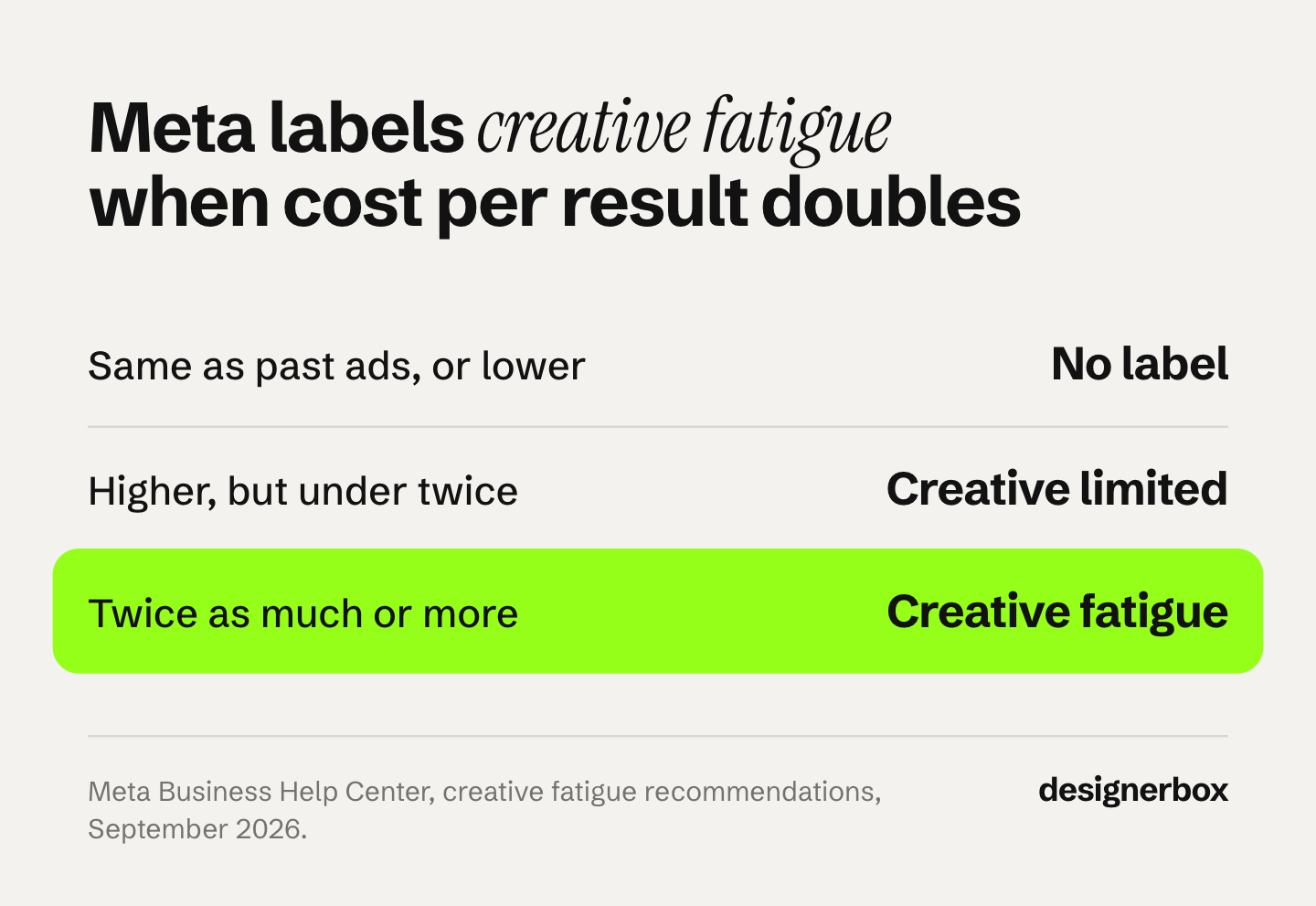
Meta’s help page lists the rules (facebook.com/business/help, September 2026):
- Before launch: if Meta predicts creative fatigue in the first 7 days, it warns you before you publish.
- The threshold is cost per result. Above your past ads but under twice as much is “Creative limited”. At 2x or more, it is “Creative fatigue”. At or below your past cost, neither label applies.
- Exposure counts across campaigns. Meta counts recent exposures of the image or video from other campaigns on your Page.
- Only some ad sets qualify. Meta says the feature is available only for ad sets with one creative, with exceptions for some automated formats.
So if your ad sets hold three to five ads, you may see no fatigue status at all. Your own weekly check has to do that job.
Meta’s fix is to create another ad with an image or video that is “materially different from the original creative”. It notes that keeping the original ad active, instead of pausing it, may maximize results. It also suggests a wider audience, or Advantage+ creative.
Every refresh costs some learning. Meta lists any change to ad creative, and adding a new ad, as significant edits that send an ad set back into the learning phase (facebook.com/business/help, September 2026). Add variants together, not one a day. How to keep the result readable is covered in ad creative testing.
What do TikTok and Google document about ad fatigue?
TikTok names refresh triggers and a monthly volume. Google gives you a frequency cap on some campaign types. Meta’s ad set guidance sits in the last row for comparison.
| Platform | What it documents | Source |
|---|---|---|
| TikTok | Refresh when delivery shows a steady decline or daily new users are low. Add new creatives to the existing ad group | ads.tiktok.com, September 2026 |
| TikTok | Smart Creative watches new videos for 3 to 5 days and pauses the ones that show fatigue | ads.tiktok.com, November 2025 |
| TikTok | At least 12 videos each month in Smart+ or GMV Max campaigns | ads.tiktok.com, September 2026 |
| Google Ads | Frequency caps in Display and Video campaigns. Not in Demand Gen | support.google.com, September 2026 |
| Meta | No more than five ads per ad set, each one distinct | facebook.com/business/ads, September 2026 |
TikTok also suggests 3 to 5 different creatives per ad group. A frequency cap limits how often one person sees the ad, so it can slow fatigue. It cannot give the viewer something new. Automated rotation, such as Smart Creative or Advantage+ creative, still needs new material. How platforms build ads from the parts you supply is covered in dynamic creative optimization.
How do you fix ad fatigue without losing the winner?
Fix ad fatigue with variants of the ad that won. Keep what the data proved: the product, the offer and the claim. Change what the viewer sees first, so the new ad is materially different to Meta and new to the person. Add the variants next to the original.
| Lever | What changes | What stays | Example |
|---|---|---|---|
| New hook | Headline, first line of copy, first spoken line | Product, offer, claim | ”Free returns” becomes “Try it for 30 days” |
| New first frame | The opening image, or the first second of video | Hook, product, offer | Packshot opening becomes the product in use |
| New format | Static to video, 1:1 to 9:16, image to carousel | The whole message | A static winner becomes a short video |
| New market | Language, currency, local setting | Layout, offer, claim | The English winner rebuilt in German |
Change one lever per variant when you want to learn which one mattered. Change two when the winner is badly tired. A color swap on the same layout is not a lever, because Meta’s similarity point applies to it. When you have used every lever, write a new creative concept and test it.

A format change is the largest visual change of the four. A static winner that becomes a 9:16 video is a new ad to the viewer, and AI video ads can start from the same product photo. Static ads vs video shows where static still wins. Each new format also needs its placements, which one ad in every platform size covers. The sizes for a static version are in image ad specs for five platforms.
How often should you refresh ad creative?
Refresh ad creative when the signals say so. Meta names no refresh interval. TikTok names a monthly volume for its automated campaigns. For the rest, a daily status check and a weekly trend check show which ad needs a variant.
This cadence is a starting point, not a platform rule. Change the intervals to fit your spend.
| When | What to check | What to do |
|---|---|---|
| Every day | Meta Delivery column status | ”Creative fatigue” on a winner: add a variant today |
| Every week | CTR and cost per result by ad, against last week | A winner that fell two weeks in a row: new hook or first frame |
| Before a launch or a big budget increase | Meta’s fatigue warning before you publish, and the audience size | Run two or three distinct ads |
| Every month | Share of spend on ads older than your last refresh | Brief one new concept, not only variants |
| Every quarter | The winners you rested | Test a rested winner again with a new first frame |
On TikTok’s automated campaigns, the monthly line has a number: at least 12 videos. On Meta, the number comes from your account. How many variants a month fits each spend level is in ad variants at scale.
Ad variants from your own winners
Anyone can make an AI picture. Making hundreds that still look like your brand is the hard part. A tired winner needs new versions that change the first frame and keep the product, the colors and the voice.
DesignerBox is AI creative production for brands and agencies. You build the refresh once as a workflow. It takes your winning ad and your product photo. It applies your brand rules. It returns new versions with a new headline, a new first frame or a new size. The winning-ad variations template makes new versions of an ad that already works. The ad localizer rebuilds one ad in another language and redraws the layout. The AI ad generator starts a new concept from your own product photo.
You set the brand once, and the workflow reads it on every run. Batch runs one workflow over a whole sheet of products, and you review the results in one pass. Three critic steps score the results, and best-of-N keeps the best one. You still read every headline before an ad ships. The cost of a run is shown before you press Run. Video starts on the Premium plan. An 8-second clip costs 40 to 560 credits, depending on the model.
The full workflow from the first product photo to the finished ad, in one subscription.
Here are the limits. DesignerBox does not publish into Meta or TikTok. You download the results, or send them with a webhook or an S3 step. Uploading your own photos and the commercial license start on the Pro plan. Team features, shared brand kits and white label are on the Ultra plan, and every plan below Ultra is one seat. The free plan cannot make video. DesignerBox for performance marketers shows the setup for paid social.
A free plan for your first run
There is a free plan, and it runs on sample products. Start from a template and see the cost before you run it. Get started free.
FAQ
What is ad fatigue in marketing?
Ad fatigue is the drop in an ad’s results after the same people have seen it many times. Engagement and click-through rate fall, and cost per result rises. It comes from repeated exposure. The usual fix is a new version of the ad that looks different, shown next to the original.
What does “Creative fatigue” mean in Meta Ads Manager?
It is a delivery status. Meta shows it when an ad’s cost per result is at least twice as much as your past ads, because the audience has seen the image or video too often. “Creative limited” is the milder status, for a cost above your past ads but under twice as much.
What frequency causes ad fatigue on Facebook?
Meta publishes no frequency threshold. Its glossary says frequency may average 1 to 2 per ad set, or much higher, depending on budget, audience size and schedule. When results fall as frequency rises, the audience may have ad fatigue. The right number for your account comes from your account.
How often should you refresh ad creative?
Refresh when the signals say so. Check the Meta delivery status every day, and CTR and cost per result every week. Add a variant when a winner falls two weeks in a row. On TikTok’s Smart+ or GMV Max campaigns, TikTok says advertisers use at least 12 videos a month.
Should I pause an ad that shows creative fatigue?
Meta suggests you keep it running and add a new ad with a materially different image or video. It notes that keeping the original active, instead of pausing it, may maximize results. Add two or three variants at the same time, so the ad set restarts learning once.
What is the difference between creative fatigue and creative similarity?
Creative fatigue is overexposure to the same image or video. Creative similarity is Meta’s term for ads that look too alike, even as different files. Meta says high similarity can also drive fatigue. A new color on the same layout is similar. A new first frame or a new format is different.
Sources
- Meta Business Help Center, About creative fatigue recommendations in Meta Ads Manager: facebook.com/business/help/1346816142327858, accessed September 2026
- Meta Business Help Center, Glossary of reservation terms (formerly reach and frequency): facebook.com/business/help/230299314945919, accessed September 2026
- Meta Business Help Center, About ad relevance diagnostics: facebook.com/business/help/403110480493160, accessed September 2026
- Meta Business Help Center, Significant edits and learning phase: facebook.com/business/help/316478108955072, accessed September 2026
- Meta for Business, ad set structure: facebook.com/business/ads/ad-set-structure, accessed September 2026
- Meta for Business, “Demystifying creative diversification”: facebook.com/business/news, 16 December 2025, accessed September 2026
- TikTok Ads Help Center, Creative best practices: ads.tiktok.com/help/article/creative-best-practices, accessed September 2026
- TikTok Ads Help Center, About Smart Creative: ads.tiktok.com/help/article/smart-creative, last updated November 2025, accessed September 2026
- TikTok Ads Help Center, Account optimization recommendations: ads.tiktok.com, accessed September 2026
- Google Ads Help, Use frequency capping: support.google.com/google-ads/answer/6034106, accessed September 2026
- Pechmann, C. and Stewart, D. W., “Advertising repetition: a critical review of wearin and wearout”, Current Issues and Research in Advertising 11(1-2), 1988: doi.org/10.1080/01633392.1988.10504936
- Kronrod, A. and Huber, J., “Ad wearout wearout: how time can reverse the negative effect of frequent advertising repetition on brand preference”, International Journal of Research in Marketing 36, 2019: doi.org/10.1016/j.ijresmar.2018.11.008, accessed September 2026
- DesignerBox for performance marketers (designerbox.ai/for/performance-marketers), September 2026
Ad fatigue rules verified from Meta, TikTok and Google help pages as of September 2026. Individual results vary.