


Labeling AI-generated content in fashion applies to a small part of a drop. Since 2 August 2026, Article 50(4) of the EU AI Act has required deployers to disclose deep fakes: realistic AI images, audio or video that could pass as real. A relit packshot, a swapped background and a flat lay usually sit outside that. A photorealistic AI model wearing your garment is likely inside it.
The trigger is a synthetic person. Using AI does not trigger the label on its own. That distinction decides almost every asset you ship. It also sits inside a bigger picture: where AI in fashion has real evidence behind it and where it does not. The usual argument runs that fashion has always retouched, so singling out AI applies a standard the industry never held itself to.
The argument is correct. It also loses, because France has required a label on commercial photos with a retouched body since 2017.
This covers labeling AI-generated content in fashion as it applies to a brand right now: which assets in a drop trigger anything, what the research says a label costs, and how to stop treating disclosure as a task somebody has to remember.
Key Takeaways
- The trigger is a synthetic human. Using AI is not enough on its own. The European Commission’s guidelines say color correction, background replacement for clearly aesthetic purposes, rescaling and arranging existing products are likely to have only a minor impact, so they usually do not make an image a deep fake (European Commission, C(2026) 5054, published 20 July 2026, non-binding).
- An invented model can still count. The guidelines cover subjects that “can plausibly exist”, and read “persons” to include “realistic AI-generated human avatars or personas”. A model who is nobody real is likely still in scope.
- The retouching double standard is real and already answered. France has required a “Photographie retouchée” notice on silhouette-altered commercial images since October 2017. The fine is EUR 37,500 and can rise to 30% of the advertising spend (Légifrance, Décret n° 2017-738, and ARPP, September 2026).
- Metadata does not meet the duty. The guidelines say deployers “cannot rely on the machine-readable marking embedded in the content by the provider”. The label has to be visible to a person.
- Fines can reach EUR 15,000,000 or 3% of worldwide turnover, whichever is higher. For SMEs, startups and small mid-cap companies the cap is whichever is lower (AI Act Article 99(4), 99(6) and 99(6a)).
- The evidence is mixed on the label and clearer on the model. A preregistered study of 7,579 US adults found a plain “AI-generated” label had little effect on engagement intentions (PNAS Nexus, 2025). A study of 875 US consumers found AI models in fashion ads raised advertising skepticism and lowered purchase intention (Journal of Retailing and Consumer Services, June 2026).
- You may not get the choice. Meta, TikTok, YouTube and Pinterest can each add an AI label to your content themselves. The ecommerce shot list by channel rule shows where each label lands across a drop.
Should fashion brands label AI-generated images?
Fashion brands need to label only the AI-generated images that contain a photorealistic synthetic person, or that show the garment as better than it really is. Everything else in a normal drop, packshots, flat lays, ghost mannequin, relights and styled scenes built on a real garment photo, usually carries no disclosure duty under Article 50 of the EU AI Act or New York’s synthetic performer law, as of September 2026. You can label those anyway. The law does not ask for it, and the label has a cost.
The retouching double standard is real, and France already answered it
The strongest case against a labeling mandate goes like this. Fashion images have never been documentary. Garments are pinned at the back, bodies are reshaped, skin is cleaned, backgrounds are replaced, colors are pushed. None of that has ever carried a notice. Singling out AI applies a standard the industry declined to apply to itself for forty years.
Every part of that is true. It also assumes retouching goes unlabeled, and in the market that legislated it, it does not.
France’s Décret n° 2017-738 has required commercial photographs of models whose silhouette was slimmed or thickened by image-processing software to carry the notice “Photographie retouchée” since 1 October 2017. The wording is prescribed, it has to be legible and clearly separated from the ad, the advertiser carries the duty, and the fine is EUR 37,500, which can rise to 30% of the amount spent on the advertising (Légifrance, Décret n° 2017-738, and ARPP, September 2026).
Norway went further and standardized the mark itself. A regulation under its Marketing Control Act requires retouched advertising to carry a standard mark of about 7% of the image area, usually in the upper left corner, in force since 1 July 2022 (Lovdata, FOR-2022-06-17-1114, September 2026).
So the double standard argument is nine years late. Europe already decided that altering how a body looks in a commercial image is something shoppers get told about. AI did not introduce that principle. It inherited it.
The scope of those two laws is worth knowing precisely, because it cuts the other way. Both were written for a retouched photograph of a real person. Norway’s regulator has published its assessment that generating a wholly new body falls outside the labeling duty, while using AI to alter an existing body stays inside it (Forbrukertilsynet, updated September 2025). France closed part of that gap separately: Article 5 of Loi n° 2023-451 of 9 June 2023 requires the notice “Images virtuelles” on commercial influence content where AI produced a face or a silhouette, alongside “Images retouchées” for modified ones (Légifrance, Loi n° 2023-451, Article 5, September 2026). An ordinance of 6 November 2024 allows equivalent wording in place of those two notices.
The pattern across both is consistent. Retouching a real body is labeled. Inventing one was the gap, and the AI Act now reaches it when the image could pass as real.
What changed on 2 August 2026
Article 50 of the EU AI Act has applied since 2 August 2026. The Commission says the grace period covers one duty only. Tool makers whose generative systems were on the market before 2 August 2026 have until 2 December 2026 to add machine-readable marks. The deployer duty to label deep fakes has no grace period. The AI Omnibus, Regulation (EU) 2026/1744, in force since 27 July 2026, delayed the high-risk rules and did not move the Article 50 date (European Commission FAQ on Article 50 and Commission news on the AI Omnibus, September 2026). This is general information, not legal advice.
Two duties sit in Article 50 and they land on different parties. Article 50(2) makes the model provider mark outputs in a machine-readable format. Article 50(4) makes the deployer disclose when the content is a deep fake. The brand is usually the deployer: a company using an AI system professionally. The Commission’s guidelines say a company stays the deployer when contractors or freelancers operate the system on its behalf and under its control. A brand that only commissions an agency, and does not control how the agency uses AI, is not the deployer. A brand outside the EU is covered too, where it expects the AI images to be used in the EU.
Content generated before 2 August 2026 does not need retroactive labeling. The Commission encourages brands to label older deep fakes, without expecting heavy effort such as auditing existing content databases.
Fines for an Article 50 breach can reach EUR 15,000,000 or 3% of total worldwide annual turnover, whichever is higher (AI Act Service Desk, Article 99, accessed October 2026). For small and medium-sized companies, including start-ups, and for small mid-cap companies, the cap is the lower of the two figures. That changes the picture a lot for a DTC label. The full jurisdictional detail, including what Amazon, Etsy, Walmart, eBay and TikTok Shop each require, sits in marketplace rules and disclosure for AI product photos.
The trigger is a synthetic person, not a synthetic pixel
A deep fake under the AI Act is content that “resembles existing persons, objects, places, entities or events and would falsely appear to a person to be authentic or truthful”. Two readings in the Commission’s guidelines, published on 20 July 2026, decide how that lands on fashion work (European Commission, September 2026). The guidelines are not binding.
The first closes the escape hatch most brands reach for. It is enough that a simulated subject “can plausibly exist or could have plausibly existed” in reality. The guidelines then define “persons” to include “realistic AI-generated human avatars or personas”. An AI model who is nobody, who has no real counterpart and never signed a release, is likely inside the definition. Intention does not decide it: the guidelines say the assessment is objective and does not require an intention to deceive or mislead.
The second reading is the one that saves most of your catalog. The guidelines say these edits in product advertising are likely to have only a minor impact: “AI-powered color correction, background extensions of existing content, adjustments or replacements of backgrounds for clearly aesthetic purposes, compositions and arrangements of existing products, or re-scaling of images”. The worked example says a real product shown against an AI-generated background is not a deep fake, as long as the ad does not mislead about the product.
There is a third line worth knowing, because it catches accuracy rather than synthesis. The guidelines list as a deep fake “an AI-generated image of a product in advertisement or packaging that can affect the audience’s perception and mislead as to the actual product appearance, characteristics or use”, naming images that make a product look “more appealing or with improved quality than in real life”. A label is the wrong fix there. BBB National Programs, a US advertising self-regulator, wrote on 9 June 2026 that where the core deception is implied authenticity, an “AI-generated” disclosure “would be insufficient since the underlying claim is not truthful” (BBB National Programs, September 2026). If the image flatters the garment beyond what arrives in the box, the answer is a different image, which is why product photo accuracy is worth solving before compliance is a question at all.
Do not expect the artistic rule to help much. Deep fakes in clearly artistic, creative or fictional works still need a label, in a lighter form that does not spoil the work. Ads qualify for this only in specific cases. The guidelines exclude content whose nature “is exclusively informative or commercial and is recognisable as such”. Their list of deep fakes that are not artistic work includes a realistic synthetic influencer testing a sponsored real product. For a brand that plans such a character, AI influencer marketing covers how to test one first and where to label it.
Which assets in a drop trigger a label
Run this per asset. The triggers are asset-level, not campaign-level.
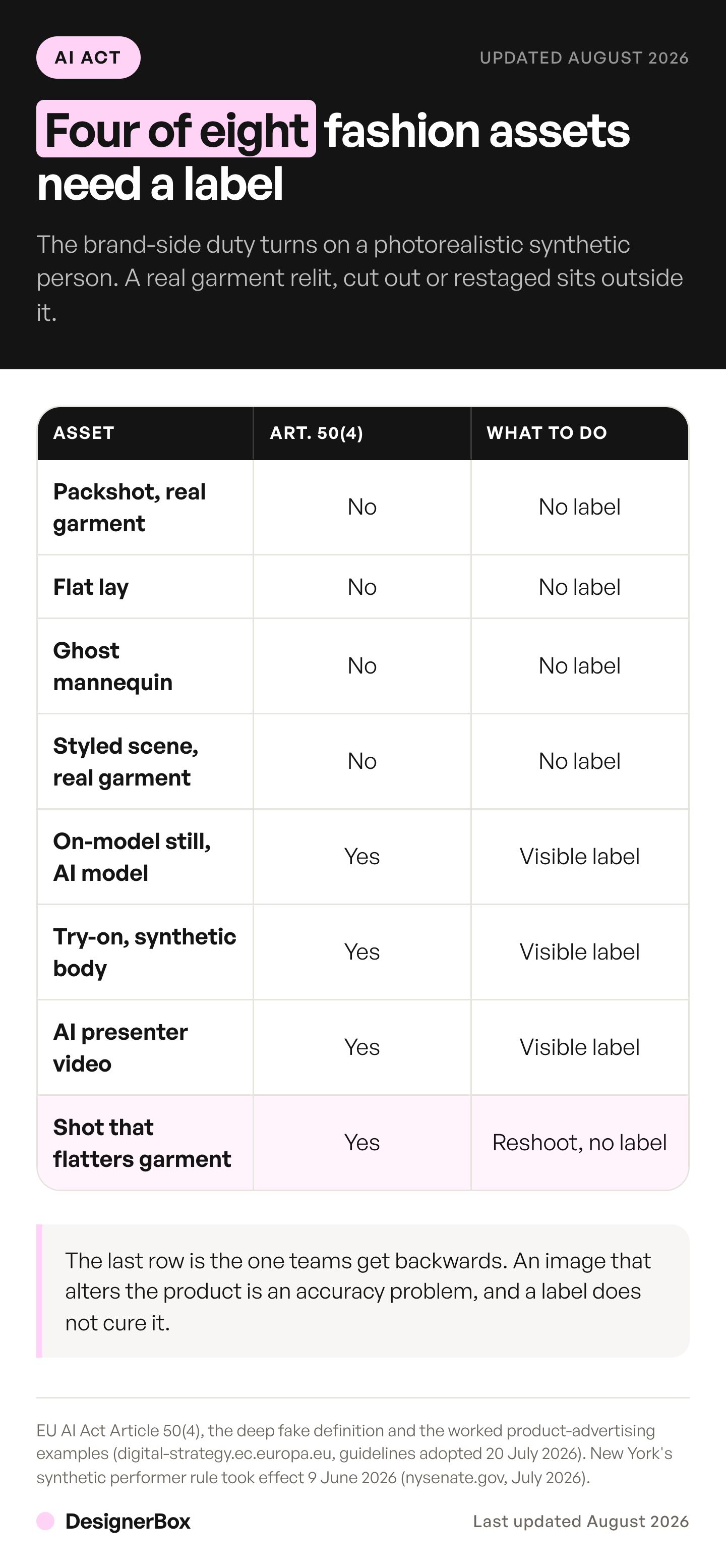
| Asset | What AI did | EU Art. 50(4) | New York | What to do |
|---|---|---|---|---|
| Packshot, real garment | Relight, cutout, rescale | No | No | No label |
| Flat lay | Arrange existing product photos | No | No | No label |
| Ghost mannequin | Composite, background | No | No | No label |
| Styled scene, real garment | AI background and environment | No | No | No label |
| On-model still, AI model | Generates a photorealistic person | Likely | Unsettled | Visible label |
| Virtual try-on on a synthetic body | Generates a photorealistic person | Likely | Unsettled | Visible label |
| AI presenter or UGC-style video | Generates a person and a performance | Likely | Yes | Visible label |
| Any shot that flatters the garment | Alters the product itself | Can be | n/a | Reshoot, do not label |
New York’s synthetic performer law, General Business Law section 396-b, took effect on 9 June 2026. New York State calls it the first law of its kind in the US. If you make an ad and you know it contains a synthetic performer, the ad must say so in a way people will notice. The law defines a synthetic performer as a digitally created asset meant to give the impression of “an audiovisual and/or visual performance of a human performer who is not recognizable as any identifiable natural performer”. The civil penalty is USD 1,000 for a first violation and USD 5,000 for each one after (nysenate.gov, GBL 396-b, September 2026). Retailer programs now use the same term: the terms of the Walmart Creator program require creators to disclose a synthetic performer to viewers.
The unsettled column is honest. The duty turns on a “performance”, and we found no New York guidance on whether a still product-page image is one, as of September 2026. Video is clearly covered. A packshot-style on-model still is arguable, and anyone telling you confidently either way is guessing. The EU answer likely puts a label on that asset already, so for a brand selling into both markets the question is mostly academic.
California passed a law similar to New York’s. The governor signed SB 1050 on 16 September 2026. It covers ads that prominently include a synthetic performer. Those ads need a clear disclosure, with wording close to “this performance features a synthetic performer”. The law takes effect on 1 January 2027 (leginfo.legislature.ca.gov, accessed September 2026).
We found no federal US rule that requires an “AI-generated” label on ads or product images, as of September 2026. FTC rules against deception still apply. In FTC v. Colgate-Palmolive (1965), the Supreme Court held that an undisclosed mock-up shown as a real test is deceptive, even when the product claim is true (Cornell LII, September 2026). The FTC says its 2024 rule on consumer reviews and testimonials was written so it does not ban virtual influencers (ftc.gov, September 2026). In December 2025 the FTC set aside its 2024 order against Rytr, a company whose AI tool wrote customer reviews (ftc.gov, December 2025). California’s AI Transparency Act is often cited here. It has applied since 2 August 2026. Since 30 September 2026 it covers any company that makes a generative AI system available in California, with no user threshold. Large platforms follow from 1 January 2027 and capture device makers from 1 January 2028. It does not put a labeling duty on a brand that publishes AI images (California SB 1000, accessed October 2026).
Every trigger in that table is a person or a misrepresentation, and the on-model row is where fashion does most of its AI work. If you generate on-model shots from a flat garment photo, that is the asset class to build a disclosure around. Your packshots, flat lays and styled scenes usually need no label. Sustainable fashion brands face a second set of rules on what an image claims. Sustainable fashion photography covers where AI labeling meets the green-claims rules.
You may not get the choice
The debate treats labeling as a decision the brand makes. Increasingly it is a decision made about the brand.
Meta’s ad policy says that from 1 June 2026 it checks ads for signs of third-party AI, such as C2PA metadata. When it finds them, it adds an “AI info” label under About this ad, and no advertiser action is needed (Meta Business Help, September 2026). Meta says this may not be available in every region. Meta asks advertisers to disclose AI only in ads about social issues, elections or politics. Meta says minor changes such as resizing or color correction get no label.
TikTok adds an AI label itself when content carries C2PA Content Credentials. Its help page is clear about what follows: with an automatic label, “you won’t be able to remove the label” (TikTok Support, September 2026).
YouTube requires creators to disclose realistic content that AI made or changed in a meaningful way. It lists the edits a brand usually makes as outside that: beauty filters, color and lighting filters, special effects filters, production assistance, and video sharpening or upscaling. YouTube can also add an AI label itself, including for content with C2PA metadata (YouTube Help, September 2026).
Pinterest labels Pins it finds to be AI-generated or AI-modified. It uses metadata and its own detection tools, and you can appeal a label through Pinterest support (Pinterest Help, September 2026). For creators, Pinterest affiliate marketing covers that label next to the disclosure rules.
Metadata is one route. TikTok, YouTube and Pinterest also run their own detection, so removing metadata does not reliably avoid a label. Detection still needs a signal, so platform labeling is likely rather than certain.
That still moves the question. It stops being whether to disclose, and becomes whether the label that appears is one you wrote, placed and controlled, or one a platform attached on your behalf, in wording you did not choose, in a menu you cannot edit.
What a label costs, and what costs more
Disclosure is not free, and pretending otherwise makes it harder to argue for internally. Two things are true at once, and holding both is what makes the decision tractable.
Consumers say they want it. In an IAB study of 505 US Gen Z and Millennial consumers published in January 2026, more than half wanted brands to disclose an ad that is fully AI-generated or that uses AI images or video (IAB, January 2026).
Disclosure also costs trust. Across 13 experiments, actors who disclosed their AI use were trusted less than those who did not. The effect held whether disclosure was voluntary or mandatory, and it ran through reduced perceptions of legitimacy (Organizational Behavior and Human Decision Processes, Vol. 188, 2025). That research covers organizational actors and work tasks broadly rather than fashion imagery, so read it as a direction rather than a conversion figure.
The same paper contains the finding that decides the question. Being exposed by a third party as having used AI without disclosing it was more damaging to trust than disclosing voluntarily. Put that beside the platform behavior above and the calculation resolves. Silence is rarely the real alternative. The choice is your own disclosure or a label from someone else.
Two more findings sharpen where the cost sits. In the same IAB study, 73% said clear disclosure would increase their likelihood to buy or make no difference. And in a mixed-methods study of 875 US consumers, fashion ads featuring AI models produced greater advertising skepticism, which reduced brand advocacy, word-of-mouth intention and purchase intention, with respondents naming job displacement and ethics (Journal of Retailing and Consumer Services, Vol. 92, June 2026).
The reputational cost sits mostly with the synthetic model. The sentence that admits it costs less. Using an AI model is the decision that carries the risk. Disclosing it is comparatively cheap, and hiding it converts a production choice into a credibility story. A creator who shows a garment on an AI model faces the same choice, and how to become a fashion influencer gives the label wording for it.
The Guess campaign in the August 2025 US issue of Vogue is the case worth studying, because it was disclosed. The two-page ad used AI-generated models. A small line in the corner read “Produced by Seraphinne Vallora on AI” (ContentGrip, 5 August 2025). CNN described the disclosure as small print and reported the criticism that followed on social media (CNN, 31 July 2025).
That is the shape of the risk. A disclosure that is present but easy to miss earns none of the trust a clear one would. It can still start the same criticism.
Disclosure as a property of the asset
Disclosure fails as a checklist item because it is asset-level and catalogs ship in large sets. Somebody has to remember, per file, months after the shoot, which route produced it.

Four habits make it part of the process instead.
Separate the two pipelines at generation. Assets with a synthetic person and assets without are different compliance objects. Save them into different folders from the start and the labeling question answers itself at export.
Start every asset from the real garment. When each asset traces back to a photograph of the actual product, you can check it against that product. A starting photo does not make an image accurate on its own, so you still compare. On DesignerBox, a workflow starts from your real garment photo and returns packshots, flat lays, on-model shots or video. Video starts on the Premium plan. You see the cost before the run. The how it works page shows the steps. The brand rules sit in one record, and each run reads them again. The labeled shots then match the rest of the catalog.
Keep the source photo with the result. Every accuracy dispute resolves by comparing the published image against the real product. A library that holds both makes that a lookup instead of an investigation.
Decide the label rule once, and save it with the workflow. Decide the rule on one garment. Save the workflow that produced the asset, and record the disclosure rule next to it. A saved workflow runs the same way on the next garment, so the next person who runs it applies the same rule. Batch runs one workflow over a whole sheet of products, and you keep or discard per row in one review pass.
For fashion work, the synthetic-person trigger applies to two kinds of result: a virtual try-on template on a generated model, and a model creator template for a reusable face. Uploading your own photos starts on the Pro plan, and virtual try-on starts on the Premium plan. The rest of a fashion catalog usually sits outside that trigger, and DesignerBox for fashion brands covers that work. Keeping both pipelines on one system helps here. The full workflow from the first product photo to the finished ad, in one subscription. The disclosure rule then travels with the workflow, not with a person. Fit is a separate problem from disclosure and a harder one, covered in what virtual try-on can and cannot tell a shopper about fit.
Start from a template, add your brand and your products, and run it. See the templates.
FAQ
Do I have to label AI-generated fashion images in the EU?
Only when the image is a deep fake. Article 50(4) of the EU AI Act has applied since 2 August 2026. It makes deployers disclose realistic AI images, audio or video that could pass as real. The European Commission’s guidelines say color correction, background replacement for aesthetic purposes, rescaling and arrangements of existing products usually have only a minor impact. They treat a photorealistic AI-generated person as likely inside the rule.
Does an AI model who is not a real person still need disclosure?
Likely yes, if the image is realistic. The Commission’s guidelines, published on 20 July 2026, say it is enough that a simulated person “can plausibly exist or could have plausibly existed”, and define “persons” to include “realistic AI-generated human avatars or personas”. The guidelines are not binding. New York’s synthetic performer law reaches a similar result by defining a performer who is “not recognizable as any identifiable natural performer”.
Is metadata or a watermark enough to comply?
No, not for the deployer duty. The guidelines say deployers “cannot rely on the machine-readable marking embedded in the content by the provider”, because people cannot see those markings without special tools. The disclosure has to be visible or audible at first exposure. Machine-readable marking is a separate obligation that falls on the model provider.
Do I need to relabel my existing catalog?
No. The Commission says deep fakes made before 2 August 2026 do not need to be labeled retroactively. It encourages brands to label older content, without expecting heavy effort such as auditing existing content databases.
What are the penalties for getting this wrong?
Article 99(4) of the AI Act sets fines for transparency breaches at up to EUR 15,000,000 or 3% of total worldwide annual turnover, whichever is higher. Under Article 99(6) and 99(6a), the cap for SMEs, startups and small mid-cap companies is whichever is lower. New York’s synthetic performer law is separate and carries a civil penalty of USD 1,000 for a first violation and USD 5,000 for each later one.
Does the US require labeling AI-generated product images?
Not at the federal level. As of September 2026, we found no federal rule that requires an “AI-generated” label on US ads or product images. FTC rules against deception still apply. The FTC says its 2024 rule on consumer reviews and testimonials was written so it does not ban virtual influencers. New York’s synthetic performer law is the rule aimed at a fashion advertiser, and it triggers on a synthetic human, where the person making the ad knows about it. We found no New York guidance on whether it reaches a still product-page image, as opposed to video.
Do platforms label AI content without me declaring it?
Several do. Meta checks ads for signs of third-party AI, such as C2PA metadata, and adds an “AI info” label itself when it finds them. It asks advertisers to disclose AI only in ads about social issues, elections or politics. TikTok adds a label to content that carries C2PA Content Credentials. Metadata is one route, and TikTok, YouTube and Pinterest also run their own detection. Detection still needs a signal, so a label is likely but not certain.
Sources
- Article 50 transparency obligations, the provider and deployer split, the first-exposure timing rule and the 2 August 2026 application date: AI Act Service Desk, Article 50 and European Commission FAQ on Article 50, September 2026
- The deep fake definition at Article 3(60), the “can plausibly exist” reading, the “realistic AI-generated human avatars or personas” definition of persons, the minor-edit examples, the product-advertising examples, the lighter label for artistic works, the metadata point, contractors and freelancers, third-country deployers and the no-retroactive-labeling rule: European Commission, Guidelines on the transparency obligations under Article 50, C(2026) 5054, published 20 July 2026, non-binding, digital-strategy.ec.europa.eu, September 2026
- The AI Omnibus, Regulation (EU) 2026/1744, in force since 27 July 2026, its delay of the high-risk rules and the provider-side marking grace period to 2 December 2026: European Commission news and EUR-Lex, Regulation (EU) 2026/1744, September 2026
- Fine caps at Article 99(4), the SME cap at Article 99(6) and the small mid-cap cap at Article 99(6a): AI Act Service Desk, Article 99, accessed October 2026
- France’s “Photographie retouchée” requirement, its 1 October 2017 start, the legibility standard and the EUR 37,500 fine that can rise to 30% of advertising spend: Légifrance, Décret n° 2017-738 of 4 May 2017, and ARPP, September 2026
- France’s “Images virtuelles” and “Images retouchées” notices for commercial influence content, and the November 2024 ordinance on equivalent wording: Légifrance, Loi n° 2023-451 of 9 June 2023, Article 5, September 2026
- Norway’s standard retouching mark, its size of about 7% of the image area, its placement and its 1 July 2022 start: Lovdata, Forskrift om merking av retusjert reklame, FOR-2022-06-17-1114, September 2026
- The Norwegian Consumer Authority’s view that the marking duty covers AI changes to an existing body and not a wholly generated one: Forbrukertilsynet, questions on retouched advertising, updated September 2025
- New York’s synthetic performer law, General Business Law section 396-b, its 9 June 2026 effective date, the definition and the penalties: nysenate.gov, September 2026
- California SB 1050, the synthetic performer disclosure duty for ads, its disclosure wording and its approval by the Governor on 16 September 2026: leginfo.legislature.ca.gov, accessed September 2026
- The FTC’s rule on consumer reviews and testimonials and its treatment of virtual influencers: FTC questions and answers, September 2026
- The FTC setting aside its 2024 order against Rytr: ftc.gov press release, 22 December 2025
- The Supreme Court holding that an undisclosed mock-up shown as a real test is deceptive: FTC v. Colgate-Palmolive Co., 380 U.S. 374, decided 5 April 1965, Cornell LII
- The position that an “AI-generated” disclosure does not cure a claim that is untruthful underneath it: BBB National Programs, “Digital Replicas, Synthetic Performers, and Advertising Law”, 9 June 2026
- California’s AI Transparency Act and AB 853, covering AI providers, large platforms and capture device makers: leginfo.legislature.ca.gov, September 2026
- California SB 1000, signed on 30 September 2026 as an urgency statute, which removes the user threshold from the definition of a covered provider: leginfo.legislature.ca.gov, accessed 2 October 2026
- Meta’s detection of third-party AI in ads, the “AI info” label, the region limit and the social issue, election and political ad disclosure rule: Meta Business Help and Meta SIEP ad standards, September 2026
- TikTok’s automatic label for content with Content Credentials, and that an automatic label cannot be removed: TikTok Support, September 2026
- YouTube’s disclosure requirement, its examples of edits that need no disclosure, and its automatic labels: YouTube Help, September 2026
- Pinterest’s AI labels, its detection tools and the appeal route: Pinterest Help, September 2026
- The trust penalty for disclosing AI use, its persistence under mandatory disclosure, and the finding that third-party exposure is more damaging than voluntary disclosure: Schilke, O. and Reimann, M. (2025), “The transparency dilemma: How AI disclosure erodes trust”, Organizational Behavior and Human Decision Processes, Vol. 188, article 104405, sciencedirect.com
- The effect of “AI-generated” labels on belief and engagement, two preregistered experiments with 7,579 US adults: “Labeling AI-generated media online”, PNAS Nexus, 2025, pmc.ncbi.nlm.nih.gov
- Consumer demand for AI disclosure and the effect of clear disclosure on purchase likelihood: IAB with Sonata Insights, “The AI Ad Gap Widens”, January 2026, n = 505 US Gen Z and Millennial consumers, iab.com
- Consumer response to AI models in fashion advertising: “AI vs. human models in fashion brand advertising: A schema theoretical perspective on consumer responses”, Journal of Retailing and Consumer Services, Vol. 92, June 2026, n = 875 US respondents, sciencedirect.com
- The Guess campaign in the August 2025 US issue of Vogue, the “Produced by Seraphinne Vallora on AI” line and the reaction: (CNN, 31 July 2025, and ContentGrip, 5 August 2025)
EU obligations verified from the European Commission’s Article 50 FAQ and guidelines, published 20 July 2026, and from the Commission’s notice on Regulation (EU) 2026/1744. US, French and Norwegian positions verified from nysenate.gov, ftc.gov, leginfo.legislature.ca.gov, Légifrance and Lovdata as of September 2026. Platform policies verified from Meta, TikTok, YouTube and Pinterest documentation as of September 2026. California SB 1000 and the Article 99 fine caps were re-checked on 2 October 2026. Policy in this area moves quickly. This is general information, not legal advice. Confirm your obligations for your own markets.