


Brand compliance means that every asset a company releases follows its own written rules. In marketing, a compliant image, ad or video passes three checks in a fixed order. It shows the real product. It follows the brand rules for logo, color, type and tone. It meets the rules of the channel where it will run, including any AI disclosure.
The term has a second meaning. In retail and supply chains, brand compliance is how a supplier or a store location meets the standards of the brand it sells under. This guide covers the marketing meaning only.
A small team can now make hundreds of assets in a week with AI. This guide turns brand compliance into a review standard: three checks, written rejection criteria, a named owner for each check, a one-page checklist and two numbers to track.
Key Takeaways
- Brand compliance is a review standard. A guideline says what the brand looks like. A standard says what a reviewer rejects, and who decides.
- Three checks, one order. Product truth first, brand rules second, channel rules third.
- Each check has one owner. The product owner signs product truth. The brand lead signs brand rules. The channel owner signs channel rules.
- Channel rules include AI disclosure. TikTok asks advertisers to label AI ad media, and Google Merchant Center asks for AI metadata on product images.
- Two numbers show progress. The first-pass approval rate, and the count of defects by type.
What is brand compliance?
Brand compliance is the practice of checking every asset against written rules before it reaches the public. The rules come from three places: the facts of the product, the brand guidelines, and the policies of each channel. An asset is compliant when it passes all three.
Brand guidelines are the second source. They cover logo use, color values, fonts and tone of voice. Our brand guidelines template shows how to write each one so a reviewer can check it.
A complete standard is wider than the guidelines. A picture can use the right logo and still show the wrong product, or break a platform policy.
Why AI makes brand compliance urgent
Before AI tools, a designer made a few ads a day, and the brand lead saw each one. Review was informal because volume was low. That limit is gone.
Here is an illustrative count. One sheet of 200 products with four pictures for each product gives 800 results in one run. If a reviewer spends 30 seconds on each picture, that is 400 minutes, or almost seven hours. The 30 seconds is an assumption, so time your own reviewer.
At this volume, informal review fails. Reviewers get tired and accept defects, or two reviewers apply two standards. Our guide to AI brand consistency explains why assets drift between tools.
The three checks, in a fixed order
Each check asks one question, and an early failure ends the review of that asset.
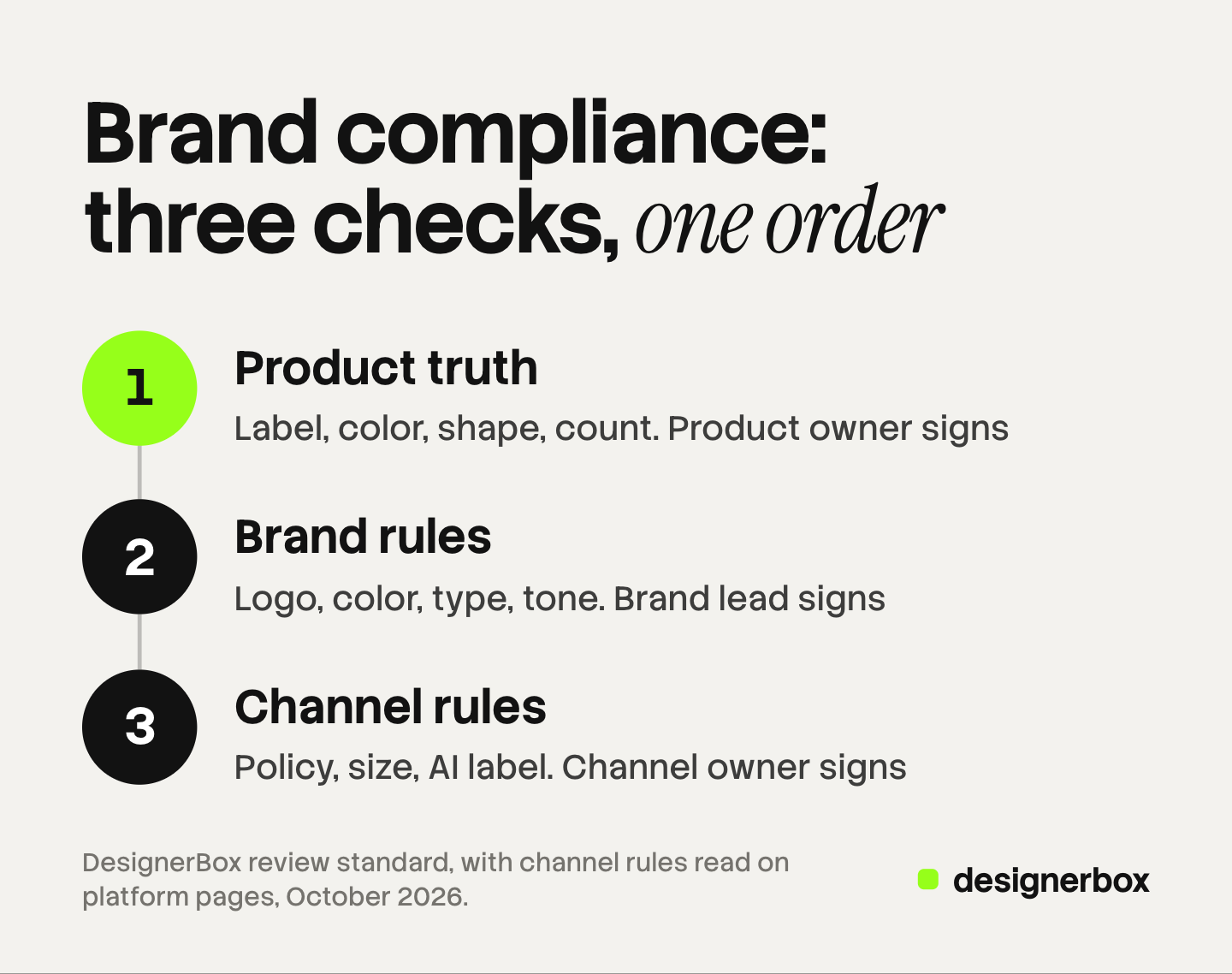
| Check | The question | The reviewer compares against | Who signs |
|---|---|---|---|
| 1. Product truth | Is this the real product? | The source photo and the product sheet | Product owner |
| 2. Brand rules | Does this look and sound like the brand? | The brand guidelines | Brand lead |
| 3. Channel rules | Can this run where it is going? | The channel’s own policy page | Channel owner |
Product truth comes first because a small edit cannot repair it. A wrong label means the asset shows something you do not sell. Brand rules come second, because one decision covers every version of an asset. Channel rules come last because they differ by destination. Our guide to four checks for AI ads covers which failures to reject and which to edit.
Check 1: product truth
The reviewer opens the source photo beside the result and compares the product, part by part.
Reject without discussion when:
- The label, logo or printed text on the product is changed, blurred or misspelled.
- The color differs from the approved product photo.
- The shape, proportion or a part of the product is different, added or absent.
- The count is wrong, such as two units where the listing sells one.
- The scene makes a claim that nobody approved, such as a result, an ingredient or an award.
These criteria follow the channels and the law. Amazon says a main image should accurately represent the real scale, quantity and color of the product (Amazon Seller Central, October 2026). Google’s image guidance says to match the image to the product option being sold, with the exact color, pattern, finish and material (Google Merchant Center Help, October 2026).
In the United States, the FTC says advertising must be truthful and non-deceptive, and advertisers must have evidence for their claims. It also says it looks at an ad in context, including the pictures (FTC advertising FAQ, October 2026). This is general information, not legal advice.
For a test that measures how well a model keeps a product, see our guide to AI product photo accuracy.
Check 2: brand rules
The reviewer compares the asset with the brand guidelines. The check works only when each rule describes something a person can see.
Reject without discussion when:
- The logo is redrawn, stretched, recolored or placed outside its clear space.
- A color outside the approved palette carries the headline, the button or the background.
- A font outside the approved set appears in the asset.
- The text uses a word or a claim from the brand’s banned list.
Everything else is a judgment, and the brand lead makes it. Keep the reject list short, so reviewers use it.
AI tools need the same rules in a different form. Our guide to AI brand guidelines shows how to rewrite each rule so an image model can follow it.
Check 3: channel rules and AI disclosure
The reviewer checks the asset against the policy page of the channel where it will run.
| Channel or law | What it says | Who acts |
|---|---|---|
| Amazon main image | Pure white background, RGB 255, 255, 255. The product shows as 85% of the image. The quantity shown matches the listing | The seller |
| Google Merchant Center | Images made with generative AI must contain metadata that says so. No promotional overlays, borders or placeholder images | The merchant |
| TikTok ads | Significantly edited and AI-generated ad media needs the AIGC label or a clear disclaimer, caption, watermark or sticker | The advertiser |
| Meta ads | Meta applies an AI info label itself when it detects that third-party AI tools made or edited an ad | Meta |
| EU AI Act, Article 50 | Deployers must disclose a deep fake at first exposure at the latest. Applied since 2 August 2026 | Whoever shows the deep fake |
The sources are the same Amazon and Google pages as above, TikTok’s ads policy, Meta Business Help and the European Commission’s Article 50 FAQ, all read in October 2026.
Three details change what a reviewer does. First, TikTok says it rejects or restricts an ad when it finds AI content that was not disclosed.
Second, Meta finds its label through signals such as C2PA metadata, and shows it under “About this ad”.
Third, the Commission defines a deep fake as AI-made or AI-edited content that resembles existing persons, objects, places, entities or events and would falsely appear authentic or truthful. A plain product picture with no misleading change is a different case. Ask a lawyer where your asset sits.
Amazon also asks sellers to add the keyword contains-synthetic-performer to the image metadata when a picture shows people made entirely by AI. Our guide to AI disclosure in advertising covers each rule in more detail.
The reviewer rejects an asset that breaks a written minimum requirement of its channel, or that has no label where one is required.
Who signs each check
One person signs each check. A check with two owners has none, because each one assumes the other looked.
| Check | Owner | Why this person |
|---|---|---|
| Product truth | Product owner or merchandiser | Knows what is in the box and what the label says |
| Brand rules | Brand lead or creative director | Owns the guidelines and decides the judgment cases |
| Channel rules | Channel owner, such as the paid media or marketplace lead | Reads the policy pages and sees the rejections |
| Claims and disclosure, when in doubt | Legal counsel | Decides what a claim or a label must say |
In an agency, the client usually owns product truth, and the brief should say so. The agency still has a duty of its own. The FTC says an advertising agency may also be held legally responsible for misleading claims in ads (FTC advertising FAQ, October 2026).

A small team can give two checks to one person, as long as the checks stay separate. Our guide to creative operations places these owners in a full model with service levels.
A one-page brand compliance checklist
The reviewer stops at the first “no” and records which check failed.

Product truth
- The label, logo and printed text match the source photo.
- The color matches the approved product photo.
- The shape, parts and count are correct.
- The picture shows nothing the product does not include.
- The scene makes no claim without approval.
Brand rules
- The logo is the approved file, in its approved position.
- Every color is in the palette.
- Every font is in the approved set.
- The text follows the voice rules and the banned word list.
- The layout follows the fixed rules.
Channel rules
- The size, ratio and file type fit the placement.
- The asset meets the channel’s content rules.
- The AI label or metadata is present where the channel or the law asks for it.
Add a line only when a real defect reached the public and no line would have caught it.
How to measure brand compliance
Two numbers are enough for the first quarter.
First-pass approval rate. Divide the assets approved at their first review by the assets reviewed. If a reviewer sees 200 assets and approves 150 with no rework, the rate is 75%.
Defects by type. Record which check each rejected asset failed. The count shows where to spend effort.
| Defect type | Illustrative count | What to fix |
|---|---|---|
| Product truth | 30 | The source photo, or the instruction that tells the model what to keep |
| Brand rules | 12 | The rule, if reviewers read it in two ways |
| Channel rules | 8 | The export settings, or a missing label step |
In this example, 50 assets failed and 30 of them failed on product truth. A better source photo would help that team more than brand training.
Later, add the defects found after release, such as a platform rejection or a removed listing.
Review at volume in DesignerBox
DesignerBox is AI creative production for brands and agencies. It makes images, ads and video from your brand and your products. Anyone can make an AI picture. Making hundreds that still look like your brand is the hard part.
The Brand page holds your products, logo, colors, fonts, voice, rules and reference pictures. A workflow reads those rules on every run. That moves part of check 2 ahead of the review.
A batch runs one workflow over a sheet of up to 200 rows. Row one and row two hundred read the same brand. The cost is shown before the run. You then keep or discard each result, and you re-run one row without changing the others. Critic steps can score the results of a step, and best-of-N keeps the best one.
Production and review sit in one place. The full workflow from the first product photo to the finished ad, in one subscription.
For an agency, the client’s check has a place too. DesignerBox can send a client a page of pictures. The client opens the link with no account, chooses the pictures and sends the choice back.
The limits matter for a compliance standard. DesignerBox does not check a platform policy or a law for you, and the three checks stay with your people. You download the results, or send them with a webhook or an S3 step. Every plan below Ultra is one seat.
Uploading your own photos and the commercial license start on the Pro plan. AI video, virtual try-on, upscaling, the image editor and the video editor start on the Premium plan. Plans and credits are on the pricing page.
If you review for several clients, see DesignerBox for agencies.
FAQ
What does brand compliance mean?
Brand compliance means every asset a company releases follows its written rules. In marketing, those rules cover the product shown, the brand guidelines and the policies of each channel. In retail and supply chains, the same term describes how a supplier or a store location meets a brand’s standards.
What is a brand compliance checklist?
A brand compliance checklist is a short list of yes or no questions that a reviewer answers for each asset. A useful one fits on one page and follows a fixed order: product truth, brand rules, then channel rules. The reviewer stops at the first “no” and records which check failed.
How is brand compliance different from brand consistency?
Brand consistency is the result: assets that look like one brand over time. Brand compliance is the control that produces it, and it also covers product truth and channel policy.
Do AI-generated ads need a label?
Sometimes. The channel and the country decide. TikTok asks advertisers to label ad media that is AI-generated or significantly edited. Meta applies its own label when it detects third-party AI tools. Article 50 of the EU AI Act asks deployers to disclose deep fakes. Check each policy page before a campaign. This is general information, not legal advice.
Does DesignerBox check brand compliance for me?
No. A workflow reads your brand rules on every run, and you see the cost before you press Run. Critic steps can score results. The three checks, and the decision to keep or discard each result, stay with you and your reviewers.
Sources
- Truthful advertising, evidence for claims, how the FTC reads pictures in an ad, and agency responsibility: FTC, Advertising FAQ’s: A Guide for Small Business, accessed October 2026
- Amazon main image rules: accurate scale, quantity and color, pure white background, 85% of the image, and the contains-synthetic-performer keyword: Amazon Seller Central, product image requirements, accessed October 2026
- Google Merchant Center: metadata on images made with generative AI, overlays, borders, placeholder images, and matching the image to the product option: Google Merchant Center Help, image link, accessed October 2026
- TikTok: the AIGC label or a disclaimer on significantly edited and AI-generated ad media, and rejected or restricted ads: TikTok ads policy, misleading and false content, last updated April 2026, accessed October 2026
- Meta: the AI info label on ads made or edited with third-party AI tools, where it appears: Meta Business Help Center, AI info on ads, accessed October 2026
- EU AI Act Article 50: the 2 August 2026 date, the deployer duty for deep fakes and the definition of a deep fake: European Commission, FAQ on Article 50 transparency obligations, last updated 24 July 2026, accessed October 2026
- DesignerBox Brand: products, identity, voice, rules and reference pictures read by a workflow: DesignerBox brand page (designerbox.ai/product/brand), October 2026
- DesignerBox batch: 200 rows a sheet, keeping or discarding results, re-running one row, and the cost shown before the run: DesignerBox batch page (designerbox.ai/product/batch), October 2026
- DesignerBox plan gates: DesignerBox pricing page (designerbox.ai/pricing), October 2026
FTC, Amazon, Google, TikTok, Meta and European Commission facts verified on each publisher’s own page, October 2026. DesignerBox features verified on designerbox.ai, October 2026. The review time, approval rate and defect counts are illustrative arithmetic. This article is general information, not legal advice. Individual results vary.