
Claude Code for marketing means running keyword research, ad copy, landing pages, analytics and reporting from a terminal, and Codex does the same job. Both handle text and code well. Neither produces campaign visuals on its own: Anthropic’s documentation states Claude cannot generate images, and Codex generates stills but no video. Getting pixels means connecting the agent to a generation service.
The pitch you have read goes like this. A marketer who had never written code opens a terminal, and a week later runs a one-person growth engine. That story is real, it is published by Anthropic, and the numbers in it hold up. The part nobody prints is where the story stops.
This guide covers what marketers build with these agents, how the two compare, what the setup looks like, and the one gap every other guide leaves out. It is about the terminal agents specifically. For the chat assistant and Anthropic’s own Marketing plugin, the seven text jobs Claude for marketing covers is the companion piece. Written for marketing leads and agency creative directors who have seen the demos and want to know what actually lands in the campaign folder.
Key Takeaways
- The story is verified, and narrower than it reads. Anthropic publishes that growth marketer Austin Lau had never written a line of code and had to look up how to open a terminal. One week later he had two working tools. Both operate on text and layout.
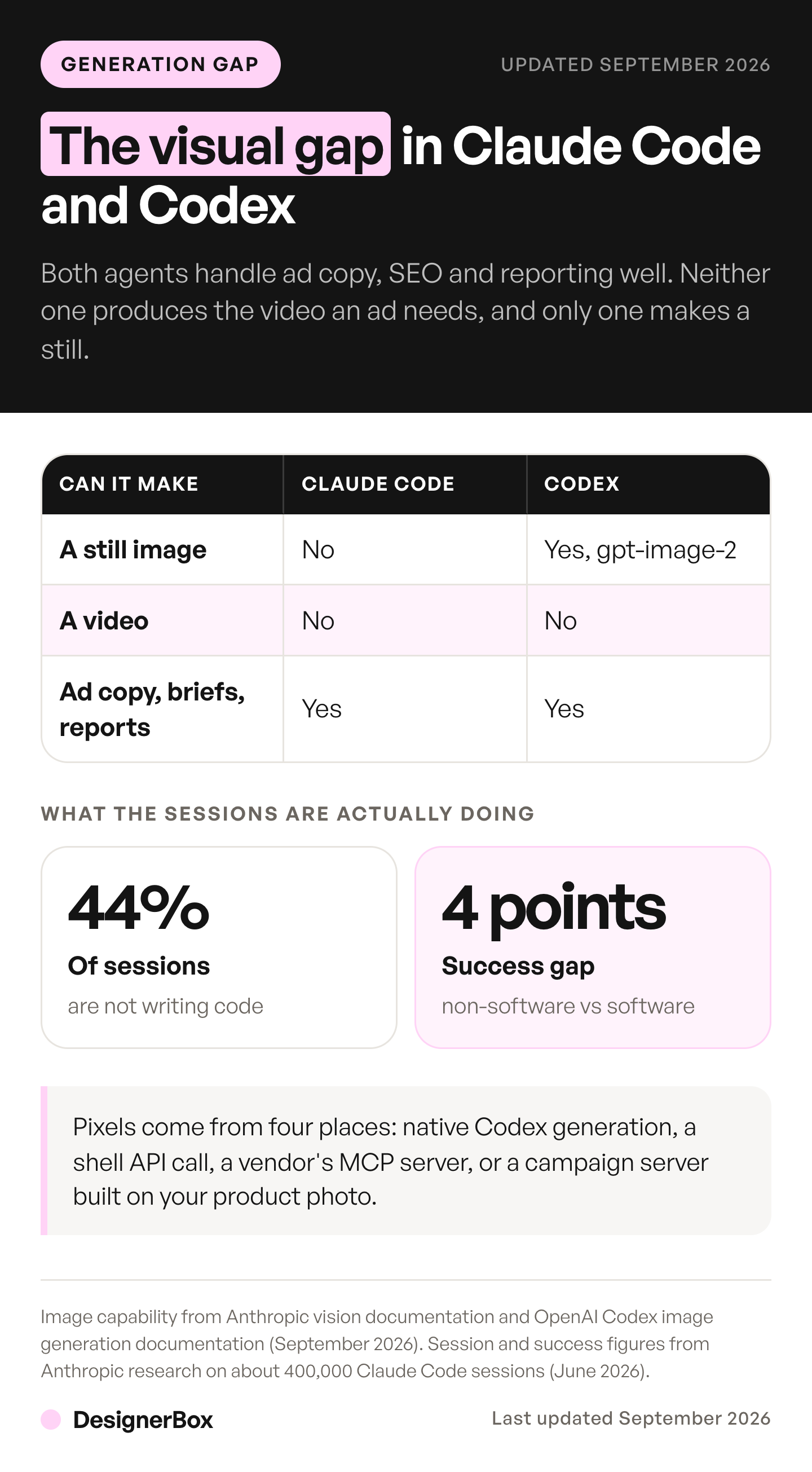
- Claude Code cannot generate an image. Anthropic’s own vision documentation answers the question directly: Claude is an image understanding model only.
- Codex can, with two limits. Built-in image generation runs on gpt-image-2 and burns your included usage 3 to 5 times faster. There is no video generation anywhere in the Codex documentation.
- Most of what marketers ship is not code. Anthropic measured about 400,000 Claude Code sessions and found 44% were not writing, fixing or testing code at all.
- The open-source skill libraries are real and mostly text. One repo passed 47,000 stars with exactly 50 skills. Copy, SEO, CRO, analytics, reporting. Almost nothing that makes a picture.
- Pixels come from four places. Native generation, a raw API call from the shell, a model vendor’s MCP server, or a campaign server that starts from your product photo.
What is Claude Code, and why are marketers using it?
Claude Code is an agentic tool that reads files, edits them, runs commands and connects to outside systems, available in the terminal, an IDE, a desktop app and a browser. Marketers use it because a campaign is mostly structured text and data: ad copy in a spreadsheet, keyword exports, analytics pulls, briefs, landing pages. The agent reads those files, works on them, and writes the result back.
The evidence that this works for non-engineers is not anecdotal. Anthropic studied roughly 400,000 Claude Code sessions from about 235,000 people between October 2025 and April 2026 and found that 44% of sessions were not writing, fixing or testing code: 17% operating software, 14% planning or exploring, 13% producing analysis or prose (anthropic.com, June 2026).
The success gap between professions is smaller than the name of the product suggests. People in software occupations reached verified success in about 30% of sessions. Everyone else reached it about 26% of the time, a gap of four percentage points. Anthropic states that every one of the ten largest occupations in the dataset lands within seven points of software engineers. After software, the largest groups are Business and Financial Operations, then Arts, Design, and Media.
That is the real argument for a marketer opening a terminal. Not that the tool is easy, but that the measured penalty for not being an engineer is four points.
What marketers actually build with it
Anthropic published its own marketing team’s builds in January 2026, which makes it the most checkable case study available. Growth marketer Austin Lau “had never written a line of code in his life” and had to look up how to open a terminal (claude.com, January 2026).

One week later he had two tools. A Figma plugin that generates ad creative variations with a single click, built in about 45 minutes to an hour. And a Google Ads copy workflow that drafts and refines ad copy against character limits, then exports upload-ready CSV files. Anthropic’s line on the first one: “What used to take 30 minutes per ad now takes 30 seconds.”
Five other Anthropic marketing sub-teams published numbers in the same post. Influencer Marketing frees 100+ hours a month. Customer Marketing drafts case studies in 30 minutes instead of 2.5 hours, saving 10 hours a week. Digital Marketing increased team productivity by 5x. Product Marketing saves 5 to 10 hours per launch. Partner Marketing cut trade show prep time by 40%.
The open-source layer moved just as fast. The largest marketing skill library, coreyhaines31/marketingskills, carries over 47,000 stars and exactly 50 skills, grouped into conversion optimization, content and copy, SEO, paid distribution, measurement, retention, growth engineering, strategy and RevOps (github.com, September 2026). Another, thatrebeccarae/claude-marketing, ships 56 skills with packs for Klaviyo, Shopify, GA4 and Looker Studio. A third, ericosiu/ai-marketing-skills, sits at about 3,500 stars.
Read the category lists and a pattern appears. Copy. Research. Audits. Reporting. Analytics. Briefs. Every one of them operates on words and numbers. That is an accurate map of what the agent is good at.
Claude Code vs Codex for marketing work
Both agents run in a terminal, read a project folder, accept a plain-language instruction and connect to outside tools over the Model Context Protocol. The differences that matter to a marketer are the memory file, the price of entry, and whether the agent can make a picture.
| Claude Code | Codex | |
|---|---|---|
| Memory file | CLAUDE.md, read at the start of every session | AGENTS.md, read before any work |
| Reusable expertise | Skills, on the open Agent Skills standard | Skills, invoked in-prompt |
| Parallel workers | Subagents, own context window each | Cloud tasks in parallel environments |
| Connects to outside tools | MCP, four transports | MCP, stdio and streamable HTTP |
| Generates images | No | Yes, gpt-image-2 |
| Generates video | No | No |
| Entry price | Pro $20/month monthly, $17 on annual | Go $8/month, Plus $20/month |
| Next tier | Max $100 or $200/month | Pro from $100/month |
| Team seat | $25/seat monthly, $20 on annual | $25/user monthly, $20 on annual |
Prices read from claude.com and learn.chatgpt.com in September 2026. Note that the Codex documentation moved: developers.openai.com/codex now redirects to learn.chatgpt.com/docs.
Neither publishes an absolute quota. Both meter usage in rolling five-hour windows plus a weekly cap, shared across the assistant and the agent, so the honest answer to “how many campaigns does that buy” is that it depends on how much context you load.
The part every guide skips: neither agent makes your campaign visuals
Anthropic’s documentation answers this question in a FAQ, in one sentence, with no hedging. Asked whether Claude can generate or edit images, the answer is: “No, Claude is an image understanding model only. It can interpret and analyze images, but it cannot generate, produce, edit, manipulate, or create images” (platform.claude.com, September 2026).
Claude Code can read an image. The Read tool returns a PNG or JPG as something the model can see. Reading a picture is not making one, and there is no generation tool anywhere in the Claude Code tool reference.
Codex is genuinely different here, and this is the one place the two products separate. Codex has built-in image generation running on gpt-image-2, invoked by including the imagegen keyword in a prompt, with reference images attached by flag (learn.chatgpt.com, September 2026). It comes with a meter: “Image generations use included limits 3–5x faster on average than similar turns without image generation.” It is not on the free plan. And the Codex documentation index has an image generation section, an image inputs section, and no video generation entry at all.
Now go back to the Anthropic case study, because the detail in it is the whole argument. The Figma plugin that took 30 minutes per ad down to 30 seconds does not generate imagery. In Austin Lau’s own description, he specifies the frame of the creative, pastes in the copy variations once, and one click produces every permutation for that single image. The image already existed. A designer or a camera made it. The agent automated the layout pass on top of it.
That is the honest shape of the win, and it is worth having plainly, because “30 minutes to 30 seconds” gets quoted everywhere as though a terminal produced the ad. The terminal produced the versioning. The visual came from somewhere else, and where it comes from is the question the rest of this guide answers.
Four ways to get images and video out of a coding agent
Every route below ends with an asset in a folder. They differ in what you manage, and in whether the output is a generic picture or your actual product.
1. Native generation, Codex only. Type the prompt, get a still. Fastest path, zero setup. It draws on your plan limits at 3 to 5 times the normal rate, produces no video, and starts from a text description rather than from your product, so a specific SKU is not what comes back.
2. Call a generation API from the shell. Both agents run shell commands, so both can call any HTTP endpoint. This is the most flexible route and the most work: you hold the keys, poll the async jobs, and file the outputs yourself. Published rates, read in September 2026:
| Service | Published rate |
|---|---|
| Veo 3.1 Standard | $0.40 per second at 720p and 1080p, $0.60 at 4K |
| Veo 3.1 Fast | $0.10 per second at 720p, $0.12 at 1080p |
| Sora 2 | $0.10 per second at 720p |
| Sora 2 Pro | $0.30 per second at 720p, $0.70 at 1080p |
| gpt-image-2 | $30.00 per 1M output tokens |
Video is priced by the second, which is the number to carry into any budget conversation. A 30-second cut at Veo 3.1 Standard is twelve dollars of generation before anyone has approved the script.
3. A model vendor’s own MCP server. Several vendors now host one, which removes the key management without removing the model choice. Black Forest Labs runs an official server at mcp.bfl.ai with OAuth sign-in and no API keys, exposing image generation, variations, video and virtual try-on, and its documentation names Claude Code, Codex, Cursor and VS Code as supported clients (docs.bfl.ai, September 2026). Runway announced a hosted server on 2 September 2026 naming the same clients (runway.com, September 2026). Google’s generative media MCP servers exist, but in a GitHub experiments tree rather than as a supported hosted endpoint.
4. A campaign server that starts from your product. The first three routes all generate from a description. For a brand, the input that matters is the product photo you already have, plus the brand rules the output has to survive. DesignerBox MCP exposes 68 tools covering image and video generation, avatars, brand profiles, assets and saved workflows, so the agent generates against your brand profile and files the result in the same library your team already uses. That is the difference between a picture of a mug and a picture of your mug. Where the job is narrower, a single-purpose generator may fit better, and the MCP server against a dedicated ad tool sets out that trade.
| Route | Setup | Video | Starts from your product |
|---|---|---|---|
| Codex native | None | No | No |
| Shell plus API | Keys, polling, storage | Yes | No |
| Vendor MCP server | OAuth sign-in | Yes | No |
| Campaign MCP server | OAuth sign-in | Yes | Yes |
The routes differ in one thing that decides whether they hold up past the first campaign: what survives to the next product. A shell script with keys in it works until the person who wrote it moves on. A saved workflow the agent calls holds the brand rules, the model and the framing, so you build the job once and run it again for the next SKU, and the fifth product comes out to the same standard as the first without anyone setting it up twice. That is the difference between a demo and a production line, and it is what the catalog batch processor is shaped around.
The setup that makes it work
Four pieces do most of the work in a Claude Code for marketing setup, and they are the same four in both agents under different names.
A context file the agent reads first. CLAUDE.md in Claude Code, AGENTS.md in Codex. It holds brand voice, audience, banned words, the campaign’s constraints. Anthropic’s guidance is to keep it under 200 lines, because a longer file eats context and reduces adherence (code.claude.com, September 2026). Treat it as standing instructions, not documentation.
Skills for knowledge you reuse. A skill is a markdown file with frontmatter that loads only when it is relevant, which is what separates it from a context file that loads every session. Claude Code skills follow the open Agent Skills standard, so they carry across tools. This is the layer the public repos fill. How a skill differs from a tool, and why a visual job needs both, is in skills vs MCP.
Subagents for parallel work. Each runs in its own context window with its own system prompt and tool access, and returns a summary rather than its whole transcript. One drafts, one fact-checks, one formats, and none of them pollutes the main thread.
MCP for everything the agent cannot do itself. This is the piece that decides the ceiling. Anthropic’s own framing is that MCP is how Claude Code reaches capability it does not have natively. Image and video generation is the clearest example of exactly that. Giving a coding agent ad, image and video tools through one connection is covered in how to make your AI agent creative. If you want the whole chain rather than the pieces, the five stages of an agentic workflow covers where these chains break.
What it costs to run
Three bills, and teams routinely forget the third.

The agent subscription is the smallest. Claude Pro is $20 a month billed monthly and Max runs $100 or $200. Codex Go is $8, Plus is $20, Pro starts at $100. Team seats land around $25 a month either way.
Generation is metered separately, and it is where the money goes. Per-second video pricing means a single 30-second spot costs more than a month of the agent that briefed it.
The third bill is the one that surprises people: every MCP server you attach adds context to every message. OpenAI names this directly in its own limits guidance, advising users to limit the number of MCP servers because each one adds context and consumes the allowance. Attaching nine servers to look thorough is a real cost, paid on every turn.
For comparison on the generation half, DesignerBox runs on credits rather than a per-second bill: Basic is $15 a month billed monthly for 500 credits, an image costs 4 to 22 credits depending on the model you pick, and an eight-second video clip runs 40 to 560 credits on the same logic. The run cost shows before you press generate, which is the number the shell route makes you work out yourself. The free plan carries 112 credits with no card. Where a per-model bill fits better, the models catalog lists what each one is for.
Where a coding agent stops being the right tool
Three honest limits.
When the job is one asset. Setup, a context file and a skill library is an investment that pays back over repetition. For one landing page banner, open a design tool.
When the output has to be a specific product. Text-to-image is the wrong shape for a catalog. If a customer will compare the ad to the thing in the box, the generation has to start from the real photo, which is what a product photoshoot agent does differently from a prompt box.
When the team cannot maintain it. A skill library is code by another name. It goes stale, it needs owners, and a repo pushed six months ago is a liability wearing a star count. Two of the marketing repos above have not been touched in about six months.
There is also a stability warning worth taking from this year. OpenAI announced the deprecation of Agent Builder on 3 June 2026 with shutdown scheduled for 30 November 2026, and states the export path does not convert the workflow graph or guarantee every behaviour transfers (developers.openai.com, September 2026). Whatever you build has to outlive the editor you built it in. Plain markdown files and an open protocol survive that better than a visual canvas does.
If the shortlist is platforms rather than terminals, ten AI marketing agents ranked by the layer they own covers the buy side, and AI agent builders for marketing teams covers the build side.
FAQ
Can Claude Code do marketing?
Yes, for the text and data half of the job: ad copy, keyword research, SEO audits, briefs, landing pages, analytics pulls and reporting. Anthropic’s own marketing team uses it, and published the builds. It cannot generate images or video, so campaign visuals come from a connected generation service rather than from the agent itself.
Do I need to know how to code to use Claude Code for marketing?
No. Anthropic publishes that its growth marketer had never written a line of code and had to look up how to open a terminal. Its research across about 400,000 sessions found non-software professions reach verified success about 26% of the time against 30% for software occupations, a four-point gap.
Can Claude Code generate images?
No. Anthropic’s vision documentation states Claude is an image understanding model only and cannot generate, produce, edit, manipulate or create images. Claude Code can read an image file as input. To produce one, connect it to an image generation service over MCP or call a generation API from the shell.
Can Codex generate images?
Yes. Codex has built-in image generation running on gpt-image-2, invoked by including the imagegen keyword in a prompt. It is not available on the free plan, and image generations consume your included usage limits 3 to 5 times faster than ordinary turns. Codex does not generate video.
What is the difference between CLAUDE.md and AGENTS.md?
They serve the same purpose in different agents. CLAUDE.md is what Claude Code reads at the start of every session, and AGENTS.md is what Codex reads before doing any work. Both hold standing instructions such as brand voice and audience. Claude Code does not read AGENTS.md directly, though it can import one.
Where do I get marketing skills for Claude Code?
Open-source repositories on GitHub. The largest carries over 47,000 stars and exactly 50 skills across conversion, content, SEO, paid, measurement and retention. Others ship packs for Klaviyo, Shopify, GA4 and Looker Studio. Check the last-pushed date before installing, because several popular repos have not been updated in months.
How much does it cost to run marketing work in Claude Code or Codex?
The subscription is the small number: roughly $8 to $20 a month for entry tiers, $100 to $200 for heavy use, about $25 per team seat. Generation is billed separately and dominates the total, because video is priced per second. Every attached MCP server also consumes usage on every message.
Sources
- Anthropic, How Anthropic uses Claude in Marketing, January 2026
- Anthropic, Claude Code and expertise research, June 2026
- Anthropic, Vision documentation, accessed September 2026
- Anthropic, Claude Code memory, accessed September 2026
- Anthropic, Claude pricing, accessed September 2026
- OpenAI, Codex image generation, accessed September 2026
- OpenAI, Codex pricing and limits, accessed September 2026
- OpenAI, API pricing, accessed September 2026
- OpenAI, Deprecations, accessed September 2026
- Google, Gemini API pricing, accessed September 2026
- Black Forest Labs, MCP integration, accessed September 2026
- Runway, Runway Dev MCP, September 2026
- GitHub repository star and skill counts read from the GitHub API, 6 September 2026
- DesignerBox product facts from the DesignerBox product brief, September 2026
Agent capabilities, pricing and model rates verified from vendor documentation as of September 2026. This category changes monthly. Individual results vary.