


Agentic marketing is a way of running marketing where AI agents plan and carry out multi-step work toward a goal that a person sets. You give the goal, the budget and the rules. The agent chooses the steps, uses your tools, reads the results and adjusts. People approve the plan before money is spent and the work before it goes live.
The idea is easy to state and hard to run well. A team asks an agent for “ads for the spring sale”, and the agent writes a plan in a minute. Then it makes 30 images that do not match the brand, quotes a discount that is not on the website, and spends credits on versions nobody asked for. The planning was the cheap part.
This guide defines agentic marketing, separates it from the marketing automation you already run, and lists the five jobs agents do today. It also covers what the evidence says about failure, and where a person must approve the work.
Key Takeaways
-
An agent chooses its own steps. Automation follows steps you wrote in advance. That is the whole difference.
-
Agents do five jobs today. Research, briefs, creative, versions and reporting.
-
Adoption is early. Salesforce’s own survey of 4,450 marketers found only 13% use agentic AI.
-
Many projects will fail. Gartner predicts that over 40% of agentic AI projects will be canceled by the end of 2027.
-
Checkpoints decide the result. Approve the plan, confirm each paid run, and approve the work before launch.
-
Creative is where agents lose the brand. An agent is as consistent as the tools it calls.
What is agentic marketing?
Agentic marketing is the practice of giving AI agents a marketing goal and letting them plan and do the steps. Vlerick Business School describes it as “AI agents autonomously performing many of these tasks on your behalf with minimal intervention” (vlerick.com, Steve Muylle, 18 April 2025, read October 2026).
The word “agentic” comes from how AI engineers describe software. Anthropic, which makes the Claude models, draws the line in its guide to building agents. “Workflows are systems where LLMs and tools are orchestrated through predefined code paths.” Agents “are systems where LLMs dynamically direct their own processes and tool usage, maintaining control over how they accomplish tasks” (anthropic.com, 19 December 2024, read October 2026).
So the test is simple. If you wrote every step, you have a workflow. If the software decides the next step, you have an agent. Most marketing products in 2026 mix both, and the label “agentic” covers a wide range.
Agents reach your tools through connectors. The most common standard is the Model Context Protocol, or MCP. Anthropic released it as an open standard on 25 November 2024 (anthropic.com). On 9 December 2025 Anthropic gave MCP to the Agentic AI Foundation, a fund under the Linux Foundation (linuxfoundation.org, read October 2026). MCP for marketing lists the marketing servers by job.
Agentic marketing vs marketing automation
Marketing automation runs the rules you set. Agentic marketing starts from a goal, and the agent writes the steps. The table compares the two on the points that matter to a marketing team.
| Marketing automation | Agentic marketing | |
|---|---|---|
| Who plans the steps | You, in advance | The agent, from your goal |
| Who picks the tools | You, when you build the flow | The agent, within the tools you allow |
| Where you approve | Once, when you build it | At checkpoints: the plan, each paid run, the final work |
| What you get | The same action each time, like a welcome email | A finished piece of work, like a set of ads |
| After launch | Runs the same way until you change it | Reads results and changes the next step |
| Best for | Work that repeats exactly | Work that needs a choice at each step |
Here is an example of each. An email flow sends the second email three days after a person signs up. That is automation. An agent gets the goal “win back customers who have not bought in 90 days”. It writes the segment, drafts three messages, asks you to approve them and reports which one worked. That is agentic marketing.

Both stay useful. A rule that never changes should stay a rule, because it is cheaper and easier to check. AI marketing automation covers where AI already sits inside classic automation.
What AI agents do in a marketing team
Agents take the repeat steps between a goal and a finished campaign. Five jobs come up most often, and they are not equally ready.
| Job | What the agent does | What a person still checks |
|---|---|---|
| Research | Collects competitor ads, reviews and search data into a summary | That the sources are real and current |
| Brief | Turns a goal and a product page into a brief you can edit | The claims, the offer and the audience |
| Creative | Writes scripts and calls image and video tools | The product, the brand and the AI labels |
| Versions | Adapts one approved ad for each channel, size and language | Text in every language, and the crop |
| Reporting | Pulls results from ad platforms into one summary and suggests the next test | Whether the data supports the suggestion |
Research and reporting are the safest jobs to hand over first. The agent reads data and writes a summary, and a mistake costs little. Creative and versions cost the most when they go wrong, because a wrong picture or a wrong price goes in front of customers. What to hand an AI creative agent covers that split in detail.
Agentic marketing examples
The large ad platforms and marketing suites all describe agents now. The table lists examples from their own pages, with the status each one states.
| Example | What the agent does | Status, as stated |
|---|---|---|
| Meta advertising | Meta’s stated goal: a business gives an objective and a price per result, and Meta “just” does the rest | A goal, stated on the 30 April 2025 earnings call |
| Google Ask Advisor | ”A new, unified agent built with Gemini” across Google Ads, Analytics, Merchant Center and Marketing Platform | Announced 20 May 2026 |
| Salesforce Agentforce Marketing | A Goals Agent that creates, runs and optimizes campaigns within set limits | ”In pilot” on 3 June 2026 |
| HubSpot Agent Hub | A Campaign Agent that turns “a single goal into a fully planned, multi-channel campaign” | On HubSpot’s AI product page, October 2026 |
| Klaviyo Composer | A marketing agent for email and SMS campaigns. “Nothing goes live without you” | Available to every customer from 13 October 2026 |
| Adobe Experience Platform Agents | An Agent Orchestrator that picks which agents to activate for a request | Generally available from 10 September 2025 |
Meta’s statement is the clearest. On the first-quarter 2025 call, Mark Zuckerberg said: “Our goal is to make it so that any business can basically tell us what objective they’re trying to achieve, like selling something or getting a new customer, and how much they’re willing to pay for each result. And then we just do the rest.” He called this “an AI agent that delivers measurable business results at scale”. It is a goal, not a finished product.
Google described Ask Advisor as “your always-on strategic partner” at Google Marketing Live (blog.google, 20 May 2026). Note the pattern across the table: several vendors keep a human step in their own description. Our comparison of agentic marketing platforms covers the platforms in detail, and the ranking of AI marketing agents covers the single agents.
Where agentic marketing breaks
The evidence so far says agents are early, and that many projects will not survive. Three sources set the scale.
- Adoption is low. Salesforce surveyed 4,450 marketers for its tenth State of Marketing report and found that “only 13% of marketers have made the leap” to agentic AI (salesforce.com, 17 February 2026). This is a vendor’s own survey.
- Many projects will be canceled. Gartner predicts that “over 40% of agentic AI projects will be canceled by the end of 2027, due to escalating costs, unclear business value or inadequate risk controls” (gartner.com, 25 June 2025).
- Many products are relabeled. The same Gartner release warns about “agent washing”, the rebranding of chatbots and older automation as agents. “Gartner estimates only about 130 of the thousands of agentic AI vendors are real.”
Gartner also predicts that 40% of enterprise applications “will be integrated with task-specific AI agents by the end of 2026, up from less than 5%” in 2025 (gartner.com, 26 August 2025). Both Gartner numbers are predictions, not measurements.
In marketing work, four failures repeat:
- Wrong claims. An agent copies a price, a discount or a product claim from an old page.
- Brand drift across a set. Each image is a separate job. Light, color and framing change from one result to the next, and the product can change too.
- Cost that grows quietly. Retries and extra versions spend credits that nobody approved.
- Missing labels. Platforms and laws ask for AI disclosure in some cases, and an agent does not decide that for you.
Where people stay in the loop
Put the approvals where a mistake costs the most. Four checkpoints cover most of the risk in marketing work.
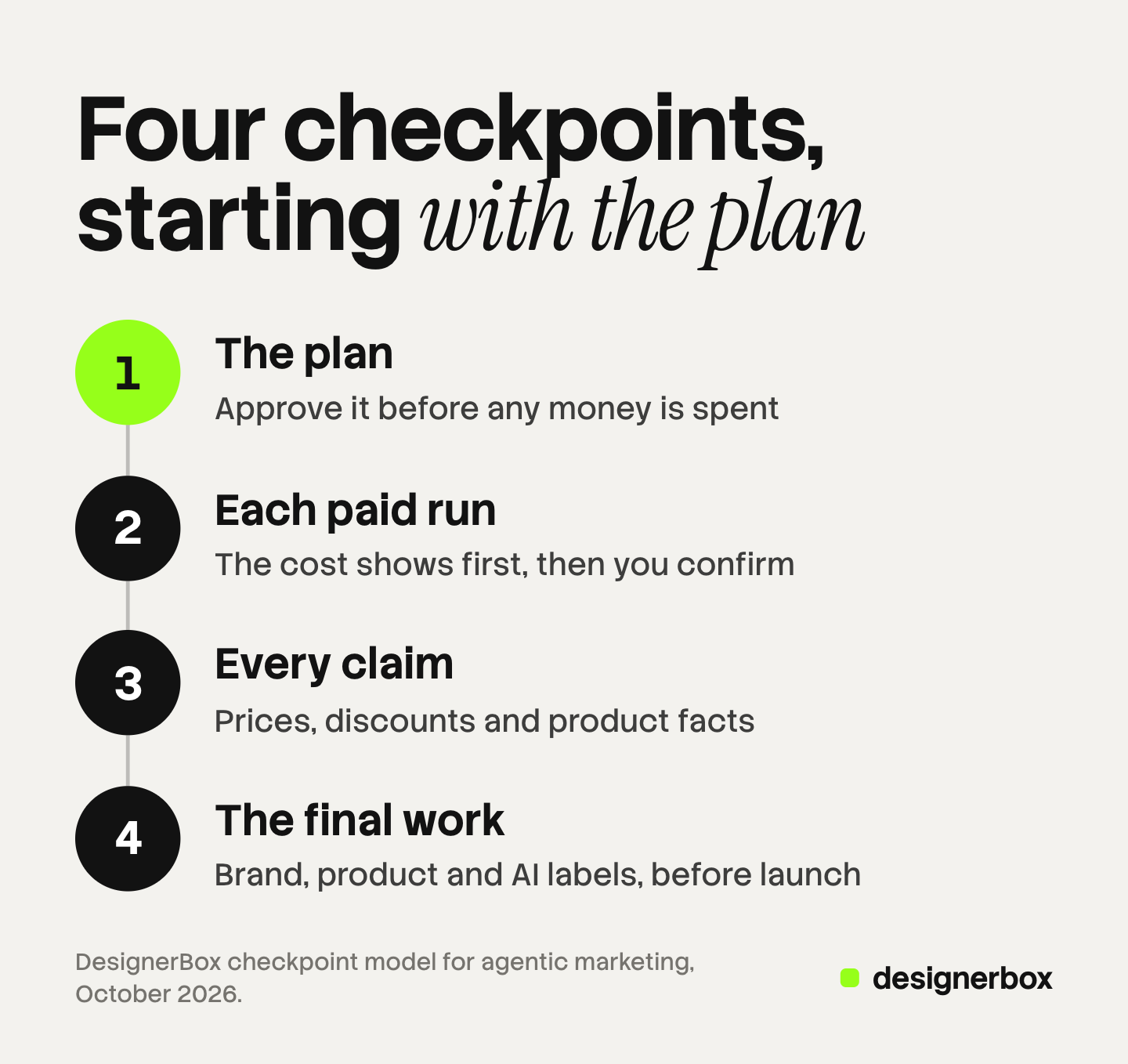
- Approve the plan before any money is spent. Ask the agent for the steps, the tools and the cost of the run.
- Confirm each paid run. A good tool shows the cost first and asks before it charges.
- Approve every claim. Prices, discounts, comparisons and product facts need a person, every time.
- Approve the final work and its labels. Check the brand, the product and the AI disclosure before launch.
The label rules differ by platform. Meta adds an AI info label when its own generative tools make or heavily change an ad (facebook.com, read October 2026). TikTok asks advertisers to label ads with completely AI-generated images, video or audio (ads.tiktok.com, read October 2026). In the EU, Article 50 of the AI Act has applied since 2 August 2026, and deployers must disclose deepfake content to people “upon first exposure at the latest” (digital-strategy.ec.europa.eu, read October 2026).
In the US, the FTC’s rule on consumer reviews and testimonials took effect on 21 October 2024. It has no blanket ban on AI avatars in marketing, but a fake or false testimonial breaks it, whoever wrote it (ftc.gov, read October 2026). This is general information, not legal advice.
How to start with agentic marketing
Start with one job your team repeats every week, and measure it against the way you do it now.
- Pick one repeat job. A weekly competitor ad summary or weekly ad versions are good first jobs.
- Connect one agent to the tools it needs. Give it read access first, and paid actions second.
- Write the checkpoints down. Name who approves the plan, the cost and the final work.
- Run it for two weeks. Count the hours saved and the results you could use, against your current process.
- Add the next job only after the first one holds. One stable job beats five half-working ones.
Choose the tools the agent calls with care. An agent that writes a new prompt for every image gets a new result every time. An agent that calls a saved workflow gets the same steps, the same model and the same brand rules on every run. Agentic AI for content creation covers the four inputs an agent needs before it makes content, and what is creative automation explains the saved-workflow side.

Agentic creative in DesignerBox
Anyone can make an AI picture. Making hundreds that still look like your brand is the hard part. With an agent in the loop, that problem moves from your team to the tools the agent calls.
DesignerBox is AI creative production for brands and agencies. It runs a Model Context Protocol server with 75 tools. You connect an AI chat such as Claude, ChatGPT or Cursor, and the chat can run your templates, workflows and apps. Your brand rules, products and reference pictures sit in a brand profile, and the workflow reads it on every run.
The checkpoints are built in. Reading your workspace charges no credits. The chat can read what each model costs and how many credits you have left before it starts. A run charges credits, and your AI chat asks you to confirm the call first. Every finished run reports the credits it charged. In batch, a sheet with more than 20 runs asks you to confirm first. A template runs by name, so its prompt stays on the DesignerBox server.
The templates, workflows, apps, batch and Assets sit in one account, so the agent reaches the whole job from one place. Reviews sends a client a page of pictures. The client opens the link with no account and ticks the pictures. A review costs no credits.
Here are the limits. DesignerBox does not plan campaigns, hold customer data or buy media, so it is not an agentic marketing platform. It does not place ads in an ad account. You download the results, or send them with a webhook or an S3 step. Uploading your own photos and the commercial license start on the Pro plan. Every plan below Ultra is one seat. Plans and credits are on the pricing page.
There is a free plan, and it runs on sample products. Get started free.
FAQ
What is agentic marketing in simple words?
Agentic marketing means you give an AI agent a marketing goal, and the agent plans and does the steps. You set the budget and the rules, and you approve the plan and the final work. The agent reads the results and changes its next step.
What is an example of agentic marketing?
An agent that gets the goal “win back customers who have not bought in 90 days” is one example. It builds the segment, drafts messages, asks for approval and reports the results. Meta’s stated goal is another: a business gives an objective and a price per result, and the ad system does the rest.
How is agentic marketing different from marketing automation?
Marketing automation runs steps you wrote in advance, the same way every time. Agentic marketing starts from a goal, and the agent chooses the steps and the tools. Anthropic separates them as workflows with predefined code paths and agents that direct their own process.
Will agentic marketing replace marketing teams?
The evidence does not support that today. Salesforce’s own survey found 13% of marketers use agentic AI, and Gartner predicts over 40% of agentic AI projects will be canceled by the end of 2027. Agents take repeat steps, while people set goals and approve claims and creative.
Where should a person approve an AI agent’s work?
At four points: the plan before money is spent, each paid run, every claim such as a price or a discount, and the final work with its AI labels before launch.
Can AI agents make ad creative?
Yes, when they are connected to image and video tools through a connector such as MCP. Check the product, the brand and the labels on every result, because each image or clip is a separate job.
What is agent washing?
Agent washing is the rebranding of chatbots, assistants or older automation as AI agents without real agentic capability. Gartner estimates that only about 130 of the thousands of agentic AI vendors are real.
Sources
- Vlerick Business School, What is agentic marketing?, Steve Muylle, 18 April 2025: vlerick.com, accessed October 2026
- Anthropic, Building effective agents, 19 December 2024: anthropic.com, accessed October 2026
- Anthropic, Introducing the Model Context Protocol, 25 November 2024: anthropic.com, accessed October 2026
- Linux Foundation, Linux Foundation announces the formation of the Agentic AI Foundation, 9 December 2025: linuxfoundation.org, accessed October 2026
- Gartner, Gartner Predicts Over 40% of Agentic AI Projects Will Be Canceled by End of 2027, 25 June 2025: gartner.com, read through an archived copy, October 2026
- Gartner, Gartner Predicts 40% of Enterprise Apps Will Feature Task-Specific AI Agents by 2026, 26 August 2025: gartner.com, read through an archived copy, October 2026
- Salesforce, tenth State of Marketing report, 17 February 2026, a vendor-run survey of 4,450 marketers (salesforce.com/blog/tenth-state-of-marketing), accessed October 2026
- Meta first-quarter 2025 earnings call, 30 April 2025, remarks by Mark Zuckerberg, read on a published transcript (transcripts.platformaeronaut.com), October 2026
- Google, Google Marketing Live 2026, 20 May 2026: blog.google, accessed October 2026
- Salesforce Agentforce Marketing announcement, 3 June 2026 (salesforce.com/news), accessed October 2026
- HubSpot AI product page and Agent Hub (hubspot.com/products/artificial-intelligence), accessed October 2026
- Klaviyo Composer launch and availability (klaviyo.com/blog/composer-marketing-agent), accessed October 2026
- Adobe, general availability of AI agents for Adobe Experience Platform, 10 September 2025 (news.adobe.com), accessed October 2026
- Meta Business Help Center, About AI info on ads created or edited with generative AI tools: facebook.com, accessed October 2026
- TikTok Advertising Policies, Misleading and false content: ads.tiktok.com, accessed October 2026
- European Commission, Transparency obligations under Article 50 of the AI Act: digital-strategy.ec.europa.eu, accessed October 2026
- US Federal Trade Commission, Consumer Reviews and Testimonials Rule: Questions and Answers: ftc.gov, accessed October 2026
- DesignerBox MCP and pricing pages (designerbox.ai/mcp and designerbox.ai/pricing), October 2026: the MCP tool count, run confirmation, plan gates and the video credit range
Definitions, vendor statements and statistics verified on each source as of October 2026. Gartner figures are predictions. The Salesforce figure is from a vendor-run survey. The four checkpoints are our recommendation. This is general information, not legal advice. Individual results vary.