AI fashion photography ROI is the money a brand keeps by using AI models, minus everything the switch costs, divided by that cost. On the honest inputs in this guide it lands between about 2x and 13x, not the 500x some calculators show. Three numbers decide it: the shots you would really have paid a studio for, the minutes it takes to approve one image, and the fixed cost of the setup.
The 500x figures come from correct arithmetic. They divide a full studio budget by one month of a subscription. That ratio measures a price gap. A finance lead asks a different question: what do we keep, after every cost, on the products we would have shot anyway?
This guide builds that answer step by step. It is for a brand with 20 to 500 products, or an agency that produces on-model images for such brands. You get a worked model, a break-even rule, and a test for the revenue side before you promise it to anyone. For what DesignerBox does in this job, see the DesignerBox page for fashion brands.
Key Takeaways
- ROI is gain minus cost, divided by cost. A shoot budget divided by a subscription fee is a price ratio, not a return.
- Count only the shots you would have bought. Products you never shot on a model save nothing on the studio line. Putting them on a model is new spending, and its return comes from sales.
- Review time is the cost that moves. On the worked model, a move from 6 to 15 minutes per approved image cuts the return from about 13x to about 7x.
- Setup is a fixed cost. Brand rules, a cast model and a test run come before the first useful image. Break-even comes after about five products on the worked inputs, not at the first one.
- Use gross margin on the revenue side. Earlier listing and better images earn margin, not revenue. A calculator that multiplies weeks by revenue overstates the gain.
- Measure the sales effect on your own products. Published conversion figures come from other stores and other image changes. A holdout test on your own catalog takes four to six weeks.
What is AI fashion photography ROI?
AI fashion photography ROI compares what a brand keeps with what it spends when AI models replace studio shoots. The gain is studio spend you no longer pay, plus any extra margin from faster listings or better images. The cost is the tool, the setup hours, and the time to prepare, review and fix each image. Divide the net gain by that cost.
The standard formula is simple. ROI equals gain minus cost, divided by cost. A result of 5 means you kept five dollars for every dollar the switch cost.
The hard part is the inputs, not the formula. Each input has a version that makes the number large and a version that survives a budget review. The rest of this guide uses the second version.
Why published ROI figures reach 500x
Vendor calculators usually run one division. They take the full cost of a studio shoot for a catalog and divide it by the price of a subscription. One vendor post reports a return of over 500x on a 100-product shoot this way (wearview.co, September 2026). The arithmetic is correct. Three things are missing from it.
The counterfactual. The calculator assumes you would have paid a studio for every product. Many brands shoot only their best sellers or a new drop on a model, and show the rest flat.
The labor. Someone prepares the garment photo, picks the results, rejects the bad ones and checks the color. That time is a cost, and it grows with every image you make.
The setup. Brand rules, a model look you keep, a crop and a light set, and a test on your hardest fabrics come before the first image you can use.
Add those three and the ratio becomes a return you can defend. The number gets smaller. It is often still large.
The three numbers that decide it
Most inputs in an ROI model barely move the result. Three inputs move it a lot. Get these right and the rest is detail.
1. The counterfactual share. This is the share of your on-model images that you would really have paid a studio for this year. Check last year’s invoices. If you shot 120 of 200 products on a model, your share is 60%. Only that 60% counts as avoided spend.
2. Minutes per approved image. This is the time from a garment photo to a result you publish. It includes the results you reject. It depends on how often the first result is right, which the first-pass acceptance test measures in an afternoon. Hard fabrics such as sheer, shiny or fine prints make it longer.
3. Fixed setup. This is the time to set the brand rules, choose a model look, fix the light and the crop, and test the job on your 20 hardest products. You pay it once per brand or per look. It decides how soon the switch breaks even.
The studio price per image matters less than people expect. It is usually large next to the AI cost, so a 20% change in it moves the return by about 20%. A change in the counterfactual share can move the return by 80% or more.
A worked ROI model, step by step
The inputs below are illustrative. They are not a quote from any tool. Replace each one with your own figure.
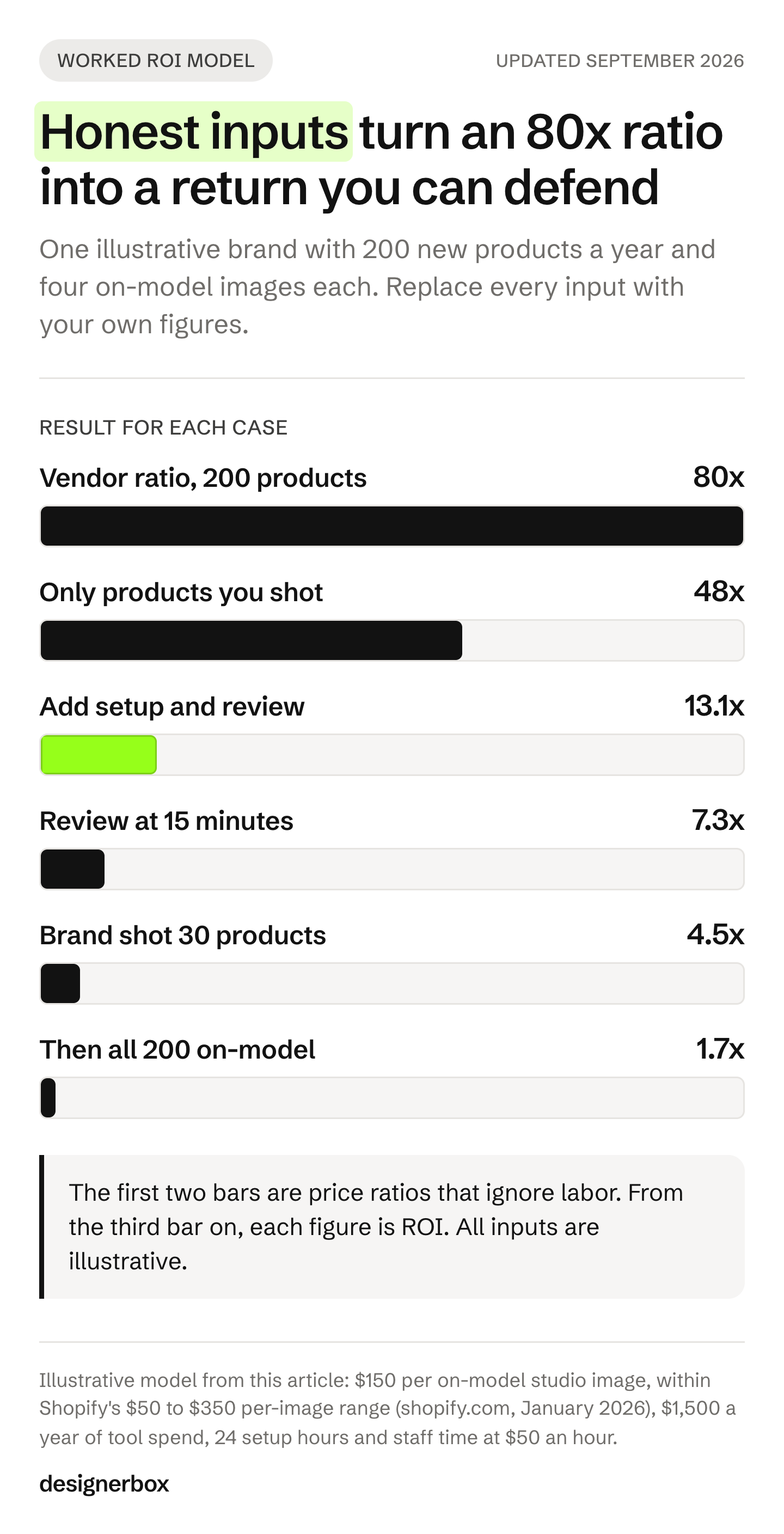
- A brand lists 200 new products a year.
- Last year it shot 120 of them on a model, with four on-model images each.
- A finished on-model studio image costs $150. Shopify puts per-image pricing between $50 and $350 (Shopify, January 2026), and on-model work sits in the upper part of that range.
- Tool spend is $1,500 a year. This is an assumption, so use your own quote.
- Setup takes 24 hours. Review takes 6 minutes per approved image. Staff time costs $50 an hour.
Now apply the corrections one at a time.
| Step | Avoided studio spend | AI cost | Result |
|---|---|---|---|
| Vendor ratio: all 200 products, tool fee only | $120,000 | $1,500 | 80x ratio |
| Count only the 120 products you shot | $72,000 | $1,500 | 48x ratio |
| Add setup and 6 minutes of review per image | $72,000 | $5,100 | 13.1x ROI |
| Review takes 15 minutes per image | $72,000 | $8,700 | 7.3x ROI |
| A brand that shot only 30 products | $18,000 | $3,300 | 4.5x ROI |
| That brand now puts all 200 products on a model | $18,000 | $6,700 | 1.7x ROI |
The first two rows are ratios, because they ignore labor. From row three, the result is a true ROI: gain minus cost, divided by cost.
Two points matter here. The honest figure is still large for a brand that already buys a lot of on-model photography. And the last row is the case most calculators hide. A brand that rarely paid for on-model shots saves little on cost. Its case rests on sales, which the next sections cover.
The hero campaign is outside this table on purpose. Many brands still shoot one campaign a year with a real model, and that budget stays. AI models vs real models shows which gallery slots suit each option.
When does AI fashion photography break even?
AI fashion photography breaks even when the saving on the products you would have shot covers the fixed costs. The rule is one division. Add the setup cost and the yearly tool spend, then divide by the saving on one product.

On the worked inputs, one product saves $580. That is four studio images at $150, minus four approved images at $5 of review time. The fixed costs are $1,200 of setup and $1,500 of tool spend. So the switch breaks even after about five products.
That is fast, and it is close to what the vendors say. The condition matters more than the number. Break-even at product five is true only for products you would have paid a studio to shoot. For a product you always showed flat, there is no studio saving. That product breaks even only if the on-model image sells more.
The count starts again in two cases. A new model look needs a new test on hard fabrics. A new brand, for an agency, needs its own brand rules. Budget the setup hours for each one.
The revenue side: coverage, speed and returns
The revenue side has three parts: more products shown on a model, earlier listings, and the effect on returns. Each one is real. None has a public number you can copy into your own model, so treat each as a range to test, and price it at gross margin.
Coverage. Baymard’s usability research found that exploring the product images was the first action of 56% of users on a product page (Baymard Institute, April 2020). Its study of apparel pages says that without a human model, users must guess how a product fits, which lowers their confidence to buy (Baymard Institute, December 2020). That supports the direction. It does not give you a percentage.
Two figures that appear in many ROI posts have weak sources. The claim that clear images convert 33% better has no traceable original source. The “9.46% sales lift” comes from one A/B test on one retailer’s category pages, where larger images appeared on mouseover (wingify.com, Optimics case study, September 2026). It says nothing about on-model images.
Speed. McKinsey estimates that integrated digital merchandising could give up to 50% faster time to market and an 8% rise in full-price sell-through (McKinsey, March 2023). That covers a whole merchandising program, not photography alone. At Zalando, AI cut editorial image production from six to eight weeks to three or four days, according to its VP of content solutions in a Reuters interview (Reuters via Yahoo Finance, May 2025). Those were campaign images, not product pages.
Value speed at margin, and only for weeks you really gain. Suppose a drop sells $4,000 a week at full price with a 60% gross margin. Listing two weeks earlier adds at most $4,800 of margin. That holds only if the stock is already in the warehouse, and only if those weeks add new sales and do not just move them earlier. Many calculators use revenue here. Revenue overstates the gain by the whole cost of goods.
Returns. In a Salsify survey of 2,712 shoppers in the US, Canada and the UK, 45% said they had returned an online purchase because of incorrect or misleading information (Salsify, January 2026). The NRF estimates that 19.3% of online sales were returned in 2025 (NRF, October 2025). An on-model image that shows the real drape can help. An AI image that shifts the color or the length can hurt. Put a returns line in the model with both signs, and check it after launch. Does virtual try-on reduce returns reviews the published evidence.
How to measure the sales effect before you promise it
A holdout test on your own catalog is the only sales number you can defend. It takes four to six weeks and no new software.
- Pick 40 products that are flat-only today. Choose products with similar prices and similar traffic.
- Split them at random into two groups of 20. Add AI on-model images to one group. Leave the other group as it is.
- Change nothing else. Keep the same prices, titles, ads and position on the collection page.
- Compare conversion rate after four to six weeks. Use sessions to orders per product, not total revenue, because traffic moves.
- Watch returns for 30 days after the last order. A higher conversion rate and a higher return rate can cancel each other.
Two cautions. Low-traffic products take longer to give a clear result. And shoppers differ on AI images: an IAB study found 45% of US Gen Z and Millennial consumers feel positive about AI-generated ads (IAB, January 2026), and a YouGov study across 17 markets found 39% comfortable with AI-generated or edited product images in advertising (YouGov, June 2024). Your own customers are the ones that count. Ecommerce image testing covers test design in more detail. For a full rollout plan with casting and review, see a 30-day pilot for AI models.
What stays on the budget
The switch removes the studio line. It does not remove the work around it. Cut fashion photography costs itemizes the four costs that stay, so this list stays short.
- The garment photo. Every AI model image starts from a real photo of the real garment. Someone still pulls, steams and photographs the sample.
- Art direction. A person still chooses the look, the pose and the crop.
- Review. It grows with the number of images, and it is the input that moved the worked model most.
- The hero campaign. Most brands keep one real shoot for the campaign and the lookbook.
- Disclosure checks. Since 2 August 2026, the EU AI Act requires deployers to disclose deep fakes (European Commission FAQ, September 2026). The Commission’s guidelines say a realistic AI person who could plausibly exist can count. Since 9 June 2026, New York requires an ad that contains a synthetic performer to say so (New York General Business Law 396-b, September 2026). Labeling AI-generated fashion images covers when a label is needed. This is general information, not legal advice.
The ROI case on DesignerBox
Anyone can make an AI picture. Making hundreds that still look like your brand is the hard part. That hard part is where two of the three numbers live: the setup and the minutes per approved image.
DesignerBox is AI creative production for brands and agencies. Scale your images, ads and video with AI and keep your brand on every piece: build the workflow once with your brand rules, run it on every product, see the cost before each run, and keep everything from the first product photo to the finished ad in one place.
Here is how that maps to the model.
- Setup, paid once. You set the brand rules, the model look, the light and the crop once in brand profiles. The workflow reads them on every run. A saved workflow runs the same way on the next product, so the setup hours do not repeat each drop.
- Minutes per approved image. Three critic steps score the results, and best-of-N keeps the best one. Batch runs one workflow over a whole sheet of products. You review the set in one pass, keep or discard per row, and re-run one row alone.
- The tool line. The cost of a run is shown before you press Run. So the AI cost in your model is a number you know in advance.
- The on-model images. Dress my model puts one garment on a model. Clothing catalog turns one garment into four shots: front, three-quarter, back and a fabric close-up.
The full workflow from the first product photo to the finished ad, in one subscription.
Here are the limits, stated plainly. The commercial license starts on the Pro plan. AI video and virtual try-on start on the Premium plan. Team features, shared brand kits, white label and the API are on the Ultra plan, and every plan below Ultra is one seat. An agency that runs this for several brands needs one set of brand rules per client, and the setup hours count once for each. Plans and credits are on the pricing page.
For a brand that already pays for on-model shoots, start with the products you shot last season and compare. For a brand that rarely did, start with the holdout test above. See how the job runs on the DesignerBox page for fashion brands, or get started free.
FAQ
What is a good ROI for AI fashion photography?
On the worked model in this guide, a brand that already shot 120 products a year on a model gets about 13x on cost. That assumes 6 minutes of review per approved image and 24 setup hours. At 15 minutes per image it falls to about 7x. A brand that rarely paid for on-model shots may see less than 2x on cost, and its case rests on sales.
How much do AI models save on a photoshoot?
They save the studio line for each product you would have shot: photographer, studio, model, styling and retouching. Shopify puts per-image pricing between $50 and $350. Subtract the time to prepare, review and fix each AI image, the setup hours and the tool spend. The rest is your saving. Cut fashion photography costs gives the full worksheet.
When does AI product photography break even?
Divide the setup cost plus the yearly tool spend by the saving on one product. On the worked inputs that is about five products. The rule holds only for products you would have paid a studio to shoot. A product you always showed flat saves nothing on cost, so it breaks even only through extra sales.
Do AI model images increase conversion?
There is no public study that isolates AI on-model images on apparel product pages. Baymard’s research shows that shoppers look at images first and trust an item more when they see it on a person. The only reliable number is your own, from a holdout test on 40 flat-only products over four to six weeks.
Do I still need a real photoshoot if I use AI models?
You still need one real photo of each garment, because AI model images start from it. Many brands also keep one campaign shoot a year with a real model for the lookbook and the hero images. The switch replaces the catalog shoot. The campaign shoot often stays.
Do AI model images need a label?
It depends on where and how you use them. Since 2 August 2026, the EU AI Act requires deployers to disclose deep fakes, and a realistic AI person who could plausibly exist can count. Since 9 June 2026, New York requires ads with a synthetic performer to say so.
Does DesignerBox show what a run costs?
Yes. The cost of each run is shown before you press Run. Plans and credits are on the pricing page, and the commercial license starts on the Pro plan.
Sources
- Per-image pricing of $50 to $350: Shopify, accessed 24 September 2026
- Product images as the first action of 56% of users: Baymard Institute, accessed 24 September 2026
- Human models and purchase confidence on apparel pages: Baymard Institute, accessed 24 September 2026
- Faster time to market and full-price sell-through from integrated digital merchandising: McKinsey, “Great merchandising never goes out of fashion”, accessed 24 September 2026
- Zalando editorial image production time: Reuters via Yahoo Finance, accessed 24 September 2026
- Returns because of incorrect or misleading information, 2026 consumer research: Salsify, accessed 24 September 2026
- Online return rate in 2025: NRF, accessed 24 September 2026
- Consumer attitudes to AI-generated ads: IAB, “The AI gap widens”, accessed 24 September 2026
- Comfort with AI-generated product images in advertising, 17 markets: YouGov, accessed 24 September 2026
- EU AI Act Article 50: European Commission FAQ, accessed September 2026
- New York synthetic performer disclosure: New York General Business Law 396-b and Governor of New York, accessed September 2026
- The 9.46% test: Optimics case study (wingify.com/success-stories/optimics), accessed 24 September 2026
- The 500x vendor calculation: wearview.co/blog/ai-models-photoshoot-roi, accessed 24 September 2026
- DesignerBox plan gates and the cost shown before each run: DesignerBox pricing page (designerbox.ai/pricing), September 2026
Rates, research and laws verified from the sources above as of September 2026. The worked model uses illustrative inputs, not measured results or a quote. Individual results vary.