
The best ComfyUI alternative depends on one question: do you keep the GPU, or hand it over? If you want free, local and fully controllable, SwarmUI, InvokeAI and Automatic1111 run the same open-weight models on your own hardware. If you want no install and no graphics card, hosted ComfyUI starts at $20 a month. Brand teams usually need the second lane plus a licensing answer.
ComfyUI costs nothing to download. The rest of the setup does. The Comfy Registry lists 5,472 published custom node packs (Comfy Registry API, api.comfy.org/nodes, measured 6 September 2026), and a graph that calls a pack a colleague has not installed will not run until they install it. Then there is the card: FLUX.1 [dev] needs over 23 GB of VRAM in plain FP16, and the RTX 5090 starts at $1,999 (nvidia.com, September 2026).
This guide covers both lanes the search splits into: free local front ends, and hosted services that rent the GPU by the hour or the month. It is written for a brand or agency team with no ML engineer, and it prices the line most roundups skip: the model weights licence.
Key Takeaways
- Free and local still wins on control. SwarmUI (MIT), InvokeAI (Apache 2.0) and Automatic1111 (AGPL-3.0) cost nothing and keep every checkpoint on your drive.
- Hosted ComfyUI starts at $20 a month. Comfy Cloud Standard is $20/month for 4,200 credits, or $16/month billed yearly (comfy.org/pricing, September 2026).
- The graphics card is the real bill. A rented A100 80 GB runs $1.59 an hour on RunPod, and a local RTX 5090 starts at $1,999.
- 5,472 node packs is the strength and the maintenance surface. Each runs Python with the same privileges as the server process.
- The weights carry their own licence. FLUX [dev] weights are non-commercial only unless you buy a licence from Black Forest Labs.
- Workflow JSON only moves between tools running real ComfyUI. A native canvas means rebuilding the graph by hand.
What is the best ComfyUI alternative for a brand team?
For a team with no ML engineer, the shortlist is short. Pick a hosted service if nobody wants to own Python, CUDA drivers and node updates. Pick a local front end if you have the hardware and want every checkpoint in the building. The interface matters less than who answers the licensing question in writing.
| Tool | Lane | Software licence or price | Own GPU | Runs real ComfyUI | Model weights licence |
|---|---|---|---|---|---|
| ComfyUI | Local | GPL-3.0, free | Yes | Yes | You obtain it |
| SwarmUI | Local | MIT, free | Yes | Yes, as backend | You obtain it |
| InvokeAI | Local | Apache 2.0, free | Yes | No | You obtain it |
| Automatic1111 | Local | AGPL-3.0, free | Yes | No | You obtain it |
| Fooocus | Local | GPL-3.0, free | Yes | No | You obtain it |
| Comfy Cloud | Hosted | From $20/month | No | Yes | Stated as included by comfy.org |
| RunComfy | Hosted | $29.99/month plus GPU hours | No | Yes | Not stated on the pricing page |
| ThinkDiffusion | Hosted | $29.99/month plus GPU hours | No | Yes | Not stated on the pricing page |
| Krea | Hosted canvas | From $5.25/month billed yearly | No | No | Included on paid plans per krea.ai |
| DesignerBox | Hosted | From $15 a month billed monthly | No | No | Commercial licence from Pro |
Two questions pick the row. Do you want the graphics card in the building or rented by the hour, and do you need arbitrary custom nodes or a simpler interface? A third one sorts a chunk of the people searching this term. If the real job is one approved layout in forty sizes and five languages, that is a template problem, and creative automation solves it without a graph at all.
What are the free alternatives to ComfyUI?
Three Stable Diffusion front ends cover most of the free lane, and all three are free software rather than a trial. SwarmUI is MIT licensed, InvokeAI is Apache 2.0, and Automatic1111 stable-diffusion-webui is AGPL-3.0 with roughly 165k GitHub stars and 7,689 commits on master (github.com/AUTOMATIC1111/stable-diffusion-webui, September 2026). None charges for the software. All still need a graphics card and the same Python and driver setup.
SwarmUI is the shortest step across, because it runs ComfyUI as its backend and puts a simpler Generate tab in front, with the raw graph still on a Comfy Workflow tab. Its own notes flag that connected projects bring their own terms: it can auto-install ComfyUI (GPL), use Automatic1111 as a backend (AGPL), and auto-install ultralytics (AGPL) for face detection (github.com/mcmonkeyprojects/SwarmUI, September 2026). InvokeAI ships a web interface with its own node editor under Apache 2.0 (github.com/invoke-ai/InvokeAI, September 2026).
Fooocus carries a caveat stated by the project itself. Its README describes it as built entirely on the Stable Diffusion XL architecture and now in limited long-term support with bug fixes only, pointing users who want newer models such as Flux to WebUI Forge or ComfyUI (github.com/lllyasviel/Fooocus, September 2026).
Can you run ComfyUI in the cloud without a GPU?
Yes, in three shapes. Comfy Org runs the official hosted version. Third-party services run managed ComfyUI on rented hardware. Or you rent a bare GPU and install it yourself. All three remove the driver problem. None removes the maintenance problem, because you still run the same graph with the same custom packs behind it.

Comfy Cloud is the first-party option, and Comfy Org is direct about why it exists: “Comfy Cloud is an optional hosted service for those who prefer convenience, accessibility, or don’t have powerful GPUs” (comfy.org/cloud, September 2026). It starts free with 5 runs and no credit card. Billed monthly, Standard is $20 for 4,200 credits, Creator $35 for 7,400, Pro $100 for 21,100, and Team runs $200 to $2,500 on a credit slider. Credits burn only when the GPU runs, so building a workflow is free (comfy.org/pricing, September 2026).
RunComfy and ThinkDiffusion both run managed ComfyUI and bill machine time by the second. RunComfy Pro is $29.99/month, or $19.99/month billed yearly, with a 16 GB machine at $0.79/hour on Pro rates and an A100 80 GB at $3.99 (runcomfy.com/pricing, September 2026). ThinkDiffusion is similar: TD-Pro at $29.99/month, TD-Teams at $59.99/month for 2 members (thinkdiffusion.com/pricing, September 2026). Renting the bare card is cheaper and costs you the setup: RunPod Secure Cloud lists an RTX 4090 at $0.74/hour and an A100 80 GB at $1.59 (runpod.io/pricing, September 2026).
What does it actually cost to run ComfyUI yourself?
Add three lines the download page does not show. The hardware or the rented hours. The install work, since the docs list Python 3.13 recommended and PyTorch 2.7 or newer, with CUDA 13.0+ for NVIDIA 20-series and above (docs.comfy.org, September 2026). And the person who keeps the graph working after every core update. That third line is the one a five-person team does not have.
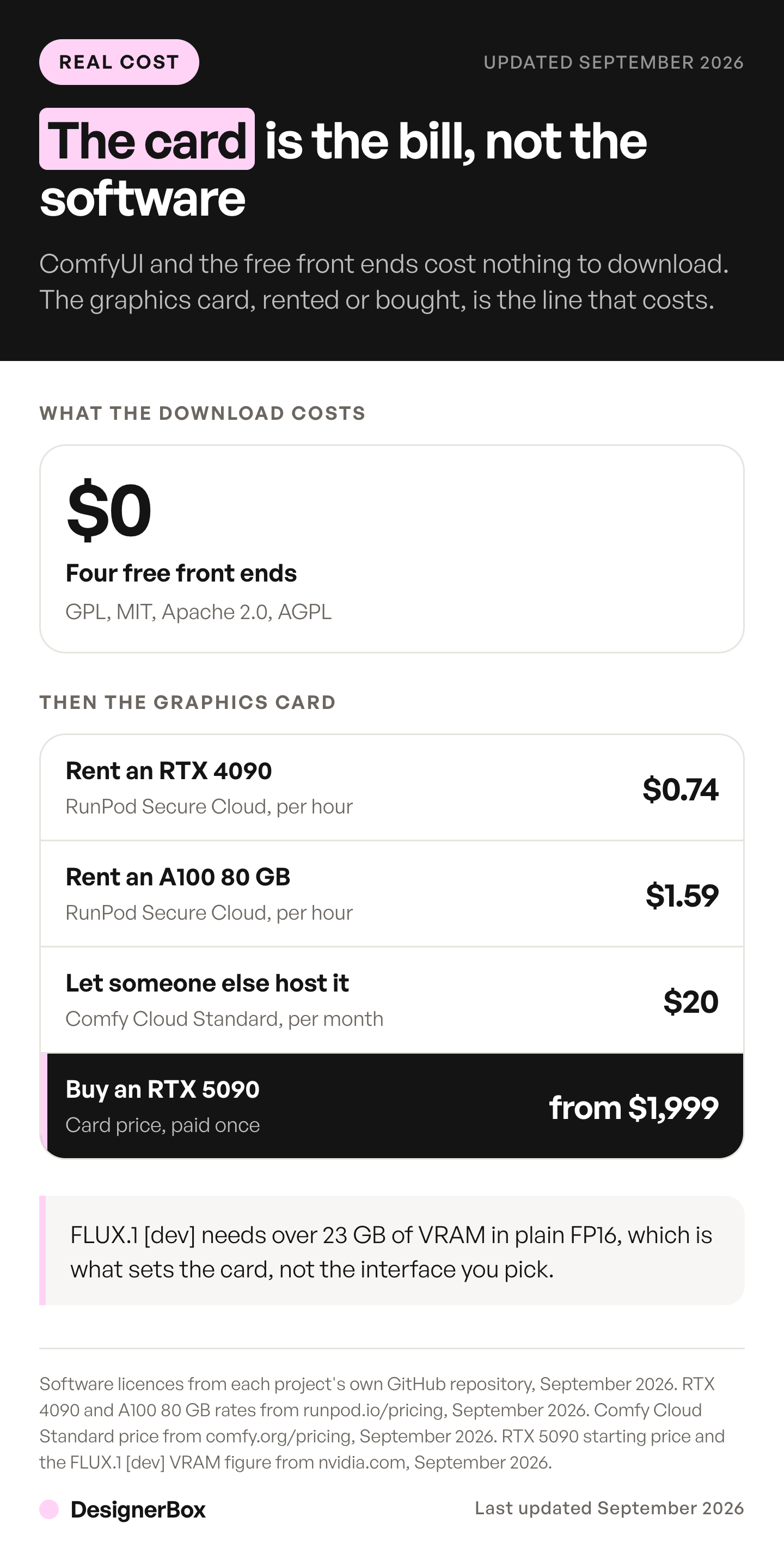
Hardware is the easiest number to anchor. NVIDIA states that FLUX.1 [dev] requires over 23 GB of VRAM in plain FP16, generates an image in 15 seconds on an RTX 4090, and drops to just over five seconds on an RTX 5090 using FP4 (nvidia.com, September 2026). ComfyUI supports NVIDIA, AMD, Intel, Apple Silicon and Ascend hardware plus a CPU-only mode, and the docs state no minimum VRAM figure (docs.comfy.org/installation/system_requirements, September 2026).
The 2026 catch is that the strongest models are no longer weights you download. Veo, Sora, Kling and Seedance run as hosted APIs rather than weights you download, so a local setup covers the open-weight image half of a campaign and stops at video. Weighing that against a bundled subscription is what the tool consolidation audit works through, and what a six-tool AI stack really costs covers the bills nobody counts.
Who maintains the custom nodes, and is that a security question?
The custom node catalog is ComfyUI’s biggest strength and its largest maintenance surface. The Comfy Registry lists 5,472 published packs, and every one runs Python inside your server process, so a workflow shared from a forum is executable code, not a document. Comfy Org treats it that way and has shipped hardening for it, which is the right lens for a brand team.
Snyk found over 1,300 custom node extensions at the time of its research, noted each runs with the same privileges as the server process, and reported three CVEs: CVE-2024-21574 in ComfyUI-Manager, CVE-2024-21575 in ComfyUI-Impact-Pack and CVE-2024-21576 in ComfyUI-Bmad-Nodes (labs.snyk.io, September 2026).
Comfy Org published its own January 2025 response: registry security checks that let the team ban a node quickly, removal of runtime pip installation, and a mechanism in ComfyUI-Manager to remotely disable a malicious node without updating ComfyUI (blog.comfy.org, September 2026). A Cloud Security Alliance note dated 8 April 2026 records a cryptomining campaign that used ComfyUI-Manager as a delivery path, plus that same hardening (cloudsecurityalliance.org, September 2026). Someone owns which packs are approved. On a team of three, that is the person who was supposed to be making ads.
Can you use images from open-weight models in commercial campaigns?
Check the model licence, not the software licence. They are two different documents. GPL, MIT and Apache cover the front end you installed. The weights you load carry separate terms, and some of the most-used open weights are not free for commercial work. That is the line a brand team gets asked about.

Black Forest Labs is explicit. The FLUX [dev] licence states you may only use, distribute or create derivatives of the model for non-commercial purposes, and that commercial use requires a licence from the company, which may carry a fee or revenue share. It covers FLUX.1 [dev], the Fill, Depth, Canny and Redux variants, Kontext [dev] and FLUX.2 [dev]. One precision point: the same licence states outputs are not considered derivatives, so the restriction attaches to the weights (bfl.ai, September 2026).
Black Forest Labs sells self-serve commercial licences in four tiers for teams that self-host: Builder (fine-tuning and LoRA rights, 10,000 images a month, one domain), Platform (100,000 images a month), Professional (agencies serving up to three clients) and Enterprise (bfl.ai, September 2026). Stability AI takes a different route: its Community License is free for research, non-commercial and commercial use while annual revenue stays under USD $1M (stability.ai, September 2026). Hosted services know this is a purchase driver, which is why Comfy Cloud markets “All models. Commercial license guaranteed.” (comfy.org/cloud, September 2026).
Do your existing ComfyUI workflows transfer to another tool?
Only to tools running real ComfyUI underneath. Comfy Cloud, RunComfy and ThinkDiffusion execute the same engine, so an exported graph loads as it is, assuming every custom pack it references is installed. A native canvas is a different program with different node names, so moving there means rebuilding the graph and re-testing the output. The jobs behind the names barely move, and the eight node jobs every canvas is built from read the same across tools even when the labels do not.
Two other things travel badly. Community checkpoints and LoRAs, the kind shared on Civitai, stay on your drive, and Comfy Cloud’s Standard tier does not include importing your own models (comfy.org/pricing, September 2026). A graph depending on ten custom packs is only as portable as the least maintained one.
Some canvases are built as their own thing on purpose. Wireflow states on its own page that it uses a fixed hosted node set and a curated model catalog rather than arbitrary custom Python nodes or local checkpoints, at $24, $45 and $249 a month (wireflow.ai, September 2026). NodeTool is AGPL-3.0 and runs on your own provider API keys at list prices with no markup (nodetool.ai, September 2026). Krea Nodes sits in the same family, and Krea states its paid plans include a commercial licence while the free tier does not (krea.ai/pricing, September 2026). Flora’s node canvas is the same shape again, priced per seat from $18 a month and running other companies’ models rather than checkpoints you supply (flora.ai/pricing, September 2026).
Where DesignerBox fits, and where it does not
DesignerBox is a hosted workflow tool, not a node canvas. You start from your product photo, pick an app or write a brief, and the model is chosen for you or by you. Basic is $15 a month billed monthly for 500 credits, and the free plan carries 112 credits. Image cost is per model, from 4 credits on Seedream 5 to 22 on GPT Image 2, with the default Nano Banana Pro at 14. The catalog is 8 image models and 13 video models, and the commercial licence starts at Pro, $35 a month billed monthly.
Pro carries 1,000 credits a month. Saved workflows rerun the same job for the next product, and 68 MCP tools let Claude or ChatGPT drive the same models. The model catalog lists every one, and our guide to AI tools for graphic designers covers where each fits.
Be clear about the trade. You do not get arbitrary custom Python nodes, and you do not load your own checkpoints or LoRAs. Video is priced per second, and the model you pick moves the bill 14x: an 8-second clip is 40 credits on Lite Video, 320 on Premium Video, and 560 at the top on Sora 2 Pro at 1080p. The run cost shows before you press generate. Try-on and AI video need Premium at $75 a month, and team features are Ultra at $200. The credit pricing breakdown has the full ladder, and how a creative workflow gets built and rerun shows the repeatable half.
One more question sits underneath the tool choice: how many products does this job run on? A graph is built for one output at a time, and rebuilding it per SKU is where the week goes. Build the job once with your brand, your products and your rules, then run it again for the next forty, and row one and row forty come out to the same standard.
Here is the honest hand-back. If you want free, local and total control over every node, the answer is SwarmUI, InvokeAI, or ComfyUI itself with a friendlier front end on top. The hosted case holds when nobody wants to own the graph, several people need the same setup, and someone will ask for licensing terms in writing.
FAQ
Is ComfyUI free?
The software is. ComfyUI is released under the GPL-3.0 licence and the repo carries 131.2k stars and 15.5k forks (github.com/comfyanonymous/ComfyUI, September 2026). What costs money is the hardware or rented GPU time, and in some cases the licence on the model weights you load. Comfy Org also sells an optional hosted version.
Is there a free ComfyUI alternative with a simpler interface?
SwarmUI is the usual answer, and it is free under the MIT licence. It runs ComfyUI as its backend and puts a simpler Generate tab in front, with the full node graph still reachable on a separate tab. InvokeAI, under Apache 2.0, ships its own web interface and node editor. Both still need your own graphics card.
How much VRAM do you need to run ComfyUI?
The docs state no minimum, because it depends on the model. NVIDIA gives the useful anchor: FLUX.1 [dev] needs over 23 GB of VRAM in plain FP16, generating an image in 15 seconds on an RTX 4090. Smaller and quantised models run on far less. Plan around the largest model in your shot list, not around the interface.
What does hosted ComfyUI cost per month?
Comfy Cloud starts free with 5 runs, then $20 a month for 4,200 credits on Standard, or $16 a month billed yearly. RunComfy Pro is $29.99 a month plus GPU time from $0.79 an hour at Pro rates. ThinkDiffusion TD-Pro is $29.99 a month with comparable machine rates (comfy.org, runcomfy.com and thinkdiffusion.com pricing pages, September 2026).
Can a marketing team run ComfyUI without an engineer?
It is possible, and it becomes a standing job, not a one-off setup. Someone owns Python and driver updates, approves and installs custom node packs, and repairs graphs after core updates. The Comfy Registry lists 5,472 packs, and each executes code inside the server process. Teams without that person usually pick a hosted service instead.
Do I need a commercial licence for images from open-weight models?
Check each model separately, because the terms differ. FLUX [dev] weights are licensed for non-commercial purposes only, with commercial licences sold in four tiers by Black Forest Labs. Stability AI’s Community License allows commercial use free while annual revenue stays under USD $1M. Hosted services often bundle a commercial licence into the plan, which is why they advertise it.
Sources
- ComfyUI repository, licence and feature list: github.com/comfyanonymous/ComfyUI, September 2026
- ComfyUI system requirements: docs.comfy.org/installation/system_requirements, September 2026
- Comfy Cloud positioning and commercial licence claim: comfy.org/cloud, September 2026
- Comfy Cloud pricing and Team plan: comfy.org/pricing, September 2026
- Comfy Registry pack count: Comfy Registry API, api.comfy.org/nodes, measured 6 September 2026
- Comfy Org January 2025 security update: blog.comfy.org/p/comfyui-2025-jan-security-update, September 2026
- Custom node security research and CVEs: labs.snyk.io, September 2026
- Cryptomining campaign and platform hardening: cloudsecurityalliance.org, September 2026
- RunComfy plans and machine rates: runcomfy.com/pricing, September 2026
- ThinkDiffusion plans: thinkdiffusion.com/pricing, September 2026
- RunPod GPU rates: runpod.io/pricing, September 2026
- FLUX [dev] non-commercial licence terms: bfl.ai, September 2026
- Black Forest Labs commercial licence tiers: bfl.ai, September 2026
- Stability AI Community License revenue threshold: stability.ai, September 2026
- FLUX.1 [dev] VRAM requirement and RTX 5090 price: nvidia.com, September 2026
- InvokeAI licence: github.com/invoke-ai/InvokeAI, September 2026
- SwarmUI licence and backend behaviour: github.com/mcmonkeyprojects/SwarmUI, September 2026
- Automatic1111 licence and repository activity: github.com/AUTOMATIC1111/stable-diffusion-webui, September 2026
- Fooocus licence and support status: github.com/lllyasviel/Fooocus, September 2026
- NodeTool licence and pricing model: nodetool.ai/alternatives/comfyui, September 2026
- Wireflow node set, model catalog and plans: wireflow.ai/comfyui-alternative, September 2026
- Krea plans and commercial licence terms: krea.ai/pricing, September 2026
- DesignerBox pricing, credit costs, plan allocations, model catalog and MCP tool count verified against live product configuration, September 2026
Tool licensing, pricing and hardware requirements verified from GitHub, comfy.org, RunComfy, ThinkDiffusion, RunPod, Black Forest Labs, Stability AI, NVIDIA, Snyk and the Cloud Security Alliance as of September 2026. Individual results vary.