
Flora AI is a node-based creative canvas for teams. You chain prompt, generate and edit steps as connected nodes instead of typing into one box, and it runs other companies’ models rather than training its own. The free plan covers one seat, three active projects and up to 17 generations. Paid seats run $18, $50 and $200 a month billed monthly (flora.ai/pricing, September 2026).
Search that name and two products come back. One is a plant identification app on the App Store (apps.apple.com, September 2026). The other raised a $42 million Series A led by Redpoint Ventures in January 2026 and is used by designers at Alibaba, Brex, Pentagram and Lionsgate (techcrunch.com, September 2026). This guide covers the second one.
This is for the person evaluating canvas tools with four pricing tabs open. It covers what the product does, whether the free plan is usable, what a seat costs, who is behind it, and which five tools sit in the same bracket. Every price below was read from the vendor’s own page in September 2026.
Key Takeaways
-
The free plan has a published ceiling. One seat, three projects, up to 17 generations, with video models on the paid tiers (flora.ai/pricing, September 2026).
-
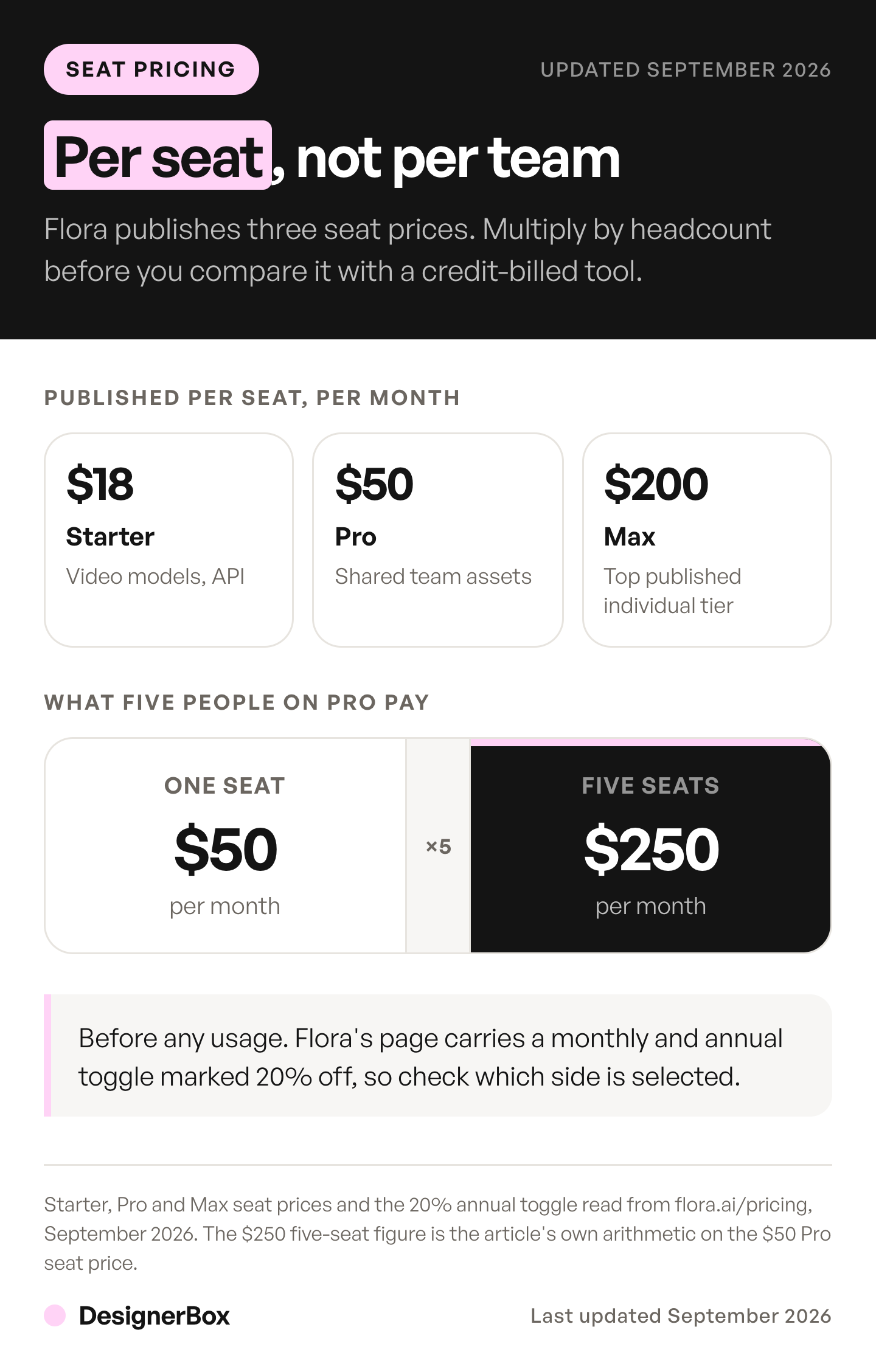
Pricing is per seat, not per team. Starter $18, Pro $50, Max $200 per seat per month, billed monthly (flora.ai/pricing, September 2026). Five people on Pro is $250 a month before any usage.
-
The hosted canvases run vendor models. Flora’s founder states his company trains none of its own (techcrunch.com, September 2026). Veo, FLUX, Kling and Sora are built by Google, Black Forest Labs, Kuaishou and OpenAI.
-
Four pricing pages, four billing states. Krea preselects annual under a Save 40% banner, Flora carries a 20% annual toggle, Magnific quotes euros before VAT (each company’s pricing page, September 2026).
-
A canvas starts empty. It suits people who enjoy wiring graphs. A saved workflow starts from a job you already got right, which is the different buy for a team running the same four formats across a whole catalogue every week.
What is Flora AI used for?
Flora is a node-based canvas for creative teams. You place a prompt, connect it to an image or video model, then branch that output into edits, upscales and variants on one infinite board. Its homepage states 50+ models and describes every text, image and video model sitting on one canvas (flora.ai, September 2026).

Two features are named on Flora’s own pages. Techniques are reusable workflows built by Flora and top creators that you run instantly or open in your own canvas (flora.ai, September 2026). Real-time collaboration is listed from the Starter tier upward (flora.ai/pricing, September 2026).
Is Flora AI free?
Yes, with a defined ceiling. The free plan is one seat, three active projects, the text and image models, the full canvas and layer editor, and up to 17 free generations (flora.ai/pricing, September 2026). Video models sit on the paid tiers, so the free plan covers still images and the canvas itself.
Flora states generations rather than credits there, and publishes no conversion between the two. Read 17 as the size of the trial, and check the current figure on the page before you plan around it.
How much does Flora cost per seat?
Paid pricing is per seat per month across three published tiers, plus a fourth for larger teams. Starter is the first tier carrying video models, unlimited projects, pooled team usage and API access. Pro adds shared team assets, per-member usage caps and usage analytics (flora.ai/pricing, September 2026).
| Plan | Price, billed monthly | What the tier adds |
|---|---|---|
| Free | $0 | 1 seat, 3 projects, text and image models, canvas and layer editor, 17 generations |
| Starter | $18 per seat / month | Video models, unlimited projects, pooled usage, API and MCP access, collaboration |
| Pro | $50 per seat / month | Shared team assets, per-member usage caps, usage analytics |
| Max | $200 per seat / month | The top published individual tier |
| Enterprise | Custom | Teams of nine or more |
Source: flora.ai/pricing, September 2026. The page carries a Monthly / Annual toggle labelled 20% off, so the figure you read depends on which period is selected. Check it, then multiply by seats.
Is Flora legit, and who uses it?
Yes. Flora raised a $42 million Series A led by Redpoint Ventures, announced 27 January 2026, taking total funding to $52 million, and TechCrunch names designers at Alibaba, Brex, Pentagram and Lionsgate as users (techcrunch.com, September 2026). The company was founded by Weber Wong, previously an investor at Menlo Ventures, and had 25 people at the time of that round.
The founder background and headcount come from NYU’s own note on the round (tisch.nyu.edu, September 2026). Wider client lists circulate in secondary posts. Only those four names are confirmed by primary reporting, which is the standard to apply to every tool below.
How does a node-based AI canvas actually work?
A canvas replaces the single prompt box with a board of connected steps. One node holds your prompt or uploaded image. An edge carries that output into a model node, which passes its result into an edit, an upscale or a second model. Branch it and one input becomes four variants. The graph is what you save and rerun. The eight node jobs, and how branching behaves once a graph gets long, sit in how an AI workflow builder chains nodes.

What sits underneath matters more than the wiring. Flora’s founder has said plainly that models are not creative tools, which is why Flora integrates existing models rather than building them, and that the company trains none itself (techcrunch.com, September 2026).
The hosted canvases here name the same vendors on their own pages (krea.ai/pricing and weave.figma.com, September 2026). Veo 3.1 generates video with native audio at 1080p and 4K (deepmind.google, September 2026). The FLUX.2 line from Black Forest Labs outputs up to 4MP at any aspect ratio and references up to 10 images at once for character consistency (bfl.ai, September 2026). Those capabilities belong to the vendors. What separates the tools is how work is saved, how a team shares it, and how you are billed, the same split we cover in AI creative agents.
What are the alternatives to Flora AI?
Five tools sit in the same bracket, each shaped for a different buyer. ComfyUI is the open-source original, Krea and Figma Weave are hosted node editors, Magnific offers a shared canvas called Spaces, and DesignerBox starts from a job rather than a blank board.
| Tool | What it is | Free plan | Entry paid price | How output is billed |
|---|---|---|---|---|
| Flora | Node canvas, 50+ models | 1 seat, 3 projects, 17 generations | $18 per seat / month | Per seat, pooled team usage |
| Krea | Canvas, Krea Nodes, app builder | 100 units a day, no commercial licence | $5.25 / month billed annually | Compute units, no individual rollover |
| ComfyUI | Open-source node graph, GPL-3.0 | Self-hosted, 5 free cloud runs | Comfy Cloud $20 / month | Your hardware, or a Cloud plan |
| Figma Weave | Node canvas, formerly Weavy | 150 monthly credits, 5 workflows | $24 / month | Credits |
| Magnific | Spaces shared canvas, formerly Freepik | None listed | Not quoted, see below | Credits, excluding VAT |
| DesignerBox | Apps, templates and saved workflows you rerun per product | 112 credits, no card | $15 / month billed monthly | Credits, 4 to 22 an image by model |
Prices from each company’s own pricing page, September 2026.
Krea
Krea publishes the most granular allowance table in this group. The free plan is 100 compute units a day without a commercial licence. Paid allocations run 5,000 units a month on Basic, 20,000 on Pro, 60,000 on Max and 80,000 on Business, where up to 50 seats sit under one flat price. The feature list includes Krea Nodes, an App Builder that turns a workflow into a reusable app, and a Nodes Agent that builds workflows from natural language (krea.ai/pricing, September 2026).
Two conditions decide whether the numbers work. Units on individual plans do not roll over, Business and Enterprise plans do, and one-time packs expire after 90 days. The page opens with annual billing preselected, showing Basic at $5.25, Pro at $21 and Max at $63 a month, all annual-billed figures (krea.ai/pricing, September 2026).
ComfyUI and Comfy Cloud
ComfyUI is the open-source project this category grew up around. It is released under GPL-3.0 and describes itself as the most powerful and modular diffusion model GUI, API and backend with a graph and nodes interface (github.com/comfyanonymous/ComfyUI, September 2026). The Community Edition is on GitHub and costs nothing.
Cost sits in hosting rather than licensing. Comfy Cloud is $20 a month for Standard, $35 for Creator, $100 for Pro and $700 for Team, all billed monthly, with 5 free GPU runs and no card. Standard and Creator cap a run at 30 minutes, Pro at one hour (comfy.org/pricing, September 2026). Local front ends and hosted GPU rates are compared in the ComfyUI alternative shortlist.
Figma Weave, formerly Weavy
Weavy is now Figma Weave. The product says so on its own site and has moved to a new home at weave.figma.com (weave.figma.com, September 2026). Figma acquired Weavy in October 2025 and relaunched it under the new name, announced by CEO Dylan Field (linkedin.com, Dylan Field, September 2026). It still runs standalone, with its own billing.
Pricing is credit-based and published in full. Free is $0 with 150 monthly credits, roughly 375 images, one seat and 5 workflows. Starter is $24 with 1,500 credits, Professional $45 with 4,000 and a three-month rollover, Team $60 per user with a shared pool, all monthly-billed figures (weave.figma.com/pricing, September 2026).
Magnific, formerly Freepik
Freepik rebranded as Magnific on 28 April 2026, unifying its stock library and its AI tools under one name, and freepik.com/pricing now redirects to magnific.com/pricing (thenextweb.com, September 2026). Magnific lists a shared canvas called Spaces, described on its pricing page as built for workflows (magnific.com/pricing, September 2026). Generation paired with the stock library it already ran as Freepik is the distinguishing part of the offer.
No plan price is quoted here on purpose. Two reads of magnific.com/pricing in one session returned different figures, and the page shows euro prices excluding VAT with no free plan listed (magnific.com/pricing, September 2026).
DesignerBox
DesignerBox starts from a finished job instead of a blank board. You open one of 16 apps or one of 273 image templates, feed it your product photo and your brand rules, and get the asset. Save that run as a workflow and the same setup runs again for the next product, the next colourway and the next drop, at the same standard on row one and row five hundred. Behind it sit 8 image models and 13 video models, including Nano Banana Pro, Seedream 5, FLUX 2 Flex, Veo 3.1, Sora 2 Pro and Kling 2.6 Pro, with 68 tools over MCP for teams that drive it from Claude or Cursor.
Plans are $0, $15, $35, $75 and $200 a month billed monthly, for 112, 500, 1,000, 2,500 and 8,000 credits. There is no single per-image price: an image is 4 credits on Seedream 5, 5 on FLUX Pro 1.1, 14 on Nano Banana Pro, the default, and 22 on GPT Image 2. Video is priced per second, and the model you pick moves an 8-second clip from 40 credits to 560, a 14x spread. The 2,500-credit plan covers seven 8-second Veo 3.1 clips at 720p, or 62 lite ones. The number is on screen before you press generate, which is the part the full credit breakdown sets out per model. Read how DesignerBox and Flora compare for the detail.
Why four canvas prices are not comparable until you check the billing toggle
Every pricing page in this category loads in a different default state. Krea opens with annual billing preselected under a Save 40% banner, so the large figure on screen is the annual rate. Flora carries a Monthly / Annual toggle marked 20% off. Magnific quotes euros excluding VAT. Compare those at face value and you are comparing discounts, not products.
| Tool | Default state of the pricing page | Check before comparing |
|---|---|---|
| Flora | Monthly / Annual toggle marked 20% off | Which side of the toggle is selected |
| Krea | Annual preselected, Save 40% banner | The monthly rate is a different number |
| Figma Weave | Monthly and annual both published | Credits per plan, rollover window |
| Magnific | Euros, excluding VAT, no free plan | Currency, tax, any promo running |
| Comfy Cloud | Monthly and yearly both listed | The run-time cap on your tier |
| DesignerBox | Annual view opens first, shown as a per-month figure | Basic reads $6 on the annual view and $15 billed monthly |
Page states read on each company’s own pricing page, September 2026. Build the comparison on one billing period, in one currency, per seat. Then add the usage model. Per seat is predictable and scales with headcount. Credits scale with output, so a video-heavy month costs more than the subscription. That is the argument for seeing the cost of a run before you start it rather than reading it off an invoice.
Do you need a canvas at all, or does a saved workflow do the job?
A canvas is the right buy when the graph is the work: exploratory concepting, one-off art direction, technical image pipelines, or a team that enjoys wiring nodes. You get precision over each step, and the board is a shared artefact.
It is a different buy when your team ships the same four asset types every week. A canvas starts empty. A saved workflow starts from the run that already worked, and an app puts that run behind a form a colleague fills in. Some tools sit across both ends: Pletor publishes each canvas as an app the rest of the team runs without opening the graph. Picture 40 SKUs, a drop every month, and the same four formats to fill each time. That is 160 files, and the expensive part is not making them, it is keeping the last one to the standard of the first and checking them all. Our guide to building a repeatable creative workflow walks that decision, and saved workflows show the reusable version, with the catalog batch processor as the batch version of the same idea. Price it per product rather than per month, the arithmetic in what an AI tool stack really costs.
DesignerBox has limits worth stating. Team collaboration, shared brand kits, white label and API access are Ultra at $200 a month, and every tier below is a single seat. Try-on and AI video need the $75 plan. To wire a graph node by node, a canvas covers that better. Our alternatives roundup puts DesignerBox under the same test, and current plans carry the credit detail.
FAQ
Does Flora have an API?
Yes. API and MCP access are listed from the Starter tier upward at $18 per seat per month billed monthly, alongside video models, unlimited projects, pooled team usage and real-time collaboration (flora.ai/pricing, September 2026). The free plan does not include them. Confirm the current scope on the pricing page before you build against it, since tier contents move.
Which models do these canvas tools run?
Largely the same vendor models. Veo, Sora, Kling, FLUX, Nano Banana and Seedream are built by Google, OpenAI, Kuaishou, Black Forest Labs and ByteDance, and the hosted canvases here name those vendors on their own pages. Flora’s founder states his company trains none itself (techcrunch.com, September 2026). Model access separates these tools less than billing does.
How much does a canvas tool cost for a five-person team?
The billing model decides this, more than the sticker price. Five Flora Pro seats are $250 a month at $50 each, billed monthly (flora.ai/pricing, September 2026). Krea’s Business plan covers up to 50 seats under one flat price (krea.ai/pricing, September 2026). Figma Weave Team is $60 per user. DesignerBox is single-seat below Ultra, which is $200 a month billed monthly for five users.
Which Flora alternative is free?
ComfyUI is free and open source under GPL-3.0, with cost moving to your own GPU (github.com/comfyanonymous/ComfyUI, September 2026). Figma Weave gives 150 monthly credits on one seat. DesignerBox gives 112 credits with no card. Krea’s free tier is 100 compute units a day and carries no commercial licence, so it suits testing rather than client work.
Can I use free-tier output in a paid ad?
Check the licence, not the plan name. Krea’s free tier carries no commercial licence (krea.ai/pricing, September 2026), so its output is for testing. On DesignerBox the commercial licence starts at Pro, $35 a month billed monthly for 1,000 credits, and free-tier output carries a watermark. Read the terms before an asset reaches a live campaign.
Sources
- The plant identifier app of the same name: apps.apple.com, September 2026
- Flora free plan, tiers, annual toggle: flora.ai/pricing, September 2026
- Flora 50+ models, Techniques: flora.ai, September 2026
- Flora’s $42M Series A and named users: techcrunch.com, September 2026
- Founder thesis, no models trained: techcrunch.com, September 2026
- Founder background, headcount: tisch.nyu.edu, September 2026
- Krea tiers, units, rollover, Krea Nodes: krea.ai/pricing, September 2026
- ComfyUI licence: github.com/comfyanonymous/ComfyUI, September 2026
- Comfy Cloud pricing and run caps: comfy.org/pricing, September 2026
- Weavy to Figma Weave rename: weave.figma.com, September 2026
- Figma Weave pricing and credits: weave.figma.com/pricing, September 2026
- Figma’s acquisition of Weavy: linkedin.com, Dylan Field, September 2026
- Freepik rebrand to Magnific: thenextweb.com, September 2026
- Magnific Spaces, euro pricing, VAT: magnific.com/pricing, September 2026
- Veo 3.1 native audio, 1080p and 4K: deepmind.google, September 2026
- FLUX.2 resolution and referencing: bfl.ai, September 2026
- DesignerBox plans, credits, model catalog, per-model credit costs and gating: designerbox.ai/pricing, September 2026
Flora, Krea, ComfyUI, Figma Weave and Magnific pricing and features verified from each company’s own pages as of September 2026. Individual results vary.