
The best OpenArt alternative depends on what you are replacing. OpenArt is an all-in-one platform for AI images, video, characters and audio, and its own FAQ says it is built for everyday creators (openart.ai, September 2026). For one asset, Krea, Leonardo and Midjourney all cover it. For the same asset across 300 products, the shortlist gets much shorter.
Most OpenArt alternative lists sort by model count. That is the wrong axis. Every platform on this page runs the same handful of frontier models, so model access stopped being a difference some time in 2025. What still differs is what happens around the generation: whether your brand rules apply on the two hundredth run, whether you can script it, and whether you are allowed to put the result in a client deck.
That last one is worth reading carefully before you switch, because OpenArt’s own pages do not agree on the answer.
A note on bias. DesignerBox makes AI creative production software, so it is one of the tools on this list. Rows below say where the other seven are the better buy, and there are several.
Key Takeaways
Sort by the job, not the model list. Every platform here runs the same frontier models. The difference is what surrounds the generation.
Read the commercial-use terms first. Three OpenArt pages describe commercial rights three different ways. The Terms of Service are the binding one.
No public API. OpenArt’s own help center states that no public API is available currently. It ships an MCP server and a CLI instead, both tied to a signed-in account.
Character work is where OpenArt is strong. Character Builder, Director Mode and its fine-tuned model library are real reasons to stay.
Agencies hit the seat wall early. OpenArt states that seats on basic plans cannot share content or collaborate. Check the team tier, not the seat count.
Brand rules have a scope. OpenArt says Brand Kit currently applies inside Create Image and Text to Video, so check it covers the surface you actually use.
What OpenArt is, and who it is built for
OpenArt calls itself “your all-in-one AI creation platform that brings characters, stories, brands, and worlds to life” and describes its scope as “image, video, voice, audio. Every asset generated, edited, and stitched together without leaving the platform” (openart.ai, September 2026).
The surfaces it names on its own site are broad: image generation and editing, video up to 15 seconds, a Character Builder for reusable characters, Director Mode for longer films, Smart Shot for turning one prompt into several cuts, voiceover in 30 or more languages with lip sync, a 3D environment generator called Worlds, model fine-tuning, a library of community models, and an MCP server with a CLI (openart.ai, September 2026).
On audience it says two things at once. The homepage FAQ says OpenArt “is built for everyday creators”. The Brand Kit page names four business segments directly: creative ad agencies, in-house marketing teams, freelancers and content creators, and ecommerce and DTC brands (openart.ai, September 2026). The product spans both, which is why people arrive at an alternatives search from two very different directions.
Read the terms before you pick a replacement
This is the part no other shortlist covers, and it is the one that decides whether you can bill for the work.
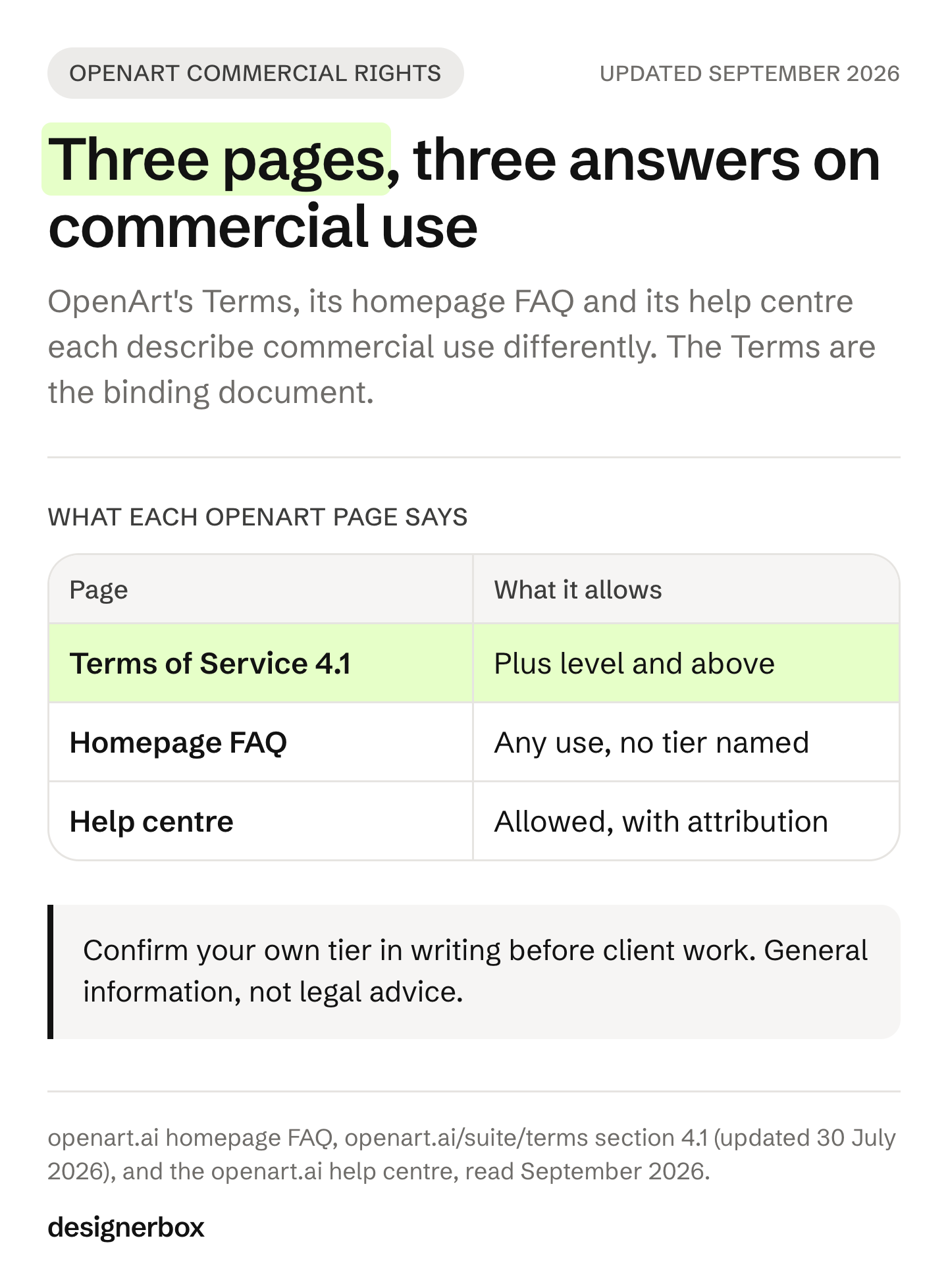
Three OpenArt pages describe commercial-use rights three different ways, all live in September 2026:
| Where | What it says |
|---|---|
| Terms of Service, section 4.1 | Output may be used freely for non-commercial purposes on all subscription levels. Commercial use applies “for subscription levels at, and above, the Plus level” |
| Homepage FAQ | ”You fully own what you create and can use it however you like, in ads, on social media, in client work, on merchandise”. No tier condition is stated |
| Help center | Commercial or non-commercial use is allowed “with proper attribution to OpenArt and/or the human artist when applicable” |
Source for all three: openart.ai, read September 2026.
The Terms of Service are the binding document, and they gate commercial use at a tier. The pricing page agrees with the Terms: a commercial-use line appears on the upper tiers and not on the entry tier (openart.ai, September 2026). The Terms also state that output generated on a free plan may include a visible OpenArt watermark, and that removing it is a material breach.
None of that makes OpenArt a bad tool. It does mean that if you are an agency putting generated frames into client work, you need to confirm your own tier in writing with OpenArt rather than relying on the homepage FAQ. This is general information, not legal advice, and terms change. Read the current version before you sign anything.
The same check applies to whichever tool you move to. We wrote up what usage rights normally cover in what you actually own after a shoot.
Eight OpenArt alternatives, sorted by the job
| Tool | What it is | Programmatic access | Free plan |
|---|---|---|---|
| Krea AI | Creative suite for images, video and 3D, with a node editor, Realtime canvas and LoRA training | Developer docs | Yes |
| Leonardo AI | Creator-first platform for images and video, with its own model family and model training | Public developer API | Yes |
| Midjourney | Independent research lab producing images and video, on Discord and its own site | None published | No |
| Adobe Firefly | Adobe’s creative space for image, video, audio and vector, with Firefly Boards for teams | Through Adobe | Yes |
| Magnific (formerly Freepik) | Full production suite for image, video, audio and 3D, plus a stock library | Public API and MCP | Yes |
| Higgsfield AI | Cinematic video and image studio with Cinema Studio and Marketing Studio surfaces | API and MCP | Yes, a free tier |
| Runway | Video, image and audio in one workspace, plus a separate developer platform | Public API | Yes |
| DesignerBox | AI creative production for agencies and brand teams, built around workflows you run again | 68 tools over MCP, API on Ultra | Yes |
All rows read from each company’s own site in September 2026. Prices are not listed here for any tool. Each vendor publishes its own on its own pricing page, and those pages change faster than an article does.
Two things worth pulling out of that table.
Programmatic access splits the field cleanly. Leonardo, Runway, Higgsfield and Magnific all publish a developer API. Krea publishes developer docs. OpenArt’s help center states plainly that no public API is available currently, and offers an MCP server plus a CLI instead, both signed in through the browser rather than with keys (openart.ai, September 2026). If you came to OpenArt hoping to script it, that is the single fact to check first.
Midjourney is the only one with no free plan. Its documentation says no free trial is currently available in Discord or on the midjourney.com website (docs.midjourney.com, September 2026). Everything else here lets you test before you commit.
Which alternative fits your team
The job is different for each of these, and the honest answer is different too.
| Your team | The job you are replacing | Look first at |
|---|---|---|
| Agencies | One workflow per client, kept separate from every other client | Magnific, DesignerBox |
| Brand teams | One brand standard applied to every piece | Adobe Firefly, DesignerBox |
| Performance marketers | New ad variants built from your winners | Higgsfield, Magnific |
| Creative studios | Finished sets you sell under your own name | Krea, Runway |
| Ecommerce brands | The same shot for every product in the catalog | DesignerBox, Magnific |
| Fashion brands | On-model sets for every colorway | DesignerBox |
| Furniture and homeware brands | Room scenes built from one product photo | Adobe Firefly, DesignerBox |
| Solo founders | A consistent brand look without hiring a designer | Leonardo, Krea |
Two rows deserve a warning rather than a recommendation.
Agencies should check seats before anything else. OpenArt’s help center is direct about this: multiple seats on basic plans “cannot share content or collaborate; it’s just multiple independent accounts”, and shared assets and centralized billing sit on its named Team Plan (openart.ai, September 2026). Its Enterprise page adds unlimited seats, admin controls over projects and spending, and an indemnification option, on a contact-sales basis. The equivalent wall exists here too, and it is worth saying plainly: every DesignerBox plan below Ultra is a single seat. An agency needs the Ultra plan, which is where team features, shared brand kits, white label and the API sit. Plans are on DesignerBox pricing.
Creative studios selling work under their own name should check white label. OpenArt names no white-label or reseller concept anywhere on its public site (openart.ai, September 2026). Most tools on this page do not either. DesignerBox puts white label on Ultra.
Which alternative fits the asset you make
| What you make | Closest replacement | The reason |
|---|---|---|
| Product imagery | DesignerBox, Magnific | Packshots, on-model shots and scenes repeated across a catalog |
| Static ads | Magnific, DesignerBox | Layout and resizing matter as much as the picture |
| Video ads | Higgsfield, Runway | Both are built video-first with named studio surfaces |
| User-generated content | Higgsfield, Magnific | Presenter-style clips with audio in one place |
| Social creatives | Adobe Firefly, Magnific | Feed formats, templates and stock in the same workspace |
| Campaign concepts | Krea, OpenArt | Moodboards and storyboards. OpenArt’s Director Mode is genuinely good here |
| Brand assets | Adobe Firefly, Magnific | Vector, logo and design work sit outside most AI image tools |
| Automations | Leonardo, Runway, Magnific | These three publish a developer API. OpenArt does not |
The last row is the one to read twice. “Automations” is where the API split stops being trivia. If your plan is a nightly job that renders the week’s new products, a tool with no public API means you are scripting a CLI against a signed-in session instead.
Where OpenArt is still the better pick
Switching is not always right, and four things here are genuinely strong.
Character consistency. Character Builder lets you create, customize and reuse consistent characters across projects (openart.ai, September 2026). If a recurring character is the point of your content, this is OpenArt’s best surface. We covered the general problem in how to stop character drift.
Long-form direction. Director Mode lays out a storyboard and shapes each shot through chat, and Smart Shot turns one prompt into three to five cuts with varied angles (openart.ai, September 2026). Short-film and narrative work is well served.
Model training and the community library. OpenArt supports fine-tuning your own model and lists 100 or more fine-tuned models in its library (openart.ai, September 2026). Few all-in-one platforms carry both.
MCP without keys. OpenArt’s MCP server signs in through OAuth with no API keys to manage (openart.ai, September 2026). For running generation from an AI chat, that is a clean setup.
If any of those four is your main job, stay where you are.
Cost before the run
DesignerBox is AI creative production for brands and agencies. The full workflow from the first product photo to the finished ad sits in one subscription, so the work your team repeats every week runs on hundreds of products instead of one.
The shape is different from a generation tool. One workflow, four ways to run it. A template is a workflow somebody already built: open one, add your photo and run it. Your own workflow holds your brand and your products. You publish it as an app, which is a workflow with a form, so a colleague completes the form and presses Run without opening the workflow. Batch takes that same workflow over a whole sheet of products and you review the results in one pass.
Three things decide whether that shape fits you.
Brand rules are a record the workflow reads. You set the brand profile once, with voice, logos, fonts, palette and rules, and every run reads it. That is the answer to the consistency problem, and it is why per-image tools struggle with it structurally.
The cost of a run is shown before you press Run. You see what a run costs first, so you can price a set before you produce it. An 8-second video clip costs 40 to 560 credits depending on the model. An avatar run returns nine fixed poses for 25 credits.
Review is part of the workflow. Three critic steps score the results of a run, and best-of-N keeps the best one.
The honest limits, in one place. Nothing publishes into a store or a channel on its own: you download the results, or send them with a webhook or an S3 step. The commercial license starts on the Pro plan. AI video and virtual try-on start on the Premium plan. The free plan cannot make video, and its results carry a watermark. Team features, shared brand kits, white label and the API are on the Ultra plan, and every plan below Ultra is one seat.
DesignerBox has 68 tools over MCP, so an AI chat such as Claude can run the same workflows, and the MCP page covers how that connects.
If you want to see how we stack against the rest of the field, including where we are the wrong answer, read DesignerBox alternatives or the comparison pages. Agencies running many client brands should start at DesignerBox for agencies.
The first job, built once
Start from a template, add your brand and your products, and run it. The cost is shown before the run.
FAQ
What is the best OpenArt alternative?
There is no single best one. Sort by the job you are replacing. For character and story work, Krea and Runway are closest. For ads at volume, Higgsfield and Magnific. For the same product shot repeated across a catalog with brand rules applied on every run, DesignerBox. For a solo brand look, Leonardo.
Does OpenArt allow commercial use?
Its Terms of Service, section 4.1, allow commercial use for subscription levels at and above the Plus level, while its homepage FAQ states no tier condition and its help center mentions attribution (openart.ai, September 2026). The Terms are the binding document. Confirm your own tier with OpenArt before using results in client work. This is general information, not legal advice.
Does OpenArt have an API?
OpenArt’s help center states that no public API is available currently (openart.ai, September 2026). It publishes an MCP server and a command-line tool instead, both signed in through the browser rather than with API keys. Leonardo, Runway, Higgsfield and Magnific each publish a developer API.
Is there a free OpenArt alternative?
Krea, Leonardo, Adobe Firefly, Magnific, Higgsfield, Runway and DesignerBox all have a free plan, each read from the company’s own site in September 2026. Midjourney does not: its documentation says no free trial is currently available. Free plans differ a lot in what they allow commercially, so check the terms and not the feature list.
Can OpenArt run a whole product catalog?
OpenArt names no batch or bulk feature on its current site (openart.ai, September 2026). Its closest live surfaces are Smart Shot, which turns one prompt into several cuts, and parallel generations. For catalog work the question to ask any tool is whether brand rules apply automatically on every run, not how many images it can make at once. DesignerBox runs batch over a sheet of products and you review the results in one pass.
What do agencies need to check before switching?
Three things. Whether seats actually share work, because OpenArt states that seats on basic plans do not collaborate. Whether commercial rights cover client delivery on your tier. Whether the tool has an API if you plan to automate. Rights and seats decide more agency purchases than model quality does.
Is OpenArt good for ecommerce product photos?
It can make them, and its Brand Kit holds a logo, palette, typography and brand rules. OpenArt states that Brand Kit currently applies inside Create Image and Text to Video (openart.ai, September 2026), so confirm it covers the surface you use. For catalog work the test is whether product 200 matches product 1 without a person re-prompting it.
Sources
- openart.ai homepage, FAQ, Brand Kit, Character Builder, Director, Models, MCP and Enterprise pages, read September 2026
- openart.ai/suite/terms, sections 3.1, 3.2, 4.1 and 4.5, last updated 30 July 2026, read September 2026
- openart.ai help center, API access and team plan entries, read September 2026
- krea.ai and docs.krea.ai, read September 2026
- leonardo.ai and docs.leonardo.ai, read September 2026
- docs.midjourney.com, free trial and plans entries, read September 2026
- adobe.com and firefly.adobe.com, read September 2026
- magnific.com, read September 2026. Freepik announced the Magnific rebrand on 28 April 2026
- higgsfield.ai and its help center, read September 2026
- runway.com, read September 2026
- DesignerBox pricing and product pages, September 2026
Competitor scope and terms verified from each company’s own pages as of September 2026. No competitor prices are published here. Terms change, so read the current version before you rely on one. Individual results vary.