




Real estate video ads are paid video placements for listings, open houses and agents on Facebook, Instagram, YouTube and TikTok. In the US and Canada they run as housing ads. Meta, Google and TikTok all remove age, gender and ZIP code targeting from them. So the video has to find the right buyer. Its first seconds, price and place name do the work that targeting used to do.
That changes how a team makes the ads. A product brand can run one broad video and let lookalike audiences find the buyers. A brokerage cannot. The lookalikes are gone, the radius is wide, and a listing in one neighborhood is shown to people across a whole metro area.
This guide covers real estate video ads for social media and search. It is for brokerage marketing teams and the agencies that run paid social for several agents every week. It explains the targeting rules on each platform, five ad formats that work inside them, the AI labels on paid ads, and a weekly routine for listing ads. This is general information, not legal advice.
Key Takeaways
- Housing ads lose their targeting tools. Meta, Google Ads and TikTok all block age, gender and ZIP code targeting for housing ads aimed at the US and Canada.
- The radius has a floor. On Meta, a city, address or pin includes everyone within 15 miles in the US and Canada, and within 10 miles in the UK and much of Europe. Google Ads asks for at least 1 km.
- The creative now picks the audience. Put the price, the place and the property type on screen in the first three seconds.
- Not every real estate ad is a housing ad. A brokerage that recruits agents runs an employment ad. A home valuation offer is a housing ad on Meta.
- AI labels apply to paid ads too. TikTok rejects or restricts an ad with undisclosed AI media. Meta labels ads it detects as made with AI.
- California treats an altered listing image as a disclosure item. AB 723 asks for a statement and a link to the original image.
What are real estate video ads?
Real estate video ads are short paid videos that promote a property, an open house, an agent or a brokerage service. They run in feeds, Reels, Stories, YouTube and TikTok, and many are short vertical cuts. They differ from organic real estate video in one way: you pay for reach, so the platform asks what you are selling and limits who you can target.
The organic side is a different job. Our list of real estate video ideas covers what to post on your own account. This guide covers what changes once money is behind the post.
Housing ad targeting rules on Meta, Google and TikTok
All three platforms ask you to declare a housing ad. All three then remove the same core tools. The differences sit in the details, and the details decide how you plan a campaign.
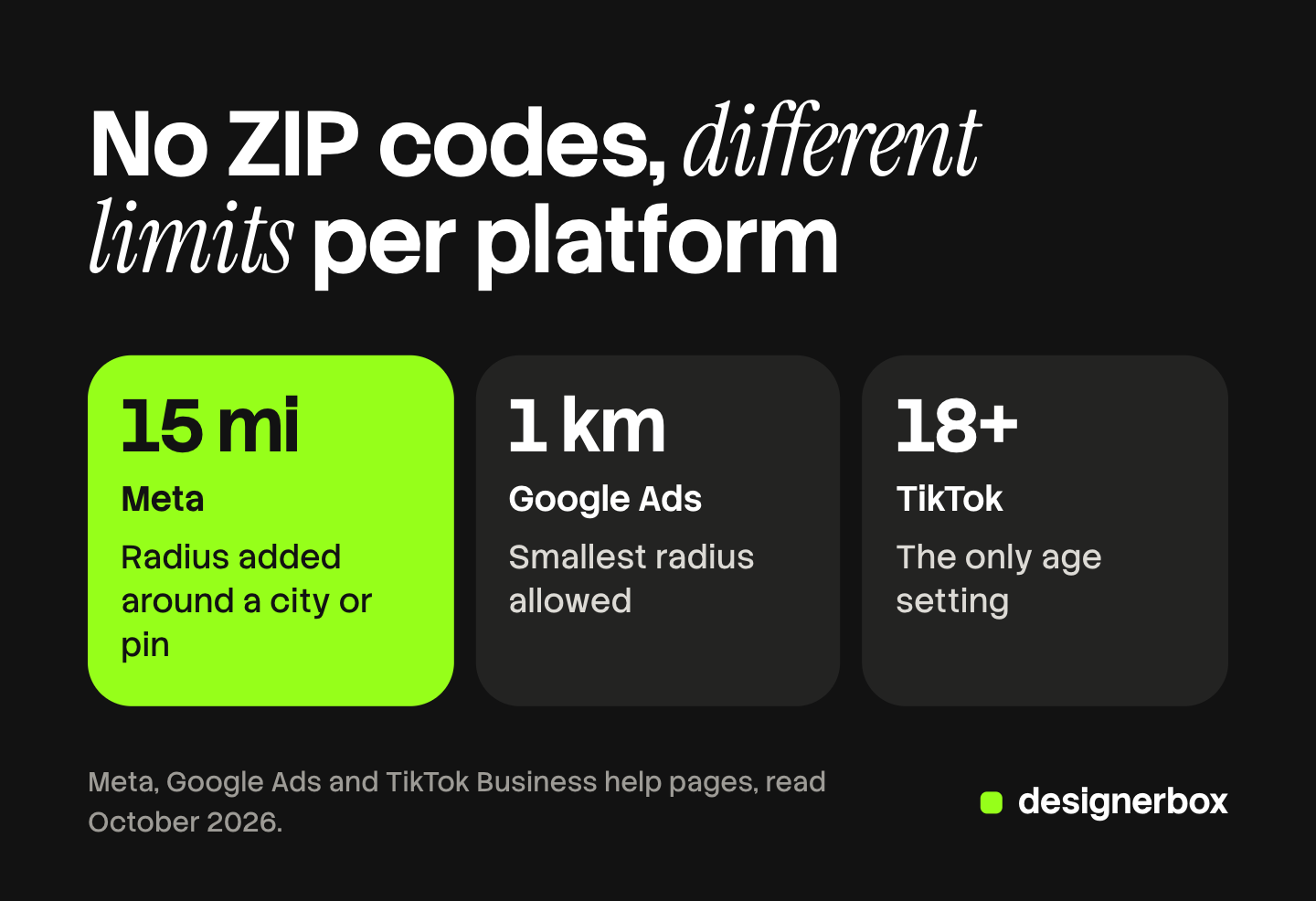
Meta (Facebook and Instagram). Meta defines a housing ad as one that promotes “listings for the sale or rental of a home or apartment, homeowners insurance, mortgage insurance, mortgage loans, housing repairs and home equity or appraisal services” (Meta Business Help Center, October 2026). For advertisers in the US, or ads shown in the US, Canada and some European countries, age, gender, ZIP code, exclusions, lookalike audiences and saved audiences are “limited or unavailable” (Meta Business Help Center, October 2026). The age range is fixed at 18 to 65+, and the audience must include all genders.
Google Ads (Search, YouTube, Display). In the US and Canada, housing ads cannot target by gender, age, parental status, marital status or ZIP code. Radius, city and country targeting stay. A radius must be at least 1 km (Google Advertising Policies Help, October 2026).
TikTok. Advertisers who reach the US or Canada must turn on the Special Ad Category toggle for housing ads. The ads then cannot target by age, gender, ZIP code, or marital or parental status (TikTok Business Help Center, last updated April 2026). The age setting is “18+ only”, and lookalike audiences, interest keywords and hashtag targeting are not allowed (TikTok Business Help Center, last updated April 2026).
| Setting | Meta | Google Ads | TikTok |
|---|---|---|---|
| Age targeting | Fixed at 18 to 65+ | Not allowed | 18+ only |
| Gender targeting | All genders only | Not allowed | Not allowed |
| ZIP code targeting | Not allowed | Not allowed | Not allowed |
| Smallest location | 15 miles around a city, address or pin (US, Canada) | 1 km radius | City or region, no ZIP |
| Where it applies | US, Canada and some European countries | US and Canada | US and Canada |
The radius is the rule that surprises agents most. On Meta, an ad for a house in Seattle reaches “people within a 15-mile radius of Seattle’s city center” (Meta Business Help Center, October 2026). In the UK and much of the EU, the floor is 10 miles. A team that sells in the UK or Europe should not assume the rules stop at the US border.
Why the video has to do the targeting
When the platform cannot pick the viewer, the viewer picks themselves. A person in the wrong price band scrolls past a video that shows the price in the first frame. A person who wants a condo scrolls past a video that opens on a back garden. That self-selection is the only targeting left that you fully control.
So a listing ad that worked on an organic account often fails as a paid ad. The organic clip can open on a slow pan across the kitchen, because its viewers already follow the agent. The paid clip is shown to strangers across a 15-mile circle. It has to say what, where and how much before the viewer decides to scroll.
Four lines carry the selection, and all four go on screen in the first three seconds:
- The place, named as people say it: a neighborhood or a street, never “a great area”.
- The price or the rent, as a number.
- The property type and size: three bedrooms, a two-bed condo, a lot.
- The one feature that makes this listing different from the next one in the feed.
The words must describe the property, never the buyer. HUD’s rule lists “words, phrases, photographs, illustrations, symbols or forms” that convey a dwelling is or is not available to a group of people (eCFR, 24 CFR 100.75, October 2026). “Perfect for young families” describes the buyer. “Three bedrooms, 400 meters from a primary school” describes the property. Our guide to AI UGC video for real estate covers casting and wording in more depth.
Five real estate video ad formats that work inside the limits
Each format below has one job, one category to declare and one thing the creative must carry. The category column matters because two common real estate ads are not housing ads, or are housing ads when people do not expect it.
| Format | What it sells | Category to declare | What the first frame must show |
|---|---|---|---|
| Just listed | One property | Housing | Place, price, bedrooms |
| Open house | One visit, one date | Housing | Date, time, street |
| Three homes at one price | A price band | Housing | The price band and the area |
| Home valuation offer | A seller lead | Housing on Meta (appraisal services) | The area and the offer |
| Join our brokerage | Agent recruitment | Employment, not housing | The role and the city |
1. Just listed
The listing video cut to 15 seconds, with the four selection lines in the first frame. Use one exterior shot and three interior shots. End on the street name and how to book a viewing. This is the format you will make every week, so it is the one to build once and repeat.
2. Open house
A shorter cut, often 6 to 10 seconds, with the date and time on screen the whole time. Run it for the three or four days before the visit. Because the radius is wide, the date and street do more filtering than any audience setting.
3. Three homes at one price
Three listings at a similar price, two or three shots each. The price band is the headline. This format turns the wide radius into an advantage: a buyer in that budget anywhere in the circle is a real lead for the brokerage, even if the first home is not the right one.
4. Home valuation offer
A seller-lead ad: “What is your home worth in [neighborhood]?” Meta lists “home equity or appraisal services” in its housing definition, so declare it as a housing ad.
5. Join our brokerage
A recruitment ad for agents. This is an employment opportunity, so on Meta, Google and TikTok it falls under the employment category, not housing. The same age, gender and ZIP limits apply. The words now have to follow employment rules, so describe the role, not the person.
Meta also says that US advertisers “can include the Equal Opportunity Housing logo and slogan to help differentiate your ads as non-discriminatory” (Meta Business Help Center, October 2026). Put it on the end card of every housing format. For sizes and placements per Meta surface, see our Meta ad specs guide.
AI labels and altered listing media in paid ads
AI real estate video ads carry two extra checks: the label the platform shows, and the disclosure the law asks for. They are separate checks.

TikTok. Ads with AI-generated or significantly edited media are allowed if you “apply the AIGC label, or” add “a clear disclaimer, caption, watermark, or sticker of your own”. If TikTok finds AI content that is not disclosed, “your ad will be rejected or restricted” (TikTok Advertising Policies, last updated April 2026). Turn on the label for any listing clip where a model animated the photos or staged a room.
Meta. Meta says it will “automatically apply an AI info label when we detect your ad was created or edited by third-party generative AI tools”. It uses signals such as C2PA to find them (Meta Business Help Center, October 2026). The label sits under “About this ad”. Write the ad so it still reads well with a label on it.
Google Ads. Google adds a visible label when an advertiser marks an asset as made or edited with AI and the campaign targets the European Union, India or New York. Google also says its label setting “doesn’t guarantee your compliance with specific regulations” (Google Ads Help, October 2026).
California, AB 723. A broker or salesperson who uses a digitally altered image in an advertisement for the sale of real property must include “a statement disclosing that the image has been altered”. The ad must also link to “a publicly accessible internet website, URL, or QR code” with the original image. The law names “photo editing software or artificial intelligence” and lists furniture, flooring, walls, paint color and views through windows. It excludes lighting, sharpening, white balance, color correction, cropping and exposure (leginfo.legislature.ca.gov, October 2026). A video ad made from virtually staged photos is still an ad with altered images. Put the statement and the link on screen or in the ad text. The full portal and MLS picture is in AI real estate video marketing.
New York, synthetic performers. If an ad uses an AI presenter, New York’s General Business Law section 396-b asks anyone who makes the ad to “conspicuously disclose” a synthetic performer when they know one is in it (nysenate.gov, October 2026). It has applied since 9 June 2026. Our comparison of AI avatar tools for real estate walkthroughs covers the presenter side.
A weekly routine for listing ads
An agency that runs ads for ten agents has the same problem every Monday. Twenty new listings, each needs a just-listed ad, an open house ad and maybe a price-band ad, in two formats. The rules above do not change from week to week, so the work should not either.

A routine that holds up:
- Collect the inputs per listing: the photo set, the address as people say it, the price, the bedrooms, the one feature, the open house date.
- Make the cuts from one template per format: a 15-second vertical just-listed cut, a 6 to 10 second open house cut, and a square or horizontal version of each.
- Add the end card: the agent, the brokerage, the Equal Housing Opportunity logo, and the AB 723 statement and link when an image was altered.
- Review against one checklist: four selection lines in the first three seconds, no words about the buyer, AI label set, altered-image disclosure present.
- Launch with the category declared. Then read results by format, not by listing, because one listing runs for days and a format runs for months.
The checklist step is where most rejected ads start. A missing category declaration stops the campaign. A missing AI label on TikTok gets the ad rejected or restricted. A sentence about who the home suits is a fair housing problem no platform setting can fix. If you are deciding whether to film or to make these cuts from photos, real estate videographer cost against AI video compares the two budgets. The step-by-step build of one listing clip is in how to make a real estate video.
Listing ad sets in DesignerBox
Anyone can make an AI picture. Making hundreds that still look like your brand is the hard part. For a brokerage or an agency, the brand is the agent’s end card, the font, the colors and the same layout on every listing ad.

DesignerBox is AI creative production for brands and agencies. Scale your images, ads and video with AI and keep your brand on every piece. DesignerBox is not a real estate product. Here a listing takes the place of a product.
The listing photos, the animated clips, the end card and the edit all sit in one account. In practice that looks like this:
- One workflow per format. Start with the Video from a photo app on one listing. Then save the steps as a workflow. It animates the listing photos, adds the four selection lines and adds the end card.
- Brand rules set once. Your brand rules hold the logo, font and colors, and the workflow reads them on every run.
- One sheet of listings. Batch runs the workflow over a sheet of listings, up to 200 rows, with the same standard on row one and row two hundred. You keep or discard per row and re-run one row alone.
- A real timeline. The video editor has several tracks, transitions, animated text and audio, so you can add the disclosure line and the end card by hand when a listing needs it.
- Cost before the run. An 8-second clip costs 40 to 560 credits, depending on the model, and the cost is shown before the run. The AI video ads page shows the path from a photo to a short ad.
Uploading your own listing photos and the commercial license start on the Pro plan. AI video and the video editor start on the Premium plan. Every plan below Ultra is one seat. Plans are on the pricing page.
DesignerBox does not declare the special ad category, set the AI label or launch the campaign. You download the results and upload them to Meta, Google or TikTok yourself. It does not check your fair housing wording, your MLS rules or your state’s disclosure law. Those checks stay with your team.
If you run listing ads for several agents each week, see DesignerBox for agencies.
FAQ
Do real estate video ads have to use the housing special ad category?
Yes, on Meta, Google Ads and TikTok, when the ad promotes a property for sale or rent, or a related service, to people in the US or Canada. Meta also applies the limits for some European countries and the UK. A brokerage recruitment ad uses the employment category instead.
Can I target a ZIP code with real estate Facebook ads?
No. Meta does not allow ZIP code or postal code targeting for housing ads. You can target a city, region or address, but Meta adds a 15-mile radius around it in the US and Canada, and a 10-mile radius in the UK and much of Europe.
How long should a real estate video ad be?
Most just-listed ads work at around 15 seconds, and open house reminders at 6 to 10 seconds. These are working lengths, not platform rules. Put the place, price and property type in the first three seconds, because the targeting no longer filters the viewer for you.
Do I have to label AI in real estate video ads?
On TikTok, yes, for AI-generated or significantly edited media: use the AIGC label or your own disclaimer, or the ad can be rejected or restricted. Meta adds an AI info label when it detects third-party AI. In California, AB 723 also asks for a statement and a link to the original when a listing image is digitally altered.
Is a virtually staged room in a video ad an altered image?
Under California AB 723, adding furniture or changing flooring, walls or paint color with software or AI makes a digitally altered image. Lighting, cropping, color correction and exposure changes do not. Check your own state law and MLS rules, because they differ.
Can AI real estate video ads use an AI presenter?
Yes, with care. In New York, an ad maker who knows an ad contains a synthetic performer must disclose it conspicuously. Never present a generated person as a real client. The presenter’s look is also part of the ad’s message under fair housing rules.
Can DesignerBox launch my real estate video ads?
No. DesignerBox makes the cuts and you download them. You upload them to Meta, Google or TikTok, declare the category and set the AI label yourself. AI video and the video editor start on the Premium plan.
Sources
All read in October 2026.
- Meta Business Help Center, How to choose a Special Ad Category, housing definition and the Equal Opportunity Housing logo: facebook.com
- Meta Business Help Center, About audiences for housing, employment or financial products and services campaigns, on age, gender, ZIP, lookalike and radius limits: facebook.com
- Meta Business Help Center, About AI info on ads created or edited with generative AI tools: facebook.com
- Google Advertising Policies Help, Restricted targeting in personalized advertising, housing, employment and consumer finance: support.google.com
- Google Ads Help, AI disclosures and labels: support.google.com
- TikTok Business Help Center, Housing, Employment, and Credit (HEC) Ad Policy, last updated April 2026: ads.tiktok.com
- TikTok Business Help Center, List of targeting restrictions for Special Ad Categories, last updated April 2026: ads.tiktok.com
- TikTok Advertising Policies, Misleading and false content, on the AIGC label for ads, last updated April 2026: ads.tiktok.com
- HUD rule 24 CFR 100.75, on words, phrases and photographs in housing advertisements: ecfr.gov
- California AB 723, Business and Professions Code section 10140.8, on digitally altered images in property advertising: leginfo.legislature.ca.gov
- New York General Business Law section 396-b, on synthetic performers in advertising: nysenate.gov
- DesignerBox plan gates: DesignerBox pricing page (designerbox.ai/pricing), October 2026
Platform policies, statutes and regulations checked against each source as of October 2026. This is general information, not legal advice. Platform rules and state laws change often, so confirm them before you launch. Individual results vary.