



Creative diversification is an ad strategy where you make distinct ads for different customer personas or use cases. Each ad differs in look, story and message, so the ad system has real options to match to different people. Meta says its system groups ads that share key visual and thematic attributes and treats them as one creative. A new headline on the same video is iteration, and it does not count as a new ad.
Take a performance team with one winning video. The client wants 40 new ads for the next test. The team swaps the opening line, the button text and the color of the price tag, and it ships 40 files on Friday. The results come back flat, because the ad system read most of those files as one creative.
This guide separates what Meta has written from what agencies have added since. It covers the counts Meta, TikTok and Google publish, four axes to plan a diversified round, and where AI production helps and where it drifts off-brand.
Key Takeaways
-
Meta groups look-alike ads. Its system “groups together ads that share key visual and thematic attributes” and shares learning at the creative level.
-
Iteration is not diversification. Meta’s own example of iteration is two ads with identical visuals and different text calls to action.
-
The counts depend on the level. Meta suggests no more than five distinct ads per ad set, and at least 20 diversified ads in an Advantage+ shopping campaign.
-
Some popular rules have no Meta source. “70% of the creative must look different” comes from an agency blog, and Meta has not said that a shared hook alone makes two ads the same.
-
Plan on four axes. Persona, use case, visual world and format. Keep the brand and the product fixed.
-
AI makes the axes cheap and the product fragile. A new person or setting is where the product and the brand drift.
What is creative diversification?
Creative diversification is a way to build a campaign from several distinct concepts, each made for a different persona or use case. Meta defines it as “an advertising strategy where marketers create unique campaign assets tailored to different potential customer personas or use cases” (facebook.com, published 16 December 2025, read October 2026).
The opposite is creative iteration. Meta describes iteration as “manual A/B testing to refine assets, formats, and messages”. Its example of iteration is “two ads with identical visuals, but different text CTAs”. Its example of diversification is “a Reels ad tailored for GenZ and a separate partnership ad featuring a creator who connects with new moms”. Meta says iteration “can inform new ad concepts” but “should not replace true creative diversification”.
The two need different work. Iteration edits an approved ad. Diversification needs a new brief for each concept: who it is for, why they buy, who appears on screen and where. The ad versioning guide covers the first job, one layer at a time.
Why Meta groups look-alike ads
Meta’s ad delivery starts with a retrieval stage called Andromeda. Meta says Andromeda “quickly scans tens of millions of ads and selects a few thousand strong candidates so only the most relevant and distinct creatives move forward”. Ranking models then choose which of those candidates each person sees.
The grouping happens at the creative level. In the same December 2025 post, Meta writes that its ads system “analyzes creatives and groups together ads that share key visual and thematic attributes. When multiple ads look or feel alike, these are seen as variations of the same creative.” Learning and delivery optimizations are then “shared at the creative level”, not only at the level of each ad.
So ten near-identical ads give the system one option, not ten. Meta’s advice is to upload ads “that are truly distinct in their visuals, messaging, and formats”, so the system can reach different audiences.
Meta’s engineering team published the retrieval design in December 2024. It reports a 6% recall improvement and an 8% ads quality improvement “on selected segments” after the launch on Instagram and Facebook (engineering.fb.com, read October 2026). Those are Meta’s own figures about its own system.
Meta also names a second problem. “Fatigue is about overexposure, while similarity is about a lack of visual diversity.” An ad can be new and still too similar to the ads beside it. The ad fatigue guide covers the first problem and how it shows in the numbers.
What Meta has said, and what agencies added
Creative diversification became a popular topic in 2025, and the advice now mixes Meta’s words with agency rules of thumb. The table separates them. Each row names where the claim comes from.
| Claim | Source | Status |
|---|---|---|
| Ads that share key visual and thematic attributes are grouped as one creative | Meta, December 2025 | Meta’s own words |
| Two ads with the same visuals and a different CTA are iteration | Meta, December 2025 | Meta’s own words |
| Run no more than five ads per ad set, distinct from each other | Meta, ad set structure page | Meta’s own words |
| An ad with the same opening hook as your other ads counts as the same ad | Agency executives quoted by Marketing Brew, September 2026 | Agency view. Meta’s text says “visual and thematic attributes” |
| About 70% of each creative must look different | An agency blog, April 2026 | No Meta source found |
| Meta compares creatives at the pixel level | The same agency blog | No Meta source found |
| Diversified creative improves CPA by up to 32% | Meta-supplied content, October 2023 | Meta’s claim, “up to”, with no study named |
Marketing Brew asked Meta about the mechanics in September 2026. A Meta spokesperson replied: “We don’t get into the specifics of how our ranking models represent individual creative assets.” Meta’s guidance, in the same reply, is “diversify your creative, test, and let the system optimize” (marketingbrew.com, 28 September 2026, read October 2026).

The 70% rule appears in an agency post that cites no Meta page for it (excitemedia.com.au, April 2026). Treat any fixed percentage as a guess. No one outside Meta can measure the grouping, and Meta has not published a threshold.
The useful reading is narrower than the folklore. Meta groups ads that look or feel alike. A change the viewer barely notices is probably not a new creative. A new person, setting, story and message is the change Meta asks for.
How many diversified ads should you run?
Meta, TikTok and Google each publish a number or a rule, and they apply at different levels of the account. Read each one at its own level.
| Platform | What it says | Level | Source |
|---|---|---|---|
| Meta | ”We recommend running no more than five ads per ad set,” with images or videos “distinct from each other” | Ad set | facebook.com, undated, read October 2026 |
| Meta | ”At least 20 diversified ads” in Advantage+ shopping campaigns, with 20 to 30% of the ad budget for testing new ads | Campaign | facebook.com, November 2024 |
| Meta | Up to 10 images and videos in one ad with the flexible format, where available | One ad | facebook.com, read October 2026 |
| TikTok | ”Between 3-5 different creatives per ad group and 3-5 diversified ad groups per campaign” | Ad group and campaign | ads.tiktok.com, last updated June 2025 |
| Ad Strength “Good” asks for “good asset varieties, and good text diversification” in Performance Max | Asset group | support.google.com, read October 2026 |
TikTok’s guidance is the most direct. “It is always better to use creatives with big differences, especially when testing.” TikTok’s Smart Creative feature also picks “the most differentiated videos as assessed by scene similarity” for its first 3 to 5 days (ads.tiktok.com, last updated November 2025).
Meta’s numbers are older than its December 2025 post, which gives no count at all. Use them as a starting shape: a few distinct ads in each ad set, a steady supply of new concepts across the campaign, and a fixed share of budget for testing. The ad creative volume guide covers how many new ads each spend level needs in a month.
The four axes of a diversified concept
A diversified concept changes at least one of four axes, and usually two or three. Meta’s best practice asks for ads “truly different in look, feel, storyline, and message”. The four axes turn that sentence into a brief.
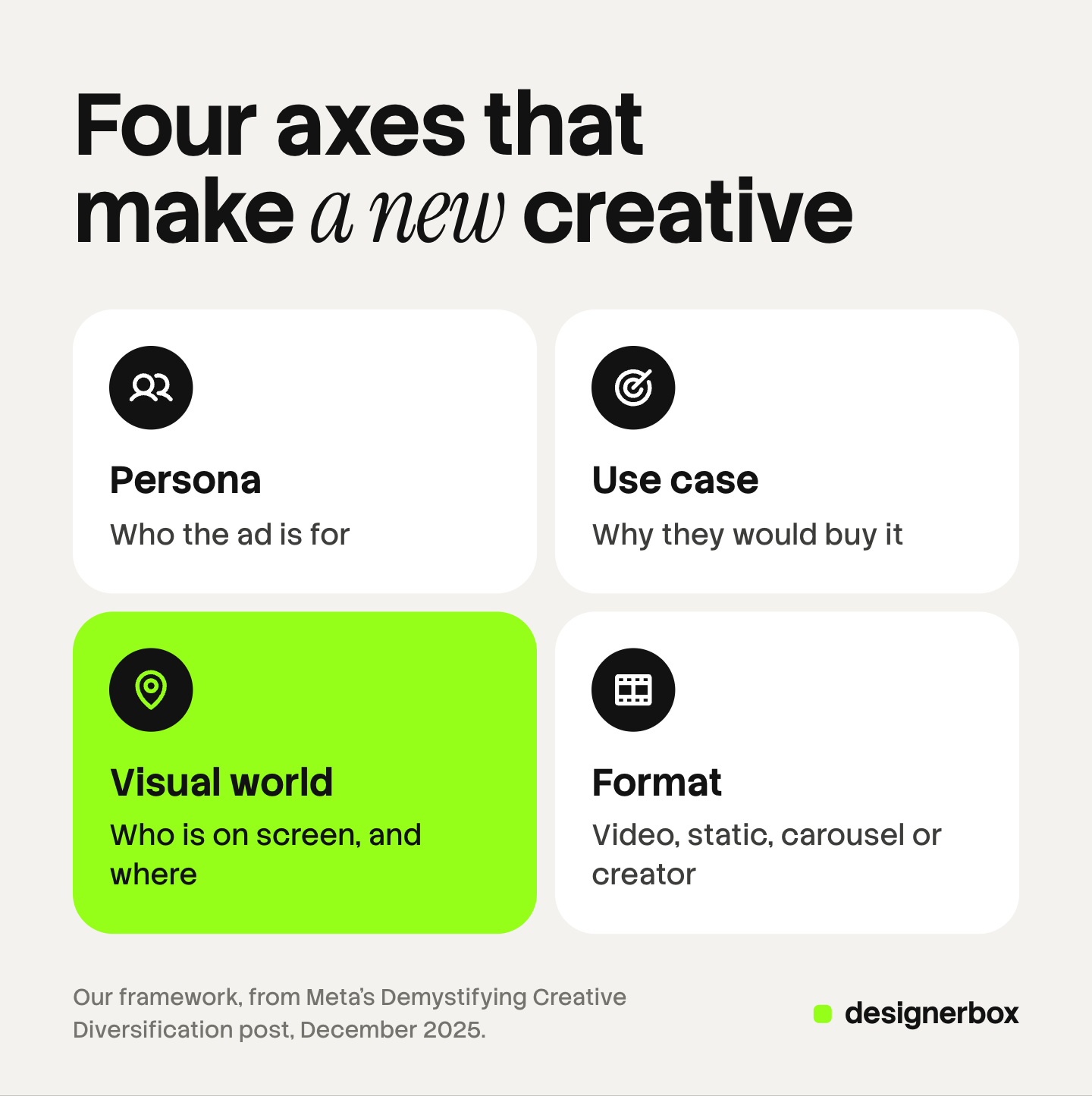
| Axis | The question it answers | Example for a linen bedding brand |
|---|---|---|
| Persona | Who is this ad for? | A new parent, a renter in a small flat, a hotel buyer |
| Use case or message | Why would they buy? | Cooler sleep in summer, easy to wash, a guest room that looks finished |
| Visual world | Who is on screen, and where? | A parent at 6 a.m., a studio flat with one window, a hotel corridor |
| Format | How is it told? | A Reels video, a static image, a carousel, a creator video |
Two things stay fixed in every concept: the brand and the product. The logo, the colors, the type and the product itself must match the real thing in every world. That is what makes 20 different ads read as one brand.
Here is an illustrative example, with numbers chosen for the arithmetic. Three personas and two messages give 6 concept cells. Give each cell its own visual world, and make each one as a video and a static image. That is 12 files and 6 concepts. Twelve headlines on one video is also 12 files, and it is 1 concept.
Meta gives one more method. “Segment Your Messaging: one ad focuses on ‘emotional appeal,’ another focuses on ‘product features.’” That is the message axis with two values, and it is a good first split for a team that has never diversified. The creative concept guide covers how to write each concept before production.
How to plan a diversification round
A round is a set of distinct concepts, launched together and read together. Plan it on paper first, because the expensive part is the production that comes after.
- List the personas and use cases you already have. Use customer reviews, support questions and your sales data. Do not invent personas for the grid.
- Fill the grid. Write one line per cell: who, why and where. Drop any cell that you would not show to a real customer.
- Fix the constants. Write down the brand rules, the product shots and the offer that every concept keeps.
- Give each concept its own visual world. A new person and a new setting are the clearest signal of a distinct creative.
- Name every file by its axes. For example P2-UC1-W3-REELS. Then a report sorted by name shows which axis moved the result.
- Hold the testing budget. Meta suggests 20 to 30% of the ad budget for testing new ads in Advantage+ shopping campaigns.
- Read by concept, then by format. A concept that wins as a video and loses as a static still tells you something about the concept.
The ad creative testing guide explains how to set up a test whose result you can read, and how much volume that needs.

Where AI helps, and where it drifts
AI production makes the costly axes cheap. A new person, a new setting and a new format used to mean a new shoot. Now a team can make a new visual world for each concept in a day. That is why AI and diversification arrived together, and Meta’s own post points advertisers to its generative AI tools for new assets.
Three risks come with that speed.
- The product changes. A new world means a new picture of the product. Check the label text, the logo, the shape and the color in every concept, against the real item.
- The concepts look alike. One model with one prompt template tends to repeat the same light, framing and color. If only the subject words change, the results can still share their visual attributes. That is our reading of Meta’s grouping statement, so check your own results.
- The label rules apply. Meta adds an AI info label when its own generative tools make or heavily change an ad (facebook.com, read October 2026). TikTok asks advertisers to label ads with completely AI-generated images, video or audio (ads.tiktok.com, read October 2026). This is general information, not legal advice.
The second risk is the one teams miss. Twenty concepts made from the same prompt can look like five. Vary the reference pictures, the setting and the camera, and keep the brand rules fixed. The AI generated ads guide covers what the platforms and the studies say about AI creative results.
Diversified concepts in DesignerBox
Anyone can make an AI picture. Making hundreds that still look like your brand is the hard part. Diversification makes that problem larger: the concepts must differ, and the brand and the product must not.
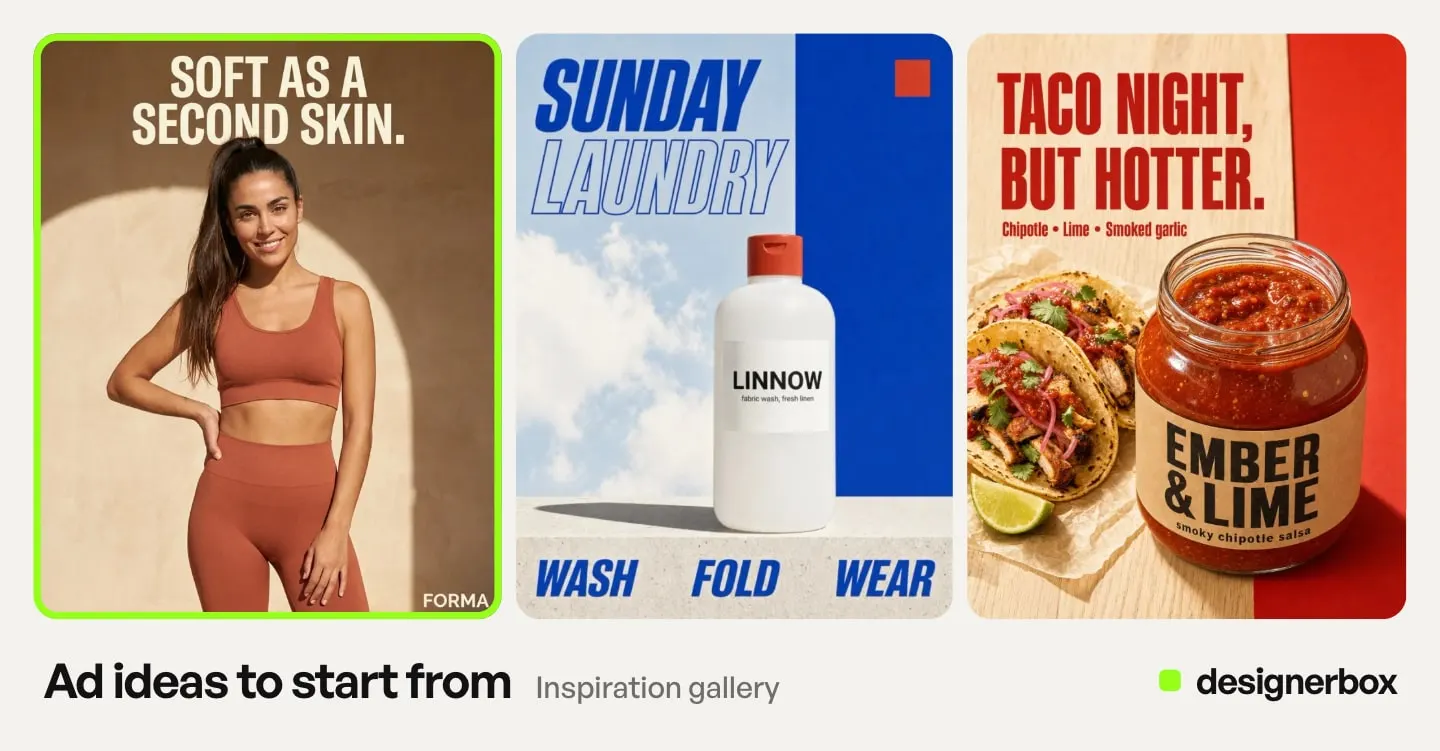
DesignerBox is AI creative production for brands and agencies. You save the brand once as a brand profile: logo, colors, fonts, voice, rules, products and reference pictures. The workflow reads it on every run. So the person, the setting and the message change, and the brand stays fixed.
You build each concept once as a workflow, with its own steps and its own model choice. Batch then runs it over a sheet, with one row for each concept cell: a persona, a setting and a message line. The standard is the same on row one and row two hundred. You keep or discard each row and re-run one row alone. The cost is shown before the run.
The static ads, the video clips and the editors sit in one account, so every concept uses the same brand rules. Critic steps score the results of a run, and best-of-N keeps the best one. For client work, Reviews sends a page of pictures as a link. The client opens it with no account, ticks the pictures and sends the choice back.
Here are the limits. DesignerBox does not measure how similar two ads look to Meta, because no tool outside Meta can. It does not place ads in an ad account. You download the results. Uploading your own photos starts on the Pro plan. Every plan below Ultra is one seat. Plans and credits are on the pricing page.
See how one workflow per client brand works on DesignerBox for agencies.
FAQ
What is creative diversification on Meta?
Creative diversification on Meta means running distinct ads for different personas or use cases. Each ad differs in look, story and message. Meta says its system groups ads that share key visual and thematic attributes, so near-identical ads act as one creative.
Is a new hook enough for creative diversification?
Often not. Meta’s own example of iteration is two ads with identical visuals and different text calls to action. Agency executives go further and say a shared opening hook makes ads the same, but Meta has not said that. A new hook with a new scene, person and message is the safer change.
How many ads should be in one Meta ad set?
Meta recommends “no more than five ads per ad set”, with images or videos that are distinct from each other. At campaign level, a November 2024 Meta post suggests at least 20 diversified ads in Advantage+ shopping campaigns.
What is the difference between creative diversification and creative iteration?
Iteration refines one approved ad, for example a new headline or button on the same visuals. Diversification makes new concepts for different personas or use cases. Meta says iteration can feed new concepts but should not replace diversification.
Does Meta penalize ads that look similar?
Meta has not published a penalty. It says similar ads are seen as variations of the same creative, and that learning and delivery are shared at the creative level. The practical cost is fewer real options for the system to show different people.
Does TikTok also reward different creatives?
Yes. TikTok suggests 3 to 5 different creatives per ad group and says creatives with big differences are better, especially when testing. Its Smart Creative feature first delivers the most differentiated videos, measured by scene similarity.
Can AI help with creative diversification?
Yes, for the person, the setting and the format, which used to need a new shoot. Check every concept for product changes and for look-alike results, and follow each platform’s AI label rules.
Sources
- Meta for Business, Demystifying Creative Diversification, published 16 December 2025: facebook.com, accessed October 2026
- Meta Engineering, Meta Andromeda: Supercharging Advantage+ automation with the next-gen personalized ads retrieval engine, 2 December 2024: engineering.fb.com, accessed October 2026
- Meta for Business, Three steps to optimize your performance with creative diversification, 19 November 2024: facebook.com, accessed October 2026
- Meta for Business, Simplify your ad set structure: facebook.com, accessed October 2026
- Meta Business Help Center, About the flexible ad format: facebook.com, accessed October 2026
- Meta Business Help Center, About AI info on ads created or edited with generative AI tools: facebook.com, accessed October 2026
- Marketing Brew, How advertisers are adjusting to Meta’s ad creative diversification best practices, 28 September 2026: marketingbrew.com, accessed October 2026
- B&T, Creative Is The New Targeting: Five Tips From Meta, 16 October 2023, Meta-supplied content with the “up to 32%” CPA figure: bandt.com.au, accessed October 2026
- Excite Media, What does Meta mean by creative diversification?, 15 April 2026, the source of the 70% rule of thumb (excitemedia.com.au), accessed October 2026
- TikTok Business Help Center, Creative best practices for performance ads, last updated June 2025: ads.tiktok.com, accessed October 2026
- TikTok Business Help Center, About Smart Creative, last updated November 2025: ads.tiktok.com, accessed October 2026
- TikTok Advertising Policies, Misleading and false content: ads.tiktok.com, accessed October 2026
- Google Ads Help, About Performance Max Ad Strength: support.google.com, accessed October 2026
- DesignerBox brand, workflows, batch and pricing pages (designerbox.ai/product/brand, designerbox.ai/product/workflows, designerbox.ai/product/batch and designerbox.ai/pricing), October 2026: brand profiles, batch rows, plan gates and the video credit range
Platform guidance verified on Meta, TikTok and Google pages as of October 2026. Meta’s performance figures are self-reported. The four axes, the bedding example and the 12-file arithmetic are illustrative. The claim that one prompt template can produce look-alike results is our reading of Meta’s grouping statement. Platform features change. Individual results vary.