

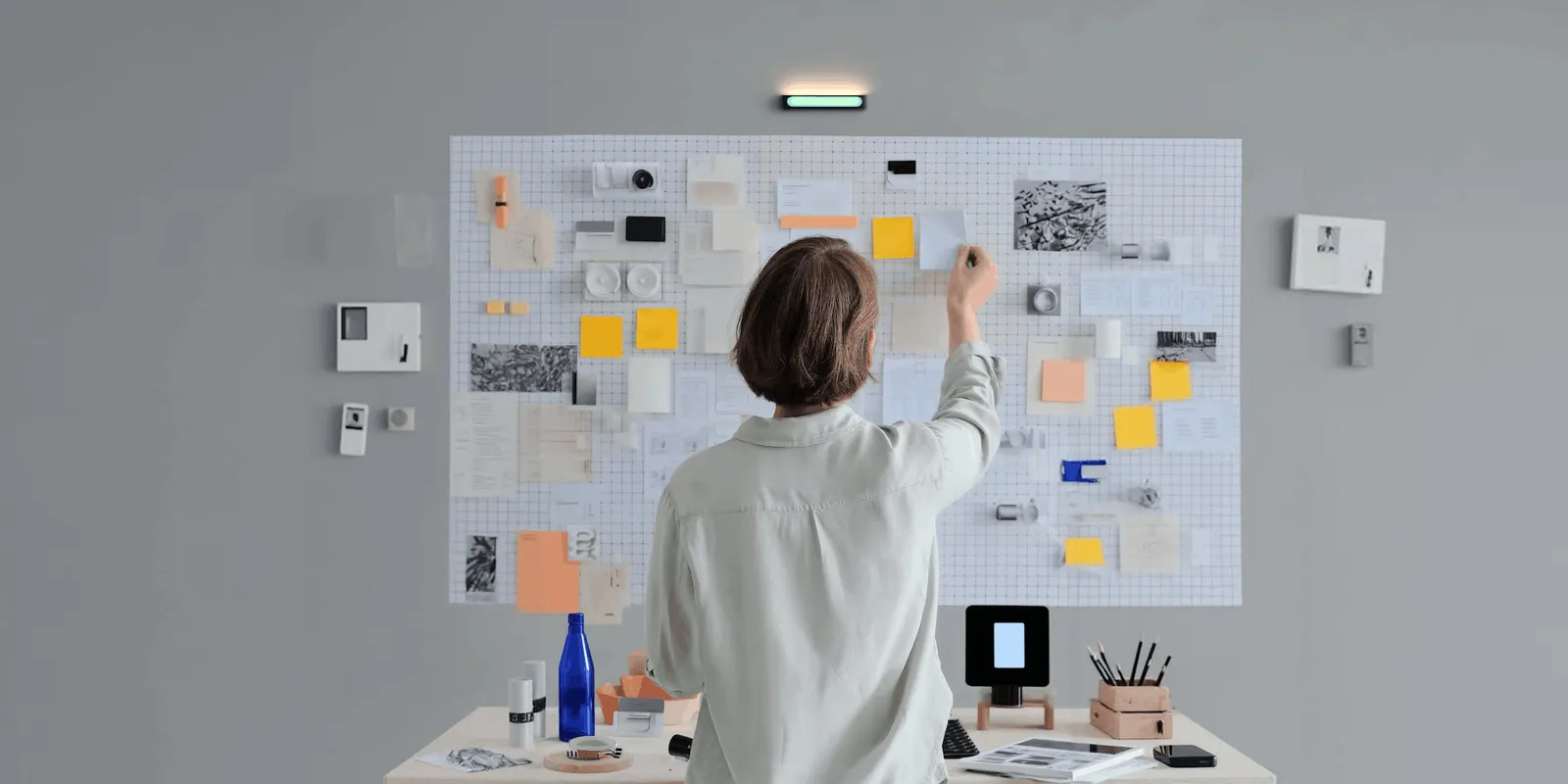
A creative concept is the one central idea that every piece of a campaign expresses. It sits between the brief and the finished ads. The brief says what the campaign must do. The concept says how it will do it, in one sentence. The executions are the ads, videos and posts that carry that sentence into every format and market.
The concept is also where a campaign gets expensive. Count the files. One concept on four platforms in three formats is 12 files. Test five concepts that way and you make 60 files before anyone knows which idea works.
This guide defines the concept, shows three examples, and covers how to write, test and scale one. It is written for agencies and brand teams who run one campaign in many places. To show a concept on your own product before a shoot, see campaign concepts.
Key Takeaways
-
A concept fits in one sentence. It names the idea every execution repeats. The tagline, the key visual and the script come from it.
-
The brief comes first. The brief sets the job. The concept answers the brief, and the executions carry the concept.
-
Test before production. A moodboard tests the look, a storyboard tests the order of shots, and a few rough ads test the idea on your real product.
-
Present three to five concepts. The New Jersey Innovation Authority’s playbook suggests four to six for the internal review and three to five for stakeholders.
-
A new concept is the variety Meta asks for. Meta calls distinct creative “diversification” and small edits of one ad “iteration”.
-
Every market changes the words. Short English text can grow to two or three times its length in a European language.
What is a creative concept?
A creative concept is the organizing idea of a campaign, written as one sentence that every execution can follow. It tells the team what to show and why. The tagline, the key visual, the script and the casting all come from it. A strong concept works in a feed image, a vertical video and a billboard. A weak one works in one format only.
The Compass, a guide from the Johns Hopkins Center for Communication Programs, calls it an overarching “Big Idea” that “captures audience interest, influences their emotional response and inspires them to take action” (thecompassforsbc.org, September 2026). It says a concept usually appears as a headline, a tagline and a key visual. The campaign playbook of the New Jersey Innovation Authority adds that “creative concepts are not actual ads” (innovation.nj.gov, September 2026). They exist so a team can react to an idea before it pays for finished work.
Ad concept, advertising concept and campaign concept name the same thing. The idea matters because creative carries much of an ad’s effect. Nielsen wrote in October 2017 that “creative quality contributes as much to a brand’s in-market success as all other factors combined” (nielsen.com, October 2017).
How is a concept different from an idea, a brief and an execution?
The four words are easy to confuse. Each one answers a different question and has a different owner. The examples use a made-up cold brew brand.
| Term | The question it answers | Example | Who usually owns it |
|---|---|---|---|
| Brief | What must the campaign do, and for whom? | Get office workers aged 25 to 40 to try our cold brew cans | The client or the brand lead |
| Idea | What could one ad show? | A can on a desk at 3 pm | Anyone in the room |
| Concept | What does every ad repeat? | Every ad shows the moment the afternoon slump ends, and the can is the reason | The creative lead, approved by the client |
| Execution | What does the viewer see in this place? | A 9:16 video, a 4:5 feed image, a German banner | The production team |
A quick test separates an idea from a concept. Ask the team what the next ad shows. With a concept, everyone gives a similar answer. With only ideas, the team needs another meeting.
The tagline belongs on the execution side. It is one line the concept produces, like a headline. A team that approves a tagline with no concept behind it has approved one ad.
Creative concept examples from three campaigns
Each of these three campaigns had one idea that many executions could repeat, in many places, for years.
Got milk? (1993). Goodby, Silverstein & Partners created “got milk?” for the California Milk Processor Board in 1993. The ANA Educational Foundation describes the strategy: “remind milk drinkers of the anxiety and disappointment that came when milk wasn’t available” (aef.com, September 2026). That is the concept, and the two words are its tagline.
Share a Coke (2011). Coca-Cola started “Share a Coke” in Australia in 2011, with the 150 most popular first names on its bottles. The company says it sold more than 250 million named bottles and cans that summer, in a country of about 23 million people (coca-colacompany.com, 2014). By 2014 it had reached more than 70 countries, and several markets adapted the execution.
Shot on iPhone (2015). Apple’s “Shot on iPhone 6” campaign started in March 2015, with photos by 77 photographers in 70 cities and 24 countries. They ran in magazines, newspapers, on billboards and on transit posters (macrumors.com, March 2015). Apple kept the concept for years. In January 2019 it opened a Shot on iPhone Challenge. Apple said the 10 winning photos would appear on billboards in select cities, in Apple stores and online. Each winning photographer would receive a licensing fee (apple.com, January 2019).
| Campaign | The concept | Executions the sources name |
|---|---|---|
| Got milk? | Remind people how it feels when the milk runs out | TV, print, billboards, bus stops, store floor decals |
| Share a Coke | A name on the bottle | Named bottles and cans, nicknames in China, an online store in Germany |
| Shot on iPhone | Real iPhone photos, shown as the ad | Magazines, newspapers, billboards, transit posters, stores |
Each concept fits in one line, and each tells a team in another country what to make next.
How do you write a creative concept in five steps?
Start from the brief, find one true thing about the product or the buyer, and write the concept as one sentence. Then sketch it in three formats, and list which parts of every execution stay fixed. These five steps take a team from a brief to a concept it can test.

1. Start from the brief’s one job
Write the brief’s job in one line: who the campaign is for, and what they should think or do after it. A brief with three jobs produces a concept that tries three things at once. Our one-page creative brief template keeps the brief to six fields.
2. Find one true thing
A concept needs a true fact at its center: a product truth, such as a name on a bottle, or a buyer truth, such as the moment the milk runs out. Search reviews, sales calls and support tickets for the words buyers use.
3. Write it as one sentence
Write the concept as one sentence a colleague can repeat after one reading. A simple shape helps: “We show [the buyer] that [the truth] by [the thing every ad repeats].” Give it a short working name too. Write several, because the New Jersey playbook suggests four to six for the first internal review.
4. Sketch it in three formats
Sketch each concept three ways: a square feed image, a vertical video frame and a wide banner. The Compass names this as one reason to develop concepts: to “see how the campaign will work (or not) across multiple media channels”. A concept that works in only one of the three is a single ad idea.
5. List what stays fixed
List what every execution must keep and what each one may change. Fixed parts are usually the device (the name on the bottle), the tone, the role of the product, and the brand’s type and colors. Free parts are the scene, the person, the headline wording, the language and the size. This list lets a second team or market make new executions without a new briefing. An AI workflow needs the same list. AI creative direction covers what to fix and what to vary across a set. For the steps from one concept to one finished ad, see how to make an ad in seven steps.
How do you test a concept before production?
Test a concept with rough material before you pay for finished work. A moodboard tests the look. A storyboard tests the order of shots in a video. A few rough ads made on your real product test whether the idea reads in a feed. Then run the best two or three concepts in a small paid test.
The New Jersey playbook describes the review. Show three to five concepts to stakeholders and keep their feedback on strategy, such as more emotion or a clearer call to action. The color of a headline is a detail for the creative team. The playbook says not to test more than three or four concepts, and it plans one to three weeks for this phase.
| Method | What it tests | What it cannot tell you | Use it when |
|---|---|---|---|
| Moodboard | Tone, light, color and casting | Whether the idea is clear | Every concept, first |
| Storyboard | The order of shots and where the product appears | How the finished video looks | The concept leads with video |
| Rough ad variants | Whether the idea reads on your product, at feed size | How buyers respond | You have product photos |
| Paid test | Which concept buyers respond to | Why they respond | Two or three concepts pass the review |
Keep one moodboard per concept, so the concepts stay separate. An approved board can become the style reference for every later result, and our comparison of moodboard generator tools covers the options. When video leads the campaign, the New Jersey playbook suggests a 30-second script. For frames made from a script, see AI storyboard generators.
Make the rough ads on your own product, in the sizes the ads will run. Stock images show another company’s product, so they cannot tell you if the idea works on yours.
Meta’s A/B test compares two versions of an ad by changing a variable, such as the image or the text. It shows each version to a separate group and makes sure “nobody sees both” (facebook.com/business/help, September 2026). Test concepts against each other here. Small edits of one ad belong in a later round.
How does one concept become many executions?
One concept becomes many executions when the team keeps the fixed parts and changes the free ones. Each platform needs its own sizes, and each market needs its own words. So one approved concept becomes a grid of files, and every cell is a file someone must make and check. Creative assets lists the file types and how the count grows.
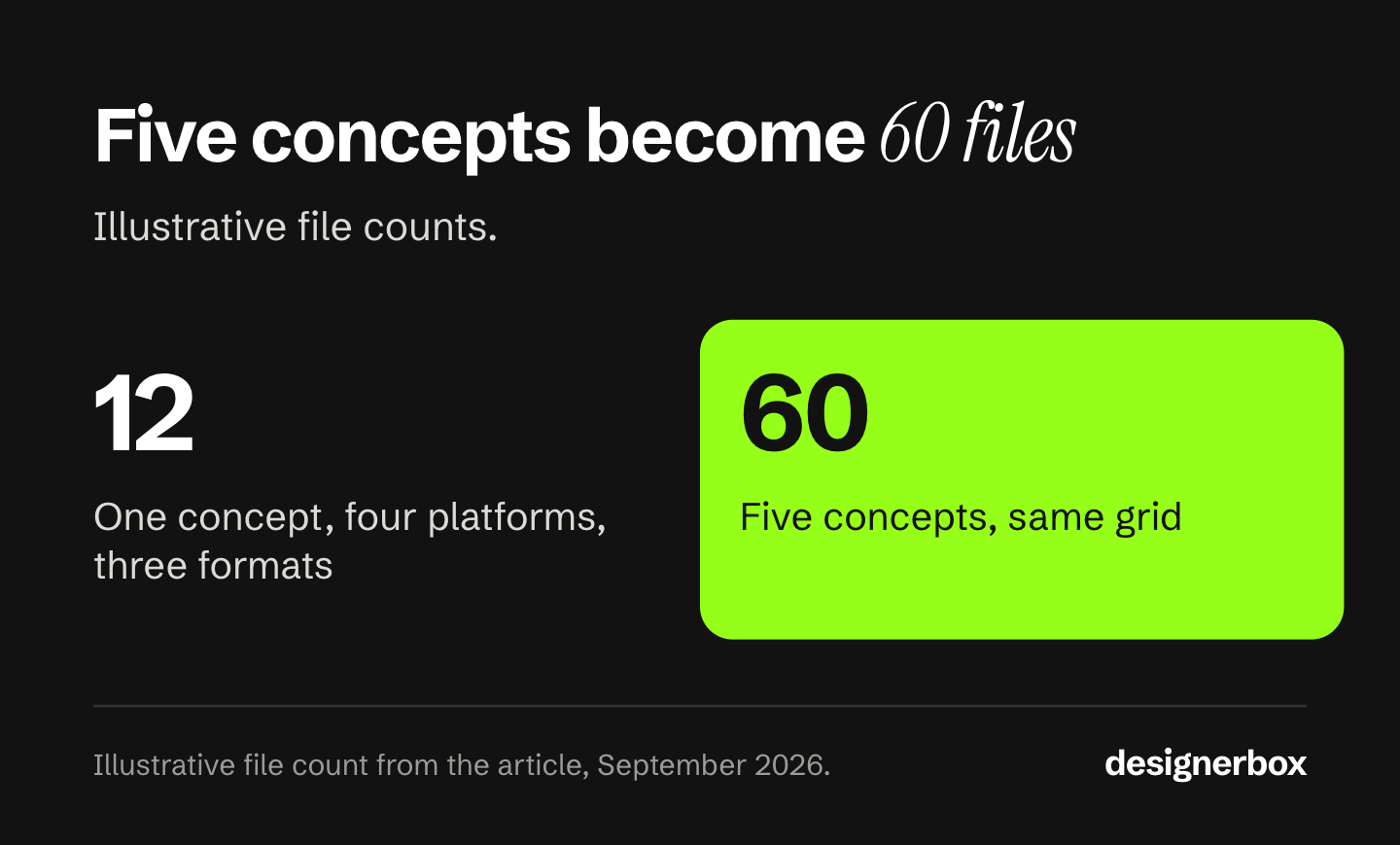
Start with shapes. Meta recommends 4:5 for single-image ads in Facebook Feed, 1:1 for Instagram Feed, 9:16 for Stories and Reels, and 16:9 for in-stream video (facebook.com/business/help, September 2026). As an illustration, one concept on four platforms in three formats makes 12 files, and a test of five concepts makes 60. Our guide to one ad in every platform size shows how to count and build that grid.
Then markets. In IBM figures quoted by the W3C, English text of up to 10 characters grows to 200 to 300% of its length when translated into European languages. Text over 70 characters grows to about 130% (w3.org, September 2026). In the W3C’s own example, the English word “views” became a phrase 2.8 times as long in German. Headlines and buttons are short, so they grow the most. For layouts that change language without a rebuild, see ad localization without rebuilding the layout.
Keep the line between a new concept and a new variant clear. Meta says creative iteration “might produce two ads with identical visuals, but different text CTAs”. Diversification produces “two distinctly different pieces of creative” (facebook.com/business/news, December 2025). Meta adds that iteration “should not replace true creative diversification”. So run two or three concepts, and give each one several executions. Fresh executions also delay ad fatigue on a winning concept.
Where do concepts go wrong?
These five problems start before production. Each one is cheap to fix at the concept stage and expensive in 60 finished files.

- A tagline in place of a concept. A line can be clever and still give the next team nothing to make. Ask what the second and third ads would show.
- Colors, fonts or models counted as concepts. The Compass lists these as execution choices, tested later. The same goes for a different call to action.
- Detail feedback too early. The New Jersey playbook asks stakeholders to comment on strategy and to leave the details to the creative team.
- Too many concepts in the test. Every extra concept adds a full set of files. The playbook gives three or four as the limit.
- No list of fixed parts. Without it, each market and each freelancer reads the concept in a different way, and the campaign drifts.
Campaign concepts as a workflow
Anyone can make an AI picture. Making hundreds that still look like your brand is the hard part. A concept shows that problem early: the team approves one look, then needs it on every product, size and market.
DesignerBox is AI creative production for brands and agencies. Scale your images, ads and video with AI and keep your brand on every piece: build the workflow once with your brand rules, run it on every product, see the cost before each run, and keep everything from the first product photo to the finished ad in one place.
For the concept stage, campaign concepts shows the work before the shoot. The product scene placement template puts your own product in a styled scene. The brand storyboard app takes one product photo and a brief. It returns four square photos of that product for one campaign, and it reads your brand rules.
When the team approves a concept, save it as a workflow. The workflow holds the steps, the brand rules and the fixed parts. Batch runs it over a whole sheet of products. You keep or discard per row, and re-run one row on its own. Three critic steps score the results, and best-of-N keeps the best one. You still choose what goes into the ads. For static ads, the AI ad generator starts from your own product photo. The full workflow from the first product photo to the finished ad, in one subscription.
Here are the limits. DesignerBox does not publish into ad platforms. You download the results, or send them with a webhook or an S3 step. DesignerBox does not build the moodboard itself, so keep it in your board tool. You need the Pro plan to work from your own product photos. The commercial license also starts on the Pro plan. AI video starts on the Premium plan. Team features, shared brand kits and white label are on the Ultra plan, and every plan below Ultra is one seat.
A free plan for your first run
There is a free plan, and it runs on sample products. Start from a template and see the cost before you run it. Get started free.
FAQ
What is a creative concept in simple terms?
It is the one idea that every ad in a campaign repeats, said in one sentence. The tagline, the pictures and the videos come from it. “Remind people how it feels when the milk runs out” is a concept. “got milk?” is the tagline it produced.
What should a concept presentation include?
Include the concept sentence, a short name, a headline or tagline and a key visual. The New Jersey Innovation Authority describes sample copy, such as a headline and a call to action, plus imagery. Add rough executions in three formats to show that the concept travels.
How many creative concepts should you present?
The New Jersey Innovation Authority suggests four to six concepts for the internal review, three to five for stakeholders, and no more than three or four in a test. Each concept should take a different approach, so the choice is clear.
How long does concept development take?
The New Jersey playbook plans one to three weeks, and it says a quick project can time-box ideation to one day. The Compass gives a wider range, from a few days to two months.
What is the difference between an ad concept and an ad variant?
An ad concept is a distinct idea. An ad variant changes one detail of an existing ad, such as the headline or the call to action. Meta calls the second kind “creative iteration” and says it should not replace “true creative diversification”. Test concepts first, then variants of the winner.
Can AI write a concept?
AI can draft many concept sentences and rough executions quickly. It cannot tell you which concept fits your brand and your buyer, so a person still chooses. AI helps most after that choice, when one approved concept needs the same look on every product and in every size.
Sources
- The Compass for SBC (Johns Hopkins Center for Communication Programs), “How to Develop a Creative Concept”: thecompassforsbc.org, accessed September 2026
- New Jersey Innovation Authority, campaign playbook, “Developing Your Creative Concept(s)”: innovation.nj.gov, accessed September 2026
- Nielsen, “Perspectives: Want a Successful Ad? Get Creative”: nielsen.com, October 2017, accessed September 2026
- ANA Educational Foundation, “got milk?” case history: aef.com, accessed September 2026
- The Coca-Cola Company, “How a Groundbreaking Campaign Got Its Start Down Under”: coca-colacompany.com, September 2014, accessed September 2026
- MacRumors, “Apple Launches Worldwide ‘Shot on iPhone 6’ Ad Campaign”: macrumors.com, March 2015, accessed September 2026
- Apple Newsroom, “Share your best photos shot on iPhone”: apple.com, January 2019, accessed September 2026
- Meta Business Help Center, “About A/B testing”: facebook.com/business/help, accessed September 2026
- Meta Business Help Center, “Best practices for aspect ratios”: facebook.com/business/help, accessed September 2026
- Meta, “Demystifying creative diversification”: facebook.com/business/news, December 2025, accessed September 2026
- W3C Internationalization, “Text size in translation”, citing IBM’s Guidelines to design global solutions: w3.org, accessed September 2026
- DesignerBox campaign concepts and pricing pages (designerbox.ai), September 2026: templates, apps and plan gates
Campaign facts and platform guidance verified from Johns Hopkins CCP, the New Jersey Innovation Authority, Nielsen, the ANA Educational Foundation, Coca-Cola, Apple, Meta and the W3C as of September 2026. Individual results vary.