Fashion business automation tools do the repeat work of a clothing brand without a person starting each task. They write tech packs, send line sheets to wholesale buyers, keep stock counts right for every size, handle exchanges and make product images. For a fashion brand, the useful way to sort them is by the count each tool works on: styles, colorways or sizes.
Here is why the count matters. A drop of 30 styles, each in 4 colors and 6 sizes, is 30 tech packs, 120 colorways that each need photos, and 720 SKUs that each need a stock count. Those are three different jobs at three different sizes. A tool that handles one of them well can do nothing for the other two.
This guide maps the tools a fashion brand compares to the count each one works on. It covers product development, wholesale, stock, fit, exchanges and product images, with the platform rules behind each job. It is written for brands with 20 to 500 styles, and for agencies that run production for fashion clients. The general store jobs, such as order rules and support, are in our guide to ecommerce automation tools.
Key Takeaways
- A fashion catalog is a matrix. One style becomes colors times sizes. A 30-style drop in 4 colors and 6 sizes is 30 style records, 120 colorways and 720 SKUs.
- Each tool works on one count. PLM and wholesale tools work per style. Image and feed tools work per colorway. Stock, fit and exchange tools work per SKU.
- The SKU count is the largest and the most rule-based. Stock sync and back-in-stock alerts follow rules you can write, so automate them first.
- The colorway count is public. Every product image reaches every shopper. Automate it with a review step before anything goes live.
- The style count is the smallest and the most expensive to get wrong. A tech pack error reaches the factory, so a person approves every one.
- Size drives returns. In NRF’s 2025 survey, 26% of apparel and footwear purchases included a bracketed item, bought in several sizes or colors to return the rest.
- In DesignerBox, one workflow makes the images for every colorway. The workflow reads your brand on every run, and each run shows its cost before you start it.
What are fashion business automation tools?
Fashion business automation tools are software that runs a clothing brand’s repeat work when something happens, without a person starting each task. A new style starts a tech pack. A sale in one channel changes the stock count in the others. A return for the wrong size becomes an exchange. A new colorway starts a set of product images for review.
The tools split into three groups, one for each count in a fashion catalog:
- Style tools work once per design. Product lifecycle management (PLM), production orders and wholesale line sheets sit here.
- Colorway tools work once per color of a style. Product images and the color data in shopping feeds sit here.
- SKU tools work once per size of each colorway. Stock counts, back-in-stock alerts, size advice and exchanges sit here.
Generic store automation sits across all three. Shopify Flow, Zapier and a support help desk treat a size-8 dress like any other product, which is why they fit every store and do not solve a fashion-specific job.
Why a fashion catalog is three counts
A fashion catalog multiplies at each step, and each step brings a different kind of work. The counts below are an illustration for a 30-style drop, not a benchmark. Put your own numbers in and the shape stays the same: the style count stays small, and the SKU count grows fastest.
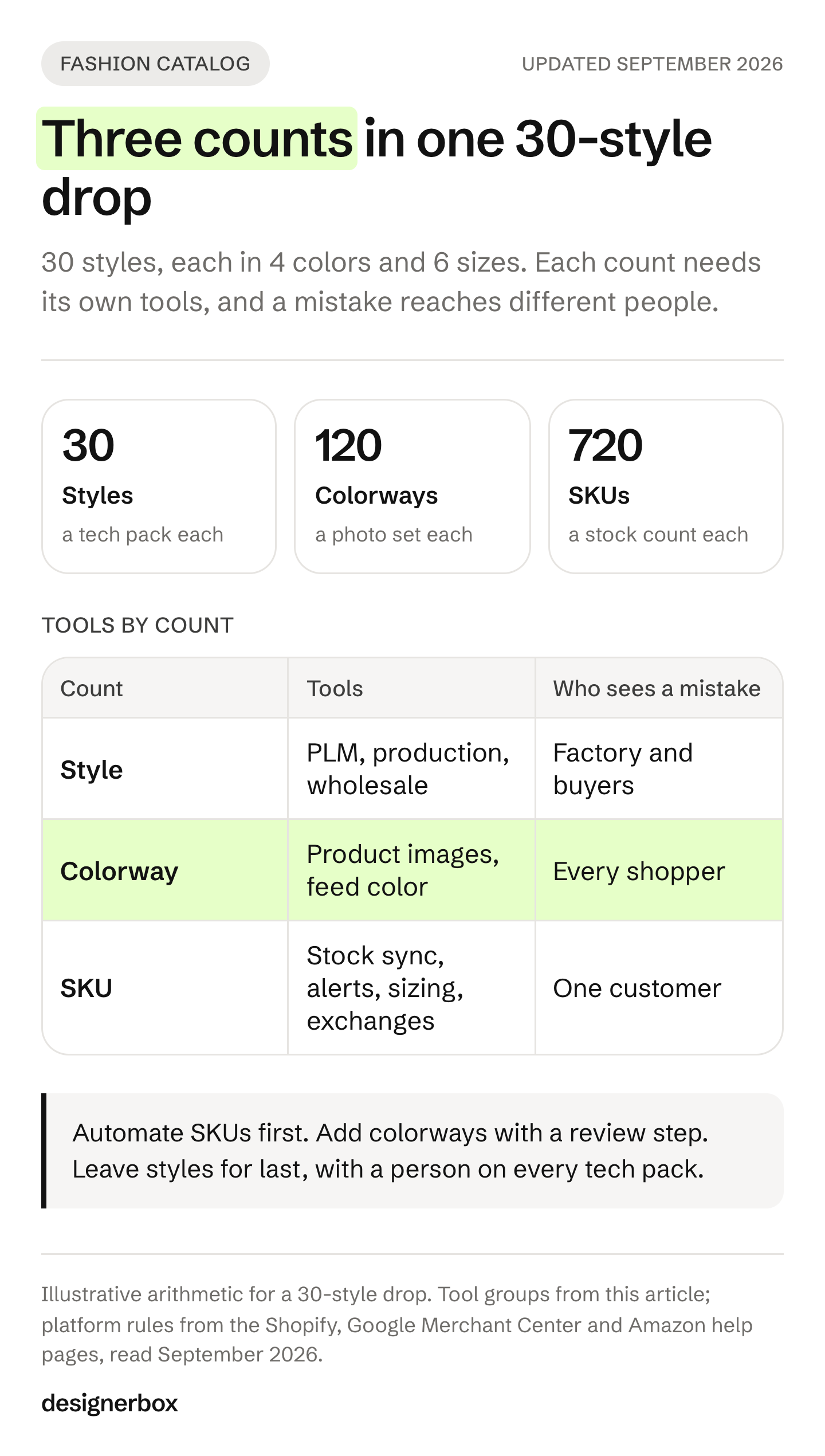
| Count | In a 30-style drop (4 colors, 6 sizes) | What each one needs | Who sees a mistake |
|---|---|---|---|
| Styles | 30 | A tech pack, a bill of materials, a production order, a wholesale line sheet | Your factory and your wholesale buyers |
| Colorways | 120 | Product images, a color value in each feed, a lookbook frame | Every shopper |
| SKUs | 720 | A stock count in every channel, a feed item, an alert and an exchange path | One customer at a time |
The platforms you sell on are built around the same matrix. Shopify allows up to 2,048 variants and up to three options per product, so color and size fit as two options with room to spare. Shopify also warns that some themes and apps do not support more than 100 variants (help.shopify.com, September 2026). Amazon groups clothing as one parent product with child products that differ by size or color, and the parent carries no stock of its own (sellercentral.amazon.com, September 2026).
Google Merchant Center goes one step further. It asks you to submit each variant as a separate product with the same item group ID (support.google.com, September 2026). In Brazil, France, Germany, Japan, the UK and the US, Shopping ads need color, size, gender and age group for clothing (support.google.com, September 2026). In the example drop, that is 720 feed items, and every one needs four apparel attributes.
Fashion business automation tools by count
This table maps the tools fashion brands compare to the count each one works on. Every tool listed has the feature on its own site, read in September 2026. No tool here is ranked above another, and none of their prices appear in this guide. Check each vendor’s own page before you buy.
| Job | Count | What gets automated | Mode | Tools to compare |
|---|---|---|---|---|
| Tech packs and product data | Style | Bills of materials, size specs, points of measure | Review step | Backbone PLM, Centric PLM, Browzwear |
| Production | Style | Production orders, purchase orders, work in progress | Handoff | Uphance, ApparelMagic |
| Wholesale | Style | Digital line sheets, buyer orders | Handoff | JOOR, NuORDER by Lightspeed, Shopify B2B |
| Product images | Colorway | On-model, flat lay and ghost mannequin shots per color | Review step | Shopify Magic, Google Product Studio, DesignerBox |
| Feed data | Colorway and SKU | Color, size, gender and age group per variant | Automate fully | Your store’s feed, Google Merchant Center |
| Multichannel stock | SKU | Stock counts synced across store and marketplaces | Automate fully | Sellbrite, Uphance |
| Back-in-stock alerts | SKU | An email when the exact variant returns | Automate fully | Klaviyo |
| Size advice | SKU | Size charts and a size suggestion per shopper | Automate fully | Kiwi Sizing, True Fit |
| Exchanges | SKU | A swap to another size or color | Handoff | Loop Returns |
We make DesignerBox, which sits in the product images row. Read that row with that in mind. Every other row names tools we do not sell.
The mode column uses the same three modes as the ecommerce automation guide linked above. “Automate fully” means your team sees any error first. “Handoff” means the tool does the common case and a person takes the exceptions. “Review step” means a person approves each result before it goes live or reaches a factory.
Fashion PLM software and other style tools
Style tools do the work that happens once per design, before a single SKU exists. Fashion PLM software holds the tech pack, the bill of materials and the size specs, and sends them to the factory. Production tools track the order once it is placed. Wholesale tools show the new line to buyers. There are few style records, but a mistake at this stage costs the most.

Tech packs: Backbone, Centric and Browzwear
Backbone PLM gives brands tech pack templates, bills of materials, size specs and points of measure, kept in shared libraries so the next style reuses them (backboneplm.com, September 2026). Centric Software sells PLM for fashion that manages complex bills of materials, links 2D and 3D design tools, and aims to reduce sample rounds (centricsoftware.com, September 2026).
Browzwear starts from a 3D garment instead of a spreadsheet. It builds virtual twins of physical garments with physics-based simulation. From the virtual sample, it generates a tech pack that can include a bill of materials with colorways, fabrics and trims, artwork with measurements, or pattern pieces (browzwear.com, September 2026).
The question for a small brand is where the tech pack lives today. If it is a spreadsheet that someone copies for each style, a PLM tool replaces the copying. If you have five styles a season, the spreadsheet may still be enough.
Production: Uphance and ApparelMagic
Uphance tracks stock by variant and treats size matrices and prepacks as core objects. It also handles production orders, purchase orders to vendors, tech packs and EDI with retailers (uphance.com, September 2026). ApparelMagic tracks work in progress and links bills of materials to production orders. It offers EDI through a partner that it says connects to over 400 retailers (apparelmagic.com, September 2026).
These tools sit between the style and the SKU. They start from the style, then count stock by size once the goods arrive. A brand that sells wholesale and direct from one stock pool gets the most from them.
Wholesale: JOOR, NuORDER and Shopify B2B
JOOR offers virtual showrooms, digital line sheets and order management. Its line sheets can connect to your stock system, so buyers see live availability, and it syncs orders to Shopify (joor.com, September 2026). NuORDER by Lightspeed offers digital catalogs, ordering at any hour and integrations with over 120 ERP, PLM and POS systems (nuorder.com, September 2026).
Shopify B2B is now on the Basic, Grow, Advanced and Plus plans (help.shopify.com, September 2026). The number of B2B catalogs and some payment features differ by plan, so check the plan table. For a brand that sells to a few stores, native B2B may cover what a wholesale platform does.
A line sheet also needs a photo of every colorway, so the colorway count reaches your wholesale buyers too.
Size tools: stock, fit and exchanges
SKU tools do the work that repeats for every size of every colorway. They are the largest count and the most rule-based. A stock count is a number. A back-in-stock alert fires when that number goes above zero. That is why this group is the first place to automate. It also carries the biggest cost in fashion: returns for the wrong size.

The numbers are large. In NRF’s 2025 survey, US retailers expected 19.3% of online sales to come back. That figure covers all categories. The same report found that 26% of apparel and footwear purchases included a bracketed item, bought in several sizes or colors to return the rest (nrf.com, October 2025). Coresight Research and Alvanon, a company that sells sizing technology, put the US online apparel and footwear return rate at 23.4% in 2025. They found that size and fit caused about 70% of returns (wwd.com, May 2026).
Stock in every channel: Sellbrite and Uphance
A sale on Etsy has to lower the count on Amazon and on your own store before a second shopper buys the last size 8. Sellbrite lists products on Amazon, eBay, Etsy, Walmart, Google Shopping and other channels, and adjusts stock in every channel when an order arrives (sellbrite.com, September 2026). Uphance does the same inside a system that also runs wholesale and production.
Back-in-stock alerts: Klaviyo
When one size sells out, the shopper who wanted that size already chose the product. Klaviyo’s back-in-stock alerts name the exact variant the shopper asked for. The forms work on Shopify and BigCommerce. They do not work when Shopify’s “Continue selling when out of stock” setting is on (help.klaviyo.com, September 2026). Check that setting on your most popular sizes before you build the flow.
Size advice: Kiwi Sizing and True Fit
Kiwi Sizing adds size charts to a Shopify store and a size recommender that suggests a size to each shopper (kiwisizing.com, September 2026). True Fit uses purchase and return data across apparel and footwear to help shoppers choose the right size (truefit.com, September 2026). Size advice has published retailer evidence behind it: Zalando reported that its fit tools, taken together, prevented 8% of size-related returns in 2025. The details are in our look at whether virtual try-on reduces returns.
Exchanges: Loop Returns
Loop Returns lets customers swap for a different size, color or variant of the same product and tracks stock as they do. Its instant exchanges ship the new item before the return arrives, and it can offer extra store credit to shoppers who choose an exchange (loopreturns.com, September 2026). For a fashion brand, the aim is simple: turn a size return into a size exchange, so the sale stays.
Colorway tools: product images and feed data
Colorway tools do the work that repeats for every color of every style. This count is smaller than the SKU count, but it is the one every shopper sees. Every colorway needs its own photos, because a buyer on a product page picks a color by looking at it. That makes product images the fashion job where automation needs a review step.
The platforms set what those images must be. Amazon’s main image for adult clothing shows the item on a standing model, with no part of a mannequin visible (sellercentral.amazon.com, September 2026). Google recommends images of clothing worn by people, and asks that an AI product image keep the metadata that says AI made it (support.google.com, September 2026).
Shopify lets you add one image to each variant (help.shopify.com, September 2026). In practice, the six sizes of one color point to the same image. To show a group of images when a shopper picks a color, Shopify points to its Combined Listings app, which is on the Plus and Enterprise plans. So the unit of image work is the colorway, not the SKU.
Wrong images are expensive. In Salsify’s 2025 survey of 1,910 US and UK shoppers, 71% had returned an item because of incorrect product content, such as images that did not match the product (salsify.com, 2025). Salsify sells product content software, and the survey covers all categories.
Tools for product images per colorway
Free tools cover the common edits. Shopify Magic removes backgrounds (help.shopify.com, September 2026). Google’s Product Studio is a free set of AI tools inside Merchant Center (support.google.com, September 2026). For on-model shots, flat lays and ghost mannequin shots across a whole drop, brands use AI tools built for fashion. DesignerBox is one of them, and the next section says what it does and does not do.
Check every colorway for three things before it goes live:
- The garment matches the real one. Print, logo, stitching, collar and the exact color.
- The set matches the rest of the catalog. The same model, light and framing on every colorway. Our guide to consistent AI fashion images covers how to hold it.
- The file meets the channel. The size, the background and, where a channel asks for it, the AI metadata. The channel rules are in what each marketplace allows for AI product photos.
McKinsey and The Business of Fashion found that more than 35% of fashion executives already use generative AI in areas such as customer service, image creation, copywriting and product discovery (mckinsey.com, The State of Fashion 2026). Image creation is on that list because the colorway count grows every season and a studio day does not.
What should a fashion brand automate first?
Automate the SKU count first, then the colorway count with a review step, and the style count last. The SKU count is the largest and follows rules you can write, and a mistake reaches one customer. The colorway count is public, so it needs a person to approve each set. The style count is the smallest, and a mistake reaches the factory.
| Order | Count | Start with | Why |
|---|---|---|---|
| 1 | SKU | Multichannel stock sync, back-in-stock alerts | A rule you can write, repeated hundreds of times |
| 2 | SKU | Size charts, size advice, exchanges | Size is the main reason clothing comes back |
| 3 | Colorway | Product images for every color, with a review step | Every shopper sees them, and the count grows each season |
| 4 | Style | PLM and wholesale, once the spreadsheet breaks | Few records, high cost per mistake |
There is one exception. If you sell mostly wholesale, move the style tools up. A line sheet with a wrong price or a missing colorway reaches every buyer at once.
Use the general store tools alongside all of this. Shopify Flow is a free app on the Basic, Grow, Advanced and Plus plans, and it handles order tags and internal alerts (help.shopify.com, September 2026). The glue between apps, support and email content is covered in that ecommerce automation guide. For the full creative stack a fashion drop needs, from on-model stills to video, see AI tools for fashion brands.
One workflow for every colorway
DesignerBox is AI creative production for brands and agencies. In a fashion business, it covers the colorway count: the images every color of every style needs. It does not sync stock, write tech packs, send line sheets or handle exchanges. Use the tools above for those jobs.
Anyone can make an AI picture. Making hundreds that still look like your brand is the hard part. So you build a workflow once, with your brand, your garments and your rules. The workflow reads your brand profile on every run. Three critic steps score the results, and best-of-N keeps the best one. You still approve each set before it goes live.
The pieces for fashion:
- Clothing catalog turns one garment into four shots: front, three-quarter, back and a fabric close-up.
- Dress my model puts one garment on a model and makes a full on-model set.
- Brand holds your logos, fonts, palette and rules, and the workflow reads them on every run.
- Batch runs one workflow over a whole sheet of products and colorways. You review the results in one pass, keep or discard per row, and run one row again.
Every run shows its cost before you start it. The full workflow from the first product photo to the finished ad, in one subscription. The image editor and the video editor sit in the same place, so the picture you make is the picture you edit. To see how the steps connect, read about workflows, or the page for fashion brands.
The results leave DesignerBox as files. You download the results, or send them with a webhook or an S3 step. Adding them to your Shopify listings or your line sheets stays a separate step. DesignerBox also has 68 tools over MCP, so an AI chat such as Claude can run it.
The plan gates, all on the pricing page:
- There is a free plan.
- The commercial license starts on the Pro plan.
- Virtual try-on and AI video start on the Premium plan.
- Team features, shared brand kits, white label and the API are on the Ultra plan, and every plan below Ultra is one seat.
If you shoot one new color a month, a studio or a free tool may be enough. If you need images added to your store listings with no extra step, DesignerBox does not do that today.
A free plan for your first run
Start from a template, add your brand and your products, and see the cost before you run it.
FAQ
What are the best automation tools for a fashion brand?
No single tool covers the whole business. Sort the tools by the count they work on. For styles, compare PLM tools such as Backbone, Centric and Browzwear, and wholesale tools such as JOOR and NuORDER. For SKUs, compare stock sync, Klaviyo alerts, size advice and Loop Returns exchanges. For colorways, compare product image tools with a review step.
What is fashion PLM software?
Fashion PLM software holds the product data for each style, from the first sketch to the factory order. It keeps the tech pack, the bill of materials, the size specs and the points of measure in one place. Backbone PLM, Centric PLM and Browzwear are three examples. Browzwear can generate a tech pack from a 3D sample.
What should a clothing brand automate first?
Start with the SKU count. Stock sync across channels and back-in-stock alerts follow rules you can write, and a mistake reaches one customer. Add size charts, size advice and exchanges next, because size is the main reason clothing is returned. Add product images with a review step after that, and PLM once your tech pack spreadsheet breaks.
Can Shopify handle clothing with many sizes and colors?
Yes, within limits. Shopify allows up to 2,048 variants and three options per product. Shopify warns that some themes and apps do not support more than 100 variants. Each variant takes one image, so sizes of one color share an image. Showing a group of images per color needs the Combined Listings app on Plus or Enterprise.
Which Google Merchant Center attributes does clothing need?
For Shopping ads in Brazil, France, Germany, Japan, the UK and the US, clothing needs color, size, gender and age group. Each variant is a separate product with the same item group ID. So a style in 4 colors and 6 sizes is 24 feed items, and each one needs all four attributes.
Does automation reduce returns in fashion?
It helps with the causes you can reach. Size and fit drive most apparel returns. Size charts, size advice and exchanges target that cause directly. Zalando reported that its fit tools prevented 8% of size-related returns in 2025. Accurate product images help too. In Salsify’s 2025 survey, 71% of shoppers had returned an item because of incorrect product content.
Can one tool automate a whole fashion business?
Not today. ERP tools such as Uphance cover production, wholesale and stock in one system. They do not make product images or send marketing email. Most brands combine an ERP or a store platform, a stock and exchange layer, and a creative tool. Pick one tool for each count, and connect them with Shopify Flow or a connector.
Sources
- Shopify Help Center, adding variants (help.shopify.com, accessed September 2026).
- Shopify Help Center, adding images to variants (help.shopify.com, accessed September 2026).
- Shopify Help Center, B2B plan features (help.shopify.com, accessed September 2026).
- Shopify Help Center, Shopify Flow (help.shopify.com, accessed September 2026).
- Shopify Help Center, Shopify Magic (help.shopify.com, accessed September 2026).
- Amazon Seller Central, variation relationships (sellercentral.amazon.com, accessed September 2026).
- Amazon Seller Central, product image guide (sellercentral.amazon.com, accessed September 2026).
- Google Merchant Center Help, size (support.google.com, accessed September 2026).
- Google Merchant Center Help, color (support.google.com, accessed September 2026).
- Google Merchant Center Help, item group ID (support.google.com, accessed September 2026).
- Google Merchant Center Help, image requirements (support.google.com, accessed September 2026).
- Google Merchant Center Help, Product Studio (support.google.com, accessed September 2026).
- Klaviyo Help Center, back in stock (help.klaviyo.com, accessed September 2026).
- National Retail Federation and Happy Returns, 2025 Retail Returns Landscape (nrf.com, October 2025).
- WWD, on Coresight Research and Alvanon, “Shifting the Size and Fit Paradigm” (wwd.com, May 2026).
- Salsify, 2025 Consumer Research Report (salsify.com, 2025).
- McKinsey and The Business of Fashion, The State of Fashion 2026 (mckinsey.com, accessed September 2026).
- Zalando Corporate, how Zalando helps customers find the right size (corporate.zalando.com), accessed September 2026.
- Backbone PLM (backboneplm.com), September 2026.
- Centric Software, fashion and what is Centric PLM (centricsoftware.com), September 2026.
- Browzwear, home page and automation in digital fashion design (browzwear.com), September 2026.
- Uphance, inventory and production management (uphance.com), September 2026.
- ApparelMagic, production and EDI integration (apparelmagic.com), September 2026.
- JOOR for brands (joor.com), September 2026.
- NuORDER by Lightspeed (nuorder.com), September 2026.
- Sellbrite (sellbrite.com), September 2026.
- Kiwi Sizing (kiwisizing.com), September 2026.
- True Fit (truefit.com), September 2026.
- Loop Returns, exchanges (loopreturns.com), September 2026.
- DesignerBox pricing page (designerbox.ai/pricing), September 2026.
Tool features, platform rules and survey figures verified from the sources above as of September 2026. Plans and features change, so check each vendor’s page before you buy.