

Marketplace rules for AI product photos turn on two things. One is whether a photorealistic synthetic person appears in the image. The other is whether the picture misrepresents the product. As of September 2026, no marketplace we checked requires a visible label on an accurate AI-generated product photo with no people in it. Amazon asks sellers to tag images that show AI-generated people. Etsy requires disclosure when AI made the item.
That distinction is the whole subject, and much of what is written about it misses it. The question sellers ask is “is AI allowed?” Every rule on the books answers a different question.
The stakes are not theoretical. The EU AI Act’s transparency article has applied since 2 August 2026. Under Article 99(4), fines for breaking it can reach 15 million euros or 3% of worldwide annual turnover, whichever is higher (ai-act-service-desk.ec.europa.eu, October 2026). New York’s synthetic performer law took effect on 9 June 2026. Both reach the same asset type, from opposite directions.
This is what each platform and each regulator published, quoted from the source, with the date it was checked. It also flags the claims circulating in marketing content that are not true.
Key Takeaways
- We found no general legal duty in the US, UK or EU to label an accurate AI-generated product photo, as of September 2026. Every real obligation is narrower than the headlines suggest.
- Trigger one is a synthetic person. Amazon asks sellers to tag images that show a photorealistic person made fully by AI (sellercentral.amazon.com, September 2026). New York’s law sets a civil penalty of $1,000 for a first violation and $5,000 for each later one when an ad does not disclose a synthetic performer (nysenate.gov, September 2026).
- Trigger two is product misrepresentation, and it predates AI by decades. Walmart, eBay and Etsy all apply accuracy rules, and those rules cover AI images whether or not they name AI.
- The EU’s rule is narrower than reported. A real product shown against an AI-generated background is not a deep fake and needs no label, as long as the ad does not mislead about the product, per the European Commission’s own worked example (digital-strategy.ec.europa.eu, September 2026). The guidelines are not binding.
- Google Merchant Center has the one hard technical requirement. AI-generated images must carry metadata that says AI made them, with the IPTC DigitalSourceType tag as Google’s example, and you must not strip it (support.google.com, October 2026).
Do you have to disclose AI-generated product images?
In most cases, no. We found no US federal rule, no UK rule and no EU rule that makes a brand label a product photo only because a model generated it. The obligations that exist attach to a synthetic human appearing in the shot, or to an image that misleads about the product. Some categories carry a second layer on top of platform policy: jewelry sits under the FTC Jewelry Guides, which apply to claims made through illustrations and depictions as well as words (16 CFR 23.0, September 2026). That is worked through in the bracelet shot list and, for rhodium-plated white gold specifically, in ring photography. We found no visible labeling duty for an accurate AI-generated photo of a real product, with no people in it, on the marketplaces or in the jurisdictions covered here, as of September 2026. Google Merchant Center still requires its AI metadata.
The confusion comes from collapsing four separate things into one word. Platform policy, advertising law, ad-platform labeling, and product-feed metadata are different systems with different triggers. A rule from one gets quoted as though it governs all four.
Sorting them out is the practical work, because the answer changes what you can ship. It also changes what you need to keep records of.
This page covers marketplaces and retail listings. The social platforms run a separate set of rules with different triggers and different mechanisms, set out in AI for social media content. The shops inside those apps sit between the two, and social commerce on TikTok, Instagram and Facebook covers their image rules.
What each marketplace says about AI product photos
These are the published positions, taken from each platform’s own pages. Where a platform is silent, that silence is stated as a finding rather than filled in. We found no AI rule in Whatnot’s listing guidelines (September 2026), and what Whatnot’s listing rules allow covers why its accuracy rule still bites harder than most.
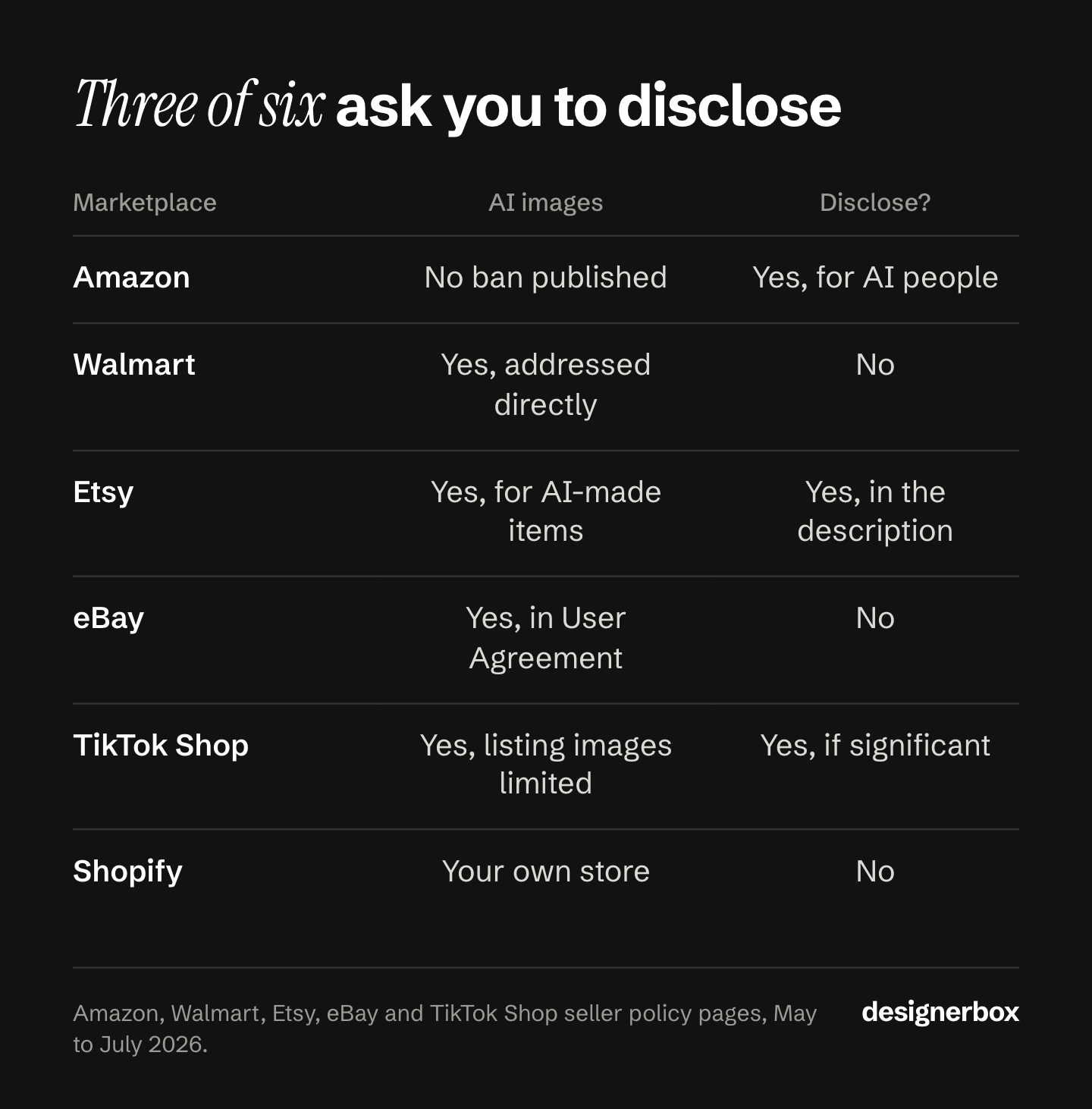
| Platform | AI imagery allowed? | Disclosure required? | The rule that binds |
|---|---|---|---|
| Amazon | No published prohibition | Yes, a metadata tag for photorealistic AI-generated people | Image accuracy standards; the AI-people tag |
| Walmart | Yes, explicitly addressed | No | AI images “must be truthful, accurate and not misleading” |
| Etsy | Yes for AI-made items | Yes, in the listing description, when AI made the item | Listing photos must be “original photos of the actual product” |
| eBay | Yes, named in the User Agreement | No | Photos must accurately represent the item |
| TikTok Shop | Yes, with a dedicated AI policy | Yes, for fully or significantly AI content | Listing images do not allow “digital renderings”; promo video is governed separately |
| Shopify | Your own store, no marketplace policy | No | Your own claims and applicable ad law |
Shopify is the one row with no marketplace policy to clear, because it is your own storefront. The constraints there are platform mechanics rather than content rules, and what Shopify’s variant and media caps mean for AI imagery is the version of this question that applies. The permission question has its own answer too, and the four rulebooks that bind a Shopify store are Google Shopping, Meta, the EU AI Act and your own terms of sale. The free AI image tools built into Shopify, Google and TikTok have limits of their own, set out in free platform AI tools and where they stop.
Amazon publishes image standards that are about output, not method. The main image must be a realistic, professional-quality image, at least 500 pixels on the longest side, on a pure white background, with the product as 85% of the image (sellercentral.amazon.com, September 2026). Apparel carries extra composition rules on top, and which garment presentations Amazon accepts in the main image slot is a separate question from whether AI made the picture. Category style guides are worth reading with a date in mind, because some are badly out of step: Amazon’s published eyewear guide is stamped 2010 to 2012 and still asks for 80% frame fill against the current 85% (Amazon Eyewear Style Guide, September 2026). That guide says nothing about generative AI, and the product image guide’s only AI rule is about people. Separately, an Amazon staff member posted in the Amazon Seller Forums that sellers must now disclose photorealistic AI-generated people, with checkboxes for “AI-generated” and “AI-generated people” in the A+ Content upload flow. The same reply states the requirement is not retroactive for already-published content, and that simple AI retouching such as background removal and color correction is treated like traditional photo editing (Amazon Seller Forums, read September 2026).
Be precise about where each part comes from. The forum reply is an Amazon staff statement on an Amazon-owned domain, which makes it citable, and it is not a policy page. The mechanism is on a policy page: Amazon’s product image guide names the keyword contains-synthetic-performer and asks sellers to add it to the image’s XMP dc:subject field before upload. Amazon says the tag is not needed for real people edited with AI, or for images with no photorealistic people (sellercentral.amazon.com, September 2026).
Walmart is the clearest of the five, and it took the opposite approach. Its image guidelines state that “Images generated by artificial intelligence must be truthful, accurate and not misleading.” Walmart also says sellers must check AI content before they publish it (marketplacelearn.walmart.com, September 2026). We found no disclosure requirement in it. Walmart applies a similar accuracy rule to creators, and how the Walmart Creator program works covers that section of its terms. Walmart also announced an AI-powered listing tool for single and bulk item setup for its marketplace sellers (corporate.walmart.com, 26 August 2025).
Etsy splits the question in a way that surprises people. Etsy allows items made with AI, and its Seller Policy states that “If an item is created through the use of artificial intelligence, you must disclose this in your relevant listings” (etsy.com, effective 9 July 2026, last updated 10 September 2026). That rule is about AI making the item. Separately, Etsy’s Listing Image Requirements say “we require sellers to use original photos of the actual product buyers will receive, not renderings or stock photos, except in the situations outlined below”, and the exceptions are computer-made mockups in extra images for personalized items and stock photo mockups for print-on-demand designs. Etsy never says “AI” in that sentence, and it does not have to. Etsy’s image rules do not mention AI at all, and an image made fully by AI is not a photo of the actual product, so the safest reading is that it does not satisfy the image rule. What that leaves an Etsy seller to do, from a photo taken at home, is worked through in Etsy product photos: what to shoot and what AI can fix.
eBay answered by allocating liability rather than restricting the tool. Its User Agreement says a seller assumes “full responsibility for the item offered and the accuracy and content of the listing, including listing content created using tools offered by eBay or third parties such as translation, image editing, and generative artificial intelligence tools” (ebay.com, September 2026). The binding constraints are the pre-AI ones. eBay’s picture policy does not allow photos that don’t accurately represent the item, or stock photos for used, damaged or defective items. It also does not allow added borders, added text, or watermarks of any type (ebay.com, September 2026). That last rule matters if an AI tool stamps a visible watermark on its results. In June 2024 eBay announced an AI background tool for its seller app, which it described as “powered by open source deep learning, inpainting models (Stable Diffusion)” (innovation.ebayinc.com, 4 June 2024, read September 2026).
TikTok Shop publishes a dedicated AI policy, and it governs two surfaces with two different rules. Its AI-Generated Content page states that “AI-generated content is allowed, but you must be transparent and accurate” and, more directly, that “Content will not be restricted or penalized solely for using AI.” It names permitted uses including AI editing to “adjust lighting and colors” and “change backgrounds,” plus AI-generated virtual scenes for product demonstrations. It requires creators “to proactively disclose content that is fully generated or significantly edited using AI,” via a text note in the video or the platform’s AI-generated content toggle (seller-us.tiktok.com, September 2026).
The listing image is stricter and sits under a different policy. TikTok Shop’s Product Listing Policy states that “Placeholders and digital renderings of a product are not allowed” and that images “must include only what the customer will receive” (seller-us.tiktok.com, September 2026). So a generated background on a promo video is permitted, and a generated rendering as the listing photo is not. We found no TikTok page that reconciles the two, and writing that TikTok either allows or bans AI product photos gets it wrong in both directions.
One practical constraint outranks all of that. TikTok Shop allows one video per product listing, and it “must not exceed 5MB” (seller-us.tiktok.com, September 2026). That limit decides your encoding long before any policy question does. The rest of TikTok’s listing spec, including the two different pixel minimums it publishes, is in TikTok Shop product images.
The two triggers that decide every case
Strip the policies down and the same two conditions appear everywhere, in platform rules and in law. Neither of them is “you used AI.”

Trigger one: a photorealistic synthetic person. Amazon’s tag targets AI-generated people specifically, not AI-generated products. New York’s law, effective 9 June 2026, requires whoever produces or creates an ad to disclose it conspicuously when they know the ad contains a “synthetic performer,” defined as a digitally created asset “intended to create the impression that the asset is engaging in an audiovisual and/or visual performance of a human performer who is not recognizable as any identifiable natural performer.” The civil penalty is $1,000 for a first violation and $5,000 for each later one (nysenate.gov, September 2026). New York is the first state with this rule, according to New York State (governor.ny.gov, June 2026). Check the rules in every state you advertise in.
Vehicle listings follow the same logic, and what Google allows in a vehicle photo covers that case. The EU lands in the same place by a different route, which is covered below. The pattern is consistent: the rules single out synthetic humans, and they reach product shots only when the product is misrepresented.
For anyone generating on-model imagery this is the line that matters. A packshot, a flat lay, a relit hero shot, a product composited into a styled scene: no synthetic person, no trigger. An AI model wearing the garment: likely a trigger in the EU and in New York ads, plus Amazon’s tag on listing images.
Trigger two: the image misrepresents the product. This is the older rule and the one with real enforcement history. Walmart, eBay and Etsy all state it plainly, and none of them needs the word “AI” to apply it. A generated image that flatters the product, shows a color it does not come in, or implies a size it is not, is a violation whether a camera or a model produced it. Accuracy is the constraint that survives every policy rewrite, which is why product accuracy in AI images is worth solving before compliance is even a question.
What the EU AI Act has required since 2 August 2026
Article 50 of the EU AI Act has applied since 2 August 2026 (Commission FAQ, September 2026), and the European Commission published its guidelines on Article 50 on 20 July 2026, reference C(2026) 5054 (digital-strategy.ec.europa.eu, September 2026). The guidelines are not binding. Much of the reporting reads the rule too widely: for brands it is narrower than the coverage suggests. This is general information, not legal advice.
Two obligations in Article 50 matter here, and only one touches a brand. The machine-readable marking duty under Article 50(2) binds providers, meaning the company that builds the AI system, not the company using it. The visible disclosure duty under Article 50(4) binds deployers, which is usually you when you use the tool. If you hire an agency and do not control how it uses AI, the Commission says the agency is the deployer. For images, that deployer duty applies only when the result is a deep fake.
The Commission’s guidelines give worked examples, and they are unusually direct. Not a deep fake:
“A real product (e.g., a car) shown in an advertisement against an AI-generated background and surrounding environment as long as the ad is not likely to mislead the audience about the product’s actual representation and its characteristics and use.”
Is a deep fake, and must be visibly labeled:
“An AI-generated image of a product in advertisement or packaging that can affect the audience’s perception and mislead as to the actual product appearance, characteristics or use (e.g. making the product appear not identical to the real product, more appealing or with improved quality than in real life).”
The guidelines also say some edits usually have only a minor effect, naming “AI-powered color correction, background extensions of existing content, adjustments or replacements of backgrounds for clearly aesthetic purposes, compositions and arrangements of existing products, or re-scaling of images.”
So color-correct, restage, swap the background, or composite your real product into a scene: no label, as long as the ad does not mislead about the product. Generate a product that looks better than the real one: label. It is the same accuracy test the marketplaces apply, written into law. Fines under Article 99(4) can reach 15 million euros or 3% of worldwide annual turnover, whichever is higher. For small and medium-sized companies, including start-ups, and for small mid-cap companies, the cap is the lower of the two figures (AI Act Service Desk, Article 99, accessed October 2026).
One point fashion brands should not miss. The Commission’s guidelines read “persons” in the deep fake definition to include “realistic AI-generated human avatars or personas.” A photorealistic AI model wearing your garment is likely in scope, although photorealism alone does not decide it. If you generate on-model shots from a flat garment photo, assume the EU disclosure likely applies to those and not to your packshots. The asset-by-asset version of that call, and what a label costs when you apply one, is in labeling AI-generated fashion images.
Three more details that cut against common advice. Content generated before 2 August 2026 does not need retroactive labeling. AI-written product copy is outside Article 50(4) unless it makes health, consumer-safety or sustainability claims. And embedded metadata does not discharge the duty: the Commission says deployers “cannot simply rely on the machine-readable marking embedded in the content by the provider” (Commission FAQ, September 2026). People must be able to see or hear the label without special tools.
Where the US and UK stand
The FTC regulates deceptiveness. We found no federal US rule that requires an “AI-generated” label on ads or product images, as of September 2026. FTC rules against deception still apply. The provision that does bite is in the Endorsement Guides at 16 CFR 255.2(c). The guides say ads presenting endorsements by apparent “actual consumers” should use actual consumers “or clearly and conspicuously disclose that the persons in such advertisements are not actual consumers of the advertised product” (law.cornell.edu, September 2026). Note the trigger is “not an actual consumer,” not “AI-generated.” A hired human actor has always triggered the same requirement.
The FTC has also said the opposite of what is often claimed about virtual influencers. Its staff Q&A on the Consumer Reviews and Testimonials Rule states the rule “has no blanket prohibition on the use of AI-generated avatars in marketing” and is “drafted specifically so as to not prohibit companies from using virtual influencers” (ftc.gov, September 2026). An avatar breaks the rule only if the testimonial behind it is fake or false.
We found no UK law that requires AI disclosure in ads. The Advertising Standards Authority put it directly: “There is no blanket legal requirement in the UK to disclose the use of AI in ads.” It adds that the existing advertising codes apply however content is generated, edited or targeted (asa.org.uk, May 2025, read September 2026). The ASA suggests one test: is the audience likely to be misled if the use of AI is not disclosed?
Meta’s disclosure rule covers ads about social issues, elections or politics. Meta requires advertisers to disclose AI in those ads, and states it will reject ads where the disclosure is missing. Other ads have no advertiser declaration. Meta’s policy says that since 1 June 2026 it has used automated detection to find ad media made or edited with third-party AI, and that “No advertiser action is required” (transparency.meta.com, September 2026). When it finds signs such as C2PA metadata, Meta adds an “AI info” label, and Meta says this may not be available in every region (facebook.com, September 2026). We found no rule in Meta’s policy text that rejects ordinary commercial ads for undeclared AI.
The technical requirement most brands miss
Google Merchant Center has the one hard, in-force requirement we found that touches an ordinary AI product image, and it is metadata rather than a consumer-facing label.
Google states: “All images created using generative AI must contain meta data indicating that the image was AI-generated (for example, the IPTC DigitalSourceType TrainedAlgorithmicMedia metadata tag).” It adds the instruction most workflows break: “Don’t remove embedded metadata tags such as the IPTC DigitalSourceType property from images created using generative AI tools” (support.google.com, October 2026).
That second sentence is the practical risk, and the standards body agrees. C2PA’s own security document states that the standard “does not offer any protection against the complete removal of C2PA manifests from assets,” and its implementation guidance adds that metadata “may be routinely removed or corrupted” and that this “is common, for example, on social media platforms” (C2PA security considerations and C2PA guidance, September 2026). IPTC puts it more bluntly still: C2PA metadata is “removable by design” (IPTC C2PA FAQ, September 2026).
So resizing, format conversion and many CDN pipelines can strip it. An image that left the model compliant can arrive at the feed non-compliant without anyone touching the policy question. Check the file at the end of the pipeline, not at the start.
Metadata also travels further than intended. TikTok can add an AI label itself when content carries Content Credentials, and you cannot remove an automatic label (tiktok.com, September 2026). TikTok Shop says auto-labeled content “will not face penalties solely for the label” (seller-us.tiktok.com, September 2026). It is still a label you did not choose and cannot remove.
A separate Merchant Center rule catches heavily styled imagery regardless of how it was made. Google asks for a main image that gives a clear view of the product being sold, with nothing in the frame that is not sold with it (support.google.com, October 2026). A dramatic generated scene belongs in an additional image or a lifestyle image, not the main one. This is the same reason PDP image choices move conversion independently of anything about AI.
The feed’s text attributes carry their own restrictions, and they catch far more brands than the image rules do. Google’s description attribute does not allow promotional text, links to your store or other websites, or your company’s name (support.google.com, September 2026). Most on-page copy contains at least one of these. What the Google feed accepts against what the page accepts sets the two side by side.
On Google Ads, the July 2026 update added an AI label setting. Google says labels added for this purpose do not break its rules against text overlays and watermarks (support.google.com, September 2026). Google also says AI rules in the European Union, India and New York require a label on some ads with AI assets, and it states plainly that “Use of the AI label setting in Google’s advertising products doesn’t guarantee your compliance with specific regulations” (support.google.com, September 2026). Election ads keep their own separate checkbox.
What you are not required to do
We checked eight common claims about AI product images against the primary sources in September 2026.
Before the table, one example of how these claims get made, because it is unusually instructive. One claim says that TikTok Shop bans AI voiceover in product videos. The phrase does appear on a real TikTok Shop page. The rule against “AI-generated voices” sits under a heading that reads “During a LIVE” (seller-us.tiktok.com, September 2026). It governs livestreams, where the point is real-time interaction, and a pre-rendered video is not a livestream. For posted videos the same page sets a different rule: do not use still, looping or scrolling images through the entire video without featuring your face and the physical product.
The wording of the false claim is easy to trace. The summary at the top of that page reads “In LIVE, still or animated content over 50% of the screen, AI/pre-recorded audio, and PDP screenshots are prohibited.” Remove the words “In LIVE” and you have the claim.
That is the failure mode to guard against generally. The link is real, the page is real, the phrase is on it, and the rule still does not say what the claim says.
| Common claim | What the source says |
|---|---|
| ”You must label AI-generated product photos” | We found no US federal, UK or EU rule that requires it for an accurate product image |
| ”The EU AI Act makes AI ad labeling mandatory in August 2026” | For images, the brand-side duty covers deep fakes. A real product on an AI background is not a deep fake if the ad does not mislead |
| ”Meta requires advertisers to declare AI in ads” | True for ads about social issues, elections or politics. For other ads, Meta adds a label itself when it detects AI signals |
| ”Google bans AI product images” | Merchant Center accepts them and requires AI metadata, with the IPTC tag as its example |
| ”You need C2PA Content Credentials to be compliant” | The EU Code of Practice on AI-generated content, published 10 June 2026, does not name C2PA. It asks signatory providers for at least two layers of marking, signed metadata and an invisible watermark, and only the richer provenance detail is optional. Google asks for IPTC, a different standard again |
| ”AI-written product descriptions must be disclosed” | The Commission’s guidelines usually place ad copy and product descriptions outside Article 50(4), unless they make health, safety or sustainability claims |
| ”The FTC’s fake reviews rule bans virtual influencers” | The FTC’s own Q&A says it was drafted specifically not to |
| ”TikTok Shop bans AI voiceover in product videos” | That rule sits under “During a LIVE”. TikTok’s Community Guidelines say generic text-to-speech needs no AI label |
Being accurate about the ceiling matters as much as being accurate about the floor. Over-disclosing is not free. It puts a label on creative that does not need one, and it trains a team to treat a real obligation as boilerplate.
A checklist before you publish AI product content
Run this per asset, not per campaign. The triggers are asset-level.
- Does a photorealistic person appear? If yes, expect likely disclosure duties in the EU and in New York ads, plus Amazon’s contains-synthetic-performer tag on listing images. If the person is presented as a customer or reviewer, the FTC’s actual-consumer rule applies on top.
- Does the image depict the product accurately? Color, size, materials, quantity, condition, and what is in the box. This is the rule every marketplace enforces, and the one with the longest enforcement history.
- Is the item itself AI-made? On Etsy that requires disclosure in the listing description. On a marketplace selling physical goods it usually means the listing photo needs to be a real photo.
- Did the metadata survive? Check the IPTC DigitalSourceType tag is still on the file after every resize and export, before it reaches a Google product feed. The other feed checks are in the guide to agentic commerce and catalog checks.
- Does your tool’s license cover commercial use? Check the terms of each tool you use. On DesignerBox, uploading your own photos and the commercial license start on the Pro plan. AI video, virtual try-on, upscaling, the image editor and the video editor start on the Premium plan. Team features, shared brand kits and white label are on the Ultra plan, and every plan below Ultra is one seat. Confirm current terms on the pricing page before you run generated imagery on a live listing.
- Keep the source photo. Every accuracy dispute is resolved by comparing the published image against the real product. Generating everything from your actual product shot rather than from a text prompt is what makes that comparison easy to win.
That last point is the structural answer rather than a compliance one. When every asset derives from a photograph of the real item, the accuracy risk drops, because you can compare every result with the real product. That is how AI product photography in DesignerBox starts: your own product photo goes in, and a workflow returns packshots, flat lays, on-model shots or video. Three critic steps score the results, and best-of-N keeps the best one. The cost is shown before the run.

For the platform specs those assets have to meet once they clear policy, see how many listing image slots each marketplace shows and what affordable AI video for product listings costs, plus the per-platform detail on Amazon’s four video slots and Etsy’s listing video rules. To see which image and video models DesignerBox runs, browse the model list. Platform specs move on their own schedule, and the AI Creative Production newsletter tracks them one issue at a time, with the source and the date on each rule.
Compliance is judged per asset, but the decision behind it is not. Once you have settled how a listing shot gets made and which trigger it clears, save that as a workflow: same brand rules, same model, same framing. Write down the disclosure call you made for that shot. A saved workflow runs the same way on the next SKU, so you review results instead of re-deciding policy for each listing. Batch runs one workflow over a whole sheet of products, and you keep or discard per row.
Keeping the record is also easier when nothing leaves the workspace. Templates, workflows, apps, batch, the image editor, the video editor, brand rules and Assets are one subscription, so the source photo, the derived frames and the disclosure call you made stay together. Start from a template that already does the shot, add your brand and your products, and run it. You set the brand once. Every run after that reads the same record. Listing forty then carries the same look as listing one.
FAQ
Do I need to disclose AI-generated images on Amazon?
Only when the image contains photorealistic AI-generated people. Amazon’s product image guide asks you to tag those images with the keyword contains-synthetic-performer in the XMP dc:subject field before upload. An Amazon staff member also said on the Seller Forums that the A+ Content upload flow has “AI-generated” and “AI-generated people” checkboxes, that the requirement is not retroactive, and that simple AI retouching such as background removal and color correction is treated like traditional photo editing. That forum reply is not a policy page.
Does Etsy allow AI-generated product photos?
Etsy allows AI-generated items and requires you to disclose in the listing description when AI created the item. Listing photographs are governed separately: Etsy says “we require sellers to use original photos of the actual product buyers will receive, not renderings or stock photos”, with two exceptions for mockups. Etsy’s image rules do not mention AI, and an image made fully by AI is not a photo of the actual product, so use a real photo of the finished item.
Is AI product photography allowed on eBay and Walmart?
Yes on both, and neither requires disclosure. eBay’s User Agreement names “generative artificial intelligence tools” among the tools a seller may use for listing content, and makes the seller responsible for its accuracy. eBay’s picture policy does not allow watermarks of any type. Walmart says AI images “must be truthful, accurate and not misleading.” eBay announced its own AI background tool for its seller app in June 2024.
Does the EU AI Act require labeling AI product images?
Only if the image is a deep fake. Article 50 has applied since 2 August 2026, and the European Commission’s non-binding guidelines state a real product shown against an AI-generated background is not a deep fake as long as the ad does not mislead. An AI-generated image that makes the product look better than it is needs a visible label, and a photorealistic AI-generated person is likely in scope too.
Do I have to label AI images in Facebook or Instagram ads?
Not for ordinary commercial ads. Meta requires advertiser disclosure only for ads about social issues, elections or politics. For other ads, Meta says it checks for signs of third-party AI, such as C2PA metadata, and adds an “AI info” label when it finds them, with no advertiser action required. Meta says this may not be available in every region. We found no rule in Meta’s published policy that rejects commercial ads for undeclared AI.
What metadata do AI product images need for Google Shopping?
Google Merchant Center requires images created with generative AI to carry metadata that says AI made them, with the IPTC DigitalSourceType TrainedAlgorithmicMedia tag as its example, and instructs sellers not to remove it. The practical failure is silent: resizing, format conversion and CDN pipelines often strip metadata, so verify the tag survives your export before the image reaches the feed.
Can I use AI-generated models wearing my clothes?
On most platforms reviewed, yes, but this is the highest-disclosure use case. Amazon’s clothing guide says only photos are allowed and does not say whether a photorealistic AI image counts as one. A photorealistic AI person triggers Amazon’s metadata tag, and is likely to trigger New York’s synthetic performer law in ads and the EU’s deep fake rule. If the model is presented as a customer or reviewer, the FTC’s actual-consumer disclosure applies as well. Non-photorealistic or clearly stylized figures sit outside most of these.
Sources
- Article 50 has applied since 2 August 2026, and deployers cannot rely on the provider’s machine-readable marking: (Commission FAQ, September 2026)
- Fines for Article 50 breaches under Article 99(4)(g), the lower cap for SMEs under Article 99(6) and for small mid-cap companies under Article 99(6a): (ai-act-service-desk.ec.europa.eu, re-checked on 2 October 2026)
- Article 50 deployer duty, the deep fake definition, the worked product-advertising examples and the minor-edit examples: (digital-strategy.ec.europa.eu, guidelines published 20 July 2026, read September 2026)
- Amazon staff forum reply on the A+ Content checkboxes, the non-retroactive scope and simple retouching: (Amazon Seller Forums, read September 2026)
- Amazon product image guide: main image standards and the contains-synthetic-performer tag: (sellercentral.amazon.com, September 2026)
- Amazon clothing image guide, where only photos are allowed: (sellercentral.amazon.com, September 2026); Amazon Eyewear Style Guide, stamped 2010 to 2012: (images-na.ssl-images-amazon.com, September 2026)
- Whatnot listing guidelines: (help.whatnot.com, September 2026)
- Walmart’s rule that AI images be truthful, accurate and not misleading: (marketplacelearn.walmart.com, September 2026); Walmart’s AI-powered listing tool: (corporate.walmart.com, Marketplace Seller Summit announcement, 26 August 2025)
- Etsy’s AI-item disclosure rule and the original-photos listing image rule: (Etsy Seller Policy, effective 9 July 2026, last updated 10 September 2026; Etsy Listing Image Requirements, September 2026)
- eBay’s User Agreement clause on seller responsibility for generative AI listing content: (ebay.com, September 2026); eBay’s picture policy on accuracy, stock photos, borders, text and watermarks: (ebay.com, September 2026)
- eBay’s AI background tool and the models behind it: (innovation.ebayinc.com, 4 June 2024, read September 2026)
- TikTok Shop’s AI-generated content policy, permitted uses, creator disclosure and platform labels: (seller-us.tiktok.com, September 2026)
- TikTok Shop’s Product Listing Policy on placeholders, digital renderings and the 5MB video limit: (seller-us.tiktok.com, September 2026); TikTok Shop’s LIVE and video requirements: (seller-us.tiktok.com, September 2026)
- TikTok’s automatic label for content with Content Credentials: (tiktok.com, September 2026); TikTok Community Guidelines on AI labels and generic text-to-speech: (tiktok.com, September 2026)
- Google Merchant Center’s AI metadata requirement, the do-not-strip instruction and the clear-view rule for the main image: (support.google.com, re-checked on 2 October 2026); the description attribute: (support.google.com, September 2026); the Google Ads AI label setting: (support.google.com and support.google.com, September 2026)
- C2PA on manifest removal and metadata durability: (spec.c2pa.org security considerations and spec.c2pa.org guidance, September 2026)
- IPTC on C2PA metadata being removable by design: (iptc.org, September 2026)
- New York’s synthetic performer disclosure law, definition and penalties: (nysenate.gov, September 2026)
- FTC Endorsement Guides at 16 CFR 255.2(c) on actual-consumer disclosure: (law.cornell.edu, September 2026)
- FTC Jewelry Guides at 16 CFR 23.0 on claims made through illustrations and depictions: (law.cornell.edu, September 2026)
- FTC staff Q&A stating the Consumer Reviews and Testimonials Rule does not prohibit virtual influencers: (ftc.gov, September 2026)
- ASA position that there is no blanket UK legal requirement to disclose AI in ads: (asa.org.uk, May 2025, read September 2026)
- Meta’s AI disclosure scope for ads about social issues, elections or politics, and its automated detection: (transparency.meta.com, September 2026); Meta’s “AI info” label on ads: (facebook.com, September 2026)
- DesignerBox plans, credits and feature gating: DesignerBox pricing page (designerbox.ai/pricing), September 2026
Marketplace policies verified from Amazon, Walmart, Etsy, eBay and TikTok Shop seller documentation as of September 2026. TikTok Shop policies are US Seller Center pages and are not generalized to other regions. EU obligations verified from the European Commission’s Article 50 guidelines, published 20 July 2026 and read September 2026; those guidelines are not binding. US and UK positions verified from ftc.gov, law.cornell.edu, nysenate.gov and asa.org.uk as of September 2026. The AI Act Article 99 page and Google Merchant Center’s image link page were re-checked on 2 October 2026. Platform policies in this area are changing quickly. This is general information, not legal advice. Individual results vary.