



A high-converting video ad is one whose results meet your conversion and cost targets in a real test. No format, length or tool makes an ad high-converting on its own. The platforms publish evidence for a few creative choices: vertical video with sound, a fast hook, the brand early, one message and a clear next step. Each choice has a metric that shows whether it worked for your audience.
Most advice on this topic is a list of tips with no source. Open on a problem. Keep it under 15 seconds. Use captions. Some of those tips have platform data behind them, some have old data, and some have none. A team that treats all of them as rules spends money on the weak ones.
This guide sorts the common advice by its evidence. It covers six creative choices, the claims with no primary source, the metric that checks each choice, and how to run a test you can read. It also covers where AI production fits.
Key Takeaways
-
“High-converting” is a test result. An ad earns the name when its cost per conversion and its return meet your targets.
-
Creative is a large part of the result. A 2017 Nielsen and NCS study found creative quality contributes as much to in-market success as all other factors combined.
-
Vertical video with sound has the strongest platform data. Meta’s analysis of 15 split tests found 34.5% lower cost per result than still images on Reels.
-
Some popular numbers have no primary source. We found none for “47% of sales come from creative” or for a “good” hook rate.
-
Read the metrics in order. Hook, hold, click, then conversion. A good hook with a weak conversion rate is still a weak ad.
-
Test a few distinct ads at a time. Meta’s creative test compares up to 7 variants, and TikTok suggests 3 to 5 creatives per ad group.
What makes a video ad high-converting?
A video ad is high-converting when it brings conversions at a cost your margins allow. Two numbers decide that. Google Ads defines conversion rate as how often “an ad click or other ad interaction leads to a conversion”. It defines cost per conversion as “your total cost” divided by your conversions (support.google.com, read October 2026).
A third number checks the money. Google calls it conversion value per cost, which “estimates your return on investment” (support.google.com). Most teams call it ROAS. An ad with a high click rate and a low ROAS has found interest, not buyers.
Creative is one of the largest levers on those numbers. A 2017 study by Nielsen and Nielsen Catalina Solutions measured five drivers of ad results: creative, reach, targeting, recency and context. It found that “creative quality contributes as much to a brand’s in-market success as all other factors combined” (nielsen.com, October 2017, read October 2026).
Six creative choices and the evidence behind them
The platforms publish guidance on video creative, and a few pages include test data. The table rates each common choice by the strongest source we found.
| Creative choice | What the platform says | Evidence |
|---|---|---|
| Vertical 9:16 video with sound, key elements in the safe zone | Meta: 34.5% lower cost per result than image ads on Reels | Meta’s analysis of 15 split tests |
| A hook in the first seconds | Meta: put “the most compelling part” in the first three seconds. TikTok: hook in the first 6 seconds | Guidance, no data on the page |
| The brand early | Google: “Brand early, often, and richly”. Meta: show “your brand identity straight away” | Part of Google’s ABCD model |
| Works without sound, better with sound | Google: sound in Shorts ads “has been shown to increase conversions by over 20%“ | Google’s figure, no study cited |
| One message, one clear next step | Meta: “Deliver a single message”. TikTok: a hook, your selling points, then “a clear call-to-action” | Guidance, no data on the page |
| People on screen, in a native style | TikTok recommends “featuring people such as creators, employees, or customers” | Guidance, no data on the page |
Vertical video with sound
This choice has the strongest data. Meta reports that “Reels ads that were built in 9:16 video, with audio and with key creative elements in the safe zone had 34.5% lower cost per result than image ads”. Its footnote names a meta-analysis of 15 split tests in ecommerce, retail and consumer goods (facebook.com, read October 2026).

Read it with care. The test compares a full video build with a still image, so it does not isolate the frame alone. The analysis is also Meta’s own. Meta also states that “Reels default to sound-on”.
A hook and the brand in the first seconds
Every platform asks for a fast start. Meta’s mobile video guidance says to put the most compelling part of the video in the first three seconds and to show the brand “straight away” (facebook.com, read October 2026). TikTok asks advertisers to “introduce your content proposition in the first 3 seconds” and to put the hook in the first 6 seconds (ads.tiktok.com, last updated June 2025).
Google’s ABCD model joins the two. Its letters are Attention, Branding, Connection and Direction. Google says ads that follow the ABCDs “deliver as much as a 30% lift in short-term sales likelihood” (support.google.com, read October 2026). Kantar, which ran the analysis, says it used its Link AI model on over 11,000 ads and found a “strong correlation” with “predicted” short-term sales lift (kantar.com, read October 2026). It is a model-based prediction, not a measured sales test.
Sound, captions and length
Design the ad to work with sound off, and to work better with sound on. Older Meta guidance says “Build for sound off. Delight with sound on”, and reports that captions increased video view time by 12% in internal tests (facebook.com, undated, read October 2026). That post is old, so treat its figure as dated.
Length guidance differs by platform, and none of it comes with a study. TikTok says “21-34 seconds performs best” for In-Feed ads (ads.tiktok.com, read October 2026). Google suggests “10-30 second vertical videos” for action-oriented Shorts ads (support.google.com, read October 2026). Test length in your own account rather than copying one number.
Claims with no primary source
Some numbers appear in many articles about video ads, and we could not trace them to a primary page. Treat them as unproven until someone shows the study.
- “47% of a campaign’s sales come from creative.” It is often credited to Nielsen. The Nielsen page we read gives no such percentage. It says creative “contributes as much” as all other factors combined.
- A “good” hook rate of 30% or more. No platform publishes a hook rate benchmark. The hook rate guide shows how far the vendor ranges disagree.
- One ideal length for every ad. Each platform gives its own range for its own formats, without a study on the page.
- “People watch videos 5 times longer than static images.” A Meta mobile video page states this with no source attached.
The pattern matters more than any one number. A tip with platform test data is a starting point. A tip with no source is a guess, and your test result outranks it.
The metric that checks each choice
Each creative choice changes one part of the viewer’s path, and each part has a metric. Read them in order, because a fault early in the video hides everything after it.
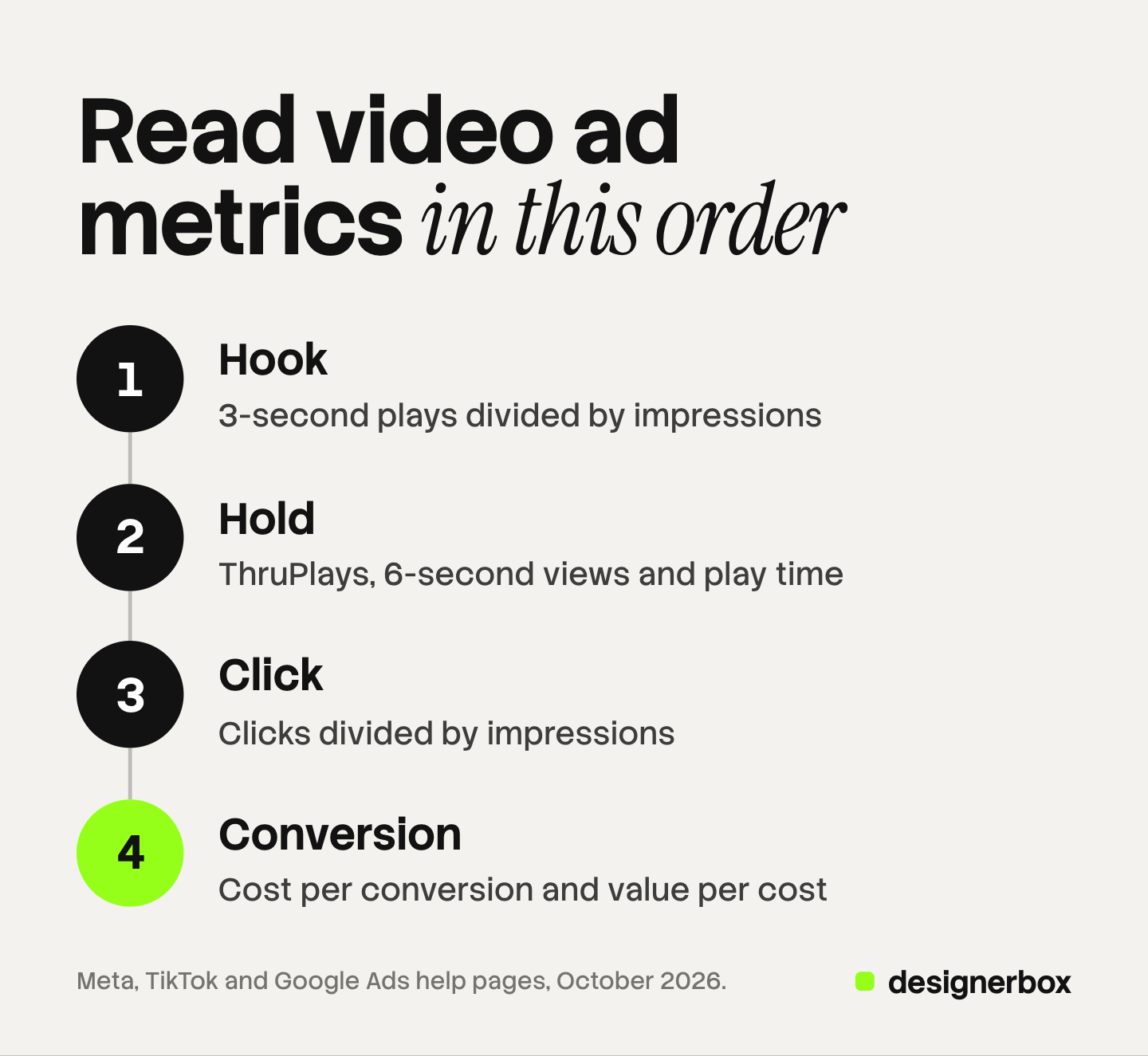
| Question | Metric | Definition, from the platform |
|---|---|---|
| Did the first seconds stop people? | 3-second plays divided by impressions, often called hook rate | Meta counts plays “for at least 3 seconds” |
| Did they keep watching? | ThruPlays on Meta, 6-second views on TikTok, average play time | Meta: played “to completion, or for at least 15 seconds”. TikTok: at least 6 seconds |
| Did the ad earn a click? | Click-through rate | Google: “clicks / impressions = CTR” |
| Did the click become a sale? | Conversion rate and cost per conversion | Google: conversions divided by interactions, and total cost divided by conversions |
| Did the sale pay for the ad? | Conversion value per cost, or ROAS | Google: total conversion value divided by total cost |
Sources: Meta’s video ad metrics page (facebook.com), TikTok’s video play metrics (ads.tiktok.com, last updated November 2025) and Google Ads Help on CTR (support.google.com), all read October 2026.
Two details catch teams out. Meta’s ThruPlay metric counts 15 seconds, but its ThruPlay goal also offers a 6-second option, so name which one you report. On YouTube, a skippable in-stream view counts when a viewer watches 30 seconds or to the end, whichever comes first (support.google.com, read October 2026).
A strong hook with a weak conversion rate usually means the opening attracts the wrong people. A strong hold with a weak click rate points at the offer or the call to action. Fix the first stage that fails, and leave the rest alone.
How to test video ads so the result means something
A test tells you something only when the versions differ in a way you chose. Decide first whether you are testing one choice or several distinct concepts.
- One choice at a time. To test a hook, keep the offer, the product shots, the audience and the call to action the same. Google’s video experiments advise “one variable (such as audiences) to keep the experiment clean” (support.google.com, read October 2026).
- Distinct concepts for reach. To find new audiences, make ads that differ in person, setting and message. The creative diversification guide explains why Meta groups ads that look alike.
- Keep the count small. Meta’s creative test compares “up to 7 creative variants” and suggests “no more than 20% of your existing budget” (facebook.com, read October 2026). TikTok suggests “3-5 different creatives per ad group”.
- Wait for conversions. Check that purchase tracking works before you compare cost per conversion. A few conversions can swing it a lot.
- Scale slowly. Raise the budget on a winner in steps, and keep reading the metrics as spend grows.
Meta’s creative test does not include a confidence level, so a small gap can be noise. The ad creative testing guide covers how many impressions a readable test needs.

Where AI fits in a video ad
AI production makes the versions cheap. A team can make several clips from one product photo, each with a different hook, person or setting, without a shoot. That makes testing faster, and it adds two jobs.
The first job is product fidelity. Every generated clip shows a new picture of the product, so check the label, the logo, the shape and the color against the real item. The second job is the label rules. Meta adds an AI info label when its own generative tools make or heavily change an ad (facebook.com, read October 2026). TikTok asks for a label on ads with completely AI-generated images, video or audio, and rejects or restricts undisclosed ones (ads.tiktok.com, read October 2026).
Google added an AI label setting in Google Ads in July 2026. It says that using the setting “doesn’t guarantee your compliance with specific regulations” (support.google.com, read October 2026). In the EU, Article 50 of the AI Act has applied since 2 August 2026 and asks deployers to disclose deepfake content (digital-strategy.ec.europa.eu, read October 2026). This is general information, not legal advice. The AI disclosure guide covers the rules by market.
The build itself is a separate skill. How to make AI ads walks through the brief, the shot list, the clips and the edit, and the AI product video guide covers the rules that decide whether a product clip works.
Video ads in DesignerBox
Anyone can make an AI picture. Making hundreds that still look like your brand is the hard part. A video test makes that harder, because every version needs the same product and the same brand in a new scene.

DesignerBox is AI creative production for brands and agencies. It makes AI video ads from your product photos. You can animate a static ad you already approved, or build a clip from a storyboard. You pick the model for each shot and see the cost of the run before you start. The video editor is a real timeline, with several tracks, transitions, animated text and audio.
You build the ad once as a workflow with your brand rules, and the workflow reads them on every run. To make test versions, you change one input, such as the hook line, and run it again. Batch runs the same workflow over a sheet of products or versions, and you keep or discard each row.
The stills the clip starts from, the clips, the editors and Assets sit in one account. Before you test, attach a finished ad to the Analyze ad skill in Create. It reviews the hook, hierarchy, brand, offer, craft and fit, and suggests fixes.
Here are the limits. DesignerBox does not run your test or read your ad results, and it does not place ads in an ad account. You download the results, or send them with a webhook or an S3 step. An 8-second clip costs 40 to 560 credits, depending on the model. AI video starts on the Premium plan, and the Free, Basic and Pro plans make images only. Plans and credits are on the pricing page.
Start from a finished video ad on the templates page.
FAQ
What makes a video ad high-converting?
A video ad is high-converting when its conversion rate, cost per conversion and return meet your targets in a real test. Creative choices such as vertical video, a fast hook and a clear call to action help, but only your ad data proves the result.
How long should a high-converting video ad be?
There is no single proven length. TikTok says 21 to 34 seconds performs best for In-Feed ads, and Google suggests 10 to 30 seconds for action-oriented Shorts ads. Neither page cites a study, so test two lengths in your own account.
Do video ads need captions?
They should work without sound. Older Meta guidance says to build for sound off and reports that captions increased view time by 12% in internal tests. Reels now default to sound-on, so use captions and good audio together.
What metrics show that a video ad converts?
Read four stages in order: 3-second plays per impression for the hook, ThruPlays or 6-second views for the hold, click-through rate for the click, and cost per conversion with conversion value per cost for the sale.
Is vertical video better for ads?
On Reels, Meta’s analysis of 15 split tests found 9:16 video with sound and a safe zone had 34.5% lower cost per result than still images. That compares a full video build with an image, so test the format in your own account.
How many video ads should I test at once?
Keep it small and distinct. Meta’s creative test compares up to 7 variants, and TikTok suggests 3 to 5 creatives per ad group. Change one thing per test when you want to learn which choice worked.
Can AI make high-converting video ads?
AI can make the versions you test, from a real product photo, without a shoot. Whether an ad converts is decided by the test. Check every clip for product changes and follow each platform’s AI label rules.
Sources
- Google Ads Help, Understand your conversion tracking data: support.google.com, accessed October 2026
- Google Ads Help, Clickthrough rate (CTR): support.google.com, accessed October 2026
- Google Ads Help, About the ABCDs of effective video ads: support.google.com, accessed October 2026
- Kantar, Validating Google’s ABCD framework with the power of artificial intelligence, the Link AI analysis of over 11,000 ads: kantar.com, accessed October 2026
- Google Ads Help, YouTube Shorts ads: asset specs and best practices: support.google.com, accessed October 2026
- Google Ads Help, About YouTube ads and view metrics: support.google.com, accessed October 2026
- Google Ads Help, Create a video experiment: support.google.com, accessed October 2026
- Google Ads Help, AI regulations and the AI label setting for ads: support.google.com, accessed October 2026
- Nielsen, Perspectives: Want a Successful Ad? Get Creative, October 2017: nielsen.com, accessed October 2026
- Meta for Business, Instagram and Facebook Reels ads: facebook.com, accessed October 2026
- Meta Business Help Center, About video ads on Facebook and Instagram: facebook.com, accessed October 2026
- Meta for Business, Mobile-first video creative: facebook.com, accessed October 2026
- Meta for Business, Who wants to be a mobile video maker?, undated: facebook.com, accessed October 2026
- Meta Business Help Center, About video ad metrics on Facebook and Instagram: facebook.com, accessed October 2026
- Meta Business Help Center, Set up a creative test in Meta Ads Manager: facebook.com, accessed October 2026
- Meta Business Help Center, About AI info on ads created or edited with generative AI tools: facebook.com, accessed October 2026
- TikTok Business Help Center, Creative best practices for performance ads, last updated June 2025: ads.tiktok.com, accessed October 2026
- TikTok for Business, Video advertising guide: ads.tiktok.com, accessed October 2026
- TikTok Business Help Center, Video play metrics, last updated November 2025: ads.tiktok.com, accessed October 2026
- TikTok Advertising Policies, Misleading and false content: ads.tiktok.com, accessed October 2026
- European Commission, Transparency obligations under Article 50 of the AI Act: digital-strategy.ec.europa.eu, accessed October 2026
- DesignerBox AI video ads, workflows and pricing pages (designerbox.ai/ai-video-ads, designerbox.ai/product/workflows and designerbox.ai/pricing), October 2026: the video plan gate and the video credit range
Platform guidance and metric definitions verified on Google, Meta and TikTok pages as of October 2026. Meta’s and Google’s performance figures are their own. The Kantar figure is a model-based prediction. The table of evidence strength is our reading of those pages. This is general information, not legal advice. Individual results vary.