


Hook rate is the share of a video ad’s impressions that became a play of at least 3 seconds. On Meta the formula is 3-second video plays divided by impressions, times 100. Hook rate is not a built-in Ads Manager column: you build it as a custom metric. Hold rate is its partner metric. It measures how many of those viewers stayed to 15 seconds or to the end.
A new video ad can spend a week’s budget with a low hook rate, and the report still shows only cost per purchase. The cost tells you the ad lost. The hook rate and the hold rate tell you which part of the video lost it: the first second, the middle, or the offer. That decides what you make next.
This guide gives the formulas for Meta and TikTok, shows where each input comes from, and explains why every published “good hook rate” is a vendor’s opinion. It ends with a table that turns the numbers into one change to the next version. It is written for performance marketers at brands and agencies who test video ads every week.
Key Takeaways
- Hook rate is a custom metric. Meta has no hook rate column. You build it from 3-second video plays and impressions in Ads Manager.
- The formula is simple. Hook rate = 3-second video plays ÷ impressions × 100. Thumbstop rate is the same number under another name.
- Hold rate has several versions. The common one is ThruPlays ÷ 3-second video plays × 100. Pick one version and keep it.
- TikTok has no 3-second metric. Its video play metrics start at 2 seconds and 6 seconds, so a TikTok hook rate is a different number.
- No platform publishes a benchmark. Every “good hook rate” range online comes from a vendor or an agency, with no sample size stated.
- Your own median is the benchmark. Compare each new ad with the median of your last 30 days of video ads on the same placement.
- Read hook, hold, CTR and conversion together. Each weak number points to a different part of the ad to change.
What is hook rate?
Hook rate is the percentage of impressions of a video ad that turned into at least 3 seconds of play. It measures the opening of the ad: the first frame, the first line and the first movement. A high hook rate means people stopped. It does not mean they watched, clicked or bought. Those are the jobs of the other three numbers.
Two things about the inputs matter before you read the number. Meta counts an impression when the ad was on screen, and “a video is not required to start playing for the impression to be counted” (facebook.com/business/help, September 2026). Video plays also count autoplay: a play occurs “either when a video starts to play automatically or when someone clicks to play the video” (facebook.com/business/help, September 2026).
So on Meta, hook rate measures who stayed on an autoplaying video for 3 seconds. Nobody has to tap anything.
What is the hook rate formula?
The hook rate formula on Meta is 3-second video plays divided by impressions, multiplied by 100. Meta defines 3-second video plays as “the number of times your video played for at least 3 seconds, or for nearly its total length if it’s shorter than 3 seconds”. Replays inside one impression do not count (facebook.com/business/help, September 2026).
| Metric | Formula on Meta | What it tells you |
|---|---|---|
| Hook rate (thumbstop rate) | 3-second video plays ÷ impressions × 100 | Did the opening stop the scroll? |
| Hold rate | ThruPlays ÷ 3-second video plays × 100 | Did the people who stopped keep watching? |
| Completion rate | Video plays at 100% ÷ 3-second video plays × 100 | Did they reach the end? Best for videos under 15 seconds |
| CTR (link) | Link clicks ÷ impressions × 100 | Did the ad give them a reason to leave the feed? |
A worked example, illustrative only. An ad gets 10,000 impressions and 2,500 3-second video plays. Its hook rate is 25%. If 600 of those plays reach a ThruPlay, the hold rate is 24%.
Thumbstop rate, thumb-stop ratio and 3-second view rate are other names for the same hook rate formula. Motion’s glossary, for example, defines thumbstop rate as “(3-Second Video Plays ÷ Impressions) × 100” (motionapp.com glossary, April 2026).
What is hold rate?
Hold rate is the share of people who passed the hook and kept watching. The usual formula is ThruPlays divided by 3-second video plays, times 100. Meta defines a ThruPlay as a play “to completion, or for at least 15 seconds” (facebook.com/business/help, September 2026). Hold rate measures the middle of the ad.
The pages that rank for this term disagree on the formula. One says ThruPlays, another says 15-second plays, and a third gives two different versions in the same article. All of them divide by 3-second plays. Three rules keep your number clean:
- Keep 3-second plays as the denominator. ThruPlays ÷ impressions answers a different question: the share of all impressions that reached 15 seconds.
- Watch the video length. On a video shorter than 15 seconds, a ThruPlay is a full play, so hold rate becomes a completion rate. For short ads, video plays at 50% ÷ 3-second plays can be the more useful hold number.
- Write your version down. A hold rate is only comparable with a hold rate built the same way.
Meta also offers a 6-second ThruPlay optimization goal: someone “watches at least 6 seconds of your video, or to 97% completion if shorter than 6 seconds” (facebook.com/business/help, September 2026). That is a delivery goal. It does not change the ThruPlay column.
How do you track hook rate in Meta Ads Manager?
You track hook rate in Meta Ads Manager with a custom metric. Go to Columns, choose Customize columns, then select Create custom metric. Enter 3-second video plays divided by impressions, set the format to Percentage, and save it. The new column then sits next to your other video metrics in every report.
Meta’s steps are on its help page for custom metrics. A formula needs “at least two metrics and one symbol”, and the format can be numeric, percentage or currency. Meta notes that a custom metric only does “basic mathematical calculations” and does not modify the metric itself (facebook.com/business/help, September 2026).
Build the hold rate column the same way: ThruPlays divided by 3-second video plays, as a percentage. The raw inputs are under Columns, then Video engagement (facebook.com/business/help, September 2026).
One change in 2026 touches video ads, but not these columns. On 3 March 2026 Meta cut the engaged view for a video ad from 10 seconds to 5 seconds, and renamed engaged-view attribution to “engage-through attribution” (facebook.com/business/news, March 2026). That changes which conversions are credited to a video. It does not change how 3-second plays or ThruPlays are counted.

How do you calculate hook rate on TikTok?
TikTok has no 3-second video metric. Its video play metrics are 2-second video views, 6-second video views, and plays at 25%, 50%, 75% and 100%. So a TikTok hook rate is 2-second video views divided by impressions. That number is not comparable with a Meta hook rate, because the time window is shorter.
TikTok defines the two metrics this way (ads.tiktok.com, last updated November 2025):
- 2-second video views: the number of times a video “starts playing for at least 2 seconds in an impression session. Replays are excluded.”
- 6-second video views: the video played for at least 6 seconds, or in full if shorter, “or received at least 1 engagement within the first 6 seconds”.
That second definition matters for hold rate. A like or a click in the first 6 seconds counts as a 6-second view. A TikTok hold rate built on 6-second views therefore mixes watching and engaging. Compare it only with other TikTok ads.
| Meta input | Closest TikTok input | Comparable? |
|---|---|---|
| 3-second video plays | 2-second video views | No. The time window differs |
| ThruPlays (15 seconds or complete) | 6-second video views, or plays at 100% | No. The 6-second view also counts engagement |
| Video plays at 25%, 50%, 75% | Video views at 25%, 50%, 75% | Close, but counted by each platform’s own rules |
What is a good hook rate?
No platform publishes a good hook rate. Neither Meta nor TikTok gives a hook rate benchmark on any help page. The ranges online come from analytics vendors and agencies, and none of the pages we read states a sample size, a date window and a method together. The best benchmark is your own: the median hook rate of your recent video ads on the same placement.
Here is what the published ranges say, and who published them. Each is a vendor or agency figure, read in September 2026.
| Publisher | ”Good” hook rate | Sample or method stated |
|---|---|---|
| Vaizle (insights.vaizle.com, January 2025) | 20 to 25%, with top ads above 30% | None |
| Motion glossary (motionapp.com, April 2026) | 20 to 40% “generally solid” | None |
| Exposure (exposure.com.au, June 2026) | 25 to 35% good, 40% or more strong | None. It says “There is no official Meta benchmark” |
| AdSights (adsights.ai, July 2026) | Cold in-feed median about 23%, Reels about 30% | None on the page |
The ranges overlap, but they do not agree. They also disagree on placement: one vendor says Reels runs lower than Feed, and another puts Reels higher. Motion’s large 2026 creative benchmark report covers 578,750 creatives, but it publishes no hook rate figure (motionapp.com, September 2026). A hook rate number credited to that report is misattributed.
Use your own numbers instead. Take the median hook rate of your video ads from the last 30 days, split by placement: Feed, Reels and Stories. A new ad above that median has a stronger opening than your usual ad. That comparison holds for your product, your audience and your placement mix. A vendor range does not.
How do you read hook rate, hold rate, CTR and conversion together?
Read the four numbers in the order a viewer meets them: hook rate, then hold rate, then CTR, then conversion rate. The first weak number, compared with your own median, is the part of the ad to change. A low hook rate means the opening fails. A good hook with a weak hold means the middle fails. Change one part per new version.
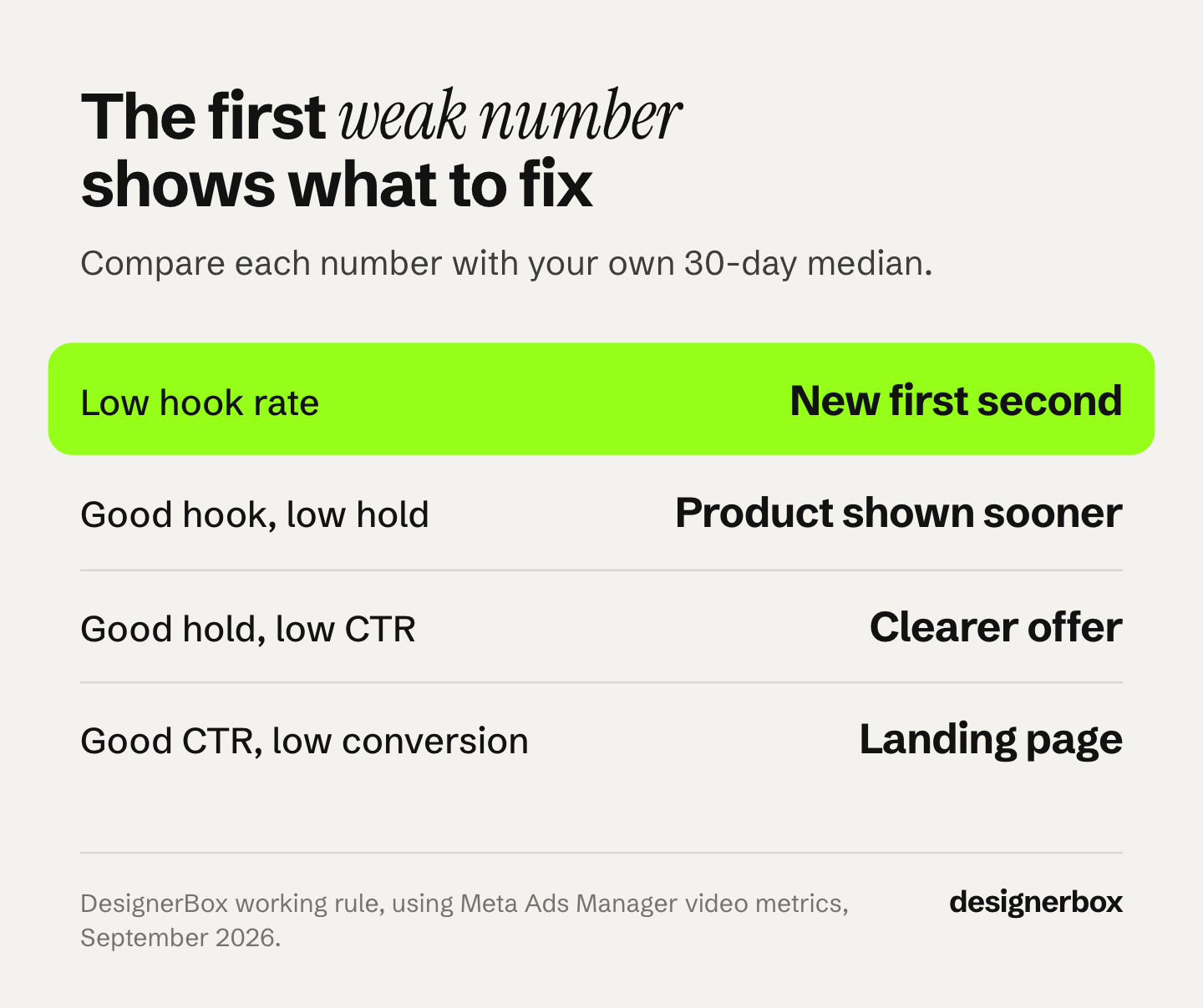
| Pattern against your median | Where the ad fails | What to change in the next version |
|---|---|---|
| Low hook rate | The first second | A new first frame and first line. Keep the body of the video |
| Good hook, low hold | The promise of the opening is not paid off | Show the product sooner, and cut the slow part. Keep the hook |
| Good hook and hold, low CTR | No reason to click | A clearer offer, a spoken call to action, and a visible product at the end |
| Good CTR, low conversion | The page after the click | The landing page, the price or the offer. The ad may be fine |
Treat the table as a starting rule. Neither platform publishes it. It belongs to the weekly review in a creative strategy, and two cautions come with it.
- A high hook rate can hide a bad ad. A shocking first frame can stop people who will never buy. If hook rate rises and cost per purchase rises too, the new opening attracts the wrong viewers.
- Small numbers mislead. A hook rate on a few hundred impressions moves a lot from one day to the next. Read it once the ad has real delivery, and read all four numbers from the same date range.

The platforms say what the opening should do. TikTok advises: “Prioritize your hook in the first 6 seconds”, and “Introduce your content proposition in the first 3 seconds for better recall and awareness” (ads.tiktok.com, last updated June 2025). Meta reported in March 2026 that “46% of online purchase conversions with Reels now happen within the first 2 seconds of attention on our video ads” (facebook.com/business/news, March 2026).
How do you improve a low hook rate?
Improve a low hook rate by changing the opening and keeping everything else. Make three to five versions of the ad that differ only in the first second: the first frame, the first spoken line and the first text on screen. Run them together, then keep the opening that beats your median. The body of a proven video does not need a new shoot.
Five openings to test, one per version:
- The result first. Open on the finished product in use, not on the problem.
- A person looking at the camera. Test a face and a direct first line against a slow product pan.
- Text in the first frame. A short claim on screen works with the sound off. TikTok recommends “5-10 words per second” for on-screen text.
- Movement in the first second. A hand, a pour, a zip, a fold. Something changes before second one.
- A new format of the same winner. A static ad that won can become a short vertical video with the same claim.
A new opening creates a new ad, so it also resets what the viewer has seen. If a winner’s hook rate falls week after week while nothing else changed, the cause may be ad fatigue, not a weak opening. To keep a test readable when you add openings, set it up as described in ad creative testing. If the opening is spoken by a creator, the words come from the script, and how to write a UGC script covers the first line. What a stronger opening is worth in revenue is worked through in improving ROAS with product video.
New openings from one approved ad
Anyone can make an AI picture. Making hundreds that still look like your brand is the hard part. A low hook rate asks for five new openings of the same ad, and each one still has to show your product, your colors and your voice.
DesignerBox is AI creative production for brands and agencies. Scale your images, ads and video with AI and keep your brand on every piece: build the workflow once with your brand rules, run it on every product, see the cost before each run, and keep everything from the first product photo to the finished ad in one place. DesignerBox for performance marketers shows the setup for paid social.
You build the job once as a workflow: your approved ad and your product photo go in, and new first frames, new headlines and new sizes come out. AI video ads turn a product photo or a winning static into a short vertical video. The video editor is a real timeline, with several tracks, transitions, animated text and audio, so you can swap the first second of a cut and keep the rest. Three critic steps score the results of a run, and best-of-N keeps the best one. You still watch every version before it ships.
The full workflow from the first product photo to the finished ad, in one subscription.
Here are the limits. DesignerBox does not read your ad account, so hook rate stays in Meta Ads Manager or TikTok Ads Manager. It does not publish ads for you: you download the results, or send them with a webhook or an S3 step. AI video and the video editor start on the Premium plan, and an 8-second clip costs 40 to 560 credits, depending on the model. Uploading your own photos and the commercial license start on the Pro plan. Team features are on the Ultra plan, and every plan below Ultra is one seat. The free plan cannot make video.
A free plan for your first run
There is a free plan, and it runs on sample products. Start from a template and see the cost before you run it. Get started free.
FAQ
What is hook rate in Facebook ads?
Hook rate is the share of a video ad’s impressions that became a play of at least 3 seconds. The formula is 3-second video plays divided by impressions, times 100. Meta Ads Manager has no hook rate column. You build it yourself under Columns, Customize columns, Create custom metric, as a percentage.
What is a good hook rate?
No platform publishes one. Vendor and agency pages put a good hook rate anywhere from 20% to 40%, without a stated sample. The reliable benchmark is your own median hook rate from the last 30 days, split by placement. A new ad above that median has a stronger opening than your usual ad.
What is the difference between hook rate and hold rate?
Hook rate measures the opening: how many impressions became a 3-second play. Hold rate measures the middle: how many of those viewers stayed to a ThruPlay, which is 15 seconds or the end of the video. A good hook with a low hold means the opening promised something the video does not show soon enough.
Is thumbstop rate the same as hook rate?
Yes. Thumbstop rate, thumb-stop ratio and 3-second view rate are other names for hook rate. They all divide 3-second video plays by impressions. Check the formula when you compare numbers from different tools, because some use a different time window or a different denominator.
How do you calculate hook rate on TikTok?
TikTok has no 3-second video metric. Its video play metrics start at 2-second and 6-second views. A TikTok hook rate is usually 2-second video views divided by impressions. It uses a shorter window than Meta’s hook rate, so compare TikTok hook rates only with other TikTok ads.
How do you improve a low hook rate?
Change only the opening. Make three to five versions with a new first frame, first spoken line or first text on screen, and keep the rest of the video. Run them together and keep the one that beats your median. If a winner’s hook rate falls over weeks, check for ad fatigue first.
Sources
- Meta Business Help Center, About impressions: facebook.com/business/help/675615482516035, accessed September 2026
- Meta Business Help Center, About video ad metrics calculation: facebook.com/business/help/1868286323447328, accessed September 2026
- Meta Business Help Center, 3-second video plays: facebook.com/business/help/743427195703387, accessed September 2026
- Meta Business Help Center, 15-second ThruPlays: facebook.com/business/help/471190536725647, accessed September 2026
- Meta Business Help Center, About the ThruPlay optimization goal: facebook.com/business/help/2051461368219124, accessed September 2026
- Meta Business Help Center, Create custom metrics in Ads Manager: facebook.com/business/help/698045821051774, accessed September 2026
- Meta Business Help Center, About video metrics: facebook.com/business/help/1792720544284355, accessed September 2026
- Meta for Business, “Simplifying Ad Measurement for a Social-First World”, 3 March 2026: facebook.com/business/news/click-attribution, accessed September 2026
- TikTok Ads Help Center, Video play metrics: ads.tiktok.com/resources/help/article/video-play, last updated November 2025, accessed October 2026
- TikTok Ads Help Center, Creative best practices for performance ads: ads.tiktok.com/resources/help/article/creative-best-practices, last updated June 2025, accessed October 2026
- Vaizle, hook rate and hold rate guide (insights.vaizle.com), January 2025, accessed September 2026
- Motion, thumbstop rate glossary and Creative Benchmarks 2026 (motionapp.com), accessed September 2026
- Exposure, hook rate vs hold rate (exposure.com.au), June 2026, accessed September 2026
- AdSights, thumbstop rate glossary (adsights.ai), July 2026, accessed September 2026
Video metric definitions verified from Meta and TikTok help pages as of September 2026. The two TikTok pages were re-checked on 2 October 2026. Benchmarks are vendor figures. Individual results vary.