
Brand asset management keeps every logo, template, product shot and campaign file in one searchable place under one set of brand rules. For a team of three to ten you can do it without a full DAM: a shared library with permissions, one current version of each asset, and a record of how each file was made. Published tools for that job start at $0 a month.
Three platforms in this category publish no price at all. Bynder, Frontify and Brandfolder each route you to a quote or a demo before you learn what a seat or a gigabyte costs (bynder.com/en/pricing, frontify.com/en/pricing and brandfolder.com/pricing, September 2026). A five-person team that wants its logo files in one findable place has to book a call to find out the number.
This guide covers what the system has to do, what the market charges when it publishes a number, and when a full DAM is the right buy. Every price below came off the vendor’s own pricing page in September 2026.
Key Takeaways
- Storage is the easy half. Any drive holds files. A brand system adds one current version, an approval state, and the rules beside the assets.
- Published entry prices run $0 to $100 a month. Brandy is free at 20 assets, Filecamp $29 billed monthly, Lingo $80 billed annually plus $16 an editor, Pics.io Solo $100 billed monthly.
- Three vendors quote instead of publishing. Bynder, Frontify and Brandfolder price each customer individually, which fits large rollouts and adds a call to a small team’s budgeting.
- Google Drive is a real starting point and a real ceiling. It handles storage and sharing. It carries no approval state and no provenance record.
- Generated assets move the hard part to provenance. One product turns into 40 files in an afternoon, and none of them arrive with a parent reference.
- Buy a DAM when search stops working. Rights tracking, outside distribution and a named owner are the other signals.
What is brand asset management?
Brand asset management, abbreviated BAM, is the practice of storing, governing and distributing everything that represents a brand: logos, typography, colour values, templates, photography, video and finished campaign work. The defining feature is that the rules travel with the files. The library holds the guidelines beside the assets, so anyone taking a logo can see which version is current.

Templafy calls it the system an organisation uses to ensure brand assets are applied correctly and consistently (templafy.com/brand-asset-management, September 2026). “Single source of truth” gets used for this constantly, and the practical test is narrower: if two people export the same logo on the same day, do they get the same file?
What is the difference between brand asset management and a DAM?
A DAM is built for retrieval at volume. It holds everything a company has produced, raw and finished, and earns its keep through metadata, search and permissions across thousands of files. A brand system is narrower: it holds the approved subset, keeps the guidelines beside it, and exists so output stays on brand.
| Brand asset system | Digital asset management | |
|---|---|---|
| Primary job | Keeps output consistent with the brand | Finds the right file in a large archive |
| Typical contents | Logos, fonts, colour values, templates, approved campaign assets | Every asset produced, including raw and archived files |
| Main users | Marketers, agencies, partners, resellers | Studio, archive, legal and library teams |
| Governance model | Rules and usage notes sit beside the assets | Metadata schemas and permissions on the files |
| Bought when | Output drifts off brand | Search stops returning the right result |
| Typical scale | The approved subset | The full archive |
OpenAsset’s guide gives DAM versus BAM a section of its own (openasset.com, September 2026), which is a fair sign of how often the question comes up. For a small team the split is the trigger: drift needs governance, slow retrieval needs a catalogue. A third system sits next to both, because how a file gets requested, approved and retired is marketing asset management, and that is the part that starts to break past 500 files.
What does brand asset management software cost?
Published entry prices run from $0 to $100 a month. Brandy has a free tier capped at 20 assets and a $5 a month plan above it. Filecamp starts at $29 a month billed monthly, or $348 a year billed annually. Lingo starts at $80 a month billed annually, plus $16 per editor. Pics.io starts at $100 a month and bills monthly only. Bynder, Frontify and Brandfolder publish no figure and quote each customer instead.
| Vendor | Price on the page | Entry price | What the entry tier includes |
|---|---|---|---|
| Brandy | Published | $0 | 1 brand space, 100 MB storage, 20-asset cap. Pro is $5 a month with 50 GB |
| Filecamp | Published | $29 a month billed monthly | Basic: 20 GB storage, unlimited users. The same tier is $348 a year billed annually |
| Lingo | Published | $80 a month billed annually | Starter: 50 consumers a month, 100 GB storage, plus $16 per editor a month |
| Pics.io | Published | $100 a month billed monthly | Solo: 100 GB storage, 1 user, monthly billing only. Micro is $250 a month, or $225 billed annually |
| Bynder | Quote only | Not published | Package built per customer, priced on users, storage, usage, products included and support level |
| Frontify | Quote only | Not published | Priced on monthly active users, averaged over six months |
| Brandfolder | Quote only | Not published | Two plans, Premium and Enterprise, both routed through a demo |
Prices read from brandyhq.com/pricing, filecamp.com/pricing-plans, lingoapp.com/pricing, pics.io/pricing, bynder.com/en/pricing, frontify.com/en/pricing and brandfolder.com/pricing, September 2026.
Filecamp includes unlimited users on every published tier, which suits a brand with many occasional downloaders. Lingo separates editors from consumers, so seat prices apply only to the people who change things.
Quote-only pricing is a business model, not a shortcoming. Bynder structures plans on what you use, influenced by the number of users, storage, usage across your marketing stack, the products included and the level of support (bynder.com/en/pricing, September 2026). Frontify prices on monthly active users rather than seats, averaged over six months (frontify.com/en/pricing, September 2026). Where two hundred people touch the library twice a year, that is often fairer than two hundred seats.
What does a brand asset system have to do?
Four jobs, in this order. Find it: search, tags and metadata in one location instead of six. Govern it: guidelines beside the assets, one current version, a visible approval state. Share it: permissions granular enough to give an agency download rights without upload rights. Prove it: a record of where each asset came from, who signed it off, and how it was produced.
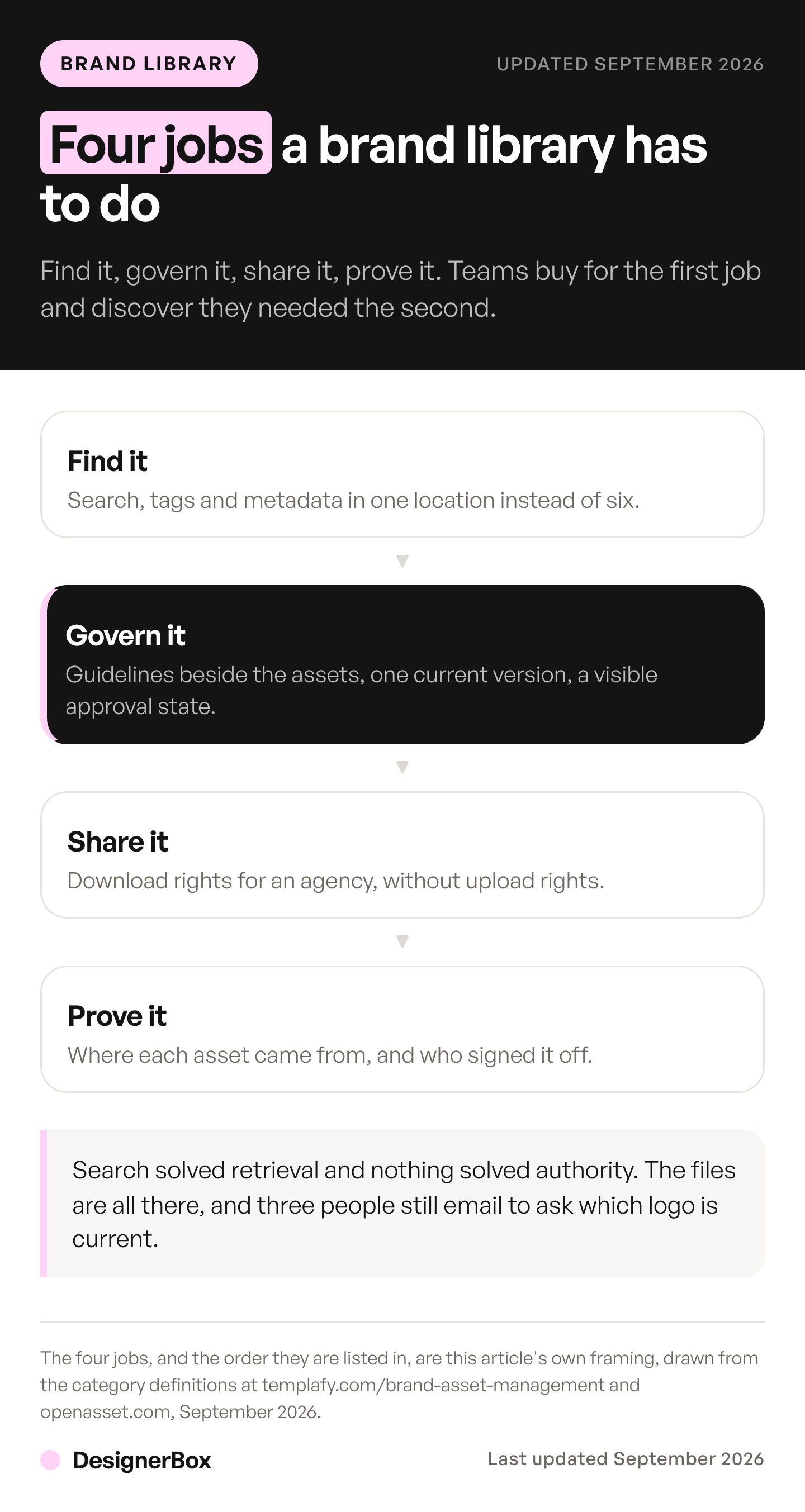
Most teams buy for the first job and discover they needed the second. The files are all there, and three people still email each other to ask which logo is current. Search solved retrieval and nothing solved authority. Tagging is the cheap half nobody funds, because a packshot with no season tag gets reused after the packaging changed.
Sharing breaks first. Freelancers and agencies need access, and the default answer is a folder link that never expires. Set the permission model before the first outsider is invited, and hand each of them one approved moodboard rather than four Pinterest boards.
Proving it used to be implicit. A shot asset had an invoice, a photographer and a date. A generated one has a parent file and a model, and neither survives a download unless the library keeps them. DesignerBox holds the rules as brand profiles the workflow reads, so the brand facts a generation is built from sit in the same account as its output.
Can you use Google Drive as your brand asset library?
Yes, for a small team with a stable set of files. Drive handles storage, sharing and search well, and storage is rarely the constraint people expect. Google Workspace pools 30 GB per person on Business Starter, 2 TB on Business Standard and 5 TB on Business Plus. What a drive does not carry is an approval state, a guideline layer, or any record of how a file was made.
Those storage tiers come off Google’s own pricing page, which also caps Business Starter, Standard and Plus at 300 users and puts no user limit on Enterprise (workspace.google.com, September 2026). For a ten-person team that is not a wall.
The wall is behaviour. A folder called Logos FINAL v3 is version control operated by hope. Move when three or four people upload, when an agency needs access, or the first time someone sends a superseded logo to print.
How do you manage AI-generated brand assets?
Volume rises and provenance becomes the hard part. One product photo can produce dozens of derivative files in an afternoon, so the library needs a parent-child relationship rather than another flat folder. That volume is what creative automation produces by design, one master asset turned into every size, language and variant a campaign needs. Each generated asset should carry what made it and what it was approved for. Two transparency laws that took effect on 2 August 2026 turn that record into a compliance artefact as well as good housekeeping.
One packshot, eight scene variants and five colourways is 40 files from one source image. What the run costs depends on which model you pick. In DesignerBox, image generation is priced per model, from 4 credits on Seedream 5 to 22 on GPT Image 2, with the default Nano Banana Pro at 14. Those 40 files are 160 credits on the cheapest model and 560 on the default, illustrative arithmetic on the published credit table, and you see the number before the run starts. The Pro plan at $35 a month billed monthly carries 1,000 credits. Generating the set is the affordable part. The 40 files landing with no parent reference are the expensive part, and our guide to keeping generated work on brand covers the naming side.
EU AI Act Article 50(2) requires providers to mark AI-generated or manipulated audio, image, video and text in a machine-readable format detectable as artificially generated, and Article 50 applies from 2 August 2026, with a grace period to 2 December 2026 for systems already on the market (digital-strategy.ec.europa.eu, September 2026). California landed on the same date: AB 853 sets the operative date of its AI Transparency Act at 2 August 2026 (leginfo.legislature.ca.gov, September 2026).
Two standards carry the record. Google embeds SynthID watermarks into generated images, audio, text and video at creation, built to survive cropping, filters and compression (deepmind.google, September 2026). C2PA Content Credentials bind assertions about an asset’s origin, its modifications and its use of AI, at specification version 2.4, and the spec concedes a credential can be stripped from a file, answering that with durable credentials and soft bindings (spec.c2pa.org, September 2026).
That last admission decides your library design. The provenance record has to live in the library, not only inside the file, because the file gets exported, resized and re-uploaded a dozen times before it runs.
DesignerBox states that your generations are private to your account, that it does not train models on your inputs, and that you can delete anything at any time. Storage runs from 10 MB on Free to unlimited on Ultra. Shared brand kits and team collaboration are Ultra features at $200 a month billed monthly, so every tier below Ultra is a single-seat library. Check that before you plan a shared library on Pro.
When is a full DAM the right buy?
Buy a DAM when retrieval breaks, not when the brand drifts. The triggers are search that stops returning the right file, licence expiry someone has to track, distribution to retailers or franchisees, integrations with the rest of the marketing stack, and a named owner with time to run it. At that point the quote-only vendors are the right call.
The mismatch case deserves the same plain statement. A six-person team buying an enterprise platform to fix inconsistent logo use has bought a catalogue to solve a governance problem. Teams running several client brands face a different version, covered in managing separate brand libraries per client. DesignerBox’s enterprise plans cover the production side of that work; a dedicated DAM covers the archive side.
Who owns the brand library on a small team?
One named person, not a committee. On a team of three to ten that is usually the brand or marketing lead, with an hour a month rather than a role. The job is narrow: approve what enters, retire what is superseded, keep the guidelines current. Shared ownership produces an unowned library, and an unowned library drifts back to being a folder.

Give that owner two recurring tasks. Run a quarterly pass to retire superseded versions, because a stale asset costs a reprint. Then re-check the guidelines against what the team ships. Both are covered in our breakdown of where brand drift starts and the brand manager’s view of controlling the input.
A library stores what you already made. It cannot make the next 40 files match the last 40. That job sits one step earlier, in the rules the generation reads. Save an approved campaign as a reusable workflow, build it once with your brand and your products, and the next product runs through the same rules instead of a new prompt. Row one and row five hundred then arrive at the library already on brand, which is the only version of this that scales.
FAQ
What is an example of a brand asset?
A primary logo in SVG and PNG, with its clear-space rule attached, is the textbook example. So are colour values in hex and CMYK, licensed typefaces, a social post template, an approved product packshot, and a campaign video. Anything a colleague or agency reuses to represent the brand belongs in the library.
Is a brand kit the same thing?
A brand kit is a subset: the small pack of core identity files, meaning logo, colours, fonts and basic usage rules. The wider system holds that kit plus every approved asset produced from it, with permissions, versions and approval states around them. The kit answers “what is our blue”. The system answers “which packshot can I run”.
Can a small team do this for free?
Partly. Brandy publishes a free tier limited to one brand space, 100 MB of storage and 20 assets, which fits an identity pack and nothing more (brandyhq.com/pricing, September 2026). A shared drive covers storage at no extra cost if you already pay for the workspace. Neither gives you an approval state or a provenance record.
How often should brand assets be reviewed?
Quarterly for retirement, annually for the guidelines. The quarterly pass removes superseded versions before someone sends one to print. The annual pass checks whether the written rules still describe what the team ships, because practice moves faster than documentation. Add an unscheduled review after any rebrand, packaging change, or new template.
Do AI-generated brand assets need to be labelled?
Your market and your role decide it. EU AI Act Article 50 requires machine-readable marking of AI-generated media and applies from 2 August 2026, with a grace period to 2 December 2026 for systems already on the market. California’s AI Transparency Act became operative the same day. The marking duty falls on the provider, not every brand using it.
Can agencies get access without paying for a seat?
The vendor’s pricing model decides it. Filecamp includes unlimited users on every published tier, so an agency costs nothing extra. Frontify prices on monthly active users rather than seats, which favours occasional external access. Lingo splits editors from consumers and includes 50 consumers a month on Starter, at $80 a month billed annually. Check the model before promising an agency access.
Sources
- Vendor pricing pages, read September 2026: brandyhq.com/pricing, filecamp.com/pricing-plans, lingoapp.com/pricing, pics.io/pricing, bynder.com/en/pricing, frontify.com/en/pricing, brandfolder.com/pricing
- Category definitions, September 2026: templafy.com/brand-asset-management, openasset.com
- Google Workspace pricing and storage tiers, September 2026
- European Commission: AI Act Article 50 transparency obligations, September 2026
- California AB 853, operative date of the AI Transparency Act, September 2026
- Google DeepMind: SynthID, September 2026
- C2PA specification 2.4 explainer, September 2026
- DesignerBox plan prices, per-model image credit costs, storage and data policy (September 2026)
Vendor pricing, storage tiers and AI transparency rules verified from each vendor’s own pricing page, the European Commission, the California Legislature, Google DeepMind and the C2PA as of September 2026. Individual results vary.